979 results for "Trade"

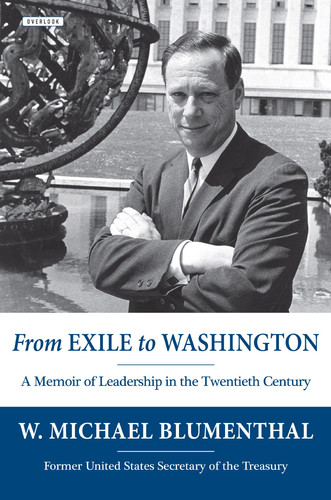
From Exile to Washington

Michael W. Blumenthal
In a life that has spanned nearly nine decades and has taken him across the world and back, W. Michael Blumenthal has borne witness to the worlds convulsions and transformations during the twentieth century. Born in Germany between the two world wars, Blumenthal narrowly escaped the Nazi horror, when, in 1939, he and his family fled to Shanghais chaotic Jewish ghetto, where they spent the entirety of the Second World War. From these fraught and humble beginnings, Blumenthal would emerge as a major leader in American business and politics. In the second half of the century, Blumenthal headed two major American corporations Bendix and Burroughs (later Unisys) served as a United States trade ambassador in the State Department and the White House, advising John F. Kennedy and Lyndon Johnson, and served under Jimmy Carter as the Secretary of the Treasury. After his retirement from business and politics, he began an entirely new chapter in his career, when he conceived and became director of Europes largest Jewish museum the Jewish Museum of Berlin a position he still holds today. An essential autobiography by one of Americas great political figures, From Exile to Washington is an engaging chronicle of the twentieth centurys greatest upheavals, and a tribute to a lifetime of courage, leadership and decisiveness.
Duckworth Publishers 2014-09-25 448 pages

Beginner's luck

Fanthorpe, U. A.
When she died, in 2009, Anthony Thwaite described U.A. Fanthorpe as a 'smiling subversive with a voice like bird-song'. An encouraging example to all late developers, this particular bird's voice took its time: she didn't become a poet until she was 45. But these examples of her very earliest work show the latent mastery and the rapid development of the craft that would bring her wide critical acclaim and an affectionate general readership. The mysteries of the trade gradually reveal themselves as rooted in a wide and uncensored range of subject-matter, a life-time's love of words, and an intuitive grasp of the mechanics of form and voice. Recognising her role so late, she was a woman in a hurry; there wasn't time for self-consciousness or grandiose notions of 'vocation'. 'A poet, ' she said, 'is a smuggler. He imports things clandestinely which are not supposed to have got through the customs.' Poetry 'happened to me', she would say. Her job? To listen, to pass it on.
Bloodaxe Books Ltd 2019 94 pages

Basketball Belles How Stanford, Cal, and One Scrappy Player Put Womens Hoops on the Map

Sue Macy
Witness the birth of women's basketball in this illustrated introduction from renowned nonfiction author Sue Macy. Raised on a cattle ranch, Agnes Morley was sent to Stanford University to learn to be a lady. But she soon exchanged her breeches and spurs for bloomers and a basketball—and in April 1896, she made history. In a heart-pounding game against the University of California at Berkeley, Agnes led her team to victory in the first-ever inter-collegiate women's basketball game, earning national attention and putting women's basketball on the map. This fast-paced story of perseverance and success digs deep into the history of one of America's most popular sports, and how it came to be so big. Realistic illustrations by Matt Collins put readers in the middle of the action, and you'll want cheer along with the crowd. With comprehensive backmatter including a timeline, author's note, select bibliography, and recommended places to visit for more information, Basketball Belles is a perfect introduction to an intriguing moment in sports and women's history. A Junior Library Guild Selection Booklist Top 10 Sports Books for Youth Booklist Editors' Choice, Books for Youth, Nonfiction, Middler Readers NCSS Notable Social Studies Trade Books for Young People, History/Life & Culture in the Americas
Holiday House 2019-05-28 32 pages

Unlocking the Middle East: the writings of Richard Falk

Falk, Richard A.
This volume explores the trade in television programme formats, which is a crucially important ingredient in the globalization of culture, in Asia. It examines how much traffic there is in programme formats, the principal direction of flow of such traffic, and the economic and cultural significance of this trade for the territories involved and for the region as a whole. It shows how new technology, deregulation, privatization and economic recession have greatly intensified competition between broadcasters in Asia, as in other parts of the world, and discusses how this in turn has multiplied the incidence of television format remakes, with some countries developing dedicated format companies and others becoming net importers and adapters of formats.
Arris 2003 305 pages

War and power in the 21st century: the State, military conflict, and the international system

Hirst, Paul Heywood
Future developments in war, armed conflict and international relations are central to our collective fate in this century. This book looks forward by considering the forces that will drive changes in military organizations, sources of conflict, the power of states and the nature of the international system. New military technologies will alter how wars are fought and will influence the balance of power. Changes in the global environment will provide new causes of conflict and will change economic priorities. As a result, the state will survive as the key social institution and populations will look to it to acquire and to distribute scarce resources like water, energy and land. Many of the changes that seem transformatory today, like globalization, the internet and mass consumerism, will be shown to be less significant than we believe them to be. Hirst puts such changes into perspective by comparing them with the revolutionary changes in the sixteenth and seventeenth centuries in Europe: the firepower revolution, the rise of the sovereign territorial state and the parallel development of the international system, and the creation of world trade. These basic structures of the modern world are still with us and will remain, despite major changes in twenty-first-century society. This book will appeal to students of politics, political sociology & international relations as well as the interested general reader.
Polity Press 2001 169 pages

The apothecary's daughter

Schonstein, Patricia
"A nobleman and his wife, an apothecary nun, an astronomer-mathematician, an inquisitor, a poet who is both lover and villain, a portraitist, a queen and loyal servants deftly act out a beautiful drama of tantalizing relationships. They take up their roles in castle and convent, some surrounded by ornate interiors, garbed in velvets and silks, garlanded with precious jewels; while others abide in simple space devoid of art or representation, and dressed in plain linens and dull calicos. THE APOTHECARY'S DAUGHTER is a wondrous tale, rendered in erotic prose and poetry, stitched through with rich imagery, humour and tenderness. It is also a story of trade and exotic travel, both across the surface of the earth and among the stars."
Bantam 2004 224 pages

Modern man in the making

Neurath, Otto
Otto Neurath’s famous "Modern Man in the Making", first published by Alfred A. Knopf in 1939, captures and describes the state of the world in the 1930s by using text and figurative illustrations. From 1925 onwards, Neurath and his team had worked on a new visual language termed "Isotype". At a time that saw the rise of new mass media making hitherto unthinkable amounts of information available, Neurath felt the need for a systematic visualization explaining facts, statistic data and comparative numbers in simple ways. The book can be seen as one of the most influential predecessors of today’s ever-present infographics. Its topics include diverse social issues of the time such as mortality, health, employment, trade, education, mobility, migration and demographics. "Modern Man in the Making" shows Neurath’s democratic endeavor to make knowledge intelligible and available to all. This pivotal historical picture-text book is made available again as a reprint of the original publication in the series XX The Century of Print. (publisher's information)
Lars Muller Publishers 2024 159 pages

Et Tu, Babe

Mark LEYNER
In this fiendishly original new novel, Mark Leyner is a leather-blazer-wearing, Piranha 793-driving, narcotic-guzzling monster who has potential rivals eliminated by his bionically enhanced bodyguards, has his internal organs tattooed, and eavesdrops on the erotic fantasies of Victoria's Secret models -- which naturally revolve around him. Leyner's jet-propelled roller derby through the cultures of celebrity, cyberpunk, and rabid egotism is exhilaratingly bizarre, exhaustingly funny -- and you'd better hope it's just fiction. From the Trade Paperback edition.
Harmony Books 1992

The Show Another Side of Santamaria's Movement

Mark Aarons
In 1942, on the recommendation of 26-year-old Bob Santamaria, Australia's Catholic bishops created a clandestine church organisation to smash the Communist Party's massive trade union base. Soon, The Movement, working closely with ASIO, became a sophisticated intelligence agency that would influence every corner of politics. Santamaria based his Movement (also called The Show) completely on the Communist Party, copying its spectacularly successful union-organising machinery. Within a decade, it had defeated communist power in many major unions. He also adopted the communists' strategy of infiltrating the Labor Party, and embarked on an aggressive program to transform it into a Catholic political machine, helping spark the great Labor Split of the mid-1950s. Ironically, in modelling the Movement on his enemy, Santamaria imported its most odious characteristic: Stalinism. He rapidly embraced the characteristics of a Stalinist leader, actively cultivating his own 'cult of personality'. Over time, this infected The Movement, as it adopted authoritarian practices and imposed anti-democratic policies on the unions it controlled, mirroring the communists' modus operandi . As in the Communist Party, this inevitably caused internal battles and catastrophic splits that undermined and, eventually, destroyed The Movement. Weaving together a rich story from previously secret archives of both The Movement and the Communist Party, ASIO's massive files, and extensive oralhistory interviews, The Show exposes a previously unseen side of Santamaria's Catholic Movement.
Scribe Publications Pty Limited 2018-10-02 288 pages

Between the yeshiva world and modern orthodoxy: the life and works of Rabbi Jehiel Jacob Weinberg

Shapiro, Marc B.
A biography of the leading halakhic authority Jehiel Jacob Weinberg, born in Ciechanowiecz, Poland. He was the last rector of the Berlin Rabbinical Seminary. Ch. 5 (pp. 110-134), "Response to the New Nazi Government (1933-1934), " characterizes the early reaction of Weinberg to the Nazis as naive and apologetic. Weinberg helped the Orthodox Jews deal with problems of daily life under the Nazis (e.g. the ban on ritual slaughter). Ch. 6 (pp. 135-171), "The Nazi Era (1933-1945), " notes that Orthodox German Jews first adopted a policy of appeasement with the regime. With Jews excluded from general education and other aspects of German life, the role of the Seminary became more important. Weinberg had opposed Jewish emigration, and the "Kristallnacht" pogrom came as a tremendous shock to him; the Seminary was closed and most of the students and faculty emigrated. At the outbreak of the war he was in Warsaw, where he helped with communal affairs. As a Soviet citizen, Weinberg suffered less than others; in October 1941 he was transferred from the Warsaw ghetto to a detention camp in Wuelzburg, Germany, possibly in order to trade him for German citizens held captive in the USSR. He remained there until April 1945. Most of his family was murdered in the Holocaust. After the war he became head of a yeshiva in Montreux, Switzerland.
Littman Library 1999 283 pages

Money, method, and the market process: essays

Von Mises, Ludwig
After Ludwig von Mises's death in 1973, his wife, Margit von Mises, went through his unpublished and out-of-print essays and selected twenty-one of the essays for publication. The result was Money, Method, and the Market Process, published in 1990 by Kluwer Academic Publishers and the Ludwig von Mises Institute and reissued now by Liberty Fund. In his introduction to the book, Richard Ebeling describes it as a "convenient composite of Misesian economics.'" He says that the essays here touch on "almost every aspect of economic and social theory that Mises considered of paramount importance. The essays were written over a period of forty years, from the 1930s to the 1960s, so they serve as a wide sampling of Mises's thought on a wide range of subjects, and they are arranged thematically. The three essays in the first section, on "Method," discuss the differences between the social and natural sciences and include some of Mises's thoughts on the science of human action. The essays in the next section, on "Money," discuss inflation and money in economic exchange, and they include Mises's analysis of why stabilizing the price level will not necessarily stabilize economic activity. This leads readers to the section on "Trade," where Mises warns of the danger of international conflict in a world without free trade. There are seven essays on "Comparative Economic Systems," and they include detailed studies on capitalism versus socialism, the cooperative movement, the Russian Reform Movement, and equality and inequality. Under the heading of "Ideas," the final two essays are "The Role of Doctrines in Human History" and the well-known piece called "The Idea of Liberty Is Western". --
Liberty Fund 2016 327 pages

Leo Melamed: escape to the futures

Melamed, Leo
Acclaim for Leo Melamed Escape to the Futures "A well-written, fascinating memoir of a remarkable man of many parts, who arrived in the United States at age 9, fleeing the Holocaust. Almost single-handedly, he transformed a minor commodity exchange into the leading futures market in the world. His influence was and remains worldwide." —Milton Friedman Senior Research Fellow Hoover Institution, Stanford University "There are only a few people who have revolutionized big portions of the business world. Warren Buffett did it in investing, Bill Gates in software. Leo Melamed, author of this book, is in that same league. He truly revolutionized futures trading in the United States, and in the world. This book tells how." —Ambassador Clayton Yeutter Past President of the Chicago Mercantile Exchange Former U.S. Trade Representative "A grizzled old Merc trader once assured me that nobody ever lost by being long on Leo. Why that's so, this endlessly fascinating personal history makes clear. It shows how an immigrant boy, after surviving unimaginable horrors, drew on the 'elan, combativeness, and sophisticated conviction' learned from his equally remarkable father to build the CME and to lay the foundations of the modern, Chicago-based, financial services industry." — Merton H. Miller 1990 Nobel Laureate Emeritus Professor University of Chicago Graduate School of Business "Leo tells it all. To say there would not have been a financial futures industry without Leo is probably only a slight exaggeration!!!" — John Damgard President Futures Industry Association "Escape to the Futures tells the remarkable story of a young boy's escape from the Nazis and the impact of his life on the financial markets of the world. It also serves as yet another poignant reminder of the immeasurable losses —in the arts, sciences, professions, and everyday life—humanity suffered because of the Holocaust." — Benjamin Meed President American Gathering of Jewish Holocaust Survivors He is one of the most powerful figures in the world of finance—a visionary who pioneered the modern futures industry and launched the International Monetary Market (IMM). Yet, Leo Melamed was not born to wealth and influence. His is an extraordinary rags-to-riches tale of intelligence, drive, savvy, timing, and the overpowering force of a uniquely charismatic personality. Now the inside story of the remarkable life and career of Leo Melamed is revealed in this long-awaited autobiography. A Holocaust survivor, Leo Melamed had barely begun the first grade in 1939 when he and his parents fled their native Poland one step ahead of the oncoming Nazi juggernaut. Crossing Siberia en route to a brief stay in Japan—just months before Pearl Harbor—the family arrived in the United States to begin life anew. They settled in Chicago, where young Leo became a product of the inner city and embraced his new country and its culture. Seeking part-time employment while attending law school, Leo Melamed answered a classified ad that would change his life. Hired by what he presumed was a law firm named Merrill, Lynch, Pierce, Fenner & Bean, he found himself on the floor of the Chicago Mercantile Exchange. "I was Alice stepping through the Looking Glass into a world of not just one Mad Hatter, but hundreds. The shouting among the traders, the movement of their bodies and hands, captivated me like nothing before . . . there was a life force on that floor that was magical and exciting, and though I didn't understand what was going on, I wanted to be a part of it." Leo Melamed became much more than just a part of it. From modest beginnings as a pork belly trader, he led the Chicago Merc for the next quarter of a century, introducing finance to an industry that was the exclusive domain of agriculture. As his reputation as a financial genius grew, so did the tales of his larger-than-life personality. In Leo Melamed: Escape to the Futures, you'll meet the man behind the legend. Written with the assistance of award-winning journalist Bob Tamarkin, this enthralling memoir deftly weaves intimate personal details with behind-the-scenes accounts of some of the most momentous financial events of our century—including Leo's role as advisor to the White House after the Hillary Rodham Clinton cattle futures trading episode. You'll read fascinating accounts of his dealings with political powerhouses like Bob Dole, Tip O'Neill, Dan Rostenkowski, and others. Offering penetrating insights into the workings of a multibillion dollar industry, this is a story that has as much to say about human nature as it does about the nature of today's markets. Hailed as both hero and tyrant, Leo Melamed is undeniably one of the most colorful and intriguing personalities of our time. This intimate, revealing personal account is not to be missed.
John Wiley & Sons 1996-05-02 463 pages

Being Jordan: my autobiography

Price, Katie
This book needs no introduction. The hardback edition was the hottest seller of 2004. WH Smith cited it as the record holder for most copies of an autobiography sold in one week. In fact it has turned out to be the surprise darling of the book trade! Now, at last, the paperback edition is available and Katie has brought it right up-to-date with full details of her love for Peter, their new life together, their engagement and their impending wedding. She also reveals the projects she has been working on and what the future holds for her career. No book buyer will want to miss out on the next instalment of Katie's life - so fasten your seatbelts for another rollercoaster ride.
John Blake 2004 316 pages

Weights and measures

Roth, Joseph
A fable about the disintegration of a good man. At the insistence of his wife, Eibenschutz leaves his job as an artilleryman in the Austro-Hungarian army for a civilian job as the inspector of weights and measures in a remote territory, near the Russian border. Attempting to exercise some proper rectitude in his trade duties, he is at a loss in a world of smugglers, profiteers, and small crooks. Eibenschutz soon finds he can no longer distinguish law from justice. When he discovers that his wife is pregnant by his own clerk, he spends more time away from home. Spending his hours at the border tavern, he finds himself hopelessly drawn to a beautiful gypsy woman, Euphemia. But she is prepared to share the bed of the landlord and Eibenschutz's enemy, Jadlowker, an unprincipled profiteer who has made the tavern a beacon for local smuggling activity.
Dent 1983 150 pages

Yankee go home? Canadians and anti-Americanism

Granatstein, J. L.
Whether it is resentment over trade barriers, fear of cultural domination, disapproval of U.S. foreign policy, or merely old-fashioned jealousy of a more powerful neighbour, Canadians have made excellent anti-Americans. Yankee Go Home? traces the winding course of this feeling over two centuries - from the United Empire Loyalists who fled north to escape unbridled republicanism, through the early twentieth century when the barons of business were determined to keep out U.S. competition, to the post-war period when Canadian nationalists took up the cry. Granatstein maintains that what began as a justifiable fear of invasion eventually became a tool of the economic and political elites bent on preserving their power. At first, anti-Americanism was largely the Tory way of keeping pro-British attitudes uppermost in the minds of Canadians. Later, with the right wing embracing the free-trade deal, it became the most important weapon of the nationalist left. Today, anti-Americanism is weaker than ever before. And what of the future? Will we inevitably become more "American" in spite of ourselves? Can we even agree on what being "Canadian" means?
HarperCollins 1996 317 pages

Discourses of the Ecclesiastical and Civil Polity of the Jews. ... Written by Isaac Abendana,

Isaac Abendana
The 18th century was a wealth of knowledge, exploration and rapidly growing technology and expanding record-keeping made possible by advances in the printing press. In its determination to preserve the century of revolution, Gale initiated a revolution of its own: digitization of epic proportions to preserve these invaluable works in the largest archive of its kind. Now for the first time these high-quality digital copies of original 18th century manuscripts are available in print, making them highly accessible to libraries, undergraduate students, and independent scholars. The Age of Enlightenment profoundly enriched religious and philosophical understanding and continues to influence present-day thinking. Works collected here include masterpieces by David Hume, Immanuel Kant, and Jean-Jacques Rousseau, as well as religious sermons and moral debates on the issues of the day, such as the slave trade. The Age of Reason saw conflict between Protestantism and Catholicism transformed into one between faith and logic -- a debate that continues in the twenty-first century. ++++ The below data was compiled from various identification fields in the bibliographic record of this title. This data is provided as an additional tool in helping to insure edition identification: ++++ British Library T032014 P.200 misnumbered 100. London: printed for Samuel Ballard, 1706. [8],100[i.e.200]p.; 8°
Creative Media Partners, LLC 2018-04-19 212 pages

North-South and South-South: essays on international economics

Stewart, Frances
'...an important and timely contribution to the study of South-South economic relations. It provides a cogent and detailed analysis...'-Henock Kifle, South Letter '...provides some interesting insights into the determinants and consequences of South-South trade.'- Frances Stewart, The World Economy 'This comprehensive, incisive work....represents both historical depth and topical breadth. ....This well-written analysis makes an important contribution to development studies, including development economics and development geography.'- Georges G. Cravins, The Journal of Asian Studies These essays explore interactions between North and South and South and South in trade, technology and finance, focusing on the interests of the South, and particularly the poor. The 'conventional' neo-classical approach is shown to have many theoretical deficiences, the consequences are often harmful to Southern interests, while the poor are neglected. The author concludes that the South should adopt a bargaining approach to N-S negotiations and urges for closer South-South relations in trade, technology and finance.
Macmillan 1992 394 pages

Bedouin of Mount Sinai: an anthropological study of their political economy

Marx, Emanuel
The Sinai Peninsula links Asia and Africa and for millennia has been crossed by imperial armies from both the east and the west. Thus, its Bedouin inhabitants are by necessity involved in world affairs and maintain a complex, almost urban, economy. They make their home in arid mountains that provide limited pastures and lack arable soils and must derive much of their income from migrant labor and trade. Still, every household maintains, at considerable expense, a small orchard and a minute flock of goats and sheep. The orchards and flocks sustain them in times of need and become the core of a mutual assurance system. It is for this social security that Bedouin live in and retire to the mountains. Based on fieldwork over ten years, this book builds on the central theoretical understanding that the complex political economy of the Mount Sinai Bedouin is integrated into urban society and part of the modern global world.
Berghahn Books 2013 195 pages

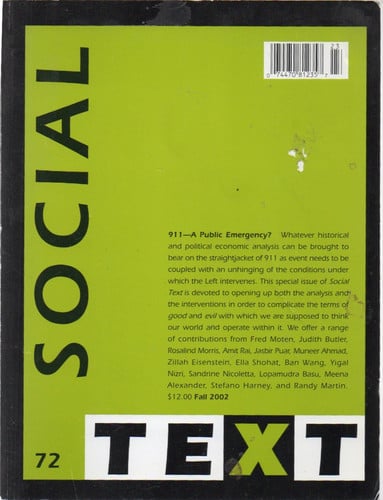
911 a Public Emergency?

Brent Hayes Edwards,Stefano Harney,Randy Martin,Ella Shohat,Timothy Mitchell,Fred Moten
Since September 11, public discourse has often been framed in terms of absolutes: an age of innocence gives way to a present under siege, while the United States and its allies face off against the Axis of Evil. This special issue of Social Text aims to move beyond these binaries toward thoughtful analysis. The editors argue that the challenge for the Left is to develop an antiterrorism stance that acknowledges the legacy of U.S. trade and foreign policy as well as the diversity of the Muslim faith and the dangers presented by fundamentalism of all kinds. Examining the strengths and shortcomings of area, race, and gender studies in the search for understanding, this issue considers cross-cultural feminism as a means of combating terrorism; racial profiling of Muslims in the context of other racist logics; and the homogenization of dissent. The issue includes poetry, photographic work, and an article by Judith Butler on the discursive space surrounding the attacks of September 11. This impressive range of contributions questions the meaning and implications of the events of September 11 and their aftermath. Contributors . Muneer Ahmad, Meena Alexander, Lopamudra Basu, Judith Butler, Zillah Eisenstein, Stefano Harney, Randy Martin, Rosalind C. Morris, Fred Moten, Sandrine Nicoletta, Yigal Nizri, Jasbir K. Puar, Amit S. Rai, Ella Shohat, Ban Wang
Duke University Press 2002-09-20 208 pages