898 results for "Evolution"

Exclusion and hierarchy: orthodoxy, nonobservance, and the emergence of modern Jewish identity

Ferziger, Adam S.
Following the Jewish Enlightenment, many eighteenth-century Jews chose not to observe the religious laws and customs that had earlier marked them as culturally different from their Christian peers. As the Jewish population became increasingly assimilated, an ultraorthodox movement also emerged, creating a discrete identity for a group within the Jewish community that opted not to move toward the mainstream but instead to embrace the traditional laws .By tracing the evolution of the approach of the Orthodox to their nonpracticing brethren, Adam S. Ferziger sheds new light on the emergence of Orthodoxy as a specific movement within modern Jewish society. In the course of this process, German Orthodoxy in particular articulated a new hierarchical vision of Jewish identity and the structure of modern Jewish society. Viewing Orthodox Judaism as no less a nineteenth-century phenomenon than Reform Judaism or Zionism, Ferziger looks at the ways it defined itself by its relationship to the nonobservant Jewish population. Ferziger argues that as the Orthodox movement emerged, it rejected the stance that the assimilated and nonobservers were deviant outcasts. Instead, they were accepted as legitimate members of a Jewish community, in which Orthodox Jews occupied the pinnacle, as the guardians of its tradition. This book's contribution, however, moves beyond a historical study of Orthodox Judaism. The sociological methodology that Ferziger employs enables the reader to appreciate how other religious groups have sought to carve out their places within the mosaic of modern society.
University of Pennsylvania Press 2005-06-09 303 pages

Strange Genius

Stanley G Weinbaum
Strange Genius is a collection of stories about people whose minds are beyond the ordinary. Included is the hard to find novel The New Adam, a surprising tale of homo superior born among us, the first of a new human race, an evolutionary leap and a man whose mind is so different that he's an alien on his own planet. Also included are the humorous van Manderpootz stories about a scientific genius who wants everyone to know how great he is, and several more of Weinbaum's delightful tales of the human mind at work.
Leonaur 2006 272 pages

Triumph of the intelligent: the creation of Homo sapiens sapiens

Itzkoff, Seymour W.
About forty thousand years ago, a new kind of hominid suddenly appeared in Europe and Western Asia. This was a creature unlike any of the other hominids then existing - borderline Homo sapiens, and the enigmatic Homo sapiens neanderthalensis.Seymour W. Itzkoff focuses in Triumph of the Intelligent on the evolutionary dynamics that led to the production of ever more intelligent humans, finally culminating in this sudden spasm of reconstruction. Itzkoff has followed the evidence carefully, attempting to stay within the assignable limits of evolutionary theory to produce a most-probable model of the dynamics that extruded this enigmatic creature, Homo sapiens sapiens.
Paideia 1985 210 pages

Why Humans Vary in Intelligence

Seymour W. Itzkoff
The third volume in a projected four-part series on the evolution of human intelligence, a series acknowledged by opponents and supporters alike as one of the most important recent investigations into the sources and nature of human intelligence. Professor Itzkoff first sets forth the evolutionary facts as a beacon to illuminate his biological theory of variable intelligence. Filling out the evidence from the psychological and brain sciences presented in THE FORM OF MAN and TRIUMPH OF THE INTELLIGENT, he here develops a full-scale model of the mind that more fully explains the relationship between I.Q. and the broader expressions of human intelligence as experienced in daily life. (His model of variable intelligence further delves into the historical consequences of our ancient biological and psychoneurological heritage. Issues such as gender, race, and ethnic variability are treated factually and responsibly, taking into account the full range of empirical evidence available to scholars.) The result is a theory having three complementary bodies of evidence - evolutionary, psychoneurological, and historical - building into a perspective on the factual «why» of human intellectual differences. These differences can best be observed in the richness and diversity of individual personality as well as in the cultures of our world. Itzkoff here takes the first tentative steps toward a biological explanation of the nature and structure of culture. WHY HUMANS VARY IN INTELLIGENCE is an appeal for the rational study of human nature, a plea to allow for further nonideological research into this most crucial area of contemporary concern.
Peter Lang Publishing, Incorporated 1989-09 392 pages

The Testament of Astrology Introduction to Astrology as an Esoteric Science - Sequence One - General Foundation of Astrology

Oskar Adler
These lectures, first given between 1930 and 1938 in Vienna, in 7 'Sequences' comprise a college level curriculum. It has earned praise by Astrologers at Kepler College of Astrology, International Academy of Astrology and American Federation of Astrologers. Ronald Davison who met Adler in London, wrote that Oskar Adler was as near to being 'a Complete Man" as anyone he'd ever met. That quote became the subtitle to the biography: "Dr. Oskar Adler: A Complete Man, by Amy Shapiro, M. Ed., based on 22 years research on Dr. Adler's life.Oskar Adler's lessons welcome new students, and challenge seasoned astrologers. As he explains: "This is the work of a searcher, for all searchers filled with a pressing desire for knowledge regarding the meaning of their existence within the immeasurable and unimaginable greatness of this universe. Overawed by a sense of our own inessentiality and by our short-termed existence on this grain of sand, "Earth," we are nevertheless elated at the thought of being witnesses of the eternal riddle. It may be that in this conflict we experience the nucleus of all that has guided the human spirit since the light of Reason was first kindled within. Contents of Sequence One: Lecture 1: General idea of Astrology as Esoteric Knowledge... What is esoteric knowledge? ... Natural Science and esoteric doctrine; Man and the universe ... The human body and number as bridge to the cosmos ... Astronomy and astrology ... The Self as key to esoteric knowledge Lecture 2: Living Community Between Man and Universe ... Macrocosmos and microcosmos... One-ness and the number One ...Suffering and sorrow as a further link to the cosmos ... The idea of fate ... Natural law and moral law Lecture 3: The Enigma of Evolution in the Light of Esoteric Wisdom ... The Zodiac Lecture 4: Evolution & Alchemy ... four elements ... Their relationship to inner life and to the road of development of man ... riddle of the Sphinx Lecture 5: Cosmic Numbers and Human Development ... The numbers 4, 7 and 12 Zodiac and planets ... Periodicity and the law of rhythm ... Planetary symbols and digit-symbols Lecture 6: The Three Cosmic Perspectives ... The cosmic importance of the moment of birth ... Heredity and self-development ... The second birthLecture 7: Zodiac-segments and Zodiac-symbols ...The precession of the vernal point ... Eternity and temporality ... The road to the neighbor ... The road to one's own self Dr. Adler closes Sequence One with: "Astrology shows us the road to knowledge of ourselves. How actually to walk that road is shown to us by love. He who can unite both will alone find redemption through the study of astrology."The subsequent six Sequences build methodically upon this one, for those ready to go even further: Sequence 2: Zodiac and ManSequence 3: The World of the Planets & Man Sequence 4: Man and EarthSequence 5: Man in the Concert of the Stars Sequence 6: Movement of Stars & Course of Life Sequence 7: Work on One's Own Horoscope.The writing, translating, editing and publishing of The Testament of Astrology has been a labor of love for each soul privileged to absorb Dr. Adler's wisdom: Mrs. Zendka Orenstein (Translator), and Amy Shapiro (Editor), given the English rights by Mrs. Orenstein. If you seek in-depth knowledge and inspiration on the celestial realms and meanings, your search will be rewarded many times over by Dr. Adler's brilliance, humor and compassion. He was first a physician; then a musician; lastly a philosopher who reached the heights and plumbed the depths of astrology. Many students report being touched by the warmth and magnitude of his SPIRIT far beyond casual intellectual interest. Might that happen for you, too? Find out!
CreateSpace Independent Publishing Platform 2011-06 146 pages

Psalm 29: a Canaanite hymn to YHWH in the Psalter

Amzallag, Gérard Nissim
"Interpreted as praising the divine powers on the storm, Psalm 29 is currently a cornerstone of the thesis of YHWH's storm-god identity and his closeness to the Canaanite Baal. Here, this view is challenged by considerations about YHWH's powers on the storm and a reanalysis of Psalm 29, including a comparative examination of the three possible expressions of the voice of YHWH (storm, volcanism, and metallurgy); a whole-psalm analysis of its structure, content and literary developments; and the meaning of five songs (Psalms 46, 96-98, 114) conditioned by it. This analysis identifies Psalm 29 as a pre-Israelite, Qenite song promoting a metallurgical relationship with YHWH, and praising him as the 'Lord of mabbul' (=revitalization). Its content unveils the Qenite Yahwism and its enduring influence in Israel. The conditioned psalms express how this song contributed to the evolution of the Israelite religion, especially the transformation of YHWH into the 'Lord of Justice' in Psalms 96-98 and the Isaiah theology."
Peeters 2021-12-31 253 pages

The dynamics of American Jewish history: Jacob Rader Marcus's essays on American Jewry

Marcus, Jacob Rader
Jacob Rader Marcus (1896-1995), scholar, professor, and rabbi, was called the Dean of American Jewish historians by students and colleagues alike. A seminal force in the evolution of the academic study of American Jewish history, Marcus was the first to apply modern critical methodology to this field. In the course of his long life, he published more than 300 books and articles on the history of American Jews. In 1947 he founded the American Jewish Archives, which he directed for almost fifty years. A beloved teacher and mentor for several generations of Hebrew Union College (HUC) students, Dr. Marcus remains a very significant figure in the history of American Jewry during the twentieth century. Marcus, raised in West Virginia, was the child of East European immigrants. At the age of 15, he moved to Cincinnati to matriculate at HUC, America's oldest rabbinical seminary. After serving in the U.S. Army during World War I, Marcus became a member of the HUC faculty upon his rabbinical ordination in 1920. He subsequently moved to Europe to pursue doctoral studies and, upon returning to Cincinnati, Marcus taught courses in Jewish history. During the late 1930s and early 1940s, Marcus realized that the i American Jewry was fast becoming the most influential Jewish community in the world. In the aftermath of the brutal destruction of European Jewry during World War II, Marcus's keen interest in the history of American Jewry burgeoned. Marcus left the pulpit for a career of scholarship and teaching, he nevertheless maintained a close connection to his students and, through them, to the American rabbinate. A mentor to generations of HUC students and graduates, Marcus was an active participant in the Central Conference of American Rabbis (the organizational arm of the American Reform rabbinate), serving as its president from 1949-1951. In this volume, Gary Philip Zola brings together a unique assortment of Marcus's most important unpublished essays, written for a more popular audience between 1916 and 1989. Read collectively, these essays bring the key themes of Marcus's work into bold relief. In the early "America: The Spiritual Center of Jewry" (1916), as in the much later "Three Hundred Years in America" (1955), Marcus calls upon American Jewry to study its heritage, arguing that this knowledge will kindle a renaissance in American Jewish life. In "Lost: Judaism in the American Expeditionary Forces, the Urgent Need for Welfare Work" (1919), he insists that the Jewish experience in America consists of a symbiotic relationship between individual Jews and the larger Jewish community. A focus on the individual in relation to the whole guided many of Marcus's essays, as did his emphasis on Jews studying their own past, strong echoes of both can be found in "New Literary Responsibilities (1941-1942) as well as works for specific occasions, such as "The Program of the American Jewish Archives" (1947) and Genesis: College Beginnings (1989). Another leitmotif linking these diverse topics is Marcus's view that American Judaism will thrive and distinguish itself as long as Jewish education and Jewish cultural life become a high priority on the Jewish communal agenda. This collection enhances our understanding of how the ideas of one of American Jewry's pioneering historians evolved, while preserving historical documents that trace the development of American Jewish life over the course of the twentieth century.
University Press of New England 2004 192 pages

Nationalism, Communism and Canadian Labour The CIO, the Communist Party and the Canadian Congress of Labour, 1935-1956

Irving M. Abella
"The history of the Canadian Congress of Labour and the CIO in Canada traces the evolution of industrial unionism in Canada from the depression years of the 1930s to the 1950s. This is not simply a historical survey. Rather it is the dramatic story of the bitter, bloody, but successful struggle to create an industrial union movement in Canada and the equality fascinating story of the fierce but less successful battle to build a national union movement. It describes the Canadian Congress of Labour's attempts to establish itself as an autonomous labour organization independent of American control and details the efforts of the CIO and its Canadian affiliates to limit that autonomy. The author raises many significant questions concerning the presence of American unions in Canada and the crucial role played by the Communist party in the history of the Canadian labour movement. He rejects many of the standard interpretations of the history of the trade union movement and presents important new evidence to support his position. This study, based on archival sources that have never before been used - the files of the Canadian Congress of Labour and its affiliates - and supplemented by dozens of interviews, should stand as the definitive work on the growth of industrial and international unionism in Canada" - Publisher.
University of Toronto Press 1973 256 pages

Research on particle imaging detectors

Georges Charpak
Much instrumentation has been developed for imaging the trajectories of elementary particles produced in high energy collisions. Since 1968, gaseous detectors, beginning with multiwire chambers and drift chambers, have been used for the visualisation of particle trajectories and the imaging of X-rays, neutrons, hard gamma rays, beta rays and ultraviolet photons.This book commemorates the groundbreaking research leading to the evolution of such detectors carried out at CERN by Georges Charpak, Nobel Prizewinner for Physics in 1992. Besides collecting his key papers, the book also includes original linking commentary which sets his work in the context of other worldwide research.
World Scientific 1995 650 pages

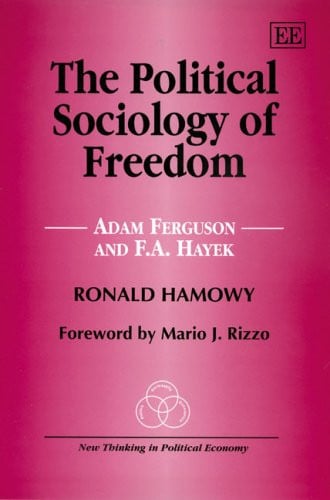
The political sociology of freedom: Adam Ferguson and F.A. Hayek

Hamowy, Ronald
Adam Ferguson and Friedrich Hayek, separated by a period of almost two hundred years, made original but similar contributions to the field of theoretical sociology. In this collection of essays, Ronald Hamowy explores the life and work of these two thinkers, giving special emphasis to their insights into the diffusion of knowledge. Ferguson, a giant of the Scottish Enlightenment, can be credited with laying the foundations of theoretical history by first proposing the idea that social institutions undergo evolutionary change. He theorized that while these institutions are formed by the actions of human beings, they are not the product of human design. Less than two centuries later, Hayek extended this insight to dealing with economic and social interaction, arguing that the knowledge requisite for structuring the social institutions under which we live is far too complex to be comprehended by any one mind or group of thinkers, and that these institutions had in fact evolved over long periods of time without deliberate design. Hayek was also the first to introduce the notion that market processes are a function of all participants contributing the limited knowledge that each possesses, out of which an orderly arrangement of enormous complexity emerges. Scholars and students of sociology, economics, history and political theory will find The Political Sociology of Freedom a unique and provocative read.
Edward Elgar 2005 265 pages

Revelation and the God of Israel

Samuelson, Norbert M.
Norbert M. Samuelson asks--what is the most reasonable possible conception of the doctrine of "revelation" found in the sources of the Abrahamic religions (Judaism, Christianity, and Islam) in the light of modern challenges from academic studies of evolutionary psychology, analytic philosophy, and biblical history? The proposed answer is drawn from his extensive knowledge of western philosophy-- from ancient Greece to contemporary England and America and Jewish intellectual history from Maimonides to Buber and Rosenzweig. The book engages with the history of philosophy, religious thought and Judaism.
Cambridge University Press 2008-11-06 272 pages

The challenge of being human

Eigen, Michael
Freud wrote that the greatest problem facing humanity is its destructive urge. There is no one factor that solves the issue. The Challenge of Being Human explores tendencies that make us up and capacities that try to meet them. The shock of ourselves is perennial. We are challenged by our own aliveness and a need to open doors as yet unknown. We are not done evolving, growing, learning, feeling, caring. Growth of capacity to tolerate and work with experience is part of our evolutionary challenge. This book seeks to support us in whatever ways we can begin to meet this challenge.
[distributor] Taylor & Francis, c/o Bookpoint 2018 146 pages

Songs of Ecstasy

Carolyn Mary Kleefeld
Product Description This art booklet combines paintings and poetry to create "a visual chartology of the evolutionary path." It includes ten full color reproductions of Carolyn s art and nine poems. About the Author Born in England, philosopher, poet, author, and visual artist Carolyn Mary Kleefeld grew up in Southern California before studying art and psychology at UCLA. Her innovative artwork and writing has been explored for more than twenty-five years in the fields of human consciousness and creativity. A visionary pioneer, she possesses the rare ability to convey through lyrical language, metaphor, and symbolic image the spiritual potential of human beings. Fueled by a need for creative expression and a lifelong fascination with psychological and spiritual transformation, Ms. Kleefeld has authored three award-winning poetry books that explore these archetypal themes. These books have been studied in university courses internationally and translated into Braille by the Library of Congress. Her book, The Alchemy of Possibility: Reinventing Your Personal Mythology (Merrill-West) inspired by the I Ching, with an introduction by Laura Archera Huxley combines visual art, philosophical prose, and poetry, and includes quotes from the I Ching and Tarot. Healers and professors of art and psychology alike have utilized Alchemy as an inspirational text and oracular guidebook. An interview with Kleefeld can be found in the anthology Mavericks of the Mind: Conversations for the New Millennium (Crossing Press), alongside conversations with Alan Ginsberg, Terence McKenna, Dr. Timothy Leary and other contemporary cutting-edge thinkers. Other works of note include Kissing Darkness: Love Poems and Art, a poetic lovers dialogue written in collaboration with David Wayne Dunn (published in 2003 by Riverwood Books, an imprint of White Cloud Press) and Soul Seeds; Revelations from the Mystery, an inspirational collection of Kleefeld s philosophical maxims (Cross Cultural Communications, 2008). Over the past three decades, she has created an extensive and diverse body of drawings and paintings, ranging in style from romantic-figurative to abstract. In her unique language of poetic imagery, Ms. Kleefeld expresses the passions of the human heart and a pantheistic reverence for the Big Sur wilderness she inhabits. In addition to past features in art magazines and textbooks, her esteemed work can be found in the personal collections of Ted Turner and Laura Archera Huxley, the United Nations, and in hospitals, galleries, and museums around the world.
Atoms Mirror Atoms, Incorporated 1990 20 pages

Reform Judaism and Darwin: how engaging with evolutionary theory shaped American Jewish religion

Langton, Daniel R.
Darwin provoked Jews as well as Christians, and this book examines leading nineteenth- and early twentieth-century American progressive Jewish thinkers who wrestled with evolutionary theories. In particular there was a widespread commitment to the application of biological evolutionary theory to history and cosmology, and a fascination with the evolution of ethical systems within human societies, bearing in mind mankind's bestial origins and new challenges for understanding religious traditions. It is argued that Reform Jewish discussions about the nature of God have been more profoundly shaped by engagement with evolutionary theory than has been recognized before and that, in fact, evolutionary thought provides the key conceptual framework for understanding the distinctive development of Reform Judaism in North America. --
De Gruyter 2019 131 pages

Biological Memory

Rignano, Eugenio
First published in 1999. This is Volume XVI of twenty-one of a series on Cognitive Psychology. Written in 1926, considered from a philosophic viewpoint, this is an English translation of Professor Rignano's work, Biological Memory," which gives an exhaustive analysis of the differences which distinguish living from non-living substance and his attempts to account for these differences as the manifold effects of a single quality.
Routledge 2014-12-02 260 pages