2328 results for "Jewish History"

An anthology of Jewish-Russian literature: two centuries of dual identity in prose and poetry

Maxim Shrayer
This definitive anthology gathers stories, essays, memoirs, excerpts from novels, and poems by more than 130 Jewish writers of the past two centuries who worked in the Russian language. It features writers of the tsarist, Soviet, and post-Soviet periods, both in Russia and in the great emigrations, representing styles and artistic movements from Romantic to Postmodern. The authors include figures who are not widely known today, as well as writers of world renown. Most of the works appear here for the first time in English or in new translations. The editor of the anthology, Maxim D. Shrayer of Boston College, is a leading authority on Jewish-Russian literature. The selections were chosen not simply on the basis of the author's background, but because each work illuminates questions of Jewish history, status, and identity. Each author is profiled in an essay describing the personal, cultural, and historical circumstances in which the writer worked, and individual works or groups of works are headnoted to provide further context. The anthology not only showcases a wide selection of individual works but also offers an encyclopedic history of Jewish-Russian culture. This handsome two-volume set is organized chronologically. The first volume spans the nineteenth century and the first part of the twentieth century, and includes the editor's extensive introduction to the Jewish-Russian literary canon. The second volume covers the period from the death of Stalin to the present, and each volume includes a corresponding survey of Jewish-Russian history by John D. Klier of University College, London, as well as detailed bibliographies of historical and literary sources.
Sharpe 2007 1278 pages

Chaim Weizmann

Reinharz, Jehuda
In the pantheon of modern Jewish leaders, Chaim Weizmann is a giant. One of the founding fathers of the State of Israel and its first president, he was also a president of the World Zionist Organization, and an eminent chemist, for whom Israel's renowned Weizmann Institute of Science was named. Yet, until now, there has never been an authoritative biography of Weizmann that removed the layers of myth obscuring our image of the man. Both a personal portrait of a fascinating man and a far-reaching history of the Jews in the modern world, this book, written by one of America's leading authorities on Jewish history, delves into the factors that shaped Weizmann's personality and worldview. Though the book focuses on the making of Weizmann as a Zionist leader, it also lays the foundations for understanding his extraordinary achievements as a scientist. This volume, the first of two that will cover his entire career, ends when, at the age of 40, Weizmann is thrust onto the center stage of world politics as a major negotiator for the Balfour Declaration.
Oxford University Press 1985 566 pages

Image before my eyes: a photographic history of Jewish life in Poland before the Holocaust

Dobroszycki, Lucjan
"The Jews of Poland between the World Wars come alive in this photographic essay in all their diversities....One imagines that Polish Jewry would have wanted to be remembered thus -- looking out to the camera and the world beyond." -- Ruth R. Wisse "Reveals a vibrantly rich kaleidoscope of life using many great photographs, some known, others never seen before. A volume to read, to study, to treasure." -- Cornell Capa "Beautifully balanced to serve the fascinating truth of a civilization that vanished into the darkest folds of history....All this seems so distant and yet so familiar, for although they are gone, they are family, and it was just yesterday." -- Mark Helprin "A poignant and visually beautiful reconstitution of the varied, culturally rich, and endlessly fascinating lost world of Polish Jews. Reading it makes one glow with pride." -- Louis Begley "If you're Jewish and looking for your roots and the world of your grandfathers, this is the book for you. If you're not Jewish, but just curious, this book is for you....It can take you on a voyage into a world that vanished in the gas and smoke of the Holocaust." -- Lucy S. Dawidowicz "One of the most extraordinary photographic histories ever assembled....An entire people and culture, now gone from the face of the earth, comes forth from its pages with an animation and vitality so powerful that the tragedy of the end of Polish Jewry seems for a moment, miraculously suspended." -- Simon Schama
Schocken Books 1994-11-01 269 pages

Re-inventing the Jewish past: European Jewish intellectuals and the Zionist return to history

Myers, David N.
David Myers' book explores a fascinating and untold chapter in modern Jewish intellectual history: the role of the first generation of Jewish scholars at the Hebrew University in Jerusalem in establishing Jewish studies within framework of a jewish national university. committed to rewriting jewsh history according to zionst standarts, these "jerusalem scholars" richly reflect the tensions that attended their dual allegiances, to both zionism and the discipline of history
Oxford University Press 1995-11-30 278 pages

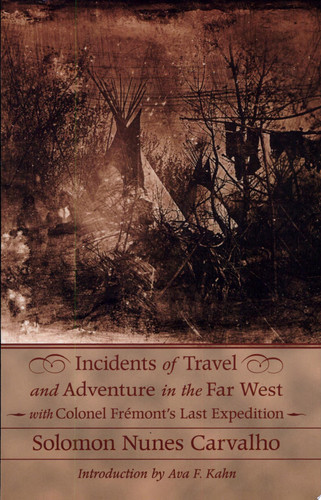
Incidents of travel and adventure in the Far West: with Colonel Fremont's last expedition across the Rocky Mountains, including three months' residence in Utah, and a perilous trip across the great American desert to the Pacific

Carvalho, Solomon Nunes
n August 1853, an American-born Sephardic Jew, Solomon Nunes Carvalho, accepted John Fremont's invitation to join his fifth expedition to find the best overland route to California. A Baltimore artist, inventor, and daguerreotypist, Carvalho was given the job of creating a photographic record of the lands and peoples along the way. Fremont's party left the Missouri on September 14, 1853, traveled up the Kansas River, overland to the Arkansas, upriver past Bent's Fort to the Huerfano, and traversed the Sandhill Pass into the Rocky Mountains. Beset by heavy snows and intense cold, they were reduced to eating their horses and mules and the occasional beaver or porcupine while making their way in midwinter across the Grand, Green, and Sevier Rivers. Suffering from frostbite, scurvy, and dysentery, Carvalho left the expedition in Utah; spent four months among the Mormons in Salt Lake City, where he observed with keen interest their system of spiritual wives; and reached California in 1854. Carvalho became the first Jewish writer to publish accounts of the Great American West and was also one of the first people to photograph the American West. Although only one of his plates is known to survive, others became the models for wood and steel engravings that broadcast the image of the West throughout the world. This Bison Books edition restores the discourses on Mormon doctrine omitted from previous twentieth-century editions. Ava F. Kahn is a visiting scholar at the California Studies Center, University of California, Berkeley. Her books include Jewish Voices of the California Gold Rush: A Documentary History, 1849-1880; Jewish Life in the American West: Perspectives on Migration, Settlement, and Community; and California Jews (coedited with Marc Dollinger).
University of Nebraska Press 2004-01-01 130 pages

The limits of Orthodox theology: Maimonides' thirteen principles reappraised

Shapiro, Marc B.
It is commonly asserted that Maimonides' famous Thirteen Principles are the last word in Orthodox Jewish theology. This is a very popular notion, and is often repeated by scholars from all camps in Judaism. Yet such a position ignores the long history of Jewish theology in which Maimonides' Principles have been subject to great dispute. The book begins with a discussion of the significance of the Principles and illustrates how they assumed such a central place in traditional Judaism. Each principle is then considered in turn: the reasons underlying Maimonides' formulations are expounded and the disputes that have arisen concerning them are discussed in detail. Marc B. Shapiro's authoritative analysis makes it quite clear that the notion that Maimonides' Principles are the last word in traditional Jewish theology is a misconception, and that even Maimonides himself was not fully convinced of every aspect of his formulations. Although structured around Maimonides' Principles, this book can also be seen as an encyclopedia of traditional Jewish thought concerning the central issues of Jewish theology. The diversity of opinion in Jewish tradition on such issues as God, Creation, and the Revelation of the Torah is sure to surprise readers.
Littman Library of Jewish Civilization 2011 221 pages

The Trial and Death of Jesus

Cohn, Haim Hermann
Haim Cohn, a Justice of the Supreme Court of Israel, and a scholar of Jewish legal history , offers a profound and respectful engagement of the Gospel narrative of the trail and death of Jesus. Using information we possess from various scholarly sources concerning the law and procedures (both Jewish and Roman) pertaining at the time, Justice Cohn presents a searching forensic and historical analysis to create a legal, political and religious context of the events as they may really have happened.
Ktav Pub & Distributors Inc 1980 419 pages

Jesus in the Jewish world

Vermès, Géza
Jesus in the Jewish Wold represents some of the seminal aspects of the lifelong research of Geza Vermes focused on the Dead Sea Scrolls, Jewish Bible interpretation and the historical study of Jesus and the New Testament. Taken together the fifteen essays, the oldest of which dates from 1970 and the most recent from 2010, constitute an evocative cross section of the contribution to scholarship by Vermes who is equally celebrated as a pioneering Jesus In The Jewish World represents a synopsis of the most significant and Scrolls expert and, according to the Sunday Telegraph, the greatest Jesus scholar of his generation. Readers of the present volume are offered lively and often humorous accounts of the impact of Jesus the Jew on Christian and Jewish readers; of the value of Josephus as a historical source regarding John the Baptist, James the brother of the Lord, and Jesus; the historical implications of ancient Jewish biblical exegesis; of the inside story of the monumental recasting by Vermes and his friends of Emil Schurer's History of the Jewish People; and of the sacrifice of Isaac and the story of the first-century Galilean rabbi, Hanina ben Dosa. The final two essays, written in 2007 and 2010, are particularly noteworthy, the first propounding a fresh and revolutionary approach to methodology in the study of the historical Jesus and the second restating and reinforcing Vermes's stance in the half -a-century long Son of Man debate. Geza Vermes is Professor Emeritus of Jewish Studies and Emeritus Fellow of Wolfson College, Oxford but continues to teach at the Oriental Institute in Oxford.
SMC Press 2010 268 pages

A childhood under Hitler and Stalin: memoirs of a "certified" Jew

Wieck, Michael
A bestseller in Germany, Michael Wieck's account of his childhood in Königsberg recalls a German city obliterated by fire-bombing during the Second World War. As the child of a Jewish mother and Gentile father, Wieck was persecuted first as a "certified Jew" by the Nazis, then as a German by the Russian occupiers, including horrific internment in the Rothenstein concentration camp. His emigration to the West in 1948 marked the end of the 408-year history of the Jewish community in Königsberg. From the earliest delights of a childhood filled with music, family, and the smell of pines and the sea, Wieck retraces his life. He tells of his school days and their sudden end, the shock of Kristallnacht, his Aunt Fanny being sent by train to a destination unknown, the chemical factory where Jewish workers gradually disappeared, the bombs falling on Königsberg. The Russian occupation was anything but the expected delivery from the horrors of the war. In the midst of privation, savagery, and death, there were moments of absurdity, and Wieck powerfully depicts them in this unforgettable memoir.
the University of Wisconsin Press 2003 293 pages

Unsettled: an anthropology of the Jews

Konner, Melvin
Presented as an anthropoligist's view of Jewish culture and history, antisemitism is noted in terms of Christianity and contempt for Jews in terms of Islam (chs. 7 and 6, respectively). The Holocaust (including religious responses and literature) is the topic of ch. 13, "Smoke: How the Germans Gave the Jews Graves in the Air, " and reistance that of ch. 14, "Fire: How the Jews Fought Back."
Viking Compass 2003 500 pages

Telling Our Story Recent Essays on Zionism, the Middle East, and the Path to Peace

Einat Wilf
The story of Israel and Zionism has been hijacked, disfigured, and trampled upon. It has been deliberately replaced by a story about sinister ideologies and evil motivations. When this tale of evil becomes the reigning story, peace becomes ever less possible, since evil is not to be negotiated with, but defeated. If peace is ever to be made, the story of Israel and Zionism is to be told anew. In this book, Dr. Einat Wilf does just that, demonstrating in the process how the true telling of the story of Israel and Zionism opens the path to peace with the Palestinians and the entire Arab and Muslim world. In the book's opening chapter, "Telling Our Story," Wilf provides a context, telling the story of the Jewish people's right to self-determination in their homeland and how through deliberate Jewish action - not foreign hand-outs or Holocaust-motivated guilt - the State of Israel was born. This story of the Zionist movement remains among the most inspiring dramas in human history: although dealt some of the worst cards in history, through force of vision, desire and work, the Jewish people returned to history as active agents and shaped a future in which they are not the victims of others. This story is crucial to understanding the importance of the Jewish state to the Jewish people, as well as in its broader ability to inspire people throughout the world. In chapter two, "On Why There Is No Peace," Wilf examines why decades after the establishment of the State of Israel conflict continues to persist with no end in sight. The core of her argument is that the requisite condition for any solution - whether it be a one-state or two-state solution - is for both sides of the conflict to recognize the equal rights of the other as collectives and individuals to all of the land, and the acceptance that neither can have the land in its entirety. As this requisite is absent - specifically on the Arab side - compromise, and thereby peace, has not been viable. In chapter three, "On What Israel Should Do," Wilf explores the steps Israel should take towards peace. Wilf argues that although peace may not be viable now, Israel should prepare for the hopeful eventuality of the creation of two states for two peoples between the Mediterranean Sea and Jordan River. Israel should do this by specifically delineating its eastern border - including the annexation of the large Jewish settlement blocks that are contiguous to the Green Line - and renouncing is territorial claims beyond that eastern border. Given the very real security issues that Israel faces, however, she should implement a policy of continued military occupation until she feels there is a partner for peace on the Palestinian side. This policy is one of "yes to the occupation, no to the settlements," east of that border. Regarding Jerusalem, Wilf clarifies that the only place where controversy persists is in regard to the Old City. The status of the Old City will be determined through a final peace agreement, but the status of the overwhelming majority of Jerusalem can already be specified; and that final peace agreement, Wilf explains, would be in a much better position if the ambiguity regarding the Old City did not spill over into the issue of Jerusalem as a whole. In the concluding chapter, "On What the International Community Should Do," Wilf explores what roles and policies might be pursued by the international community. Foremost, however, Wilf posits that it is critical for the international community to understand that the conflict between Israelis and Palestinians, between Jews and Arabs in the Middle East, rests on serious issues that go to the core of matters of each other's sense of justice, history, and identity. Additionally, it is most important to bear in mind that Israelis, Palestinians, and Arabs are sovereign agents who need to determine their future for themselves and by themselves.
CreateSpace Independent Publishing Platform 2018-03-19 224 pages

The girl from Human Street: a Jewish family odyssey

Cohen, Roger
It has taken me a long time to piece all this together. Memories come not like heavy rain but the drops falling from leaves after it. There were elements missing. At last I knew I would not be whole until I found them... June Cohen was born on Human Street in 1929. Her street ran through the centre of Krugersdorp, a mining town near Johannesburg where June's father, Laurie, a doctor, and his wife of Lithuanian Jewish heritage, had decided to establish themselves thirty years on from the family's crossing to South Africa. June was named after the month she was born in. In the wake of his mother's death, New York Times columnist Roger Cohen embarks on a compassionate and sensitive portrait of the journeys made by both his maternal and paternal family, exploring the stories that have filtered through to him since childhood. Told through personal letters and collective memories, Cohen follows his family from Lithuania to South Africa, England, the United States and Israel. He illuminates the uneasy resonance of the racism his relatives witnessed living in apartheid-era South Africa and explores the pervasive sense of 'otherness' that originated from his Jewish heritage of persecution and from the repeated loss that accompanied his forebears' multiple migrations. And through this, he begins to understand better the manic depression that has permeated his family and that plagued his mother until her last moments. A sweeping family story spanning continents, families and great swathes of history, Roger Cohen's deeply personal examination of Jewish identity is a tale of displacement and remembrance, an account of suicide and resilience, a meditation on identity and belonging, a classic for our times.
Bloomsbury 2016-01-27 304 pages

The scholar's Haggadah: Ashkenazic, Sephardic, and Oriental versions

Guggenheimer, Heinrich
Heinrich Guggenheimer presents the first Haggadah to treat the texts of all Jewish groups on an equal footing and to use their divergences and concurrences as a key to the history of the text and an understanding of its development. While many commentaries have been written on the Haggadah during the last one thousand years - most delineating the spiritual meaning or the ritual details of the Passover ceremonies - few historical investigations have dealt with texts that are not wholly Ashkenazic. Available for the first time to the reader is a Haggadah that includes the customs and ceremonies of not only Ashkenazic and Sephardic Jewry, but of Yemenite Jews as well. Additionally, the author provides a commentary that not only offers a key to the roots of the Passover ceremonies and an introduction to the thought and practice of talmudic-rabbinic Judaism, but also presents a history of the development of text and practice of the Seder celebration. While Yemenite Jewry still follows texts and prescriptions of Maimonides practically in their original form, unchanged for at least 800 years, European Ashkenazic and Sephardic practices have undergone many changes. While the history of Yemenite Jews is riddled with oppression and migration, the Moslem rulers of their country never extended their persecutions to Jewish books. On the other hand, the history of European Jews is dominated by continuous pogroms, beginning with the first crusade, and a permanent war of the Church against Jewish learning that resulted in many public burnings of the Talmud and rabbinic treatises
Jason Aronson 1995-05-01 418 pages

Hasidism on the margin: reconciliation, antinomianism, and messianism in Izbica/Radzin Hasidism

Magid, Shaul
Hasidism on the Margin explores one of the most provocative and radical traditions of Hasidic thought, the school of Izbica and Radzin that Rabbi Gershon Henokh originated in nineteenth-century Poland. Shaul Magid traces the intellectual history of this strand of Judaism from medieval Jewish philosophy through centuries of Kabbalistic texts to the nineteenth century and into the present. He contextualizes the Hasidism of Izbica-Radzin in the larger philosophy and history of religions and provides a model for inquiry into other forms of Hasidism. --
University of Wisconsin Press 2003 400 pages

A Book of Jewish Thoughts

Joseph H. Hertz
The book "" A Book of Jewish Thoughts, has been considered important throughout the human history, and so that this work is never forgotten we have made efforts in its preservation by republishing this book in a modern format for present and future generations. This whole book has been reformatted, retyped and designed. These books are not made of scanned copies and hence the text is clear and readable.
Alpha Editions 2021-11-22 248 pages