14302 results for "History"

In the days of Simon Stern: a novel

Cohen, Arthur A.
Nathan, a blind Jewish scribe, tells the story of the coming of the Messiah in the person of one Simon Stern—from his birth on the Lower East Side, through his career as a millionaire dealer in real estate, to his building of a refuge for the Jewish remnant of World War II. "A majestic work of fiction that should stand world literature's test of time, to be read and reread. A masterpiece."— Commonweal "This book ensnares one of the most extraordinarily daring ideas to inhabit an American novel in a number of years. For one thing, it is that risky devising, dreamed of only by the Thomas Manns of the world, a serious and vastly conceived fiction bled out of the theological imagination. For another, it is clearly an 'American' novel—altogether American, despite its Jewish particularity: it is not so much about the history of the Jews as it is about the idea of the New World as haven. . . . In its teeming particularity every vein of this book runs with a brilliance of Jewish insight and erudition to be found in no other novelist. Arthur Cohen is the first writer of any American generation to compose a profoundly Jewish fiction on a profoundly Western theme."—Cynthia Ozick, New York Times Book Review "This stately, ambitious amalgam of Jewish myth, history, theology, and speculations on the Jewish soul is like an enormous Judaic archeological ruin—often hard for the uninitiated to interpret, but impressive. . . . Intelligent, inventive, fascinating."— New Yorker
University of Chicago Press 1988 464 pages

American Jewish women and the Zionist enterprise

Reinharz, Shulamit,Raider, Mark A.
Product Description Despite a historical record that shows sustained involvement of American Jewish women with early Zionism and Palestine, this topic has received scant scholarly attention. A major contribution to Zionist history, women’s history, and American history, American Jewish Women and Zionism offers a much needed clarification to the historical record. Divided thematically, American Jewish Women deals with representative figures, events, and themes of the pre-state era. The essays in the book have three different foci: Several are concerned with significant personalities, such as Golda Meir, Marie Syrkin, Emma Lazarus, and Henrietta Szold, while others are concerned with the pivotal role played by American Zionist women’s organizations including Hadassah, the Pioneer Women’s Organization (later Naamat), the Mizrachi Women’s Organization (later Amit Women), and others. The remaining essays address broad themes and reveal the multidimensionality of the relationship of American Jewish women and Zionism, which includes agricultural and vocational training, religion, ideology, geography, and feminism and femininity. American Jewish Women and Zionism also includes several eyewitness documents and personal testimonies. No less significant than the corpus of memoirs and literature produced by male Zionist leaders, such data throws light on hitherto neglected facets of American Jewish and Zionist history, including the variety of roles played by Zionist women and their self-awareness as participants in one of the most dramatic and consequential episodes in the history of Jewish civilization. The volume includes a glossary of terms, a map of the principal locations referred to in the text, illustrations, and a timeline of American Jewish women and their relationship to Zionism. Each section opens with a prefactory note that places the essays in historical context. It concludes with a bibliographic note and suggestions for further readings. Review "Anyone interested in the significant role of women and Zionism should definitely find this book a must read."--The National Jewish Post & Opinion "Shulamit Reinharz and Mark Raider's magnificent study... challenges us to understand how faith in Zionism and in the American dream nourished and changed both projects. This is a story not of ideologies or, for the most part, of ideologues, but rather of the creators of a new tradition. The essays in this collection bring some of the leaders of Hadassah, Pioneer Women, and of Mizrahi beautifully to life and show how a dedication to the Zionist cause deepened a commitment to American values, and enlarged the Zionist perspective, to preserve a set of liberal principles reaching across the ethnic and national divide in Palestine...In this book Reinharz and Raider assemble essays that chart the rich profusion of movements, institutions, and activities - including aliyah - that Zionism inspired in Jewish women living in the United States."--Israel Studies "The organizations that women created as an expression of their goal are deftly analyzed. There is valuable and intriguing material here which calls for the attention of scholars in the fields of American history, women's history, feminism, and Zionism."--Jewish Book World From the Publisher 6 x 9 trim. 12 illus, 1 map, 3 tables About the Author Mark A. Raider is professor of modern Jewish history in the Department of History and director of the Center for Studies in Jewish Education and Culture at the University of Cincinnati. He is the author, most recently, of The Essential Hayim Greenberg: Essays and Addresses on Jewish Culture, Socialism, and Zionism.
Brandeis University Press 2005 393 pages

Four Mothers

Shifra Horn
Is there really such a thing as a family curse? The tale of Four Mothers captivates readers with fantastic characters, magical events, foreign colors and scents while telling the story of a dynasty of women cursed to raise their daughters on their own. This is a vibrant first person recounting of matriarchal dynasty with rich strong women who pass their material and spiritual legacy on from one generation to the next. The last woman in the line, Amal, documents the wisdom of her female predecessors from the beginning of memory. The family has known riches and fame as well as poverty and bad fortune, but women have always survived, and prospered . The epic drama echoes the wondrous realism of Gabriel Garcia Marquez and demonstrates a talent for lavish details. The realistic yet fantastic style and story question the cultural inferiority and oppression of women as well as the role of the family curse within contemporary Israeli society. The story depicts Jerusalem from the end of the 19th century to present day, covering the Turkish and British rule over the ancient city. At the same time it presents an alternative, personal perspective to the history of Jerusalem over the past century. The colorful and rich work presents a precise historiography of the period from woman's viewpoint. Four Mother has been awarded several prizes.
CreateSpace Independent Publishing Platform 2014-11-30 272 pages

The Last Secret of the Deverills

Santa Montefiore
Bestselling author Santa Montefiore’s spellbinding, historical trilogy reaches its sweeping and heartwarming conclusion in The Last Secret of the Deverills. A new generation of love and war at Castle Deverill... Ireland, 1939. Peace flourishes throughout the country, but much has changed for the Deverill family. In Dublin, Martha Wallace searches for her birth mother. Given up for adoption as a baby and raised in America, Martha returns to Ireland to connect with her Irish roots. Instead, she falls in love with the impossibly charming JP Deverill, and together they uncover the truth about her family. At Castle Deverill, the humble daughter of the castle’s former cook is now Countess di Marcantonio and mistress of the Castle. Bridie is determined to make the splendid surroundings her home, but to do so she must turn a blind eye to the failings of her husband and son. Kitty has settled into her life with Robert and their two children, but when Jack O’Leary returns to Ballinakelly with a family of his own, she realizes she never forgot her first love, even though his heart belongs elsewhere. As the Second World War hovers on the horizon, the Deverills uncover a secret that will forever change their lives. The Last Secret of the Deverills is the dramatic conclusion to a stunning saga about a family caught in the sweep of history, and the ties that keep them together.
Simon & Schuster UK 2019-01-01 480 pages

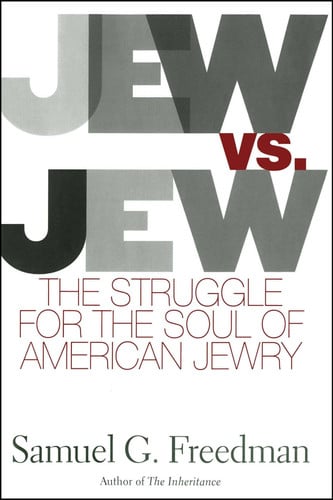
Jew Vs Jew The Struggle For The Soul Of American Jewry

Samuel G. Freedman
At a time when American Jews should feel more secure and cohesive than ever, civil war is tearing apart their community. Congregations, neighborhoods, even families are taking sides in battles about Jewish identity and Jewish authenticity. The conflict pits fundamentalist against secularist, denomination against denomination, even liberal against conservative within each branch of Jewry. Jew vs. Jew tells the story of how American Jewry has increasingly -- and perhaps terminally -- broken apart in the last forty years. Jew vs. Jew stretches in time from 1960 to 2000. It travels the country from Florida to New England, from Los Angeles to the Catskills in New York, from Cleveland to Denver, and it also crosses the ocean to Israel to show how tensions within the Jewish state inflame those among American Jews. The flash-points range from conversion standards to the role of women, from the peace process in Israel to the sexual climate on an Ivy League campus. But behind them all, as Samuel Freedman writes, lie common causes. First, far from unifying American Jews, Israel now divides them on both political and religious grounds. Second, neither America nor the larger world presents Jews with a single enemy against whom to coalesce. Third, and most important, nothing in the Jewish history of persecution, oppression, and exile prepared the Chosen People for the challenge posed by America, the challenge of being absorbed into a tolerant and diverse nation, being accepted so thoroughly that the intermarriage rate tops 50 percent. Jew vs. Jew introduces readers to memorable places and characters. Freedman describes one of the final summers at a Labor Zionist camp in the Catskills whose brand of secular Jewishness is becoming obsolete because Zionism succeeded in creating Israel. He tells the story of Orthodox and Reform Jews in a Cleveland suburb who are fighting about the construction of several synagogues -- and, on a deeper level, about whether unity or pluralism ought to be the goal of Jewish life. He portrays a Florida Jew so violently opposed to the Oslo peace accords that he planted a bomb in a synagogue where Shimon Peres was speaking. He tells about a Los Angeles congregation that spent three years debating whether or not to honor the Biblical matriarchs in its liturgy.We come to know the Long Island neighbors who cannot tolerate sharing even a property line because their versions of Jewish identity are so irreconcilably different. Jew vs. Jew is a work of vigorous reporting, lucid writing, and intellectual curiosity. And even as it chronicles an embittered and polarized community, it refuses to take sides or pass judgment. Instead, with compassion and acuity, Jew vs. Jew bears witness.
Simon & Schuster 2007-09-21 400 pages

The reality of the devil: evil in man

Anshen, Ruth Nanda
Anshen's book displays an extensive phenomenology of evil with dispassion, insight & irony. The Devil is seen as no mere medieval curiosity. He's equal to God in power, but not in substance, & a compulsive force in humans & the universe. Dr Ansen reviews the fall of Lucifer & of humanity with an analytical ingenuity that casts Satan, Eve & Cain in roles formidable & provocative for the history & psychology of humankind. Lucifer, before his fall, the author contends, was not evil. Nor was his act of rebellion against God an act of satanic hatred. It was the act of an individualist who rebelled against the fact of being created by one beyond & above himself.
Harper & Row 1972 142 pages

Temptations of a superpower

Steel, Ronald
America is the last remaining superpower. Yet what does this triumph mean when the challenges we face often defy military solutions? In Temptations of a Superpower , one of our most eloquent and incisive foreign policy analysts takes a hard look at this question, with all its implications for America's role in the post-Cold War world. Ronald Steel offers a devastating critique of a high-stakes game of foreign policy played by rules that no longer apply, and then proposes a more realistic--and pragmatic--view of the world and our place in it. The Cold War imposed a certain order on the world, giving us a secure sense of our enemies and allies, our interests and our mission. Steel paints a disturbing picture of the world now deprived of its ordering principle, where ethnic conflicts and national rivalries once held in check erupt in violence, where the shifting allegiances and fevered ambitions flout familiar strategies for keeping peace, conducting trade, and protecting human rights. He explores the history of our present predicament and explains the dangers of adapting outmoded but habitual policies to a new world whose shape is fast evolving. What, for instance, is the future of America's military, deeply embedded as it is in our culture and economy? If Wilsonian idealism, with its vision of converting the world to democracy, replaces anti-communism as the guiding principle behind foreign policy, how far should it take us? What distinctions should we make between our nearest neighbors and distant nations? How are we to balance economic needs and ethical imperatives? Analyzing the turmoil sweeping the world from China to Bosnia, Haiti to the Caucasus, Steel depicts the shattering dilemmas facing American policymakers. What concern should the United States have with many world quarrels? How can national interest be reconciled with strategic considerations and morality? When should domestic needs take precedence over foreign policy? The alternatives that Steel proposes to current policies defy much of the conventional wisdom and are certain to provoke controversy. He asks not only what America should do for the world, but what it must do for itself. Reminding us that foreign and domestic policy are inseparable, Steel argues that a renewed foreign policy must address not only changes in the world order, but the pressing, unmet needs within America itself.
Harvard University Press 1995 144 pages

Shadow chamber

Ballen, Roger
"Best known for his striking photographs of people on the fringes of South African society, Roger Ballen makes images that are ambiguous and often disturbing, but also shot through with flashes of dark humour. The photographs in Shadow Chamber blur the boundaries between documentary photography and art forms such as painting, theatre and sculpture, challenging the ways in which we perceive the 'reality' of photography. Ballen's images are completely honest, yet also fabricated." "The mysterious, cell-like rooms that Ballen photographs are actual places, but they are unsettling and strange, logical but impossible: their walls are covered with scribbled drawings, stains and dangling wires, the floors are strewn with bizarre props and artefacts. Dogs, rabbits and kittens wander into the frame or are stuffed into unlikely containers. The humans and animals in Ballen's photographs appear isolated and lost, yet strangely empowered at the same time. The resulting images are allegories of lived experiences and surreal takes on human destiny." "In his introduction to Shadow Chamber, curator Robert A. Sobieszek analyzes Ballen's unique approach and sets his work in the wider context of the history of documentary photography and critical theory."--BOOK JACKET.
Phaidon 2007-04-01 127 pages

Benedict Arnold: A Drama of the American Revolution in Five Acts

Zubrin, Robert
Benedict Arnold: A Drama of the American Revolution in Five Acts Benedict Arnold was the greatest combat soldier of the American Revolution. Yet, in September 1780, in collusion with the beautiful Tory agent Peggy Shippen and British spymaster John Andre, he attempted to betray George Washington, the Marquis de Lafayette, Alexander Hamilton, and the critical fortress of West Point into Royal hands. This devastating plot came within a hair's breath of succeeding, and the fragile infant American cause was only saved by the chance intervention of three of the humblest and most improbable heroes ever to grace the annals of history. Exciting and dramatic, the tale of the Arnold conspiracy recounts the most perilous moment in the birth of the new nation, and plumbs the depths and the heights of human nature. Now, in the historically accurate play, Benedict Arnold, noted scientist and author Robert Zubrin brings this incredible and still meaningful story back to life.
San Val 2005-06

Silverberg's Starborne

Robert Silverberg
It promises to be the greatest voyage of exploration in human history. From the stagnant, placid society of twenty-third-century Earth comes an idea so powerful that it seizes the imagination of all humankind. A starship will be sent deep into the unknown galaxy in search of habitable worlds, with the hope that the challenge of colonization will somehow rekindle the dying human spirit. Fifty men and women are chosen to crew the Wotan, each nursing his or her own secret dreams and fears. Their leader is the stoic year-captain, drawn to the dangerous mission by his lifelong quest for meaning. The single most important member of the crew is the blind Noelle, whose telepathic link with her blind twin sister on Earth provides the Wotan's only contact with Earth as it speeds through the pearl-gray twilight of unfathomable nospace. The worlds that the Wotan encounters are both strange and inhospitable, and with each disappointment its mission seems more and more hopeless. Then Noelle's mind-link with Earth is inexplicably broken, and the crew begin to despair, fearing they've been condemned to wander alone through the vastness of space forever, cut off from any contact with humankind. But when Noelle unexpectedly senses a massive alien presence in the vast vacuum of deepest space, the crew suddenly realize that their every assumption about life and the universe may prove dead wrong.
Arc Manor 2012-04 200 pages

Scientists and scoundrels: a book of hoaxes

Silverberg, Robert
As if history and nature had not provided wonders enough, through the ages humans themselves have contrived more marvels to deceive one another. Sometimes they have concocted evidence when none was available to prove pet theories; sometimes their intention has been to impress or defraud; sometimes they have acted merely for sport. ø Robert Silverberg tells the stories of a baker's dozen of these scientific hoaxers in a lively, good-humored book that ranges through time and across continents. Here are perpetual-motion machines and space rockets, men on the moon and serpents in the sea. The rogues? gallery is a varied one: Dr. Mesmer, who cast his hypnotic spell on eighteenth-century Paris; Charles Dawson, whose Piltdown Man challenged evolution; Dr. Cook, with his tale of ?discovering? the North Pole; and many others. ø These are fascinating stories and more than just entertainment. The author explains the scientific background against which the hoaxes appeared and the detective work that led to their exposure. The schemers teach us to be alert, to challenge the evidence, and to appreciate the healthy skepticism that characterizes the scientific method.
University of Nebraska Press 2007-06-01 251 pages

Doing Fieldwork: The Correspondence of Robert Redfield and Sol Tax

Rubinstein, Robert A.
Prior to the 1930s the highlands of Guatemala were largely undescribed, except in travelogues. Just two decades later, the highlands had become one of the most anthropologically well-investigated areas of the world. This is largely due to the research that Robert Redfield and Sol Tax carried out between 1934 and 1941. Separately and together, Redfield and Tax anticipated and guided anthropological investigations of people living in peasant and urban communities in other areas of the world. Their work helped to define the major outlines of research in the 1970s, and since then much writing about the region has been formulated in critical response to the Redfield-Tax program. Not coincidentally, since the mid-1970s anthropology has been caught up in a wave of self-doubt about the status of fieldwork and the authority of ethnographic description. This critical stance has often cast ethnography as a creative, literary enterprise. This volume presents a timely view of the process of ethnography as carried out by two of its early practitioners. Containing a wealth of ethnographic detail, the book reveals how Redfield and Tax developed and tested ethnological hypotheses, and it allows us to follow the development of their major theoretical statements. The result is an exceptionally clear picture of the process of ethnography. Redfield and Tax emerge as rigorous and sensitive observers of social life whose observations bear importantly on contemporary understandings of the ethnology of Guatemala and the enterprise of anthropology. This book will be of interest to students of method and theory in ethnography, Latin Americanists, and other professionals interested in the history of idea.
[distributor] Taylor & Francis, c/o Bookpoint 2017-08-02 354 pages

Enraged citizens, European peace and democratic deficits: or, Why the democracy given to us must become one we fight for

Menasse, Robert
"In 2010, Robert Menasse journeyed to Brussels to begin work on a novel centered on the European Union. His extended stay resulted in a completely different book - Enraged Citizens, European Peace and Democratic Deficits, a work of nonfiction examining the history of the European project and the evolving politics of nation-states. Spanning from the beginning of the transnational idea with 1951's Montanunion - the European Coal and Steel Community - to the current financial crisis, Menasse focuses on the institutional structures and forces both advancing and obstructing the European project. Given the internal tensions among the European Commission, Parliament, and Council, Menasse argues that current problems that are frequently misunderstood as resulting from the financial crisis are, in fact, political. Along the way, he makes the bold claim that either the Europe of nation-states will perish - or the project of transcending the nation-states will ... [this work] analyzes the financial and bureaucratic structures of the European Union and sheds light on the state of the debt crisis. Menasse unravels the real state of the Union, along the way weaving a tale of one continent's efforts to become a truly postnational democracy."--Provided by publisher.
Seagull Books 2016 134 pages

The Mayakovsky tapes: a novel

Littell, Robert
"In March 1953, four women meet in Room 408 of Moscow's deluxe Metropole Hotel. They have gathered, not altogether willingly, to reminisce about Vladimir Mayakovsky, the poet who in death had become a national idol of Soviet Russia. In life, however, he was a much more complicated figure. Each of these ladies loved Mayakovsky in the course of his life, and as they piece together their memories of him, a portrait of the artist emerges. From his early years as a leader of the Futurist movement to years as a propagandist for the Revolution, to the censorship battles that turned him against the State, Mayakovsky is revealed as a passionate, complex man who lived at the center of history and fought to hold onto his ideals even in the face of a world changing for the worse. The Mayakovsky Tapes is an ambitious, impressive novel that captures the tumultuous life of one of the most significant writers of the Soviet era"--
Thomas Dunne Books/St. Martin's Press 2016-11-22 243 pages

Maccabees, Zadokites, Christians, and Qumran A New Hypothesis of Qumran Origins

Robert Eisenman
This is Eisenman's original, ground-breaking work in which he criticizes the archaeology and paleography of Qumran as it had been developed by 'the specialists' up to that time and rather offers his own hypothesis-starting with the fact that it was impossible to consider that the Maccabees were the so-called "Wicked Priests" at Qumran, primarily because everything known about them agrees, for the most part, with the doctrines and positions emanating from the documents known at that time to emanate from the area known as "Qumran" along the Northwestern part of the Dead Sea and which, for that reason, we call "The Dead Sea Scrolls."In addition, he shows rather that the Establishment against whom the Qumran Scrolls were in an almost homogeneous manner directed was rather that of the Herodians and the Priests that owed both their appointment and authority to them and the Roman Governors that in due course either replaced or ruled either through or in conjunction with them. He also starts in this work to build his case for the fact that the individual came to be understood in Early Christian History as "James the Righteous" and called by everyone "James the Just"-that same individual known by everyone as as "James the Brother of Jesus"-had very much in common with "the Righteous Teacher" described and alluded to in many Dead Sea Scrolls documents. That is why this book, originally published in the early 1980s, was subtitled "A New Hypothesis of Qumran Origins." It was necessary to subject both the archaeology and paleography of Qumran-upon which the so-called "Establishment" or "Consensus of Qumran Scholars' had all based both their theories and chronology to thoroughgoing criticism. This he has done, as only someone who originally studied math and physics, could do, in a meticulously masterful fashion. No one has 'laid a glove' on his analysis since. At the same time and in parallel fashion, he starts to suggest that the 'opponent' of this individual in Early Christian History, Paul, had about the same amount of characteristics with the individual these same Qumran Documents are constantly referring to as "The Spouter of Lying," "the Liar" or "Man of Lying," or "the Scoffer" or Jester" (not someone to be taken seriously)-but, of course, this is not the same individual as "the Wicked Priest" whom prestigious Qumran 'scholars' on the highest level insist upon saddling him with because they saw "the Wicked Priest" and "the Lying Spouter" described in Qumran Documents as the same individual.Eisenman lays out here in very clear terms that the two individuals denoted as "the Wicked Priest" and "the Lying Spouter" were two distinct and absolutely separate persons-this again, despite what some 'scholars' attempt to foist on him in order to try to make him look ridiculous . No, on the contrary, in doing so, they only make themselves look ridiculous. Eisenman is very careful here - "the Spouter of Lying" is an internal opponent of "the Righteous Teacher" at Qumran. "He denied the Law in the midst of the whole Congregation"! "The Wicked Priest - certainly no 'Maccabean'/'Hasmonean' - was rather an Establishment and probably Herodian High Priest, meaning, appointed by the "Herodians" and their Roman Overlords.It was this individual who was responsible either for the destruction or the death of "the Righteous Teacher"-a situation very much paralleling a number of such similar situations described, albeit rather tendentiously, in the New Testament and, of course, by Josephus. Anyone who picks up this short Book with its copious footnotes (much of the argument being conducted there, so his gainsayers would, of course, had to have first had a look at these before criticizing him-which usually they have not) will not be disappointed. It is and was his first salvo in the ongoing and running battle he has been conducting with "Consensus" and "Establishment Scholars" ever since and - to his credit - with no little effect."
Amazon Digital Services LLC - KDP Print US 2019-02-12 124 pages

Democratization in America: a comparative-historical analysis

Desmond King,Robert C. Lieberman,Gretchen Ritter,Laurence Whitehead
The essays in this volume examine democracy’s development in the United States, demonstrating how that process has shaped—and continues to shape—the American political system. Scholars of American politics commonly describe the political development of the United States as exceptional and distinct from that of other advanced industrial democracies. They point to the United States as the longest-lived and most stable liberal democracy in history. What they often fail to mention, though, is that it took considerable time to extend democracy throughout the country. The contributors to this volume suggest that it is intellectually fruitful to consider the U.S. case in comparison to other countries. They argue that the development of democracy is ongoing in America; that even with a written constitution grounded in liberal democracy, the meaning and significance of U.S. democracy are still evolving. This volume shows that democratization and the pursuit of democracy are processes affected by multiple and continuing challenges—including such issues as citizenship, race, institution building, and political movements—as patterns and practices of politics and governance continue to change. This innovative approach contributes significantly to comparative democratization studies, a field normally confined to Latin America and former communist countries. The U.S. case is a unique reference point for students of American political development and comparative democratization.
Johns Hopkins University Press 2009-08-05 337 pages

The legacy of Isaiah Berlin

Mark Lilla,Ronald Dworkin,Robert B. Silvers,Aileen Kelly
In the fall of 1998, one year after the death of Isaiah Berlin, the New York Institute for the Humanities organized a conference to consider his intellectual legacy. The scholars who participated devoted much of their attention to the question of pluralism, which for Berlin was central to liberal values. His belief in pluralism was at the core of his philosophical writings as well as his studies of contemporary politics and the history of ideas. The papers given at the conference and collected in this volume concentrate on three aspects of Berlin's concept of pluralism. Aileen Kelly, Mark Lilla, and Steven Lukes trace the development and consequences of his distinction between hedgehogs, thinkers who have a single, unified theory of human action and history, and foxes, who believe in multiplicity and resist the impulse to subject humanity to a universal vision. Ronald Dworkin, Bernard Williams, Thomas Nagel, and Charles Taylor examine how liberalism can be sustained in the face of Berlin's insight that equally legitimate values, such as liberty and equality, may come into irreconcilable conflict. Avishai Margalit, Richard Wollheim, Michael Walzer, and Robert Silvers take up Berlin's advocacy for the State of Israel and his hopes for it as a place where the often contrary values of liberalism and nationalism might find harmonious resolution. The Legacy of Isaiah Berlin includes not only the panelists' contributions but also transcripts of the lively exchanges among themselves and with audience members following each session. The two days of discussion preserved here demonstrate the continuing vitality and relevance of Isaiah Berlin's thought in today's social and political debates.
New York review books 2001 198 pages

A look backward and forward at American professional women and their families

Simon, Rita J.
This edited volume contains the thoughtful and often inspiring papers that were presented at the Fourth Annual Conference of the Women's Freedom Network in 1997. Written by scholars, homemakers, entrepreneurs, professionals, and military personnel, the articles in this collection address the status of women, their careers, and their families--now and in the past. The volume is divided into four sections, each devoted to a particular area where women have played a significant role. The first section focuses on the family with papers describing the difficult choices women must make to meet the demands of home and career, the changing role of fathers, and impact of divorce on children. In section two, several women discuss their successful careers as entrepreneurs and CEOs in a variety of businesses. The papers in section three deal with the topic of women in the military, addressing issues ranging from physical fitness and injury to pregnancy and sexual scandal. The last section offers insiders' views on the history and professional experiences of women involved in medicine, journalism, law, and academia. Heart-felt and informative, the articles in this collection offer insight into the multi-faceted and ever-changing lives of women today.
University Press of America 2000-01-19 166 pages

The Womanizer A Man of His Time

Rick Salutin
Award-winning novelist, journalist, and playwright Rick Salutin takes us into the world of his protagonist, Max -- economist, leftist, and reluctant but incorrigible womanizer. Max’s amorous adventures begin at the age of eight when the young Casanova finds himself running from the scene of his first crime, a surreptitious kiss on the couch with the neighbour’s daughter. For the next few decades women become participants in Max’s awkward and often hilarious journey to self-discovery -- some willing, some reluctant, some unwitting. We follow Max from the 50s to the 90s, through shifting sexual codes and practices, from Toronto to London and Paris, and, most importantly, from one woman to another. He is doomed to repeat this history until he learns from it. Resonant with authority, experience, and self-deprecating insight, The Womanizer explores the riddles of growing up and the discovery that we understand ourselves only through others and that our most intimate moments are clues to our true selves.
National Geographic Books 2003-10-07 336 pages