2180 results for "Business"

Blood of victory

Furst, Alan
Utterly gripping spy thriller set in the glittering world of European high society, just before the Second World War. November, 1940. I.A. Serebin, a writer from Odessa and former decorated Hero of the Soviet Union, is on his way to Istanbul following a cryptic letter from a former lover. Ostensibly there on official business for the International Russian Union, an émigré organisation based in Paris, he is drawn into a clandestine world of international spies and political players. With war in Europe drawing nearer, Serebin is recruited by the British secret services - his mission to stop the export of Romanian oil to Germany. In a race against time, Serebin's journey will take him from the glittering salons of Paris to the back alleys of Bucharest and the Black Sea ports, in a covert operation to staunch the flow of oil, the precious 'blood of victory'.
Phoenix 2009-03-05 289 pages

I'll Be Short Essentials for a Decent Working Society

Robert Reich
'I don't like the basic philosophy that everyone is on their own, out for themselves, a kind of social Darwinism. It's bad for society, especially now. . . . Call me crotchety, but I can't help asking, whatever happened to the social contract?' The get-rich-quick exuberance of the late nineties may have temporarily blinded us to how dependent we are on one another. Subsequent events serve as reminders that the strength of our economy and the security of our society rest on the bonds that connect us. But what, specifically, are these bonds? What do we owe one another as members of the same society? With his characteristic humor, humanity, and candor, one of the nation's most distinguished public leaders and thinkers delivers a fresh vision of politics by returning to basic American values: workers should share in the success of their companies; those who work should not have to live in poverty; and everyone should have access to an education that will better their chances in life. An insider who knows how the economy and government really work, Reich combines realistic solutions with democratic ideals. Businesses do have civic responsibilities, and government must stem a widening income gap that threatens to stratify our nation. And everyone must get involved to help return us to a society that works for everyone.
Beacon Press 2003-05-15 136 pages

The crime of Sheila McGough

Malcolm, Janet
Sheila McGough was prosecuted and convicted because the government (and then the jury) interpreted her zealous representation of a con-man client named Bob Bailes as collaboration in his fraud. Malcolm's close readings of court records and her interviews with lawyers and businessmen connected with the case give a picture of American law and American cupidity that is startling in its pitiless specificity. And her portrait of Sheila McGough - "a woman of almost preternatural honesty and decency," as well as maddening literal-mindedness and discursiveness - brings an unconventional new heroine into vivid being. In the winter of 1996, Janet Malcolm received a letter from a stranger - a disbarred lawyer named Sheila McGough, who had recently been released from prison, and who wrote that she had been convicted of crimes she had not committed. Malcolm decided to look into the case, and this book - a dazzling work of journalism as well as a searching meditation on character, on the law, and on the incompatibility of narrative with truth - is the product of her growing belief that a miscarriage of justice had taken place.
Alfred A. Knopf 1999-01-19 161 pages

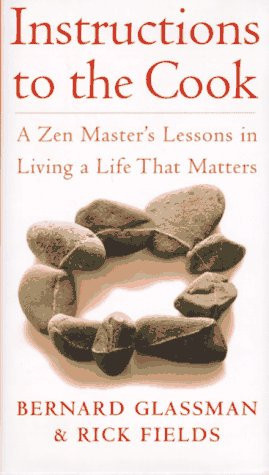
Instructions to the cook: a Zen master's lessons in living a life that matters

Glassman, Bernard
In Instructions to the Cook Glassman draws on the teaching of Dogen, the thirteenth-century founder of the Japanese Soto Zen tradition, to relate his own experiences as twentieth-century abbot-cum-entrepreneur. This book, written with Rick Fields, describes Glassman's vision and his work. It is the fruit of his long years of Buddhist practice and also of all the ways in which he has tried to improve the quality of life for those on the bottom rungs of society. The Greyston Foundation, which Glassman established in a poverty-stricken section of Yonkers, is a network of businesses and not-for-profits, including a gourmet bakery that provides training and jobs for the unemployed, three apartment buildings with social services for formerly homeless families, and a major facility for people with HIV/AIDS, which will open in 1997. With this book as our guide we can discern more clearly how to nourish both ourselves and others through integrating the economic, social, educational, and spiritual dimensions of every endeavor. According to Glassman, one of the most useful metaphors for life is what happens in the kitchen. Zen masters call a life that is lived fully and completely, with nothing held back, "the supreme meal." Some chefs keep their recipes and methods a secret, but others are willing to share their failures and successes so that the rest of us can learn how to cook our own "meals." Offering such precepts as "Use what you have," "Don't reject anything," and "Recognize your faults as your best ingredients," Brooklyn-born Glassman is forging a new, American brand of Buddhism, applying the principles of spirituality both in the community and in the marketplace, successfully practicing nonattachment while swimming with the sharks.
Bell Tower 1996 171 pages

The crunch: how greed and incompetence sparked the credit crisis

Brummer, Alex
On 9 August 2007 France's largest bank announced that it had had to suspend trading in two huge investment funds it controlled. The same day three German banks revealed that they were close to collapse. A few days later came the first run on a British bank since the 1860s as vast queues of worried investors besieged Northern Rock. Within weeks, the Government were being forced to bail out this previously little-known bank to the tune of e30 billion, share prices in other mortgage lenders were plummeting, and alarming news about the state of several of the biggest US banks was crossing the Atlantic. What lay behind this series of crippling disasters? In The Crunch , award-winning journalist Alex Brummer painstakingly traces the course of the crisis from its origins in the US 'subprime' market to its explosion on to the international scene. It's a story of greed, mismanagement and dithering in which bankers seeking to make a quick buck, regulators engaged in turf wars and blame-avoidance, and governments paralysed by the sheer scale of the problem all conspired to bring the banking system almost to its knees. It's also a story of victims- the millions of people in the US who have already been thrown out of their houses, the entire population of the UK who have been co-opted to guarantee Northern Rock with e30 billion of public money, borrowers everywhere who are now finding credit more expensive and harder to get. And, as Alex Brummer convincingly argues, now that recession looms, this is only the beginning.
Random House Business Books 2009 272 pages

Realism with a human face

Putnam, Hilary
The time has come to reform philosophy, says Hilary Putnam, one of America's great philosophers. He calls upon philosophers to attend to the gap between the present condition of their subject and the human aspirations that philosophy should and once did claim to represent. Putnam's goal is to embed philosophy in social life. The first part of this book is dedicated to metaphysical questions. Putnam rejects the contemporary metaphysics that insists on describing both the mind and the world from a God's-eye view. In its place he argues for pluralism, for a philosophy that is not a closed systematic method but a human practice connected to real life. Philosophy has a task, to be sure, but it is not to provide an inventory of the basic furniture of the universe or to separate reality in itself from our own projections. Putnam makes it clear that science is not in the business of describing a ready-made world, and philosophy should not be in that business either. The author moves on to show that the larger human context in which science matters is a world of values animated by ethics and aesthetic judgments. No adequate philosophy should try to explain away ethical facts. The dimension of history is added in the third part of the book. Here Putnam takes up a set of American philosophers, some firmly within and others outside the canon of analytic philosophy, such as William James and C.S. Peirce, and he explores the pragmatist contribution to philosophy from James to Quine and Goodman. This book connects issues in metaphysics with cultural and literary issues and argues that the collapse of philosophical realism does not entail a fall into the abyss of relativism and postmodern skepticism. It is aimed primarily at philosophers but should appeal to a wide range of humanists and social scientists. --taken from Amazon.com
Harvard University Press 1990 347 pages

Janner on meetings

Janner, Greville
In this new edition of the "Janner on Meetings", author Greville Janner presents a complete guide to success with meetings. Whether you organize, address or chair meetings, this book offers guidelines to propel you to mastery. The author illuminates every aspect of this important subject, from coping with nerves to using visual aids, handling hecklers and preparing minutes. He reveals the secrets of thinking on your feet, the skills of self-presentation and the special touches that make occasions memorable. The revised edition contains fresh material, including a new section summarizing key points in checklist form. Greville Janner's advice applies to meetings large and small, public and private, business, professional and personal. The book is a distillation of his unique experience as a public speaker and committee chair.
Wildwood House 1987 180 pages

Canned: the rise and fall of consumer confidence in the American food industry

Zeide, Anna
"This book explores the earliest roots of the modern food industry, focusing on the development of the canning industry in the United States. Canning leaders leveraged the power of scientific expertise to create a market for canned food. Before the mid-twentieth century, in order to win consumer trust, canners adopted new technologies, cooperated with federal food regulation, sponsored agricultural and bacteriological research, and standardized food production. All of these moves helped to make canned food a staple of American pantries by the 1940s. As other industries entered the processed food landscape, and environmental and consumer critiques emerged, canners widened their scientific research base to more centrally incorporate marketing, advertising, and political strategy. In their increasing power, industry leaders were less willing to defer to governmental authority and more eager to directly control production and consumption. This study takes up the stories of six particular canned foods--condensed milk, peas, olives, tomatoes, tuna, and Campbell's soup--to understand the tools used by the food industry to build consumer confidence in a new way of eating. This modified diet not only changed the relationship between business and consumers, but also the relationships among Americans, farmers, universities, advertisers, and the natural environment."--Provided by publisher.
University of California Press 2018 269 pages

The Case Against the Fed

Murray Newton Rothbard
The most powerful case against the American central bank ever written. This work begins with a mini-treatment of money and banking theory, and then plunges right in with the real history of the Federal Reserve System. Rothbard covers the struggle between competing elites and how they converged with the Fed. Rothbard provides a succinct account of the origins of money, showing how money must originate from a commodity. Banking originated from goldsmiths, who issued warehouse receipts for gold deposited with them. From this a fractional reserve system developed, inherently prone to monetary expansion and panic. In the late nineteenth century, a movement toward bank centralization arose among both "progressives" and bankers, the latter eager to increase their profits. From these plans, the Federal Reserve System developed. Rothbard shows the dominate influence of the banking House of Morgan at the Fed's inception. During the New Deal, Rockefeller interests took first place in influence, with the Morgan interests reduced to a subordinate though still potent role. The book concludes with an account of the Fed's role in causing inflation and the business cycle. Abolition of this nefarious agency must be part of any agenda for genuine financial reform.
Ludwig von Mises ,Institute 2015-05-27 166 pages

The Leaders We Need And What Makes Us Follow

Michael Maccoby,Tim Scudder
There is one irrefutable definition of a leader: someone with followers. Without followers, there is no leader. But people follow a leader in different ways and for different reasons. Leadership is a relationship between leaders and followers. This relationship depends on the qualities of both leaders and followers in a particular context. Someone can be a leader in one context but not in another. In this revised edition of The Leaders We Need and What Makes Us Follow Michael Maccoby with Tim Scudder show how leadership relationships can improve organizations and societies and be developmental for both leaders and followers. The book delves deeply into the dynamics of followership, answering questions such as the following. Why do people follow a leader? Why do we sometimes follow bad leaders? Why do we sometimes turn against leaders we once admired? How have the values of followers been changing? To collaborate more productively, both leaders and followers need to develop their Personality Intelligence. The more complex and interdependent work becomes, the more organizations need people who are engaged in their work. Personality Intelligence as it is described in this book equips us to understand each other, our drives, values, fears, hopes, and dreams. It combines intellectual and emotional intelligence, both head and heart. It is aided by personality assessments, such as the Strength Development Inventory (SDI) that give leaders and followers a shared language that helps in avoiding conflict and developing strengths. Based on the authors' extensive experience, this book provides examples from many different organizations in different countries of how Personality Intelligence has improved relationships at work. Although the myth of the single leader persists, most organizations need a leadership team, including three types of leaders: Strategic, Operational, and Networking. They typically have different personalities, but they are most effective if they develop and practice a leadership philosophy that describes their organizational purpose, the practical values essential to accomplish that purpose, the moral basis for decisions, and the definition of results. Increasingly the Millennial generation who share an Interactive social character want to work at organizations with a purpose and values that improve society. This book is not a quick-fix or a list of steps to success, but it will make you think more deeply about why people will or will not follow you and how you can become the kind of leader your followers need.
Personal Strengths Publishing, Incorporated 2017-05 198 pages

Bootstrapped Liberating Ourselves from the American Dream

Alissa Quart
An unsparing, incisive, yet ultimately hopeful look at how we can shed the American obsession with self-reliance that has made us less healthy, less secure, and less fulfilled The promise that you can "pull yourself up by your bootstraps" is central to the story of the American Dream. It's the belief that if you work hard and rely on your own resources, you will eventually succeed. However, time and again we have seen how this foundational myth, with its emphasis on individual determination, brittle self-sufficiency, and personal accomplishment, does not help us. Instead, as income inequality rises around us, we are left with shame and self-blame for our condition. Acclaimed journalist Alissa Quart argues that at the heart of our suffering is a do-it-yourself ethos, the misplaced belief in our own independence and the conviction that we must rely on ourselves alone. Looking at a range of delusions and half solutions--from "grit" to the false Horatio Alger story to the rise of GoFundMe--Quart reveals how we have been steered away from robust social programs that would address the root causes of our problems. Meanwhile, the responsibility for survival has been shifted onto the backs of ordinary people, burdening generations with debt instead of providing the social safety net we so desperately need. Insightful, sharply argued, and characterized by Quart's lively writing and deep reporting, and for fans of Evicted and Nickel and Dimed, Bootstrapped is a powerful examination of what ails us at a societal level and a plan for how we can free ourselves from these self-defeating narratives.
HarperCollins Publishers 2024-04-09 288 pages

Bad banks: greed, incompetence and the next global crisis

Brummer, Alex
The inside story of the continuing global banking crisis. Written by an award-winning financial journalist, Bad Banks is an unflinching and gripping account of the problems and scandals that continue to bedevil the world's banking system some five years after the credit crunch. It follows the fortunes and misfortunes of individual banks, from RBS to Lloyds. It exposes instances of misselling, money laundering, interest rate fixing and incompetence. And it considers the bigger picture: how the failings of the world's banking system are threatening to undermine our future economic security. Alex Brummer, the City Editor of the Daily Mail, has spoken to all the major players, from HBOS's Andy Hornby, to former Governor of the Bank of England Sir Mervyn King, to the ex-Greek permier Lucas Papademos. His book is an insightful -- and terrifying -- account of institutions once renowned for their probity, now all too often a byword for incompetence, and worse.
Random House Business Books 2014-08-07 340 pages

The Dream Merchants

Harold Robbins
From the author of The New York Times number one bestseller The Carpetbaggers comes a novel of passion, intrigue, power, and money. With 11 weeks on The New York Times best sellers list, The Dream Merchants provides a fascinating look at the early days of the world's most glamorous industry--Hollywood. It was the latest "gold rush"--when ambitious, if unscrupulous, men and women flooded California to turn cinematic dreams into reality, regardless of the moral cost. Johnny Edge, a former carnival barker, schemes and plots his way to the top while Peter Kessler turns his back on a staid life of small-town stability to stake his fortune on the movie business. Beautiful starlet Dulcie Warren is willing to use her sexuality and to play dirty to get to the top, if that's what it takes. When the lives of these three ambitious, determined characters collide, they have the potential to build a dream--or shatter one to pieces. More than 25 New York Times bestsellers later--many reaching the #1 spot--and with over 750 million copies sold to date, Harold Robbins became one of the most successful authors of all time.
Oghma Creative Media 2016-11-17 560 pages