14302 results for "History"

Scattered Among the Peoples: The Jewish Diaspora in Twelve Portraits

Levine, Allan
In Scattered Among the Peoples, historian Allan Levine presents a vivid and distinctly human perspective on how the Jewish people survived eight hundred years of persecution and forced migration, building and rebuilding their lives and communities. Structured as a chronological series of twelve moment-in-time portraits, focusing on individuals and their interaction with their families and society, the narrative carries readers through the economic, political, social and intellectual climates of some of the world's most famous and fascinating cosmopolitan centers. From the expulsion of the Jews from Spain in 1492, to the emigration of Soviet Jews from Russia following the Six Day War in Israel in 1967, Levine's masterful account describes expulsions and scandals, false messiahs and the first ghetto, assassinations, blood libels, the learning and wealth that sprung up in distant cities, and some devastating reversals of fortune. Above all, this compelling saga chronicles the lives of a vibrant cast of characters-well-known historical figures, as well as many who have been forgotten. The successes and the failures of so many-as teachers, rabbis, merchants, writers, soldiers, and physicians-add a colorful and accessible dimension to this sprawling history of the Diaspora. Scattered Among the Peoples is an impressive and immensely readable book, one that is an important contribution to the literature of Jewish history.
Overlook Books 2003-09 480 pages

Whose American Revolution was it?: historians interpret the founding

Young, Alfred F.,Nobles, Gregory H.
The meaning of the American Revolution has always been a much contested question, and asking it is particularly important today: the standard, easily digested narrative puts the Founding Fathers at the head of a unified movement, failing to acknowledge the deep divisions in Revolutionary-era society and the many different historical interpretations that have followed. Whose American Revolution Was It? speaks both to the ways diverse groups of Americans who lived through the Revolution might have answered that question and to the different ways historians through the decades have interpreted the Revolution for our own time. As the only volume to offer an accessible and sweeping discussion of the period's historiography and its historians, Whose American Revolution Was It? is an essential reference for anyone studying early American history. The first section, by Alfred F. Young, begins in 1925 with historian J. Franklin Jameson and takes the reader through the successive schools of interpretation up to the 1990s. The second section, by Gregory H. Nobles, focuses primarily on the ways present-day historians have expanded our understanding of the broader social history of the Revolution, bringing onto the stage farmers and artisans, who made up the majority of white men, as well as African Americans, Native Americans, and women of all social classes
New York University Press 2011-09 287 pages

Thatcher stole my trousers

Sayle, Alexei
'Enlightening ... Funny, smart, original and provocative ... It is hard to imagine the stalwarts of Mock the Week recognising the Druze militia leader Walid Jumblatt in a London cinema' NEW STATESMAN 'Few standups have come close to capturing a fraction of this creative energy in a book ... Alexei Sayle is an exception' GUARDIAN "What I brought to comedy was an authentic working-class voice plus a threat of genuine violence - nobody in Monty Python looked like a hard case who'd kick your head in." In 1971, comedians on the working men's club circuit imagined that they would be free to continue telling their tired, racist, misogynistic gags forever. But their nemesis, a nineteen-year-old Marxist art student, was slowly coming to meet them... Thatcher Stole My Trousers chronicles a time when comedy and politics united in electrifying ways. Recounting the founding of the Comedy Store, the Comic Strip and the Young Ones, and Alexei's friendships with the comedians who - like him - would soon become household names, this is a unique and beguiling blend of social history and memoir. Fascinating, funny, angry and entertaining, it is a story of class and comedy, politics and love, fast cars and why it's difficult to foul a dwarf in a game of football.
Bloomsbury 2016-11-03 324 pages

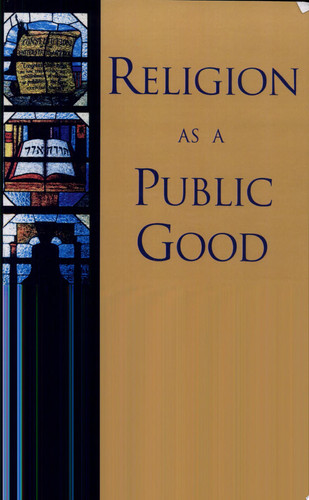
Religion as a public good: Jews and other Americans on religion in the public square

Alan Mittleman
Religion as a Public Good: Jews and Other Americans on Religion in the Public Square explores the often controversial topic of how religion ought to relate to American public life. The sixteen distinguished contributors, both Jewish and Christian, reflect on the topic out of their own disciplines-social ethics, political theory, philosophy, law, history, theology, and sociology. and take a stand based on their religious convictions and political beliefs. The volume is at once scholarly and committed, polemic and civil, reflective and activist. Written in the shadow of 9/11, it invites a new consideration of how religion enhances democratic public life with full awareness of the dangers that religion can sometimes pose. The volume is polemical, as befits the topic, but also civil, as befits a dialogue about an issue of profound significance for democratic citizenship.
Rowman & Littlefield 2003-12-09 336 pages

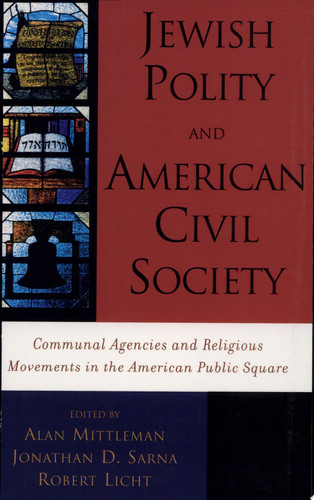
Jewish polity and American civil society: communal agencies and religious movements in the American public sphere

Alan Mittleman,Robert Licht,Jonathan D. Sarna
Jewish Polity and American Civil Society is a study of the civic and political engagements of American Jews as mediated by their communal and denominational institutions. The book explores how the various branches of the organized Jewish community seek to influence public affairs. Over the course of the last century, Jewish agencies and religious movements have tried to shape public debate and public policy on such issues as civil rights, church-state relations, and American foreign policy. The book sets the history of Jewish engagement in these areas into historical context; analyzes the motives, strategies, and tactics of various Jewish groups, and evaluates their successes and failures. The book also explores the underlying idea-the public philosophy-that informs American Jews' understanding of civic and political engagement.
Rowman & Littlefield 2002-07-23 420 pages

Holiness in Jewish thought

Alan Mittleman
Holiness is a challenge for contemporary Jewish thought. The concept of holiness is crucial to religious discourse in general and to Jewish discourse in particular. "Holiness" seems to express an important feature of religious thought and of religious ways of life. Yet the concept is ill defined. This collection explores what concepts of holiness were operative in different periods of Jewish history and bodies of Jewish literature and offers preliminary reflections on their theological and philosophical import today. The contributors illumine some of the major episodes concerning holiness in the history of the development in the Jewish tradition. They are challenged to think about the problems and potential implicit in Judaic concepts of holiness, to make them explicit, and to try to retrieve the concepts for contemporary theological and philosophical reflection. Not all of the contributors push into philosophical and theological territory, but they all provide resources for the reader to do so. Holiness is elusive but it need not be opaque. This volume makes Jewish concepts of holiness lucid, accessible, and intellectually engaging.
Oxford University Press 2018 241 pages

Transcendental number theory

Baker, Alan
The study of transcendental numbers has now developed into a fertile and extensive theory, enriching widespread branches of mathematics; and the time has seemed opportune to prepare a systematic treatise. My aim has been to provide a comprehensive account of the recent major discoveries in the field. Classical aspects of the subject are discussed in the course of the narrative; in particular, to facilitate the acquisition of a true historical perspective, a survey of the theory as it existed at about the turn of the century is given at the beginning. Notwithstanding its long history, it will be apparent that the theory of transcendental numbers bears a youthful countenance. If this book should play some small role in promoting future progress, the author will be well satisfied. The text has arisen from numerous lectures delivered in Cambridge, America and elsewhere, and it has also formed the substance of an Adams Prize essay.
Cambridge University Press 1990-09-28 165 pages

Aesthetics and modernity: essays

Heller, Agnes
Aesthetics and Modernity brings together Agnes Heller's most recent essays around the topics of aesthetic genres such as painting, music, literature and comedy, aesthetic reception, and embodiment. The essays draw on Heller's deep appreciation of aesthetics in all its forms from the classical to the Renaissance and the contemporary periods. Heller's recent work on aesthetics explores the complex and fraught status of artworks within the context of the history of modernity. For Heller, not only does the relation between aesthetics and modernity have to be looked at anew, but also the way in which these terms are conceptualized, and this is the two-fold task that she sets for herself in these essays. She engages this task with a critical recognition of modernity's pitfalls. This collection highlights these pitfalls in the context of continuing possibilities for aesthetics and our relationship with works of art, and throws light on Heller's theory of emotions and feelings, and her theory of modernity. Aesthetics and Modernity collects the essential essays of Agnes Heller, and is a must-read for anyone interested in Heller's major contributions to philosophy.
Lexington Books 2011 233 pages

Freedom and terror: reason and unreason in politics

Kaplan, Abraham
This book examines reason and unreason in the legal and political responses to terrorism. Terrorism is often perceived as sheer madness, unreasonable use of extreme violence and senseless, futile political action. These assertions are challenged by this book. Combining traditional " thought (by Kaplan) on reason and unreason in terrorism with empirical explorations of post-modern terrorism and its use of communication platforms (by Weimann) the work uses interdisciplinary and cross disciplinary dimensions to provide a multidimensional picture of critical issues in current politics and a deeper examination of their implications than previously available. The book looks at various aspects of modern politics, from terrorism to protest, from decision-making to political discourse, applying the perspective of philosophical thought. To do so, political issues and actions are examined by using concepts such as reason, emotions, madness, magic, morality, absolutism, extremism, psychopathology, rationality and others. The analysis is rooted in theories and concepts derived from history, philosophy, religion, art, sociology, psychology, and political science. This book, which was mostly written by the late Abraham Kaplan, an American philosopher, and edited and updated by Gabriel Weimann, will be of much interest to students of political violence/terrorism, philosophy, war and conflict studies and political science in general.
Routledge 2011 189 pages

Eighteenth Century Gold Boxes of Europe

Abraham Kenneth Snowman
This standard work of reference provides a carefully documented and profusely illustrated history of European gold boxes, principally of the eighteenth century, since this was the siScle de la tabatiSre, and discusses in detail the many beautiful materials used in conjunction with gold, and the various techniques of their manufacture and decoration. The methods of hallmarking adopted are examined, together with the question of makers' marks and date-letters.
Faber 1966 192 pages

A mad, mad, mad, mad world: a life in Hollywood

Kramer, Stanley
He proudly calls himself "the most frequently picketed producer in movie history"--A distinction he richly earned by taking on some of the most controversial subjects of our time. In the process, he directed or produced such classics of the American cinema as Guess Who's Coming to Dinner, High Noon, On the Beach, Judgment at Nuremberg, The Defiant Ones, Champion, Inherit the Wind, Ship of Fools, Death of a Salesman, and The Caine Mutiny.
Harcourt Brace 1997 251 pages

The Heming Way

Marty Beckerman
A hilarious guide to masculinity and self-destruction. Fifty years have passed since the death of Ernest Hemingway, history's ultimate man, and young males today-obsessed with Facebook, Twitter, and Nintendo-know nothing about his legendary brand of rugged, alcoholic masculinity. They cannot skin a fish, dominate a battlefield, or transform majestic creatures of the Southern Hemisphere into piano keyboards.With chapters such as "For Whom the Beer Flows," "Death in the Afternoon... Lunch is Served," and "The Old Man and the See You in Hell," former Esquire editor Marty Beckerman demonstrates how millions of technology-addled eunuchs-brainwashed by PETA and Alcoholics Anonymous-can learn from Papa's glorious example: drunken, unshaven, meat-devouring, wife-divorcing, and suicide-committing.The Heming Way is a difficult path, and not for the weak, but truth is manlier than fiction.
Infected Press 2011-05 90 pages

The emperor's tomb

Roth, Joseph
An intensely beautiful book about one of history’s bleakest periods The Emperor’s Tomb – the last novel Joseph Roth wrote – is a haunting elegy to the vanished world of the Austro-Hungarian Empire, and a magically evocative paean to the passing of time and the loss of hope. The Emperor’s Tomb runs from 1913 to 1938, from the eve of one world war to the eve of the next, from disaster to disaster. Striped with beauty and written in short propulsive chapters – full of upheavals, reversals and abrupt twists of plot – the novel powerfully sketches a time of change and loss. Prophetic and regretful, intuitive and exact, Roth tells of one man’s foppish, sleepwalking, spoiled youth and then his struggle to come to terms with the uncongenial society of post-First World War Vienna, financial ruin, and the first intimations of Nazi barbarities.
New Directions 2013-04-22 167 pages

LET'S MAKE THINGS BETTER

LEV, GIDON
"To me, hard times are like hide-and-seek: where is the solution, where is the hope? We can never give up looking for these things because they are just waiting to be found." Gidon Lev, an 89-year-old Holocaust survivor, has lived an extraordinary life. At the age of six, he was imprisoned in the concentration camp of Theresienstadt. Liberated when he was ten, he lost at least 26 members of his family, including his father and grandfather. But Gidon's life is extraordinary not only because he is one of the few living survivors remaining but because of his lessons learned over nearly a century. His enduring message is of hope and opportunity - to make things better. By sharing his timeless simple belief and truths, Gidon reminds us that we have the power to incrementally improve what is in front of us and leave something better behind us. His life is a lesson of how to do it, even in the face of astonishing adversity, and Let's Make Things Better is the calling card of an indomitable spirit. 'By sharing his inspiring life story, Holocaust survivor Gidon Lev reminds us that the human spirit is larger than even the most severe and unjust trauma. Through one of history's darkest nights, he preserved his brightness and warmth ' - David Von Drehle, author of the New York Times bestseller The Book of Charlie
MACMILLAN 2024 288 pages

The Dreyfus affair: a trilogy

Whyte, George R.
The cause celebre of the 19th century, the Dreyfus Affair destabilized French society (1894-1906) and reverberated across the world. Its repercussions continue to this day. A deliberate miscarriage of justice, the public degradation of an innocent Jewish officer and his incarceration on Devil's Island, espionage, intrigue, media pressure, vehement antisemitism and political skulduggery--all these elements, based on historical records, are contained in George R. Whyte's trilogy of plays which also focuses on Emile Zola's letter to the President of France, J'Accuse, arguably history's most famous plea for human rights.
Oberon Books 2010 126 pages

Coercion as cure: a critical history of psychiatry

Szasz, Thomas
Understanding the history of psychiatry requires an accurate view of its function and purpose. In this provocative new study of this nominal medical specialty, Szasz challenges conventional beliefs about psychiatry. He asserts that, in fact, psychiatrists are not concerned with the diagnosis and treatment of bonafide illnesses. He contends that the truth about psychiatry, its self-evident ends, and the means used to achieve them is socially unacceptable. Psychiatric tradition, social expectation, and the law make it clear that coercion is the profession's determining characteristi
Transaction Publishers 2009 278 pages

Racism, dissent, and Asian Americans from 1850 to the present: a documentary history

Foner,PhilipSheldon,1910-1994,Rosenberg,Daniel,1953-
Drawing from a broad range of articles, speeches, short stories, pamphlets, sermons, debates, laws, public statements, Supreme Court decisions and conventions, this documentary history demonstrates the persistence of a humanist, if not an anti-racist, pulse in American society in the face of discriminatory government policy and prevalent anti-Asian ideology and treatment. Focusing on support for the rights of Japanese and Chinese immigrants and their descendants, the book traces a 130-year period, culminating with the governmental redress for survivors of the Japanese evacuation and internment during WWII. Foner and Rosenberg highlight expressions from the clergy, the labor movement, the abolitionists, and public figures such as Wendell Phillips, Charles Sumner, Frederick Douglass, Mark Twain, John Stuart Mill, Norman Thomas and Carey McWilliams. It includes material never before published showing Black support for Asian rights and demonstrates the consistency of the Industrial Worker of the World's solidarity with Chinese and Japanese-American workers. It is also the first work to give serious treatment to clergymen's efforts against anti-Asian discrimination. After the introduction, Foner discusses law and dissent. The next four sections are devoted to statements by public figures, the views of the clergy, the labor movement and African-Americans. The final section covers relocation and protest. The book provides a valuable contribution to the debates on American dissent in general and against racism in particular, the meaning of American nationality, the criminality of the evacuation and internment of Japanese-Americans during World War II and the immigration policies of the United States government.
Greenwood Press 1993-04-30 311 pages

Space and Spatiality in Modern German-Jewish History

Simone Lässig,Miriam Rürup
What makes a space Jewish? This wide-ranging volume revisits literal as well as metaphorical spaces in modern German history to examine the ways in which Jewishness has been attributed to them both within and outside of Jewish communities, and what the implications have been across different eras and social contexts. Working from an expansive concept of "the spatial," these contributions look not only at physical sites but at professional, political, institutional, and imaginative realms, as well as historical Jewish experiences of spacelessness. Together, they encompass spaces as varied as early modern print shops and Weimar cinema, always pointing to the complex intertwining of German and Jewish identity.
Berghahn 2017-06 327 pages