1265 results for "Economics"

In days to come: a new hope for Israel

Burg, Avraham
"Born in 1955, Avraham Burg witnessed firsthand many of the most dramatic and critical junctions in Israeli history. Here he chronicles the highs and lows of his country during the last five decades, beginning with the 1967 war, when, as a young boy, his mother brought him back Uzi cartridges from the Kotel, which he incorporated into the Chanukah menorah he made for his home economics class. Burg narrates the misplaced hopes of religious Zionism (informed by his conservative upbringing), Israel's obsession with military might (informed by his own experiences as a paratrooper), the country's democratic aspirations (informed by his tenure in the Knesset) and more. What he delivers, ultimately, is an analysis of the ambitions and failures of Israel and Judaism, from the unique standpoint of his generation--the children of the mythical "founders" who established the state. In Days to Come is Burg's philosophical inquiry into what Jewish-Israeli identity means today if you are personally, ethically, and politically opposed to what your country stands for. With bravery and candor, he urges his countrymen to dare to ask the difficult questions and accept the truth of difficult answers, have the courage to move on from trauma to trust, understand that Jews do not have monopoly over suffering but a responsibility to prevent crimes against humanity, have the will to solve the conflict between Israel and Palestine by adopting new paradigms, be ready to relinquish the privileges given to the Jews and create a shared space with equal rights for every human being, lay the groundwork for a constitutional reality in which every individual--under Israeli sovereignty or responsibility--has equal rights, and build a wall of separation between synagogue and state"--
Nation Books 2018 321 pages

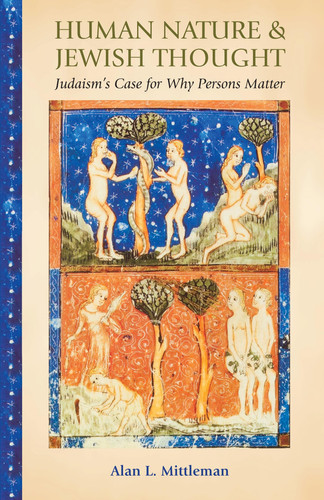
Human nature & Jewish thought: Judaism's case for why persons matter

Mittleman, Alan
This book explores one of the great questions of our time: How can we preserve our sense of what it means to be a person while at the same time accepting what science tells us to be true-namely, that human nature is continuous with the rest of nature? What, in other words, does it mean to be a person in a world of things? Alan Mittleman shows how the Jewish tradition provides rich ways of understanding human nature and personhood that preserve human dignity and distinction in a world of neuroscience, evolutionary biology, biotechnology, and pervasive scientism. These ancient resources can speak to Jewish, non-Jewish, and secular readers alike. Science may tell us what we are, Mittleman says, but it cannot tell us who we are, how we should live, or why we matter. Traditional Jewish thought, in open-minded dialogue with contemporary scientific perspectives, can help us answer these questions. Mittleman shows how, using sources ranging across the Jewish tradition, from the Hebrew Bible and the Talmud to more than a millennium of Jewish philosophy. Among the many subjects the book addresses are sexuality, birth and death, violence and evil, moral agency, and politics and economics. Throughout, Mittleman demonstrates how Jewish tradition brings new perspectives to-and challenges many current assumptions about-these central aspects of human nature. A study of human nature in Jewish thought and an original contribution to Jewish philosophy, this is a book for anyone interested in what it means to be human in a scientific age.
Princeton University Press 2015 215 pages

Essays on the intellectual history of economics

Viner, Jacob
Ranking among the most distinguished economists and scholars of his generation, Jacob Viner is best remembered for his work in international economics and in the history of economic thought. Mark Blaug, in his Great Economists Since Keynes (Cambridge, 1985) remarked that Viner was "quite simply the greatest historian of economic thought that ever lived." Never before, however, have Viner's important contributions to the intellectual history of economics been collected into one convenient volume. This book performs this valuable service to scholarship by reprinting Viner's classic essays on such topics as Adam Smith and laissez-faire, the intellectual history of laissez-faire, and power versus plenty as an objective of foreign policy in the seventeenth and eighteenth centuries. Also included are Viner's penetrating and previously unpublished Wabash College lectures. "Jacob Viner was one of the truly great economists of this century as both teacher and scholar. This collection ... covers a wide range with special emphasis on the history of thought. Today's economists will find [the essays] just as thought-provoking and as illuminating as did his contemporaries. They have aged very well indeed."--Milton Friedman, Hoover Institution "Jacob Viner was a great and original economic theorist. What is rarer, Viner was a learned scholar. What is still rarer, Viner was a wise scientist. This new anthology of his writings on intellectual history is worth having in every economist's library--to sample at intervals over the years in the reasoned hope that Viner's wisdom will rub off on the reader and for the pleasure of his writing."--Paul A. Samuelson, MIT "I am frankly jealous of those who will be reading Viner's essays for the first time, marvelling at his learning, amused by his dry wit, instructed by his wisdom. But although I cannot share their joy of discovery, I shall be able to savor the subtleties that emerge from rereading these splendid essays."--George J. Stigler, University of Chicago "This volume will be a treat for the reader who appreciates scholarship, felicitous use of language, and the workings of a great mind. The Wabash lectures are gems, and the introduction by Douglas Irwin contributes significantly to our understanding of Viner's accomplishments."--William J. Baumol, Princeton University/New York UniversityOriginally published in 1991.The Princeton Legacy Library uses the latest print-on-demand technology to again make available previously out-of-print books from the distinguished backlist of Princeton University Press. These editions preserve the original texts of these important books while presenting them in durable paperback and hardcover editions. The goal of the Princeton Legacy Library is to vastly increase access to the rich scholarly heritage found in the thousands of books published by Princeton University Press since its founding in 1905.
Princeton University Press 2014-07 408 pages

Classical economics

Hollander, Samuel
In this unconventionial and sharply written text, Hollander introduces the work of Smith, Ricardo, and Mill, and, on specific Malthus and Marx. He leads the student through the nuances of the arguments, making clear how he agrees with or challenges recieved ideas about their writings. Attention is given to the precursors of the classics, to their immediate successors, and to the Sraffian system.
B. Blackwell 1987-09-24 485 pages

An Austro-Libertarian Critique of Public Choice

Thomas J. Dilorenzo,Walter E. Block
"Dilorenzo and Block have rendered an invaluable service to scholars and students interested in Public Choice, Austrian Economics and Liberalism. Their critical analysis of Public Choice from the Austrian perspective is timely and relevant to clarify important misconceptions about both schools of thought that although in some aspects are complementary in many others offer a significantly different and even opposite approach. This is a most welcome book that was very necessary and fills an important vacuum in the literature." - Jesús Huerta de Soto"I congratulate DiLorenzo and Block for writing this important and courageous book chastising Public Choice. Austro-Libertarianism and Public Choice are to some degree complements; both veer in the direction of support for private property, fee enterprise and capitalism, and against government involvement in the economy. But they are also substitutes, in that the former is a consistent underpinning of the free marketplace, where the latter is not." - Han-Hermann Hoppe
Ludwig Von Mises Institute 2017-12-08 342 pages

Information, Incentives, and Economic Mechanisms Essays in Honor of Leonid Hurwicz

Theodore Groves,Roy Radner,Stanley Reiter
Information, Incentives, and Economics Mechanisms was first published in 1987.In 1960, economist Leonid Hurwicz formulated a theoretical model that initiated a field of research on the design and analysis of economic mechanisms (the institutional rules and structures by which economic activity is coordinated). By treating mechanisms as a "variable," this research provided a methodology for their comparison. The inefficiency of mechanisms arises from 1) the dispersion of information among agents, and 2) agents' incentives to seek private advantage from this dispersion. Exploration of these limits to efficiency was pioneered by Hurwicz in 1972, and has become a major area of active research. In part, this research enables economic theory to be a more effective instrument for the study of how a society can and should organize its economic activity.The fourteen new papers in this volume -- by a group of distinguished economists, all former students, colleagues, and collaborators of Hurwicz -- address major themes in the study of information and incentives for implementing desired economic allocations. Two comprehensive survey essays provide introductions to the topics of incentive in decentralized organizations generally and, more specifically, in classical models of private goods and public goods economies. The following sections deal with informational aspects of mechanism theory, information and the stability of general resource allocation mechanisms, market mechanisms, and nonmarket and general mechanisms.In addition to the editors, the contributors are: Masahiko Aoki, Kenneth J. Arrow, Xavier Calsamiglia, Jerry R. Green, James S. Jordan, Jean-Jacques Laffont, John Ledyard, Thomas Marschak, Eric Maskin, Andreu Mas-Coleli, Kenneth R. Mount, Andrew Postlewaite, Jean-Charles Rochet, John Roberts, David Schmeidler, and William Thomson.
University of Minnesota Press 1987 399 pages

The logic of action

Rothbard, Murray N.
In this, the first of two volumes, Murray Rothbard - one of the major figures in twentieth-century Austrian economics - argues with clarity and force that economics is a deductive science based on the fundamental realities of action, scarcity and the passage of time. Such conviction is demonstrated in the first part of this book, where Professor Rothbard analyses method. The second part focuses on some of the theoretical debates within the Austrian school, including property and justice rights, welfare economics, value and efficiency. In the third section Rothbard considers the Austrian approach to money and calculation, including discussion of the definition of the supply of money, freely floating exchange rates and calculation and its role under socialism. This latest volume of Murray Rothbard’s work goes some way to represent the important contributions he made to the field. The second volume of Murray Rothbard’s essays on Austrian economics is also available.
Edward Elgar 1997-11-04 452 pages

Jews, money and social responsibility: developing a "Torah of money" for contemporary life

Bush, Lawrence
Jews, Money and Social Responsibility is a lively discussion of socially responsible shopping, investment and philanthropy from an American Jewish perspective. The authors explore Judaism's teachings on economics, wealth, individual responsibility and community to develop a contemporary ethic of money and society. Their work offers a unifying vision of economic life that can sanctify and heal ourselves and our world.
Shefa Fund 1993 198 pages

Theorists of economic growth from David Hume to the present: with a perspective on the next century

Rostow, W. W.
This history of theories and theorists of economic growth elucidates the economic theory, economic history, and public policy observations of the renowned scholar W. W. Rostow. Looking at the economic growth theories of the classic economists up to 1870, Rostow compares Hume and Adam Smith, Malthus and Ricardo, and J.S. Mill and Karl Marx. He then examines the period 1870-1939 and its economic theorists, including Schumpeter, Colin Clark, Kuznets, and Harrod, and surveys the three forms of growth analysis in the postwar era: formal models, statistical morphology, and development theories. This authoritative overview also includes an agenda of unresolved problems in growth analysis and a description of the five major tasks statesmen will confront over the next several generations.
Oxford University Press 1990 712 pages

Causes of growth and stagnation in the world economy

Kaldor, Nicholas
These lectures contain a masterful summing up of Nicholas Kaldor's critique of the foundations of mainstream economic theory. They provide a very clear account of his theoretical structures on regional differences, primary producers and manufacturers, and on differing market structures and the likely course of prices and quantities in different markets over time. The first four lectures are concerned with theory, history and explanation; the fifth consists of a detailed set of integrated policy proposals.
Cambridge University Press 2007-07-30 243 pages

The Contempt of Freedom: The Russian Experiment and After

Polanyi, Michael
Michael Polanyi's The Contempt of Freedom quite plausibly helped to steel Friedrich Hayek to write The Road to Serfdom. In a 1941 review of Polanyi's book, Hayek wrote: The four essays [of the present book] were...written during the five years between 1935 and I940 when the ideas of liberty "were left almost uncultivated" and "the progressive minds were so fascinated by the prospects of the revolution in Russia that they had little interest left for the fate of the traditional liberties." [Polanyi's] analysis...in the essay on the "Rights and Duties of Science " is perhaps the most illuminating discussion yet attempted of the psychological propensities which so frequently turn the man of science into an ardent advocate of central planning, and of the inconsistencies which this attitude involves. While Professor Polanyi has no doubt that "the major force behind this attitude is the passionate desire to put science into the consciously organised service of human welfare", he is convinced that a consistent policy of "organising" all scientific research..."would actually stop the development of science altogether". Discover here an early work of the man who coined the term "spontaneous order" and wrote Science, Faith and Society (1946), The Logic of Liberty (1951), Personal Knowledge (1958), The Study of Man (1959), and The Tacit Dimension (1959).
Fraser Institute 2026-06-16 132 pages

The Causes of the Economic Crisis And Other Essays Before and After the Great Depression

Ludwig Von Mises
Stimulus or laissez-faire? That's the essential debate about what to about financial crisis in our time. It was the same in the 1930s.In this world before and after the Great Depression, there was a lone voice for sanity and freedom: Ludwig von Mises. He speaks in The Causes of the Economic Crisis, a collection of newly in print essays by Mises that have been very hard to come by, and are published for the first time in this format.Here we have the evidence that the master economist foresaw and warned against the breakdown of the German mark, as well as the market crash of 1929 and the depression that followed.He presents his business cycle theory in its most elaborate form, applies it to the prevailing conditions, and discusses the policies that governments undertake that make recessions worse. He recommends a path for monetary reform that would eliminate business cycles and provide the basis for a sustainable prosperity.In foreseeing the interwar economic breakdown, Mises was nearly alone among his contemporaries. In 1923, he warned that central banks will not "stabilize" money; they will distort credit markets and generate booms and busts. In 1928, he departed dramatically from the judgment of his contemporaries and sounded an alarm: "every boom must one day come to an end."Then after the Great Depression hit, he wrote again in 1931. His essay was called: "The Causes of the Economic Crisis." And the essays kept coming, in 1933 and 1946, each explaining that the business cycle results from central-bank generated loose money and cheap credit, and that the cycle can only be made worse by intervention.Credit expansion cannot increase the supply of real goods. It merely brings about a rearrangement. It diverts capital investment away from the course prescribed by the state of economic wealth and market conditions. It causes production to pursue paths which it would not follow unless the economy were to acquire an increase in material goods. As a result, the upswing lacks a solid base. It is not real prosperity. It is illusory prosperity. It did not develop from an increase in economic wealth. Rather, it arose because the credit expansion created the illusion of such an increase. Sooner or later it must become apparent that this economic situation is built on sand.Did the world listen? The German-speaking world knew his essays well, and he was considered a prophet, until the Nazis came to power and wiped out his legacy. In England, his student F.A. Hayek made the Austrian theory a presence in academic life.In the popular mind, the media, and politics, however, it was Keynes who held sway, with his claim that the depression was the fault of the market, and that it can only be solved through government planning.Just at the time he wanted to be fighting, Mises had to leave Austria, forced out by political events and the rising of the Nazis. He wrote from Geneva, his writings accessible to too few people. They were never translated into English until after his death. Even then, they were not circulated widely.The sad result is that Mises is not given the credit he deserves for having warned about the coming depression, and having seen the solution. His writings were prolific and profound, but they were swallowed up in the rise of the total state and total war.But today, we hear him speak again in this book.Bettina B. Greaves did the translations. It is her view that in that in the essays, Mises provides the clearest explanation of the Great Depression ever written. Indeed, he is crystal clear: precise, patient, and thorough. It makes for a gripping read, especially given that we face many of the same problems today.This book refutes the socialists and Keynesian, as well as anyone who believes that the printing press can provide a way out of trouble. Mises shows who was responsible for driving the world into economic calamity. It was the inevitable effects of the government's monopoly over money and banking.
Ludwig Von Mises Institute 2018-02-02 228 pages

Planned Chaos

Ludwig Von Mises
This new edition (completely reset) of Planned Chaos features a new introduction by Chris Westley of Jacksonville State University. The introduction brings this classic up to date - not that it has ever fallen out of date or ever will.The title comes from Mises's description of the reality of central planning and socialism, whether of the national variety (Nazism) or the international variety (communism). Rather than create an orderly society, the attempt to central plan has precisely the opposite effect. By short-circuiting the price mechanism and forcing people into economic lives contrary to their own chosing, central planning destroys the capital base and creates economic randomness that eventually ends in killing prosperity.This important work was written decades after Mises's original essay on economic calculation and includes the broadest and boldest attack on all forms of state control.
Ludwig Von Mises Institute 2014-09-29 102 pages

Notes on political economy

Cardozo, Jacob N. 1786-1873
This is a reproduction of a book published before 1923. This book may have occasional imperfections such as missing or blurred pages, poor pictures, errant marks, etc. that were either part of the original artifact, or were introduced by the scanning process. We believe this work is culturally important, and despite the imperfections, have elected to bring it back into print as part of our continuing commitment to the preservation of printed works worldwide. We appreciate your understanding of the imperfections in the preservation process, and hope you enjoy this valuable book.
Nabu Press 2010-08-28 140 pages

Essays on Marx's Theory of Value

Isaak Illich Rubin
Isaak Illich Rubin (12 June 1886, Dinaburg, now Latvia - 27 November 1937, Aktobe, now Kazakhstan) was a Soviet Marxian economist. His main work Essays on Marx's Theory of Value was published in 1924. He was executed in 1937 during the course of the Great Purge, but his ideas have since been rehabilitated. Rubin's main work emphasised the importance of Marx's theory of commodity fetishism in the labor theory of value. Against those who counterposed Marx's early interest in alienation with his later economic theory, Rubin argued that Marx's mature economic work represented the culmination of his lifetime project to understand how human creative power is shaped, defined, and limited by social structures, which take on a uniquely "objective" economic form under capitalism. Significantly, Rubin is at pains to argue that simple commodity production is not a historical phenomenon that developed into capitalism, as it is often understood by both Marxists and critics of Marx; rather, it is a theoretical abstraction that explains one aspect of a fully developed capitalist economy. The concept of value, as understood by Rubin, cannot exist without the other elements of a full-blown capitalist economy: money, capital, the existence of a proletariat, and so on. Rubin's work was never reissued in the Soviet Union after 1928, but in 1972 Essays on Marx's Theory of Value was translated into English by Fredy Perlman and Milos Samardzija. This work became a foundation stone of the "value-form" approach to Marxist theory, exemplified by Hans-Georg Backhaus, Chris Arthur, Geert Reuten, and the "Konstanz-Sydney" group (Michael Eldred, Mike Roth, Lucia Kleiber, and Volkbert Roth). In this interpretation of Marx, "it is the development of the forms of exchange that is seen as the prime determinant of the capitalist economy rather than the content regulated by it". Capitalism is here understood as a method of regulating human labor by giving it the social form of an exchangeable commodity (the "value-form"), rather than a disguised or mystified system that is otherwise similar in content to other class-based societies. According to Arthur, the rediscovery of Rubin's "masterly exegesis" was "the most important single influence on the value form approach to Capital". (wikipedia.org)
IndoEuropeanPublishing.com 2019-01-15 216 pages