2342 results for "Memoir"

Big Miracle

Tom Rose
Now a major motion picture starring Drew Barrymore, Ted Danson, Kristen Bell, Tim Blake Nelson, John Krasinski, and Vinessa Shaw—an account of the dramatic rescue of three gray whales trapped under the ice in Alaska in 1988. Set in Cold War–era 1988, Freeing the Whales tells the real story behind the remarkable, bizarre, and oftentimes uproarious event that mesmerized the world for weeks. On October 7, an Inuit hunter near Barrow, Alaska, found three California Gray whales imprisoned in the Arctic ice. In the past, as was nature's way, trapped whales always died. Not this time. Tom Rose, who was covering the event for a Japanese TV station, compellingly describes how oil company executives, environmental activists, Inupiat people, small business people, and the U.S. military boldly worked together to rescue the whales. He also tells the stories of some of the more than 150 international journalists who brought the story to the world's attention. The rescue was followed by millions of people around the world as Ronald Reagan and Mikhail Gorbachev joined the forces of their two nations to help free the whales.
St. Martin's Griffin 2011

Once Around the Bloch: An Unauthorized Autobiography

Bloch, Robert
Robert Bloch, grand master of horror, recounts his tales in this hilarious autobiography, Once Around the Bloch. Once Around the Bloch takes the reader from Bloch's early years in an up-and-coming Chicago suburb to his first fateful encounter with the cult fiction magazine Weird Tales. Bloch's Hollywood adventures are also chronicled, including his encounters and friendships with such famous superstars as Vincent Price, Boris Karloff, Buster Keaton, and Joan Crawford. Bloch also recounts the inspiration for and the birth of one of the most famous villains of all time, Norman Bates.
Tor Books 1995 432 pages

The moment of Cubism: and other essays

Berger, John
The Moment of Cubism is one of John Berger’s most important collections of art criticism. Whether considering Vermeer in his studio, Poussin’s poignant meditation on death, or the complexities of Rodin’s sculpture, Berger draws together the threads that bind individual artists to their social and political context. Here Berger argues that Cubism was a moment rather than a movement, one that came and went without the consent of its key figures – Picasso and Braque above all. He makes a case for Cubism’s revolutionary influence. As always, Berger helps us see the world in new ways
Verso 2026-04-14 139 pages

The making of a public man: a memoir

Linowitz, Sol M.
Sol Linowitz was a co-negotiator of the Panama Canal treaties, President Carter's representative to the Middle East peace negotiations, President Johnson's ambassador to the Organization of American States, and the chairman of the Xerox Corporation. In the first part of this memoir, Linowitz discusses his years at the Xerox Corporation, the scientific aspects of xerography and his role in founding and developing the company, using the protection of the American patent laws to shelter its growth and the antitrust laws to preserve its independence. In the second part he describes his Washington years covering the Panama Canal negotiations and their ratification, the Camp David accords, and his role as the head of the National Urban Coalition. Combining autobiography and historical reportage, he offers insights into the intricate relationship between Anwar Sadat and Menachem Begin and the strange maneuvering of Omar Torrijos. ISBN 0-316-52689-4 : $19.95.
Little, Brown 1985 258 pages

Blue-Eyed Boy A Memoir

Robert Timberg
Acclaimed journalist Robert Timberg's extraordinary, long-awaited memoir of his struggle to reclaim his life and find his calling after being severely burned as a young Marine lieutenant in Vietnam In January 1967, Robert Timberg was a short-timer, counting down the days until his combat tour ended. He had thirteen days to go before he got to go back home to his wife in Southern California. That homecoming would eventually happen, but not in thirteen days, and not as the person he once was. The moment his vehicle struck a Vietcong land mine divided his life into before and after. He survived, barely, with third-degree burns over his face and much of his body. It would have been easy to give up. Instead, Robert Timberg began an arduous and uncertain struggle back--not just to physical recovery, but to a life of meaning. Remarkable as his return to health was--he endured thirty-five operations, one without anesthesia--just as remarkable was his decision to reinvent himself as a journalist and enter one of the most public of professions. Blue-Eyed Boy is a gripping, occasionally comic account of what it took for an ambitious man, aware of his frightful appearance but hungry for meaning and accomplishment, to master a new craft amid the pitying stares and shocked reactions of many he encountered on a daily basis. By the 1980s, Timberg had moved into the upper ranks of his profession, having secured a prestigious Nieman Fellowship at Harvard and a job as White House correspondent for The Baltimore Sun . Suddenly his work brought his life full circle: the Iran-Contra scandal broke. At its heart were three fellow Naval Academy graduates and Vietnam-era veterans, Oliver North, Bud McFarlane, and John Poindexter. Timberg's coverage of that story resulted in his first book, The Nightingale's Song , a powerful work of narrative nonfiction that follows these three academy graduates and two others--John McCain and Jim Webb--from Annapolis through Vietnam and into the Reagan years. In Blue-Eyed Boy , Timberg relates how he came to know and develop a deep understanding of these five men, and how their stories helped him understand the ways the Vietnam War and the furor that swirled around it continued to haunt him, and the nation as a whole, as they still do even now, nearly four decades after its dismal conclusion. Like others of his generation, Robert Timberg had to travel an unexpectedly hard and at times bitter road. In facing his own life with the same tools of wisdom, human empathy, and storytelling grit he has always brought to his journalism, he has produced one of the most moving and important memoirs of our time.
Penguin 2015-07-14 320 pages

The Hooligan's return: a memoir

Manea, Norman
Romanian exile Norman Manea’s internationally acclaimed memoir/novel, now available to English-language readers At the center of The Hooligan’s Return is the author himself, always an outcast, on a bleak lifelong journey through Nazism and communism to exile in America. But while Norman Manea’s book is in many ways a memoir, it is also a deeply imaginative work, traversing time and place, life and literature, dream and reality, past and present. Autobiographical events merge with historic elements, always connecting the individual with the collective destiny. Manea speaks of the bloodiest time of the twentieth century and of the emergence afterward of a global, competitive, and sometimes cynical modern society. Both a harrowing memoir and an ambitious epic project, The Hooligan’s Return achieves a subtle internal harmony as anxiety evolves into a delicate irony and a burlesque fantasy. Beautifully written and brilliantly conceived, this is the work of a writer with an acute understanding of the vast human potential for both evil and kindness, obedience and integrity.
Yale University Press 2013-10-22 385 pages

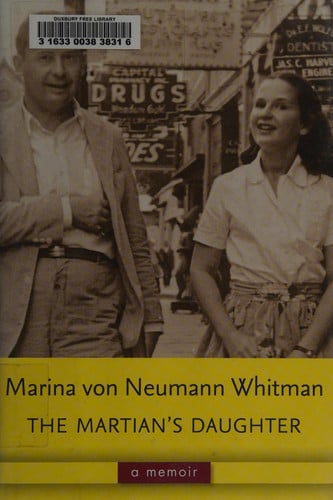
The Martian's daughter: a memoir

Whitman, Marina von Neumann
One of the five Hungarian scientific geniuses dubbed "the Martians" by their colleagues, John von Neumann is often hailed as the greatest mathematician of the twentieth century and even as the greatest scientist after Einstein. He was a key figure in the Manhattan Project; the inventor of game theory; the pioneer developer of the modern stored-program electronic computer; and an adviser to the top echelons of the American military establishment. In The Martian's Daughter , Marina von Neumann Whitman reveals intimate details about the famed scientist and explores how the cosmopolitan environment in which she was immersed, the demanding expectations of her parents, and her own struggles to emerge from the shadow of a larger-than-life parent shaped her life and work. Unfortunately, von Neumann did not live to see his daughter rise to become the first or highest-ranking woman in a variety of arenas. Whitman became a noted academic during the 1960s and '70s, casting her teaching and writing in the framework of globalization before the word had been invented; became the first woman ever to serve on the President's Council of Economic Advisers and participated actively in U.S. efforts to reshape the international monetary and financial system during the early 1970s; pioneered the role of women on the boards of leading multinational corporations; and became the highest-ranking female executive in the American auto industry in the 1980s. In her memoir, Whitman quotes from personal letters from her father and describes her interactions with such figures as Roger Smith of GM and President Nixon. She also details the difficulties she encountered as an early entrant into a world dominated by men and how she overcame the obstacles to, in her words, "have it all."
University of Michigan Press 2012-08-31 308 pages

Shanda: a memoir of shame and secrecy

Pogrebin, Letty Cottin
"In her deeply engaging, astonishingly candid memoir, author and activist Letty Cottin Pogrebin exposes the fiercely-guarded lies and intricate cover-ups woven by dozens of members of her extended family. Beginning with her own long-suppressed secret, the story spirals through the hidden lives of her parents and relatives--revealing the truth about their origins, personal traumas, marital misery, abandoned children, religious transgressions, sexual identity, radical politics, and supposedly embarrassing illnesses. While unmasking their charades and disguises, Pogrebin also showcases her family's remarkable talent for reinvention in a narrative that is, by turns, touching, searing, and surprisingly universal." --
Post Hill Press 2022 429 pages

Bronx boy: a memoir

Charyn, Jerome
Jerome Charyn's three-part memoir of his boyhood in the Bronx has all the imagery and color of an enchanting and entertaining novel -- someone has said that it captures the author's world so accurately that it can't possibly be true. Bronx Boy , like The Dark Lady of Belorusse and The Black Swan , both selected by The New York Times as Notable Books of the Year, is a tour de force of memory and imagination. In this third and final installment, the higher truths of a masterly writer's art render moot the question of exactly where the real world ends and Charyn's imagined world begins. Still known as "Baby" although a younger brother has come along, young Charyn makes pocket money delivering eggs, belongs to a group of 12-year-old wannabe gangsters that meet in a soda shop run by an ex-con, and spends afternoons telling stories to the adoring wife of a wealthy Russian émigré. He becomes famous for his black-and-tans -- a concoction of coffee ice cream, seltzer, milk, chocolate sauce, crushed pecans -- and "a touch of bitterness that may have been the Bronx." So famous, indeed, that he walks away the winner of an annual black-and-tan contest sponsored by the real-life top gangster called "The Little Man" -- Meyer Lansky. In Charyn's hands, the often ridiculed Bronx is a magic place, as full of odd and wonderful characters as a three-ring circus. And at the center of it all, young "Baby," not as lucky in love as he would like to be, drinking it all in, putting his own extraordinary take on it. Charyn looks back at this with his singular vision, and records it all for us with the skill of the fine writer he is. This is a delightful and often moving story of a childhood that could only have been lived in New York in the fifties, a New York experience that could only have taken place in the Bronx of those days, a growing-up saga that could only have been captured by this singular author.
Thomas Dunne Books/St. Martin's Press 2002-04-11 184 pages

Loud and clear: the memoir of an Israeli fighter pilot

Spector, Iftach
A recently retired Israeli Air Force general and its second-highest-scoring fighter ace, Iftach Spector is one of Israel’s living legends. He was the leader of the flight that attacked the USS Liberty in 1967. After the 1967 and 1973 wars, in which he commanded a squadron of fighter-bombers, he rose to head the IAF’s Training and War Lessons Section and later became its the Chief of Operations. He was one of the eight Israeli pilots who attacked Saddam Hussein’s nuclear reactor at Osirik in 1981. In 2003, his career took an even more dramatic turn: he was the senior signatory of the famous “Pilots’ Letter,” in which Spector and 27 other Israeli pilots stated their refusal to bomb targets in Palestine where collateral damage would likely be severe. His maverick conscience is well on display in this artfully written memoir, which is currently a 10-week-and-counting bestseller in Israel and has been licensed in Brazil as well. The son of a family that immigrated to Palestine at the turn of the 20th century, whose father and mother served in the Palmach, Israel’s early clandestine commando force, Spector has written a rich and reflective meditation on loyalty, on what is right and wrong in war, and on his dedication to the idea and reality of the state of Israel. The Pilots’ Letter ended Spector’s military career, but also made him one of the most compelling and celebrated defenders of the conscience of the Jewish state. In that battle, as in his previous battles against Nasser’s MiGs, his mother’s constant lesson to him sustained him: “All from within.” General Spector’s first book, A DREAM IN BLACK AND AZURE (1992; never translated into English), won the Sade Literary Award, given to him personally by Prime Minister Yitzhak Rabin. He has a B.A. in history and Middle East Studies from Tel Aviv University and a masters in political science from UCLA, both with honors.
Zenith Press 2009-06-15 426 pages

Burned child seeks the fire: a memoir

Edvardson, Cordelia
[A] searing memoir. . . . An enduring, indeed universal, story. Robert Taylor, The Boston Globe Summoned with her mother to Gestapo headquarters in 1943, fourteen-year-old Cordelia Edvardson was given a terrible choice: to acknowledge her secret Jewish heritage and suffer the consequences or to see her mother charged with treason. Burned Child Seeks the Fire is the true story of the love between this mother and daughter, and a piercing example of the tragedies wrought by Nazi Germany. "A lacerating, beautifully translated memoir." Publishers Weekly , starred review "Mesmerizing. . . . [Has] the concise unreality of a horrifying fairy tale." Thomas Frick, Los Angeles Times Book Review "Behind [Edvardson's] deceptively simple prose is a complex and tragic story." Judith Bolton-Fasman, Newsday "Cordelia Edvardson's defiant tone challenges us to eschew simplified encounters with the literature and experiences of Holocaust survivors." Paul H. Hamburg, Jewish Book World "To see the horrors of the Holocaust through a child's eye is to experience hell. Cordelia Edvardson's astonishing story captures, with a terrifying reality, a child's response to the myriad atrocities of the Nazis and their murderous regime. Burned Child Seeks the Fire is compelling, horrifying, poetic in its intensity." Deborah Peifer, Bay Area Reporter
Beacon Press 1997 105 pages

The Art of Leaving A Memoir

Ayelet Tsabari
WINNER OF THE CANADIAN JEWISH LITERARY AWARD FOR MEMOIR FINALIST FOR THE HILARY WESTON WRITERS' TRUST PRIZE FOR NONFICTION An unforgettable memoir about a young woman who tries to outrun loss, but eventually finds a way home. Ayelet Tsabari was 21 years old the first time she left Tel Aviv with no plans to return. Restless after two turbulent mandatory years in the Israel Defense Forces, Tsabari longed to get away. It was not the never-ending conflict that drove her, but the grief that had shaken the foundations of her home. The loss of Tsabari's beloved father in years past had left her alienated and exiled within her own large Yemeni family and at odds with her Mizrahi identity. By leaving, she would be free to reinvent herself and to rewrite her own story. For nearly a decade, Tsabari travelled, through India, Europe, the US and Canada, as though her life might go stagnant without perpetual motion. She moved fast and often because--as in the Intifada--it was safer to keep going than to stand still. Soon the act of leaving--jobs, friends and relationships--came to feel most like home. But a series of dramatic events forced Tsabari to examine her choices and her feelings of longing and displacement. By periodically returning to Israel, Tsabari began to examine her Jewish-Yemeni background and the Mizrahi identity she had once rejected, as well as unearthing a family history that had been untold for years. What she found resonated deeply with her own immigrant experience and struggles with new motherhood. Beautifully written, frank and poignant, The Art of Leaving is a courageous coming-of-age story that reflects on identity and belonging and that explores themes of family and home--both inherited and chosen.
HarperCollins Publishers 2020-02-18 336 pages

Battling for peace: a memoir

Peres, Shimon
"One of the great statesmen of our century, Shimon Peres, winner of the 1994 Nobel Peace Prize, has shaped the history of Israel and the future of the Middle East. In the seventies, as Israel's minister of defense, he engineered the legendary Entebbe raid against PLO terrorists; in the eighties, as prime minister, he saved the Israeli economy from near collapse; and as foreign minister, Shimon Peres is now a key negotiator in the peace accords that he helped bring about. In Battling for Peace, he tells, for the first time, the story of his amazing career. As we follow Peres from his ancestral home in Poland to Israel, from the youth village of Ben-Shemen to Kibbutz Alumot, from youth movement leader to prime minister, we are introduced both to a man and to a nation. A thoughtful, disciplined, and immensely resourceful young man, Peres was singled out by Israel's great leader David Ben-Gurion, who appointed him, while still in his twenties, director general of the Ministry of Defense. From this point on, Peres's life was inseparable from his country's history. Peres writes of his bitter quarrels with Golda Meir and Yitzhak Rabin, and of his great admiration for Ben-Gurion, Moshe Dayan, and Francois Mitterrand. He discusses the origins of Israel's nuclear program, and tells how he led the way toward the Oslo agreement, describing his secret talks with King Hussein in London ten years ago, and revealing how a chance for peace was thwarted by self-serving politicians and timid American diplomacy"--OCLC
Random House 1995-05-10 350 pages

Painted in words: a memoir

Bak, Samuel
In Painted in Words internationally renowned artist Samuel Bak sets aside his brushes to narrate the stories of his life--as a child in Nazi-occupied Vilna, as a youth in European refugee camps, and as a maturing artist in Israel, France, Italy, Switzerland, and the United States. Lovingly, he evokes his departed parents, grandparents, aunts, and uncles, along with their households and employees, to create a vital gallery of dramatic, lyrical, epic, and sometimes absurd heroes. With gentle humour, the child prodigy of the faraway past and the accomplished artist of today engage in a spirited dialogue from which emerges a self-portrait of "The Artist as a Young--and middle-aged and ageing--Survivor." The brilliance, vision, and virtuosity that Bak brings to his painting are equally in evidence in his writing. This deeply touching work is a worthy addition to Holocaust literature and art history.Samuel Bak, born in Vilna in 1933, had the first exhibition of his drawings at the age of nine in the Vilna ghetto. Escaping after its destruction, he emigrated to Israel, where he studied at the Bezalel Art School in Jerusalem. In an artistic career of over forty years he has had numerous exhibitions in museums and galleries throughout Israel, Europe, and the United States. Since 1993 he has lived in the Boston area with his wife, Jose.Bak's other publications include Landscapes of Jewish Experience; Chess as Metaphor in the Art of Samuel Bak; The Game Continues: Chess in the Art of Samuel Bak; and The Past Continues."At my first sight of a painting by Samuel Bak, I had the keen sense that he was telling me stories with his brush. Now that at long last he has written this book, I find it no wonder that he has painted with his pen. . . . Among the tens and hundreds of books I have read about the pre-Shoah and post-Shoah period . . Bak's book is unique. Despite being suffused with a sense of loss, horror, degradation, and death, it is ultimately a sanguine, funny book, full of the love of life, rocking with an almost cathartic joy. At times I found myself bursting out laughing . . . a marvellous ode, a colourful hymn to the forces of life, love, creation, and the joys of the senses." --From the Foreword by Amos Oz
Indiana University Press 2002 500 pages

Free as a Jew: a personal memoir of national self-liberation

Wisse, Ruth R.
"First came parents with the good sense to flee Europe in 1940 and the good fortune to reach the land of freedom. Their daughter, Ruth, grew up in the shadow of genocide--but in tandem with the birth of Israel, which remained her lodestar. She learned that although Jewishness is biologically transmitted, democracy is not, and both require intensive, intelligent transmission through education in each and every generation. They need adults with the confidence to teach their importance. Ruth tried to take on that challenge as dangers to freedom mounted and shifted sides on the political spectrum. At the high point of her teaching at Harvard University, she witnessed the unraveling of standards of honesty and truth until the academy she left was no longer the one she had entered."--Book flap.
Wicked Son 2021-09-21 359 pages