7908 results for "Science"

Heart An American Medical Odyssey

Dick Cheney,Richard B. Cheney,Jonathan Reiner,Liz Cheney
"For as long as he has served at the highest levels of business and government, Vice President Dick Cheney has also been one of the world's most prominent heart patients. Now, for the first time ever, Cheney, together with his longtime cardiologist Jonathan Reiner, MD, shares the very personal story of his courageous thirty-five-year battle with heart disease, from his first heart attack in 1978 to the heart transplant he received in 2012. In 1978, when Cheney suffered his first heart attack, he receivedessentially the same treatment as President Eisenhower had in 1955. Since then, cardiac medicine has evolved in extraordinary ways, and Cheney has benefited from nearly every medical and technological breakthrough along the way. At each juncture, when Cheney faced a new health challenge, the technology was one step ahead of his disease. In many ways, Cheney's story is the story of the evolution of modern cardiac care. Heart is the riveting, singular memoir of both doctor and patient, tracking their relationship as it unfolds over many years and crises. Like no US politician has before him, Cheney opens up about his health struggles, sharing harrowing, never-before-told stories about the challenges he faced during a perilous time in our nation's history. Dr. Reiner provides his perspective on Cheney's case and also gives readers a fascinating glimpse into his own education as a doctor. He masterfully chronicles the important discoveries, radical innovations, and cutting-edge science that have changed the face of medicine and saved countless lives. Powerfully braiding science with story and the personal with the political, Heart is a sweeping, inspiring, and ultimately optimistic book that will give hope to the millions of Americans affected by heart disease"--
Thorndike Press, A part of Gale, Cengage Learning 2014 583 pages

The age of intelligent machines

Kurzweil, Ray
Winner, 1990, category of Computer Science, Professional/Scholarly Publishing Annual Awards Competition presented by the Association of American Publishers, Inc. In The Age of Intelligent Machines, inventor and visionary computer scientist Raymond Kurzweil probes the past, present, and future of artificial intelligence, from its earliest philosophical and mathematical roots to tantalizing glimpses of 21st-century machines with superior intelligence and truly prodigious speed and memory. Generously illustrated and easily accessible to the nonspecialist, this book provides the background needed for a full understanding of the enormous scientific potential represented by intelligent machines as well as their equally profound philosophic, economic, and social implications. Running alongside Kurzweil's historical and scientific narrative are 23 articles examining contemporary issues in artificial intelligence. Raymond Kurzweil is the founder and chairman of Kurzweil Applied Intelligence and the Kurzweil Reading Machine division of Xerox. He was the principal developer of the first print-to-speech reading machine for the blind and other significant advances in artificial intelligence technology. Articles by: Charles Ames. Margaret A. Boden. Harold Cohen. Daniel C. Dennett. Edward A. Feigenbaum. K. Fuchi. George Gilder. Douglas R. Hofstadter. Michael Lebowitz. Margaret Litven. Blaine Mathieu. Marvin Minsky. Allen Newell. Brian W. Oakley. Seymour Papert. Jeff Pepper. Roger Schank and Christopher Owens. Sherry Turkle. Mitchell Waldrop.
MIT Press 1992 565 pages

The psychological birth of the human infant: symbiosis and individuation

Mahler, Margaret S.
Margaret S. Mahler and her collaborators break new ground in developmental psychology and present the first complete theoretical statement of Dr. Mahler's observations on the normal separation-individuation process.Separation and individuation are presented in this major work as two complementary developments. Separation is described as the child's emergence from a symbiotic fusion with the mother, while individuation consists of those achievements marking the child's assumption of his own individual characteristics. Each of the subphases of separation-individuation is described in detail, supported by a wealth of clinical observations which trace the tasks confronting the infant and his mother as he progresses toward achieving his own individuality.A number of chapters are devoted to following five children epigenetically through their subphase development. A separate section describes the authors' methodology, the importance of the research setting, and the effects of changes in the setting. The extensive appendices by Fred Pine discuss the uniqueness of the data-gathering techniques used by the authors. In addition, a useful glossary of concepts defines the new terms that Dr. Mahler has introduced.This book represents an important breakthrough in understanding the human infant and makes a unique contribution to the science of human behavior.
Basic Books 1975-07-06 308 pages

A general theory of magic

Mauss, Marcel
"First written by Marcel Mauss and Henri Humbert in 1902, A General Theory of Magic gained a wide new readership when republished by Mauss in 1950. As a study of magic in 'primitive' societies and its survival today in our thoughts and social actions, it represents what Claude Le;vi-Strauss called, in an introduction to that edition, the astonishing modernity of the mind of one of the century's greatest thinkers. The book offers a fascinating snapshot of magic throughout various cultures as well as deep sociological and religious insights still very much relevant today. At a period when art, magic and science appear to be crossing paths once again, A General Theory of Magic presents itself as a classic for our times."--Back cover.
Routledge 2001 183 pages

Mr. Wilson's cabinet of wonder

Weschler, Lawrence
"Pronged ants, horned humans, a landscape carved on a fruit pit--some of the displays in David Wilson's Museum of Jurassic Technology are hoaxes. But which ones? As he guides readers through an intellectual hall of mirrors, Lawrence Weschler revisits the 16th-century "wonder cabinets" that were the first museums and compels readers to examine the imaginative origins of both art and science"
Vintage Books, a Division of Random House, Inc 1996-11-26 168 pages

A universe from nothing: why there is something rather than nothing

Krauss, Lawrence Maxwell
“WHERE DID THE UNIVERSE COME FROM? WHAT WAS THERE BEFORE IT? WHAT WILL THE FUTURE BRING? AND FINALLY, WHY IS THERE SOMETHING RATHER THAN NOTHING?” Lawrence Krauss’s provocative answers to these and other timeless questions in a wildly popular lecture now on YouTube have attracted almost a million viewers. The last of these questions in particular has been at the center of religious and philosophical debates about the existence of God, and it’s the supposed counterargument to anyone who questions the need for God. As Krauss argues, scientists have, however, historically focused on other, more pressing issues—such as figuring out how the universe actually functions, which can ultimately help us to improve the quality of our lives. Now, in a cosmological story that rivets as it enlightens, pioneering theoretical physicist Lawrence Krauss explains the groundbreaking new scientific advances that turn the most basic philosophical questions on their heads. One of the few prominent scientists today to have actively crossed the chasm between science and popular culture, Krauss reveals that modern science is addressing the question of why there is something rather than nothing, with surprising and fascinating results. The staggeringly beautiful experimental observations and mind-bending new theories are all described accessibly in A Universe from Nothing, and they suggest that not only can something arise from nothing, something will always arise from nothing. With his characteristic wry humor and wonderfully clear explanations, Krauss takes us back to the beginning of the beginning , presenting the most recent evidence for how our universe evolved—and the implications for how it’s going to end. It will provoke, challenge, and delight readers as it looks at the most basic underpinnings of existence in a whole new way. And this knowledge that our universe will be quite different in the future from today has profound implications and directly affects how we live in the present. As Richard Dawkins has described it: This could potentially be the most important scientific book with implications for supernaturalism since Darwin. A fascinating antidote to outmoded philosophical and religious thinking, A Universe from Nothing is a provocative, game-changing entry into the debate about the existence of God and everything that exists. “Forget Jesus,” Krauss has argued, “the stars died so you could be born.”
Atria Paperback 2013 202 pages

Mastering 'metrics: the path from cause to effect

Angrist, Joshua David
"Applied econometrics, known to aficionados as 'metrics, is the original data science. 'Metrics encompasses the statistical methods economists use to untangle cause and effect in human affairs. Through accessible discussion and with a dose of kung fu-themed humor, Mastering 'Metrics presents the essential tools of econometric research and demonstrates why econometrics is exciting and useful.The five most valuable econometric methods, or what the authors call the Furious Five--random assignment, regression, instrumental variables, regression discontinuity designs, and differences in differences--are illustrated through well-crafted real-world examples (vetted for awesomeness by Kung Fu Panda's Jade Palace). Does health insurance make you healthier? Randomized experiments provide answers. Are expensive private colleges and selective public high schools better than more pedestrian institutions? Regression analysis and a regression discontinuity design reveal the surprising truth. When private banks teeter, and depositors take their money and run, should central banks step in to save them? Differences-in-differences analysis of a Depression-era banking crisis offers a response. Could arresting O. J. Simpson have saved his ex-wife's life? Instrumental variables methods instruct law enforcement authorities in how best to respond to domestic abuse.Wielding econometric tools with skill and confidence, Mastering 'Metrics uses data and statistics to illuminate the path from cause to effect. Shows why econometrics is important Explains econometric research through humorous and accessible discussion Outlines empirical methods central to modern econometric practice Works through interesting and relevant real-world examples "--
Princeton University Press 2015 282 pages

The great divide

Stiglitz, Joseph E.
Why has inequality increased in the Western world - and what can we do about it? In The Great Divide , Joseph Stiglitz fully exposes the inequality - from its dimensions and its causes to its consequences for the world - that is afflicting America and other Western countries in thrall to neoliberalism. From Reagan-era policies to the Great Recession and its long aftermath, Stiglitz delves into the processes and irresponsible policies - deregulation, tax cuts for the rich, the corruption of the political process - that are leaving many people further and further behind and turning the dream of a socially mobile society into an ever more unachievable myth. With formidable yet accessible economic insight, he urges us to embrace real solutions- increasing taxes on corporations and the wealthy; investing in education, science and infrastructure; helping homeowners instead of banks; and, most importantly, doing more to restore the economy to full employment. Stiglitz's analysis reaches beyond America - the inequality leader of the developed world - to draw lessons from Scandinavia, Singapore and Japan, and he argues against the tide of unnecessary, destructive austerity that is sweeping across Europe. Ultimately, Stiglitz believes our choice is not between growth and fairness; with the right policies, we can choose both. 'Stiglitz is a rare combination of virtuoso economist, witty polemicist and public intellectual. ' Robert Kuttner, New Statesman 'Stiglitz is a rare breed, an heretical economist who has ruffled the self-satisfied global establishment that once fed him.' Ian Fraser, Sunday Tribune 'A seer of almost Keynesian proportions.' Michael Hirsh, Newsweek 'An insanely great economist.' Paul Krugman, The New York Times
Allen Lane 2015 428 pages

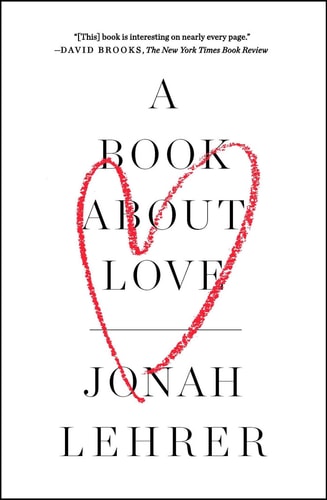
A Book About Love

Jonah Lehrer
Number one bestselling science writer Jonah Lehrer explores the “only happiness that lasts”—love—in a book that “is interesting on nearly every page” (David Brooks, The New York Times Book Review ). Weaving together scientific studies from clinical psychologists, longitudinal studies of health and happiness, historical accounts and literary depictions, child-rearing manuals, and the language of online dating sites, Jonah Lehrer’s A Book About Love plumbs the most mysterious, most formative, most important impulse governing our lives. Love confuses and compels us—and it can destroy and define us. It has inspired our greatest poetry, defined our societies and our beliefs, and governs our biology. From the way infants attach to their parents, to the way we fall in love with another person, to the way some find a love for God or their pets, to the way we remember and mourn love after it expires, this book focuses on research that attempts, even in glancing ways, to deal with the long-term and the everyday. The most dangerous myth of love is that it’s easy, that we fall into the feeling and then the feeling takes care of itself. While we can easily measure the dopamine that causes the initial feelings of “falling” in love, the partnerships and devotions that last decades or longer remain a mystery. “Lehrer uses scores of detailed vignettes to traverse a complicated intellectual landscape, eventually arriving at modern theories of love…He is a talent” ( USA TODAY ), and A Book About Love decodes the set of skills necessary to cultivate a lifetime of love. Love, Lehrer argues, is not built solely on overwhelming passion, but, fascinatingly, on a set of skills to be cultivated over a lifetime.
Simon and Schuster 2017-07-25 304 pages

The mind's own physician: a scientific dialogue with the Dalai Lama on the healing power of meditation

Kabat-Zinn, Jon
Introduction: a confluence of streams and a flowering of possibilities -- Session 1. Meditation-based clinical interventions : science, practice, and implementation. How Buddhist meditative practices can inform our understanding of pain and suffering, the potential for healing, the relief of suffering, and the underlying nature of the human mind and body / Ajahn Amaro. Some clinical applications of mindfulness meditation in medicine and psychiatry : the case of mindfulness-based stress reduction (MBSR) / Jon Kabat-Zinn. Mind-brain-body interaction and meditation / Richard J. Davidson. Session 1 dialogue -- Session 2. Possible biological substrates of meditation. Synchronization of brain rhythms as a possible mechanism for the unification of distributed mental processes / Wolf Singer. The neurobiology of the adaptive and deleterious features of stress / Robert Sapolsky. Session 2 dialogue -- Session 3. Clinical research 1 : meditation and mental health. Mindfulness-based cognitive therapy and the prevention of relapse in recurrent depression / Zindel Segal. Paths to recovery : neural substrates of cognitive and mindfulness-based interventions for the treatment of depression / Helen Mayberg. Session 3 dialogue -- Interlude preceding session 4. The Buddhist science of human flourishing / Alan Wallace. Interlude dialogue -- Session 4. Clinical research 2 : meditation and physical health. Mindfulness-based stress reduction and cardiovascular disease / David Sheps. Neural-immune interaction / John Sheridan. Session 4 dialogue -- Session 5. Integration and final reflections. Meditation and the future of health care / Ralph Snyderman. Some reflections on the evolution and nature of mind and self and their implications for humanity / Wolf Singer. Session 5 dialogue
New Harbinger Publications 2013-08-31 268 pages

Suicidal: why we kill ourselves

Bering, Jesse
"For much of his thirties, Jesse Bering thought he was probably going to kill himself. He was a successful psychologist and writer, with books to his name and bylines in major magazines. But none of that mattered. The impulse to take his own life remained. At times it felt all but inescapable. Bering survived. And in addition to relief, the fading of his suicidal thoughts brought curiosity. Where had they come from? Would they return? Is the suicidal impulse found in other animals? Or is our vulnerability to suicide a uniquely human evolutionary development? In Suicidal, Bering answers all these questions and more, taking us through the science and psychology of suicide, revealing its cognitive secrets and the subtle tricks our minds play on us when we’re easy emotional prey. Scientific studies, personal stories, and remarkable cross-species comparisons come together to help readers critically analyze their own doomsday thoughts while gaining broad insight into a problem that, tragically, will most likely touch all of us at some point in our lives. But while the subject is certainly a heavy one, Bering’s touch is light. Having been through this himself, he knows that sometimes the most effective response to our darkest moments is a gentle humor, one that, while not denying the seriousness of suffering, at the same time acknowledges our complicated, flawed, and yet precious existence. Authoritative, accessible, personal, profound—there’s never been a book on suicide like this. It will help you understand yourself and your loved ones, and it will change the way you think about this most vexing of human problems." --
The University of Chicago Press 2018-10-30 275 pages

Natural experiments of history

Jared Diamond
Consists of eight comparative studies drawn from history, archeology, economics, economic history, geography, and political science. The studies cover a spectrum of approaches, ranging from a non-quantitative narrative style in the early chapters to quantitative statistical analyses in the later chapters. The studies range from a simple two-way comparison of Haiti and the Dominican Republic, which share the island of Hispaniola, to comparisons of 81 Pacific islands and 233 areas of India. The societies discussed are contemporary ones, literate societies of recent centuries, and non-literate past societies. Geographically, they include the United States, Mexico, Brazil, western Europe, tropical Africa, India, Siberia, Australia, New Zealand, and other Pacific islands.
Harvard University Press 2011 278 pages

Asimov's chronology of the world

Asimov, Isaac
From the world's greatest science writer, a history of the world from the Big Bang to 1945, told in irresistible short takes and highlighted by a timeline.Author To list Isaac Asimov's honors, as to list his books, would be excessive. Let it simply be noted that Isaac Asimov was the most famous, most honored, most widely read, and most beloved science fiction author of all time. In his five decades as an author, he wrote more than four hundred books, won every award his readers and colleagues could contrive to give him, and provided pleasure and insight to millions. He died in 1992, still at work.
HarperCollins 1991-01-01 674 pages

The Fat Duck cookbook

Blumenthal, Heston
The cookbook hailed by the Los Angeles Times as a "showstopper" and by Jeffrey Steingarten of Vogue as "the most glorious spectacle of the season...like no other book I have seen in the past twenty years" is now available in a reduced-price edition. With a reduced trim size but an identical interior, this lavishly illustrated, stunningly designed, and gorgeously photographed masterpiece takes you inside the head of maverick restaurateur Heston Blumenthal. Separated into three sections (History; Recipes; Science), the book chronicles Blumenthal's improbable rise to fame and, for the first time, offers a mouth-watering and eye-popping selection of recipes from his award-winning restaurant. He also explains the science behind his culinary masterpieces, the technology and implements that make his alchemical dishes come to life. Designed by acclaimed artist Dave McKean-and filled with photographs by Dominic Davies-this artfully rendered celebration of one of the world's most innovative and renowned chefs is a foodie's dream.
Bloomsbury 2009-10-20 529 pages

The guns of the South: a novel of the Civil War

Turtledove, Harry
"It is absolutely unique--without question the most fascinating Civil War novel I have ever read." Professor James M. McPherson Pultizer Prize-winning BATTLE CRY OF FREEDOM January 1864--General Robert E. Lee faces defeat. The Army of Northern Virginia is ragged and ill-equpped. Gettysburg has broken the back of the Confederacy and decimated its manpower. Then, Andries Rhoodie, a strange man with an unplaceable accent, approaches Lee with an extraordinary offer. Rhoodie demonstrates an amazing rifle: Its rate of fire is incredible, its lethal efficiency breathtaking--and Rhoodie guarantees unlimited quantitites to the Confederates. The name of the weapon is the AK-47.... Selected by the Science Fiction Book Club A Main Selection of the Military Book Club
Ballantine Books 1992 561 pages

Songs of Love and Death All-Original Tales of Star-Crossed Love

George R. R. Martin,Gardner Dozois
A groundbreaking and “wonderful” ( Library Journal , starred review) anthology of fantasy, science fiction, and romance from New York Times bestselling and award-winning authors, edited by the acclaimed George R.R. Martin and Gardner Dozois. From epic fantasy, post-apocalyptic America, to faerie-haunted rural fields in 18th-century England, to an intergalactic empire, join star-crossed lovers as they struggle against the forces of magic and fate. A star-studded cross-genre anthology Songs of Love and Death features all-original tales from seventeen of the most prestigious names in romance, fantasy, and science fiction. Contributors include: -Neil Gaiman -Diana Gabaldon -Jim Butcher -Robin Hobb -Marjorie M. Liu -Jo Beverley -Mary Jo Putney -Peter S. Beagle -Jacqueline Carey -Carrie Vaughn -Yasmine Galenorn -MLN Hanover -Kristine Kathryn Rusch -Linnea Sinclair -Cecelia Holland -Tanith Lee -Melinda Snodgrass -Lisa Tuttle
Simon and Schuster 2020-12-01 480 pages