1166 results for "American History"

The failure of the founding fathers: Jefferson, Marshall, and the rise of presidential democracy

Ackerman, Bruce A.
Describes previously unknown aspects of the electoral college crisis of 1800, presenting a revised understanding ofthe early days of two great institutions that continue to have a major impact on American history: the plebiscitarian presidency and a Supreme Court that struggles to put the presidency's claims of a popular mandate into constitutional perspective. Through close studies of two Supreme Court cases, Ackerman shows how the court integrated Federalist and Republican themes into the living Constitution of the early republic. The ink was barely dry on the Constitution when it was almost destroyed by the rise of political parties in the United States. As Bruce Ackerman shows, the Framers had not anticipated the two-party system, and when Republicans battled Federalists for the presidency in1800, the rules laid down by the Constitution exacerbated the crisis. [Publisher web site].
Belknap Press of Harvard University Press 2005-10-28 384 pages

The twilight of common dreams: why America is wracked by culture wars

Gitlin, Todd
In The Twilight of Common Dreams, Todd Gitlin places the debates of the moment in a sweeping historical context and - sparing no sides - he argues that these highly charged conflicts are a sideshow, obscuring a seismic transformation in American political life. The Left, which once stood for universal values, has come to be identified with the special needs of distinct "cultures" and select "identities." The Right, long associated with privileged interests, now claims to defend the needs of all. The consequences are clear: since the late 1960s, while the Right has been busy taking the White House, the Left has been marching on the English department. With dazzling range and acuteness, Gitlin's analysis moves through American history and modern thought, from academic squabbles to the crisis in the Democratic party, from embattled school boards to the right-wing exploitation of those scarlet letters, "PC." In the end, he maintains, the culture wars are evasions of America's deepest trauma - inequality - and he eloquently contends that America is lost unless its obsession with cultural differences can be transcended in the name of the common good.
Metropolitan Books 1995 294 pages

Paul Robeson, Jr. speaks to America

Robeson, Paul Jr.
According to Paul Robeson, Jr., the controversy about multiculturalism is in fact a profound ideological struggle over the values of our national culture. More than a question of the politics of race and gender, the debate is about whether melting-pot culture, the foundation of American life, should be replaced by a mosaic culture incorporating the values of the diverse groups that make up America's population. Robeson contends that the melting pot image has not worked for Blacks, who are excluded by definition from the blended culture of the ethnic American dream. Basing his argument in part on a rejection of the idea of radical individualism, the author suggests that the absence of a concept of group rights in American history places Blacks at a disadvantage. Radical individualism, as a philosophy, rejects the premise of civil rights for groups, which in modern parlance is termed "group tyranny." Robeson attacks mainstream American culture itself in a series of interrelated essays on his father (Paul Robeson), Clarence Thomas, liberals and conservatives, cultural diversity in the workplace, gender and minorities, Blacks and Jews, the Black middle class, and the university. What is needed, Robeson contends, is a new understanding of the nature of a culture of diversity - one that also celebrates Blacks, women, and other presently marginalized groups as visible and distinct actors.
Rutgers University Press 1993-04-01 254 pages

Race and revolution

Shachtman, Max
A riveting inquiry into black history and American racism published here for the first time, Race and Revolution is a work of radiant insight and bold logic. Astonishingly advanced for its time, the document was originally drafted in 1933 as Communism and the Negro and was by far the most comprehensive statement on race produced by the Left Opposition, the dissenting Communist tendency led by Leon Trotsky. Race and Revolution places the black struggle for freedom and equality at the heart of American history. Racial oppression, Shachtman argues, can be comprehended only within the totality of social and class relations. The document culminates in a devastating polemic against the Communist Party’s call for a Black Belt state in the American South. A clarifying introduction by Christopher Phelps explains the document’s historical genesis, compares it to the views of Trotsky and C. L. R. James, and evaluates it in light of subsequent theoretical and historical developments.
Verso 2003-05-17 108 pages

Against the grain: a historian's journey

Auerbach, Jerold S.
Against the Grain is a collection of challenging and insightful essays from a reflective historian. Jerold Auerbach, Professor Emeritus at Wellesley College (where he taught for 40 years), writes in the Foreword how his academic career and his time in Israel "each in its own distinctive way converged to liberate me from my past as a non-Jewish Jew." He adds: "Regardless of the subject-law, modern American history, Pueblo Indians, American Judaism, Israel-deference to the conventional wisdom never had been my style. I always enjoyed the stimulation of writing against the grain: discovering hidden meanings, challenging historical and political pieties, and exposing the self-serving ideology that often lurked beneath self-evident truths. Providing intellectual catnip, it also enabled me to reach readers far beyond the narrow confines of academic journals. "My creative work always was done in the solitude of my study, my sanctum within my home. Enclosed within the treasured artifacts, maps, photographs, prints, and books accumulated during decades of research and travel, I explored the historical past that both inspired and reflected my own intellectual trajectory. Virtually every book I have written, to my genuine surprise, contained within it the seed of its successor. That, of course, is discernible only with hindsight-which, after all, is the distinctive attribute of a historian. I invite my family, friends, and interested readers to accompany me to some favorite destinations during my journey." A new book in Quid Pro's Journeys & Memoirs Series, Against the Grain presents this distinctive hindsight in essays and excerpts targeted to a general audience interested in such issues, in addition to historians and college students. Many of the essays were first published in non-academic periodicals and are accessible to this broader audience, though they are nonetheless supported with the prodigious research, evocative prose, and candor of a widely published writer.
Quid Pro Books 2012 256 pages

Intimate politics: how I grew up Red, fought for free speech, and became a feminist rebel

Aptheker, Bettina
Set amidst the political upheaval of the McCarthy trials, the Vietnam War, and the rise of the women's movement, Intimate Politics is a courageous and uncompromising account of one woman's personal and political transformation, and a fascinating portrayal of a key chapter in our nation's history. At eight years old, Bettina Aptheker watched her family's politics play out in countless living rooms across the country when her father, historian and U.S. Communist Party leader Herbert Aptheker, testified on television in front of the House on Un-American Activities Committee in 1953. Born into one of the most influential U.S. Communist families whose friends included W. E. B. Du Bois, Paul Robeson, and Elizabeth Gurley Flynn, Bettina lived her parents' politics witnessing first-hand one of the most dramatic upheavals in American history. She also lived with a terrible secret: incest at the hands of her famous father and a frightening and lonely life lived inside a home wrought with family tensions. A gripping and beautifully rendered memoir, Intimate Politics is at its core the story of one woman's struggle to still the demons of her personal world while becoming a controversial public figure herself. This is the story of childhood sexual abuse, abortion, sexual violence, activism, and the triumph over one's past. It's about FBI harassment and persecution, Jewish heritage, and lesbian identity. It is, finally, about the courage to speak one's truth despite the consequences and to break the sacred silence of family secrets.
Seal Press 2006-09-26 549 pages

Fundamental rights: history of a constitutional doctrine

Konvitz, Milton R.
One of the most important modern developments in American constitutional law has been the extension of the Bill of Rights to the states. The most important guarantees of the first eight amendments have been incorporated into the Due Process Clause of the Fourteenth Amendment, along with the doctrine that these are rights that are so "fundamental" that any restriction is subject to judicial "strict scrutiny." The process has nationalized fundamental rights, giving them a preferred dignity and majesty. In this volume, the renowned constitutional scholar, Milton Konvitz, traces the development of fundamental rights from the early days of American jurisprudence through twentieth-century cases involving the right to privacy, racial discrimination, voting rights, censorship, and abortion laws. In Konvitz's astute view, the Bill of Rights in the Constitution of the United States, like the Ten Commandments, places no priority among protected or guaranteed rights. He argues that values, ideals, rights, liberties, and privileges need to be placed in a hierarchical order or scale. The Supreme Court, acting on a case-by-case basis, has slowly and cautiously moved to designate some rights as superior to others. This idea that some rights are of a "fundamental" nature, while others are not, can be traced back to the early days of the nation's government. Konvitz shows that there may be said to be not one, but two or even three bills of rights, one for the Federal government and one for the States. Still another, may be an unwritten but evolving Bill of Rights. The Court has recognized rights or liberties that are in no written constitution, as for example, a right to marry, a right to have a family, a right to choose education of one's children in a private, even a religious, school, rather than a public school. In an illuminating fashion, Konvitz, whose writings have been cited in Supreme Court decisions, traces the controversial and very uneven line of development of such "fundamental rights." This volume is likely the first book on the subject and a pioneering work in the history of American constitutional law. Accessibly written for a general and scholarly audience, it will be of particular interest to political scientists, historians, and constitutional scholars.
Transaction 2007 182 pages

Third wave capitalism: how money, power, and the pursuit of self-interest have imperiled the American dream

Ehrenreich, John
In Third Wave Capitalism, John Ehrenreich documents the emergence of a new stage in the history of American capitalism. Just as the industrial capitalism of the nineteenth century gave way to corporate capitalism in the twentieth, recent decades have witnessed corporate capitalism evolving into a new phase, which Ehrenreich calls "Third Wave Capitalism." Third Wave Capitalism is marked by apparent contradictions: Rapid growth in productivity and lagging wages; fabulous wealth for the 1 percent and the persistence of high levels of poverty; increases in the standard of living and increases in mental illness, personal misery, and political rage; the apotheosis of the individual and the deterioration of democracy; increases in life expectancy and out-of-control medical costs; an African American president and the incarceration of a large percentage of the black population. Ehrenreich asserts that these phenomena are evidence that a virulent, individualist, winner-take-all ideology and a virtual fusion of government and business have subverted the American dream. Greed and economic inequality reinforce the sense that each of us is "on our own." The result is widespread lack of faith in collective responses to our common problems. The collapse of any organized opposition to business demands makes political solutions ever more difficult to imagine. Ehrenreich traces the impact of these changes on American health care, school reform, income distribution, racial inequities, and personal emotional distress. Not simply a lament, Ehrenreich's book seeks clues for breaking out of our current stalemate and proposes a strategy to create a new narrative in which change becomes possible.--Book flap
ILR Press, an imprint of Cornell University Press 2016-04-07 244 pages

A nation dedicated to religious liberty: the constitutional heritage of the religion clauses

Adams, Arlin M.
Here is a concise overview of the historical development and judicial interpretation of the First Amendment religion clauses. It begins with a survey of the history of American religious liberty, goes on to present the views of the Founding Fathers, and then considers the core value of religious liberty and the constitutional purposes that implement that value. the book ends on a practical note by applying these principles to questions of equal access, religious symbolism in public life, and the task of defining religion for constitutional purposes. As the authors note in their introduction, "the historical principles that animate the religion clauses are more than an abstract intellectual exercise. . . . They provide an essential context for guiding the resolution of modern religious liberty issues."
University of Pennsylvania Press 1990-08-29 172 pages

Homocons: the rise of the gay right

Goldstein, Richard
For most of its history, the American gay movement has been part of the democratic Left. Gay liberation's founders were Communists, and its activist core is still overwhelmingly progressive. But in recent years, a more affluent group of gay men has begun to make its mark. Though they are a minority in the queer community (which includes people of all races, classes and genders), conservatives have become the loudest gay voices in the mainstream media. With their withering contempt for feminism and radical politics, these 'gayocons' are changing the movement's public image. Unless their rise is met by a persuasive critique, they may also alter its heart and soul. Homocons offers such a critique. It describes how the gay Right agenda differs from the one the queer community has long embraced. Never abandoning its analysis of the complex relationship between homosexuals and liberal society, the book examines the conflict between liberationists and assimilationists that has raged since the Stonewall era, and explores how political success tipped the balance and facilitated the rise of the gay Right. Finally this book offers an alternative to gay conservatism grounded in queer humanism, a distinct sensibility that has been a major force in progressive thought for more than a century.
Verso 2003 113 pages

A caring society: the New Deal, the worker, and the Great Depression : a history of the American worker, 1933-1941

Bernstein, Irving
A combination of social history, labor history and a history of the New Deal, interweaving stories of migrant workers, laborers and policy makers. One chapter is devoted to the arts of the period and their portrayals of workers. Summaries of several leftist plays are also given, including plays by Clifford Odets, Lillian Hellman,, and Erskine Caldwell. Also has several pages of photographs of Depression scenes and leaders of the period.
Houghton Mifflin 1985 338 pages

Jacob's Voices Reflections of a Wandering American Jew

Jerold S. Auerbach
An American professor of history finds his roots in a personal journey through Israel -- and through assimilated America, academia, baseball, and family -- headlong into deep tensions and ambivalence about country, culture, identity and religion. Worried about the commitment of Jews to their heritage, Jerold Auerbach (renowned author of Unequal Justice) shares his story and musings with insight, irony, and intensity. A personal journey, literally and spiritually, to Israel by one of the most recognized legal historians in the United States.
Quid Pro, LLC 2010-07-13 172 pages

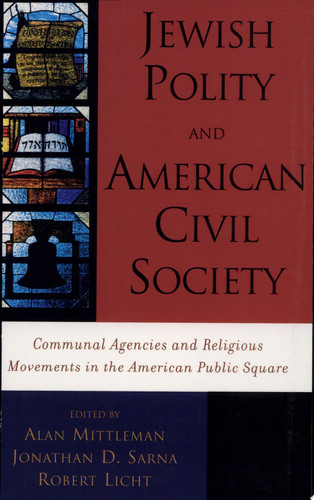
Jewish polity and American civil society: communal agencies and religious movements in the American public sphere

Alan Mittleman,Robert Licht,Jonathan D. Sarna
Jewish Polity and American Civil Society is a study of the civic and political engagements of American Jews as mediated by their communal and denominational institutions. The book explores how the various branches of the organized Jewish community seek to influence public affairs. Over the course of the last century, Jewish agencies and religious movements have tried to shape public debate and public policy on such issues as civil rights, church-state relations, and American foreign policy. The book sets the history of Jewish engagement in these areas into historical context; analyzes the motives, strategies, and tactics of various Jewish groups, and evaluates their successes and failures. The book also explores the underlying idea-the public philosophy-that informs American Jews' understanding of civic and political engagement.
Rowman & Littlefield 2002-07-23 420 pages

Between the lines: readings on Israel, the Palestinians, and the U.S. "war on terror"

Honig-Parnass, Tikva
This compilation of essays, edited by a Palestinian writer and an Israeli journalist, constitutes a challenge to critically rethink the Israeli-Palestinian conflict. Between the Lines presents a groundbreaking study that brings together insights from across the lines of conflict to put the latest chapter of Israeli apartheid and Palestinian resistance into context. Contributors include: Marwan Bargouti, Dr. Azmi Bishara, Dr. Sami Shalom Chetrit, Dr. Saleh Abdel Jawwad, Husam Khader, Eileen Kuttab, Dr. Yitzhak Laor, Dr. Adi Ophir, Dr. Ilan Pappe, Linda Tabar, Graham Usher and Dr. Jamal Zahalqa. "The destruction of a nation is not an everyday event in history. It is being carried out before our eyes, systematically and consciously, with cruelty and self-righteousness, and with the backing of the global superpower. These acute and informed essays develop a perspective on the background and unfolding of these events that is remote from anything likely to be heard in the West. They merit close attention and thoughtful consideration." --Noam Chomsky "This collection provides a lucid and critical analysis of the Israeli and American policies in the Middle East. The disastrous repercussions of this unholy alliance are presented in this collection through incisive and timely contributions. In the best tradition of [the journal] Between the Lines, readers will be rewarded by this collection that unmasks and exposes what the mainstream media refuses to report or admit." --Ilan Pappe, Israeli historian and author of A History of Modern Palestine Toufic Haddad is a Palestinian American activist who was formerly co-editor with Tikva Honig-Parnass of the Jerusalem-based magazine Between the Lines. Tikva Honig-Parnass is a Jewish Israeli active in radical anti-occupation movements.
Haymarket Books 2007 405 pages

Jumping the line: the adventures and misadventures of an American radical

Herrick, William
An eye-opening account of time served in the great battles of our century - for workers' rights, against Fascism, Communism, and racism - Jumping the Line is the life story of an American original. William Herrick relates his adventures and misadventures on the front lines of the Spanish Civil War, in (and very much out of) the Communist Party, driving a tractor on a communal farm in Michigan, jumping the line as a hobo, organizing African American sharecroppers in Georgia, at work with Orson Welles, and immersed in his own writing. When Paul Berman interviewed Herrick in the Village Voice in 1986, for the fiftieth anniversary of the Spanish Civil War, Herrick's remarks so incensed other veterans of the Abraham Lincoln battalion that they picketed the paper. What William Herrick has to say doesn't always go down easily. But for those who like the truth, with a dash of wit and a healthy dose of history, it can be exhilarating.
University of Wisconsin Press 1998 283 pages

Wounded titans: American presidents and the perils of power

Lerner, Max
Max Lerner taught generations of Americans about their government: who rules, why, and how. For almost half a century, the office of the presidency preoccupied his prodigious energies and unparalleled expertise. Lerner not only wrote about the men who inhabited the Oval Office during that time, he knew them personally, from Franklin D. Roosevelt to Bill Clinton - and he knew what made them tick. Here, collected for the first time, are Lerner's complete writings on the presidency and American presidents. Wounded Titans contains Lerner's classic essays on the presidency and its development. Here, too, are his most famous presidential portraits of Jefferson and Lincoln - the presidents he believed most significantly shaped both the office and our perception of it - as well as of the men who inherited the modern-day office created by Roosevelt. Each portrait combines a rigorous and unblinking analysis of its subject's place in history with a sympathetic appreciation of his humanity. Everything about the office of the presidency fascinated Lerner, including how someone ran for it. This volume also contains the best of Lerner's campaign journalism, written for his widely syndicated column, which appeared in the New York Post for over four decades.
Arcade Pub 1996 437 pages

The emergence of American Zionism

Raider, Mark A.
The images of Zionist pioneers in the late nineteenth and early twentieth centuries--hard working, brawny, and living off the land--sprang from the ascendent socialist Zionist movement in Palestine known as "Labor Zionism." The building of the Yishuv, a new Jewish society in Palestine, was accompanied by the rapid growth of Zionism worldwide. How did Zionism take shape in the United States? How did Labor Zionism and the Yishuv influence American Jews? Zionism and Labor Zionism had a much more substantial impact on the American Jewish scene than has been recognized. Drawing on meticulous research, Mark A. Raider describes Labor Zionism's dramatic transformation in the American context from a marginal immigrant party into a significant political force. The Emergence of American Zionism challenges many of the prevailing assumptions of Jewish and Zionist history that have held sway for a full generation. It shows how and why American Labor Zionism--"the voice of Labor Palestine on American soil"--played such an important role in formulating the program and outlook of American Zionism. It also examines more generally the impact of Zionism on American Jews, making the case that Zionism's cultural vitality, intellectual diversity, and unparalleled ability to rally public opinion in times of crisis were central to the American Jewish experience.
New York University Press 1998 296 pages

The surge: a military history

Kagan, Kimberly
"Kimberly Kagan ... [describes] the complete operational history of the surge from its inception to the end of 2007. Kagan's detailed analysis looks at the external players -- from al Qaeda in Iraq, and the Iranian-backed Special Groups, to the Jaysh al Mahdi -- and covers the day-to-day strategies, locations, tactics, organization, and responses to American actions" -- Jacket.
Encounter Books 2009 282 pages

The uses of history: understanding the Soviet Union and Russia

Dallin, Alexander
Exploring Soviet and Russian history, politics, and foreign policy, The Uses of History brings together the classic essays of renowned scholar Alexander Dallin. The author provides insightful analysis and nuanced interpretations of such key-and controversial-issues as the domestic sources of Soviet foreign policy, Stalin's leadership in World War II, Russian-American relations in the Reagan era, the causes of the collapse of the USSR, and the disappointments of Russia's post-Soviet evolution. With his incisive assessment of the biases and blunders in American interpretations, Dallin rejects single-factor explanations for Soviet and Russian domestic and foreign policies, instead examining the complex interplay of internal and external conditions, institutions, mindsets, and the role of individual leaders. All readers interested in Soviet and post-Soviet history will find this collection a stimulating and deeply knowledgeable resource.
Rowman & Littlefield Publishers 2009-10-16 271 pages

Insider/outsider: American Jews and multiculturalism

David Biale,Michael Galchinsky,Susannah Heschel
Twelve distinguished historians, political theorists, and literary critics present new perspectives on multiculturalism in this important collection. Central to the essays (all but one is appearing in print for the first time) is the question of how the Jewish experience can challenge the conventional polar opposition between a majority "white monoculture" and a marginalized "minorities of color multiculture." This book takes issue with such a dichotomy by showing how experiences of American Jews can undo conventional categories. Neither a complaint against multiculturalism by Jews who feel excluded from it, nor a celebration of multiculturalism as the solution to contemporary Jewish problems, Insider/Outsider explores how the Jews' anomalous status opens up multicultural history in different and interesting directions. The goal of the editors has been to transcend the notion of "comparative victimology" and to show the value of a narrative that does not rely on competing histories of persecution. Readers can discover in these essays arguments that will broaden their understanding of Jewish identity and multicultural theory and will enliven the contemporary debate about American culture generally. Twelve distinguished historians, political theorists, and literary critics present new perspectives on multiculturalism in this important collection. Central to the essays (all but one is appearing in print for the first time) is the question of how the Jewish experience can challenge the conventional polar opposition between a majority "white monoculture" and a marginalized "minorities of color multiculture." This book takes issue with such a dichotomy by showing how experiences of American Jews can undo conventional categories. Neither a complaint against multiculturalism by Jews who feel excluded from it, nor a celebration of multiculturalism as the solution to contemporary Jewish problems, Insider/Outsider explores how the Jews' anomalous status opens up multicultural history in different and interesting directions. The goal of the editors has been to transcend the notion of "comparative victimology" and to show the value of a narrative that does not rely on competing histories of persecution. Readers can discover in these essays arguments that will broaden their understanding of Jewish identity and multicultural theory and will enliven the contemporary debate about American culture generally.
University of California Press 1998 280 pages