2180 results for "Business"

Confident conversation: how to talk in any business or social situation

Glass, Lillian
The author tells the reader what to say to anyone in almost any situation. Chapters cover topics such as greetings and meetings, being a good conversationalist, positive criticism, business situations, social gatherings, difficult or sensitive subjects, right words for special people or special encounters, relationships, giving opinions and how to be a good listener.
Piatkus 1991 210 pages

The Billion Dollar Monopoly Swindle During a David and Goliath Battle, Anti-monopoly Uncovers the Secret History of Monopoly

Ralph Anspach
Monopoly games are notoriously long but the one which triggered the events in this book really got out of hand--it's now twenty-five years old. The problem was that one thing led to another and first I played Monopoly with the family and then I invented a game called Anti-Monopoly. Being a Professor of Economics, I decided to market my idea on my own which turned out to be a lot of laughs (on me) at first . . . but I learned. . .and eventually I developed it into a national best-seller with the help of a few loyal associates. At which point, Parker Brothers showed its gratitude for my buying its sacred game by hitting us with a major trademark infringement suit. While this caused us a lot of trouble, the law suit boomeranged into a giant mistake for Rich Uncle Pennybags, like trading Baltic for the Boardwalk even-steven. True, we had to take the smug symbol of riches all the way to the United States Supreme Court before we prevailed, enduring six years of being banned from the market and having 40,000 of our games buried in a garbage dump as an arrogant but ill-fated object lesson to other challengers of the Monopoly monopoly. All that's described in the book but another big part of it tells how the law suit stimulated me to check out the background of Monopoly and how I was almost squashed by the skeletons which started to rattle out of the closet. My detective work wasn't as easy as winning Monopoly when you own the good properties because I was up against a mom and apple pie legend about the origins of Monopoly. Central casting in this epic tale was the rags to riches story of a man named Charles Darrow, a supposedly gutsy victim of the Great Depression who invented Monopoly to feed his pregnant wife and kids but was then catapulted into countless riches as the creator of the most popular, privately-owned board game in history. One mystery phone call on a TV show triggered the hunt which eventually unmasked our hero as an impostor and proved that the whole legend was a corporate- sponsored fraud fabricated to save the business from bankruptcy. I also discovered that Parker Brother's Monopoly was based on a folkgame named monopoly which had been originated by a woman, Elizabeth Magie. Not only that but it had been played on personalized, homemade boards all over the eastern United States for twenty-three years before our folk hero arranged to become a proud papa. The Monopoly in your closet is the Atlantic City version of this folkgame. It was created by some ingenious Quakers who taught school in Atlantic City. Apart from some designs made by a graphic artist, Darrow's sole contribution to the invention was to copy the Quakers' creation with the faithfulness of a medieval monk transcribing a sacred text. The original work was then suppressed as part of a business scheme to dump Monopoly's real world competition and the nation's media, from Sports Illustrated to The New York Times was conned into trumpeting the fake story. Yes, ironically enough, the game in which players rip off tenants and utility users and dump competing players right off the board with their monopoly muscle was itself illegally monopolized by means of a fraudulent patent monopoly. And the engineers of the fraud laughed all the way to the bank as they raked in monopoly profits and gouged you and me for a cool billion dollars. And nobody knew about it until Monopoly decided to push Anti-Monopoly off the market--and this book came to be written.
R. Anspach 1998 224 pages

Conspiracy of Fools A True Story

Kurt Eichenwald
In 2000, when The Informant was published, few would've imagined that a story about price fixing at Archer Daniels Midland could be as un-put-downable as the best crime fiction. Yet critics--and consumers--agreed: The New York Times reporter Kurt Eichenwald had taken the stuff of dry business reporting and turned it into an unparalleled page-turner. With Conspiracy of Fools, Eichenwald has done it again. Say the name "Enron" and most people believe they've heard all about the story that imperiled a presidency, destroyed a marketplace, and changed Washington and Wall Street forever. But in the hands of Kurt Eichenwald, the players we think we know and the business practices we think have been exposed are transformed into entirely new--and entirely gripping--material. The cast includes but is not limited to George W. Bush, Dick Cheney, Paul O'Neill, Harvey Pitt, Colin Powell, Gray Davis, Arnold Schwarzenegger, Alan Greenspan, Ken Lay, Andy Fastow, Jeff Skilling, Bill Clinton, Rupert Murdoch, and Michael Eisner. Providing a you-are-there glimpse behind closed doors in the executive suites of the Enron Corporation, the Texas governor's mansion, the Justice Department, and even the Oval Office, Conspiracy of Fools is an all-true financial and political thriller of cinematic proportions.
Random House Large Print 2005 746 pages

How Marketers Mess with Your... . Marketing Secrets that Are Used to Get Your Attention... and How to Use Them to Your Advantage

Issamar Ginzberg
You are manipulated by marketing all the time. This book will prove it to you- and enable you to use them in your own business to sell more often, and to sell to more people.Don't think you are any different from all the "sheeple"...Most people will pass on and decline to buy the book; only a select few will be willing to risk the high price of this book to learn something new about marketing.All purchasers also receive a certificate good for 100 minutes of exclusive 1:1 consulting time with Marketing Expert and Business Strategist Issamar Ginzberg, a $575.00 Value!Don't think for a minute that the people that have reviewed this book have actually purchased it- most people won't spend this amount of money on a book!There is no questions that you'll agree that this book has taught you the most amazing lesson about marketing you have ever learned!
CreateSpace Independent Publishing Platform 2010-06-15 48 pages

The adventures of Johnny Bunko: the last career guide you'll ever need

Pink, Daniel H.
There's never been a career guide like this book. It is fully illustrated story (ingeniously told in Manga form) of a young Everyman just out of college who lands his first job. Johnny Bunko is new to parachute company Boggs Corp., and he stumbles through his early days as a working stiff until a crisis prompts him to find a new job. Step by step he builds a career, illustrating as he does the 6 core lessons of finding, keeping, and flourishing in satisfying work: 1. There is no plan. 2. Forget about your weaknesses. 3. Persistence trumps talent. 4. It's not about you. 5. Make excellent mistakes. 6. Leave an imprint. Smart, engaging, and insightful, this book offers practical advice for anyone looking to start a rewarding career. -- Publisher details.
Headline Business Plus 2008 149 pages

Who knew

Diller, Barry
"Growing up in Beverly Hills, Diller was neglected by his parents, abused by his brother, and overwhelmed by insecurity. Diller began his career in the mailroom of the William Morris Agency and had one of the most extraordinary ascents in show business history, inventing the TV Movie of the Week for ABC at age twenty-seven, becoming CEO of Paramount Pictures at age thirty-two, and launching the Fox TV network at age forty-four. . . . Diller shares his provocative and at times counterintuitive insights about advancing in a company; becoming a manager and a leader; and the value of confrontation. He describes his relentless quest for good ideas along with what he learned from the bad ones. For the first time, Diller also tells the story of his unconventional and very private personal life, describing relationships with men and the woman he calls his 'unique and complete love,' designer Diane von Furstenberg. Diller writes, 'I would have secrets, but I would tell no lies'"--
Simon & Schuster 2025-05-20 336 pages

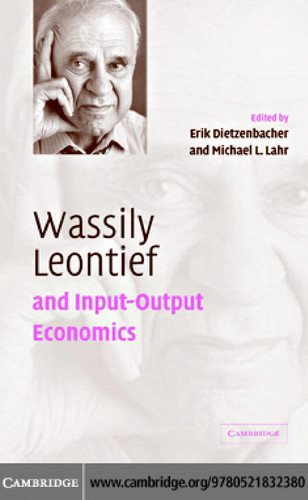
Wassily Leontief and input-output economics

Wassily Leontief,Erik Dietzenbacher,Michael L. Lahr
Wassily Leontief (1905–1999) was the founding father of input-output economics, for which he received the Nobel Prize in 1973. This book offers a collection of papers in memory of Leontief by his students and close colleagues. The first part, 'Reflections on Input-Output Economics', focuses upon Leontief as a person and scholar as well as his personal contributions to economics. It includes contributions by Nobel Laureate Paul A. Samuelson who shares his memories of a young Professor Leontief at Harvard and ends with the last joint interview with Wassily and his wife, to date previously unpublished. The second part, 'Perspectives of Input-Output Economics', includes theoretical and empirical research inspired by Leontief's work and offers a wide-ranging sample of the state of interindustry economics, a field Leontief founded. This is a strong collection likely to appeal to a wide range of professionals in universities, government, industry and international organizations.
Cambridge University Press 2004-03-25 396 pages

Raw deal: how the "Uber economy" and runaway capitalism are screwing American workers

Hill, Steven
"Every day, innovative entrepreneurs pioneer bold economic ideas that change the way we live and work. Companies like Google, Apple, Oracle, Facebook and Twitter aren't the only ones shaping our economic future--there's another trend emerging that will change the ways we work and live. The "sharing economy," or the "collaborative consumption economy," includes companies like TaskRabbit, Airbnb, Uber, Lyft, Zaarly, and DocVacay who are purveyors of an economic system that revolves around sharing human and physical resources. This new aspect to the economy, Steven Hill argues, is a dead end for U.S. workers, as well as for the national economy. In Raw Deal, Hill shows the "sharing economy" is a new and troubling component to what is an overall bad economy that undermines workers. Vulnerable freelancers and day laborers hire themselves out for ever smaller jobs and amounts of money, and it is only the companies who hire them who reap the big benefits. Hill argues that we must shift the support for American workers to one that is individual-based rather than workplace-based. Countering the onset of the freelance society and the new economy is the new civil rights and labor struggles of our time. This important book answers these questions and provides pragmatic solutions to adapt our economic system to its new realities, launching a new civil rights struggle capable of transforming the freelance society into a stakeholder society"--
St. Martin's Press 2015-10-20 326 pages

The Informational Role of Prices

Sanford J. Grossman
Over the past decade, Sanford Grossman's contributions to the economics ofinformation have significantly altered the way economists think about rational expectations. Herehis articles are collected in one place, providing a uniform framework for understanding how pricesconvey information in securities markets.Grossman elaborates a new model of economic equilibriumthat casts a dual role for prices both as constraints that affect the immediate costs or benefits ofacts and as conveyers of information about the probable future costs and benefits of those acts. Hepoints to the Wall Street panic of October 1987 as an example of the informational role of priceswhere volatility actually represented sophisticated trading strategies by relatively uninformedindividuals.In the first two chapters, Grossman interprets the ideas presented in the articles inlight of recent developments in financial markets, looks at selected contributions to the new andstill expanding literature on the informational role of prices, and introduces the rationalexpectations model of demand price equilibrium.Six chapters then take up the informational role ofprices in competitive stock markets, and future markets (where Grossman's "noisy rationalexpectations" model provides rewards for discovering new information). They look at theimpossibility of informationally efficient markets, the implications of program trading and dynamichedging strategies for stock and futures price volatility, and takeover bids. The last two chaptersconcentrate on the informational role of contracts -- warranties and private disclosure aboutproduct quality, and the implication of unemployment with observable aggregate shocks. Economistscollaborating with Grossman on several chapters include J. E. Stiglitz, Oliver Hart, and EricMaskin.Sanford Grossman is Professor of Finance at The Wharton School, University of Pennsylvania.The Informational Role of Prices is included in the Wicksell Lectures series.
MIT Press 1989-10 218 pages

SportsWorld: an American dreamland

Lipsyte, Robert
"Tough and witty, SportsWorld is a well-known commentator's overview of the most significant form of mass culture in America--sports. It's a sweaty Oz that has grown in a century from a crucible for character to a complex of capitalism, a place where young people can find both self-fulfillment and cruel exploitation, where families can huddle in a sanctuary of entertainment and be force fed values and where cities and countries can be pillaged by greedy team owners and their paid-for politicians. But this book is not just a screed, it's a guided visit with such heroes of sports as Muhammad Ali, Billie Jean King, Kareem Abdul-Jabbar, and Joe Namath, who the author knew well, and with some he met in passing, like Richard Nixon, who seemed never to have gotten over missing the cut in college varsity football, a major mark of manhood. We see how SportsWorld sensibilities help elect our politicians, judge our children, fight our wars, and oppress our minorities. And now featuring a new introduction by the author,SportsWorld is a book that will provide the foundation for understanding today's world of sports and the time of Trump. In the America of 2017--where the SuperBowl is worth billions, athletes are penalized or forced out of sports for political and anti-racist activism, and Title IX is constantly questioned and undermined--Robert Lipsyte's 1975 critique remains startlingly and intensely relevant"--
Rutgers University Press 2018-06-01 263 pages

Legend and legacy: the story of Boeing and its people

Serling, Robert J.
The name Boeing evokes vivid images, from the B-17 Flying Fortresses of World War II to the 707 and 747 jet transports that revolutionized air travel. Less well known: The Boeing Company built the first stage of the Saturn rocket that started men on the way to the moon, developed the Minuteman missile system, and is now designing America's space station. Boeing jets, in service around the globe, carry 675 million passengers annually--the equivalent of twelve percent of the world's population. Behind the statistics and the awe-inspiring aircraft is a company of paradoxes, a vast organization nimble enough to take daring market risks that have kept it at the top of its industry. Robert J. Serling, forty-five years an award-winning aviation writer, takes the reader behind the scenes with humor, objectivity, and abundant anecdotes: Boeing once went seventeen months without seeing a single domestic jetliner and came close to bankruptcy. One of its legendary test pilots unexpectedly barrel-rolled a prototype jetliner, into which the company had sunk one-quarter of its net worth, because he thought the stunt would help sell the airplane. Legend and Legacy, Robert J. Serling's most ambitious work to date, reads like a novel, complete with memorable characters who, despite occasional stumbles, helped win the war and conquer the commercial skies: The salesman who almost traded a used 727 for $12 million worth of underwear. The vice president who worked in a darkened office illuminated by a single, low-wattage light bulb. The gifted, driven engineers who did the impossible, by yesterday. Never in its seventy-five years has Boeing been so revealingly profiled. This book is must-reading for anyone fascinated by the history of aviation.
St. Martin's Press 1992 480 pages

The craftsman

Sennett, Richard
Defining craftsmanship far more broadly than "skilled manual labor," Richard Sennett maintains that the computer programmer, the doctor, the artist, and even the parent and citizen engage in a craftsman's work. Craftsmanship names the basic human impulse to do a job well for its own sake, says the author, and good craftsmanship involves developing skills and focusing on the work rather than ourselves. In this thought-provoking book, one of our most distinguished public intellectuals explores the work of craftsmen past and present, identifies deep connections between material consciousness and ethical values, and challenges received ideas about what constitutes good work in today's world. The Craftsman engages the many dimensions of skill--from the technical demands to the obsessive energy required to do good work. Craftsmanship leads Sennett across time and space, from ancient Roman brickmakers to Renaissance goldsmiths to the printing presses of Enlightenment Paris and the factories of industrial London; in the modern world he explores what experiences of good work are shared by computer programmers, nurses and doctors, musicians, glassblowers, and cooks. Unique in the scope of his thinking, Sennett expands previous notions of crafts and craftsmen and apprises us of the surprising extent to which we can learn about ourselves through the labor of making physical things --
Yale University Press 2008 326 pages

Wild Solutions How Biodiversity is Money in the Bank

Andrew James Beattie,Paul R. Ehrlich
Co-publication with Yale University Press (USA). Discussion of the biological diversity of the earth. Demonstrates how the natural systems that surround us play an essential role in protecting our basic life-support systems. Describes the millions of species providing ecosystem services and explains how biological diversity opens the way for new medicines, construction materials and designs, and manufactured goods. Urges us to protect the biological wealth of the earth from destructive human activity. Includes reccommended reading and index. Beattie is director of the Commonwealth Key Centre for Biodiversity and Bioresources at Macquarie University. Turnbull is a research associate at Macquarie. Erlich is Bing Professor of Population Studies at Stanford University.
Melbourne University Press 2001 239 pages