58,196 results in 0.13 seconds

Fashionable nonsense: postmodern intellectuals' abuse of science

Sokal, Alan D.
From Jacques Lacan and Julia Kristeva to Luce Irigaray and Jean Baudrillard, the authors document the errors made by some postmodernists using science to bolster their arguments and theories. Fashionable Nonsense dispels the notion that scientific theories are mere "narratives" or social constructions, and explores the abilities and the limits of science to describe the conditions of existence. --from publisher description.
Picador 1998 300 pages

The Kazdin method for parenting the defiant child: with no pills, no therapy, no contest of wills

Kazdin, Alan E.,Rotella, Carlo
From Alan E. Kazdin, a Yale University psychology and child psychiatry professor, The Kazdin Method for Parenting the Defiant Child is a lifesaving handbook for parents of children who are occasionally, or too often, “out of control.”Most child-behavior books are filled with advice that sounds reasonable, fits with what parents already believe about child-rearing, and is -- as Dr. Kazdin proves -- guaranteed to fail. The Kazdin Method for Parenting the Defiant Child makes available to parents for the first time Dr. Kazdin's proven program -- one backed up by some of the most long-term and respected research devoted to any therapy for children.Kazdin shatters decades' worth of accumulated myths about tantrums, time-outs, punishments fitting the crime, and much more. With the practicality of Ferber and the warmth of Brazelton, Kazdin leads parents through every step of the Kazdin Method in action -- how to use tone of voice, when and how to touch, how to lead your child in a “practice” session, how to adjust your approach for different-age children, how to involve siblings, and more. The program is temporary, but the results are permanent -- for very young children, adolescents, and even beyond.Includes a bound-in twenty-minute DVD featuring Dr. Kazdin and his staff illustrating key concepts of the Kazdin Method.
Mariner Books 2009 288 pages

Something Rotten

Alan M. Gratz
Denmark, Tennessee, stinks. The smell hits Horatio Wilkes the moment he pulls into town to visit his best friend, Hamilton Prince. And it's not just the paper plant and the polluted river that's stinking up Denmark: Hamilton's father has been poisoned and the killer is still at large. Why? Because nobody believes that Rex Prince was murdered. Nobody except Horatio and Hamilton. Now they need to find the killer, but it won't be easy. It seems like everyone in Denmark is a suspect. Motive, means, opportunity--they all have them. But who among them has committed murder most foul?
Penguin 2009-01-08 224 pages

The League of Seven

Gratz, Alan
The League of Seven is the first book in an action-packed, steampunk series by the acclaimed author of Samurai Shortstop, Alan Gratz.??In an alternate 1875 America electricity is forbidden, Native Americans and Yankees are united, and eldritch evil lurks in the shadows. Young Archie Dent knows there really are monsters in the world. His parents are members of the Septemberist Society, whose job it is to protect humanity from hideous giants called the Mangleborn. Trapped in underground prisons for a thousand years, the giant monsters have been all but forgotten--but now they are rising again as the steam-driven America of 1875 rediscovers electricity, the lifeblood of the Mangleborn. When his parents and the rest of the Septemberists are brainwashed by one of the evil creatures, Archie must assemble a team of seven young heroes to save the world.
Starscape Books 2015-06-09 350 pages

Is there a right to remain silent? coercive interrogation and the Fifth Amendment after 9/11

Dershowitz, Alan M.
The right to remain silent, guaranteed by the famed Fifth Amendment case, Miranda v. Arizona, is perhaps one of the most easily recognized and oft-quoted constitutional rights in American culture. Yet despite its ubiquity, there is widespread misunderstanding about the right and the protections promised under the Fifth Amendment. In Is There a Right to Remain Silent? renowned legal scholar and bestselling author Alan Dershowitz reveals precisely why our Fifth Amendment rights matter and how they are being reshaped, limited, and in some cases revoked in the wake of 9/11. As security concerns have heightened, law enforcement has increasingly turned its attention from punishing to preventing crime.
Oxford University Press 2008 212 pages

Preemption: a knife that cuts both ways

Dershowitz, Alan M.
Every so often, a startling book emerges that gives voice to a new of previously unexamined trend that is transforming society. In Preemption: A Knife That Cuts Both Ways, Alan M. Dershowitz, the renowned lawyer and educator, chronicles the world's fundamental shift in its approach to controlling dangerous and destructive human behavior. Dershowitz reveals that we are moving - whether in terms of fighting crime, profiling suspicious behavior, or combating terrorism - toward increasingly preventive and proactive measures and away from a traditional reliance on reactive responses. In showing the seismic shift that not only has profoundly altered foreign policy but also has affected matters as close to home as inoculation, Internet censorship, and stings, Dershowitz presents the reader with challenging dilemmas. For example, should one detain and interrogate a potential criminal solely on the basis of his profile, DNA, or predicted behavior? Should the Department of Homeland Security have the power to monitor law-abiding citizens just because they attend a certain mosque or church? Should a nation threatened by terrorism or nuclear attack be authorized to launch a preemptive attack or a preventive war? In presenting his finds, Dershowitz contrasts our approach to the Cold War - deterring a nuclear attack by threatening mutually assured destruction (MAD) - with our current approach to terrorism: kill them before they kill us. The tragic events of 9/11 have of course outwardly change the nature of American foreign policy, but Preemption convincingly demonstrated that the seeds were planted long before the collapse of the World Trade Towers and the deadly chain of al-Qaids bombings that have ripped through more than a dozen cities throughout the world. In tracing the emergence of a preemptive approach, particularly in this new century, Dershowitz examines the troubling implications not just for national security and foreign policy but for civil liberties and human rights as well. He calls for, and constructs, a new jurisprudence of preemption that seeks to balance security and freedom. With a remarkable flair for debate that has won him acclaim in the courtroom, Dershowitz brings his prodigious talen and firsthand expertise as lawyer to a topic of great philosophical and political import, The questions that he raises, both in his introduction and through the many lucid examples in Preemption, have already begun to define our age. In doing so, they will profoundly alter our fundamental understanding of how to confront crime, terrorism, and warfare. Indeed, the knife cuts both ways.
W. W. Norton 2007 348 pages

Rights from wrongs

Dershowitz, Alan M.
This is a wholly new and compelling answer to one of the most persistent dilemmas in both law and moral philosophy: If rights are "natural"-if, in the words of the Declaration of Independence, it is "self-evident that all men are endowed...with certain inalienable rights"-where do these rights come from? Does natural law really exist outside the formal structure of humanly enacted law? On the other hand, if rights are nothing more than the product of human law, what argument is there for allowing the "rights" of a few people to outweigh the preferences of the majority?In this book, renowned legal scholar Alan Dershowitz offers a fresh resolution to this age-old dilemma: Rights, he argues, do not come from God, nature, logic, or law alone. They arise out of particular experiences with injustice. While justice is an elusive concept, hard to define and subject to conflicting interpretations, injustice is immediate, intuitive, widely agreed upon and very tangible.This is a timely book that will have an immediate impact on our political dialogue, from the intersection of religion and law to recent quandaries surrounding the right to privacy, voting rights, and the right to marry. More than that, it is a passionate case for the recognition of human rights in a rigorously secular framework. Rights from Wrongs will be the first book to propose a theory of rights that emerges not from some theory of perfect justice but from its opposite: from the bottom up, from trial and error, and from our collective experience of injustice.
Basic Books 2004-11-02 261 pages

Sexual Mccarthyism

Alan M. Dershowitz
The greatest threat to the future of the office of the American Presidency may turn on whether William Jefferson Clinton told a lie, under oath, and then tried - unsuccessfully - to keep secret his sexual relationship with a twenty-two-year-old White House intern. In Sexual McCarthyism, bestselling author Alan M. Dershowitz addresses the key issues at stake - issues that transcend the titillating daily headlines - and what their long-term effects may be.
The Perseus Books Group 2000-01-01 256 pages

Shouting fire: civil liberties--past, present, and future

Dershowitz, Alan M.
Alan Dershowitz has been involved with so many high profile cases, and has written persuasively about so many issues, that it's sometimes hard to remember that he is, at heart, a legal scholar. He was the youngest professor ever to be given tenure at Harvard Law School. For decades he has been a crusader for civil liberties, often at the forefront of the most important legal debates and trials in the past few decades. With "Shouting Fire", Dershowitz returns to what he knows best and cares about most. A personal selection of his best and most provocative writings on rights, "Shouting Fire" covers a vast spectrum of civil liberties issues -- everything from the right to choice to the separation between church and state to the Holocaust and its long shadows. But also here, for the first time, is Dershowitz's surprising and brilliantly creative philosophy of rights, an innovative approach developed over nearly four decades and which is sure to cause controversy.
Little, Brown 2002 550 pages

Taking liberties: a decade of hard cases, bad laws, and bum raps

Dershowitz, Alan M.
When is conduct "unbecoming"? -- It's the silly season for the law -- ACLU takes a wrong turn -- A Birthday to remember -- Who owns Madonna's image? -- Seers' futures are under siege -- AIDS presents a legal challenge -- AIDS crisis: a rational approach -- AIDS threatens our freedom as well as our lives -- Meese misspeaks on civil rights -- The Danger of record-rating -- Suing those who make guns that kill -- Trying the hijackers -- Banned in Cambridge? -- First Amendment is the winner -- Seat belts and civil liberties -- Prostitution can't be "buckled up"--Politicizing the courts -- The Right to trust your lawyer -- Art spurs action--and truth-seeking -- Pornography and abortion: let citizens choose -- Getting tough on car crimes -- "Go to your room!"--End of affirmative action? -- Must lawyers warn their clients? -- The Right to high school humor -- Big Brother in the bedroom -- Supreme Court throws out our unwritten rights -- A New government blacklist -- Porn, whatever it is, shows no link to rape -- Press is punished for doing its job -- Testing the police for drugs -- The Rise of the "hanging jury" -- Flying past the Fourth Amendment -- The New High Court: our best nineteenth-century minds -- The Senate should not rubber-stamp judges -- Cigarette pushers have rights, too -- Who really killed John Belushi? -- Should we let pregnant women smoke and drink? -- Give Zakharov his rights--even if it's not fair -- Don't look for big shifts at the High Court--yet -- The Price of a life depends on the color of the skin -- Tortured reasoning, executed prisoners -- Supreme Court is not the "people's court" -- Judges should be a breed apart -- Judge was pioneer, conscience of the nation -- Impeachment: for emergency use only -- The Fifth Amendment: it's all the rage this year -- Insiders and the evil intentions of the small investor -- Smoking at someone else should be a crime -- Defending a terrorist: more than just a bad dream -- Of Meese and Miranda -- Fans scream for blood but shouldn't get it -- Step right up and get your clean urine here -- Homicide and the seat-belt defense -- The Buying of a witness -- Joke law is nothing to laugh at -- Junkies' needles my kill us all -- Freedom of speech for the CIA -- A Judicial cover-up? -- Alice in Wonderland replaces the Constitution -- Freedom of religion means the freedom to be mean -- His (version of the) truth is marching on -- Liberal: a conservative whose friends are in trouble -- The Supreme Court may swing right -- Robert Bork: hatchet man at a massacre -- Bork and North as mirror images -- Bork: a closet judicial activist -- White House bait and switch on Bork -- When the bench becomes soapbox -- High Court meets without magic nine -- Stallonography -- Attorney General must be free of political ties -- Charge and acquittal warrant equal time -- What Bush and others miss at Auschwitz -- Crime and the stuff of life -- The Future of our Constitution -- A daughter's death, a mother's responsibility -- Assault with a deadly virus -- A Judicial double standard on free speech -- Censorship has no place on campus -- A Double standard for husband killers -- No more Perry Mason surprise witnesses -- Students can fight censors -- Murder by magazine -- There's more to law than helping the rich get richer -- Thematic overview.
Contemporary Books 1989 332 pages

The genesis of justice

Dershowitz, Alan M.
Every weekend, in our synagogues and churches, our children are told stories from the Bible-stories of Abraham and Noah, Jacob and Joseph. But what are these stories really about? In this probing, fascinating, and entertaining book, America's leading lawyer looks at the Bible - and in particular at the Book of Genesis - as a tale of justice done, justice undone, and justice in the eyes of the beholder. What if an angel hadn't stopped Abraham from sacrificing his son Isaac? What does Genesis seem to be telling us about taking revenge? Or even about capital punishment? Drawing on biblical commentary from throughout the ages and his own actual court battles, Dershowitz shines a brilliant legal light on the stories that comprise the foundation of our society. What he reveals is how our shared tradition has formed our attitude toward modern-day justice-and why we are all engaged in a never-ending quest to separate right from wrong.
Warner 2001-02-01 320 pages

A Christmas Carol Vocal Album . Piano/vocal/guitar.

Alan MENKEN
Nine vocal selections from this Christmas classic, plus full-color photos from the New York production. Features music by Alan Menken and lyrics by Lynn Ahrens. Songs include: Abundance and Charity * Christmas Together * God Bless Us Everyone * Lights of Long Ago * Link by Link * Mr. Fezziwig's Annual Christmas Ball * A Place Called Home * The Years Are Passing By * Yesterday, Tomorrow and Today.
Leonard/Warner 1995 64 pages

Napoleon Bonaparte

Schom, Alan
Filling a remarkable gap, Alan Schom, an acclaimed historian, scholar and author, offers the most complete picture ever of Napoleon Bonaparte, "the scourge of Europe" and France's greatest hero. Based on more than 10 years of exhaustive research, Schom illuminates Napoleon's important economic and social reforms, his reorganization of the French government and his tempestuous personal life and its effect on his political decisions. Remarkably ambitious and compulsively readable, Napoleon Bonaparte covers every aspect of l'Empereur's life and career -- from his childhood on Corsica to his dramatic rise to the throne of France; from his campaigns of conquest to his final crushing defeat at Waterloo and death in exile on St. Helena. A lively and accessible text, Schom's book is generously illustrated with halftones and maps and features startling new insights about Napoleon's key aides, ministers and generals. Schom portrays Napoleon with candor, exalting his ambition and undeniable genius, but also addressing his dark side -- his ego, his failures and frailties, and the misery caused by his years of warfare across Europe. Powerful, dramatic, colorful and impossible to put down, Napoleon Bonaparte is a biography as complex, challenging and fascinating as the legend himself.
HarperCollins 1997-09-05 888 pages

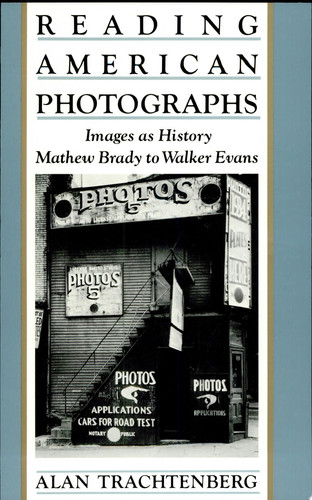
Reading American photographs: images as history, Mathew Brady to Walker Evans

Trachtenberg, Alan
Winner of the Charles C. Eldredge Prize In this book, Alan Trachtenberg reinterprets some of America's most significant photographs, presenting them not as static images but rather as rich cultural texts suffused with meaning and historical content. Reading American Photographs is lavishly illustrated with the work of such luminaries as Mathew Brady, Timothy O'Sullivan, and Walker Evans--pictures that document the American experience from 1839 to 1938. In an outstanding analysis, Trachtenberg eloquently articulates how the art of photography has both followed and shaped the course of American history, and how images captured decades ago provocatively illuminate the present.
Hill and Wang 1989 326 pages

The Politics of Petulance America in an Age of Immaturity

Alan Wolfe
How did we get into this mess? Every morning, many Americans ask this as, with a cringe, they pick up their phones and look to see what terrible thing President Trump has just said or done. Regardless of what he’s complaining about or whom he’s attacking, a second question comes hard on the heels of the first: How on earth do we get out of this? Alan Wolfe has an answer. In The Politics of Petulance he argues that the core of our problem isn’t Trump himself—it’s that we are mired in an age of political immaturity. That immaturity is not grounded in any one ideology, nor is it a function of age or education. It’s in an abdication of valuing the character of would-be leaders; it’s in a failure to acknowledge, even welcome the complexity of government and society; and it’s in a loss of the ability to be skeptical without being suspicious. In 2016, many Americans were offered tantalizingly simple answers to complicated problems, and, like children being offered a lunch of Pop Rocks and Coke, they reflexively—and mindlessly—accepted. The good news, such as it is, is that we’ve been here before. Wolfe reminds us that we know how to grow up and face down Trump and other demagogues. Wolfe reinvigorates the tradition of public engagement exemplified by midcentury intellectuals such as Richard Hofstadter, Reinhold Niebuhr, and Lionel Trilling—and he draws lessons from their battles with McCarthyism and conspiratorial paranoia. Wolfe mounts a powerful case that we can learn from them to forge a new path for political intervention today. Wolfe has been thinking and writing about American life and politics for decades. He sees this moment as one of real risk. But he’s not throwing up his hands; he’s bracing us. We’ve faced demagogues before. We can find the intellectual maturity to fight back. Yes we can.
University of Chicago Press 2019-08-22 220 pages