2220 results for "History"

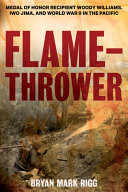
Flamethrower: Medal of Honor recipient Woody Williams, Iwo Jima, and World War II in the Pacific

Rigg, Bryan Mark
"Imagine strapping on a highly flammable 70-pound pack and entering combat as a surefire walking target-and you'd only begin to understand the job, and the horror, of Marine Corps flamethrower man. That's precisely what Hershel "Woody" Williams did in World War II, most importantly in February 1945 on Iwo Jima, one of the Pacific War's toughest battles. A few days into the battle, Marines were fighting hard for an airfield, and his captain asked Woody if he could do anything. He responded, "I'll try"-and for the next four hours, he virtually singlehandedly took on and ultimately destroyed seven enemy pillboxes and helped secure the airfield. Accomplished military historian Bryan Mark Rigg reconstructs Williams' remarkable story, from his youth in West Virginia to his experiences on Guadalcanal, Saipan, Guam, and most significantly Iwo Jima. In Rigg's telling, Williams's Medal of Honor action is not "just" a brave deed, but one of only a few strategically significant brave deeds-one that secured a strategic objective during a major campaign. Rigg tells Williams' story vividly, and objectively, and places it in the context of the broader Pacific theater of World War II."--
Stackpole Books 2020 544 pages

To begin the world anew: the genius and ambiguities of the American founders

Bailyn, Bernard
Two time Pulitzer Prize-winning historian Bernard Bailyn has distilled a lifetime of study into this brilliant illumination of the ideas and world of the Founding Fathers. In five succinct essays he reveals the origins, depth, and global impact of their extraordinary creativity. The opening essay illuminates the central importance of America’s provincialism to the formation of a truly original political system. In the chapters following, he explores the ambiguities and achievements of Jefferson’s career, Benjamin Franklin’s changing image and supple diplomacy, the circumstances and impact of the Federalist Papers , and the continuing influence of American constitutional thought throughout the Atlantic world. To Begin the World Anew enlivens our appreciation of how America came to be and deepens our understanding of the men who created it.
Alfred A. Knopf 2003 183 pages

Thinking in time: the uses of history for decision-makers

Neustadt, Richard E.
“A convincing case that careful analysis of the history, issues, individuals, and institutions can lead to better decisions—in business as well as in government” ( BusinessWeek ). Two noted professors offer easily remembered rules for using history effectively in day-to-day management of governmental and corporate affairs to avoid costly blunders. “An illuminating guide to the use and abuse of history in affairs of state” (Arthur Schlesinger).
Free Press 1986 329 pages

Gullible's travels: a comical history of the Trump era

Kitman, Marvin
"Kitman describes the land of Gulliblesylvania as a democratic country ruled by 34.9% of the people, "a minority better known as 'the base,' of whom a candidate said he could shoot someone on Fifth Avenue and they would still vote for him." At first Kitman assumed that Trump's candidacy was a publicity stunt. After he realized it was serious, as a satirist he felt very lucky and began to keep a comical journal, modeled after A Journal of the Plague Year which Daniel Defoe described as "Observations of the most remarkable occurrence, which happened in London during the last great visitation in 1665"--which is not to compare the Trump administration to the bubonic plague, Kitman hastens to add. "For one thing, as our POTUS has been telling us, he's made America Great again-AND IT ONLY TOOK A YEAR AND A HALF!" Kitman adds, "And I have never before had such a good time observing and writing about the follies of our country." Gullibles Travels includes 32 "Trumponicles; the debate over the president's intellectual capacity; "That Russian Thing;" "Who is Agent Orange"; and a CODA that asks the question, "How Will It All End?" Impeachment? 25th Amendment sacking? Resignation? Or reelection?"--
Seven Stories Press 2020-05-05 320 pages

The age of federalism

Elkins, Stanley
When Thomas Jefferson took the oath of office for the presidency in 1801, the United States had just passed through twelve critical years, years dominated by some of the towering figures of our history and by the challenge of having to do everything for the first time. Washington, Hamilton, Madison, Adams, and Jefferson himself each had a share in setting the nation's important precedents, in organizing the public finances, and in attempting - though with minimal success - to compel respect for the American republic from the powers of Europe. The historical era bounded by those first years is brilliantly represented in The Age of Federalism. Written by esteemed historians Stanley Elkins and Eric McKitrick, The Age of Federalism gives us a reflective, deeply informed analytical survey of this extraordinary period. Ranging over the widest variety of concerns - political, cultural, economic, diplomatic, military - the authors keep in view not only the problems the new nation faced but also the particular individuals who tried, with mixed results, to solve them. They intersperse their account with subtly perceptive (and sometimes delightful) character sketches, not only of the great central figures - Washington and Jefferson, Talleyrand and Napoleon Bonaparte - but also of various lesser ones, such as George Hammond, Britain's frustrated minister to the United States, James McHenry, Adams's hapless Secretary of War, a pre-Chief Justice version of John Marshall, and others. They weave these lively profiles into an analysis of the major controversies of the time in an effort to recover something that is now two centuries out of reach, the psychology of a generation of nation-builders, not all of it attractive. The moral urgency of these issues, and the bitterness of the disagreements over them, reflected a fearful sense that the entire future hung on the particular way any one of them was settled. We thus see, for example, how the fight over Hamilton's Treasury system widened an ideological gulf between Hamilton and the Virginians, Madison and Jefferson, that became unbridgeable; how their divisions came to involve questions of foreign relations as well as domestic policy; and how the passions thus generated led to what everyone professed to deplore, the formation of political parties. The most complex issues and episodes are presented with a clarity and a connectedness that they have seldom had in previous treatments. We get a fresh reading of the Whiskey Rebellion of 1794, the Adams presidency, the XYZ Affair, the naval Quasi-War with France, and the desperate Federalist maneuvers in 1800, first to prevent the reelection of Adams and then to nullify the election of Jefferson. The statesmen of the founding generation, the authors concede, did "a surprising number of things right." Some things, however, went resoundingly wrong: the hopelessly underfinanced effort to construct a capital city on the Potomac (it would have made far more sense, the authors argue, to leave it in New York); the drive in 1798 to form a mighty army that virtually nobody wanted; and prosecutions under the Alien and Sedition Acts which turned into a comic nightmare. The Age of Federalism is the fruit of many years of study and discussion. It combines breadth of scholarship with those touches already familiar in the authors' previous handling of historical subjects: analogies, fascinating side-excursions, counterfactual projections, and understated irony, all couched in a prose that is graceful and lucid. With it, Stanley Elkins and Eric McKitrick have produced a comprehensive synthesis, long awaited by historians, of our early national era.
Oxford University Press 1993 925 pages

Howard Zinn on war

Zinn, Howard
Howard Zinn on War is Zinn’s choice of the writing that represents his thinking on a subject that concerned and fascinated him throughout his career. He reflects on the wars against Iraq, the war in Kosovo, the Vietnam War, World War II, and on the meaning of war generally in a world of nations that can't seem to stop destroying each other. These readings appeared first in magazines and newspapers including the Progressive and the Boston Globe, as well as in Zinn's books, Failure to Quit, Vietnam: The Logic of Withdrawal, The Politics of History, and Declarations of Independence. Here we see Zinn’s perspective as a World War II veteran and peace activist who lived through the most devastating wars of the twentieth century and questioned every one of them with his combination of integrity and historical acumen. In his essay, "Just and Unjust War," Zinn challenges us to fight for justice "with struggle, but without war." He writes in "After the War" (2006) that while governments bring us into war, "their power is dependent on the obedience of the citizenry. When that is withdrawn, governments are helpless." In Howard Zinn on War, his message is clear: "The abolition of war has become not only desirable but absolutely necessary if the planet is to be saved. It is an idea whose time has come."
Seven Stories Press 2001 206 pages

Philip Roth: stung by life

Zipperstein, Steven J.
"Philip Roth (1933-2018) is one of the most celebrated American writers of his age. Born in Newark, New Jersey -- where his short stories and thirty-one books were often set -- he wrote with immense ambition and drive, along with a keen awareness of what must be done to produce great literature. Yet despite rubbing shoulders with the Kennedys and engaging in a spate of famous and infamous romances, he viewed himself as socially withdrawn, living much like an "unchaste monk" (his words). In this original and lucid biography, Steven J. Zipperstein captures Roth's complex life and the astonishing range of his self-reflective writings-from "Goodbye, Columbus" and "Portnoy's complaint" to the Pulitzer Prize-winning "American pastoral" and "The plot against America." Employing extensive archival research and well over one hundred interviews, including conversations with Roth himself, Zipperstein provides an intimate and probing look at one of the twentieth century's most influential authors, placing his work in the context of Jewishness, freedom, and sexuality in America"-- Provided by publisher.
Yale University Press 2025-10-14 346 pages

America the beautiful: the stirring true story behind our nation's favorite song

Sherr, Lynn
We've all sung it a thousand times, and most of us know at least the first verse by heart. "America the Beautiful" has been called a hymn, a prayer, even the "national heartbeat set to music." Numerous proposals and half a dozen bills in Congress have tried to replace our national anthem, "The Star-Spangled Banner," with this more lyrical, less militaristic song. But who knows the story behind the song? In America the Beautiful, Lynn Sherr tells the story of Katharine Lee Bates, a poet and pioneering young English professor at the newly established Wellesley College, who penned "America the Beautiful" at age 33, as she gazed over the glorious panorama from the top of Pike's Peak, Colorado. The poem, published two years later on July 4, 1895, struck a chord. Americans embraced it and immediately set it to music, trying out at least 74 different melodies. There were even Mexican, Canadian, and Australian versions. Analyzing the lyrics of "America the Beautiful" and the story of Katharine Lee Bates's unusual life, Lynn Sherr opens a window onto the shifting world of late 19th century America. She explores the lingering impact of the Civil War and the dramatic developments in commerce and technology, which shaped the American Century and the popularity of one brilliant, stirring song.
Public Affairs 2001-10-17 125 pages

Fire and rain: the James Taylor story

Halperin, Ian
Many musicians sing about heartache, despair, and confusion, but few have experienced those feelings more intensely than James Taylor, who rose from a childhood of privilege as the son of an affluent medical school dean to become a modern-day troubadour and pop superstar. When he was seventeen years old, his demons led him to a Massachusetts mental institution where he confronted them the only way he knew how, by writing his first songs. Thirty years later, Taylor's songs are among the most popular in the annals of music, but the demons are still with him. But unlike many of his contemporaries who faced a similar struggle, Taylor managed to emerge as an inspirational figure. Fire and Rain traces this remarkable path, including his troubled marriage to pop star Carly Simon and the premature alcoholism-related death of his brother: -- Taylor's ten-month stay in the exclusive private psychiatric institution where he finished high school. -- His self-imposed exile to England, where he submitted some of his music to the Beatles' Apple Records, which signed him to his first record contract in 1968. Paul McCartney mentored Taylor's early career. -- The story behind his second album, Sweet Baby James, which contained the song "Fire and Rain" about the hopelessness of mental illness and suicide. -- As Taylor's fame increased, so did his problems with heroin, alcohol, and mental illness. In the seventies, the singer nearly fell over the edge many times. Ian Halperin has interviewed more than 100 musicians, family members, music industry figures, and others to paint a detailed but ultimately sympathetic portrait of Taylor's incredible life and career -- the first-ever biographyof this pop-music icon.
Citadel Press 2000 273 pages

Talking politics

Gamson, William A.
Those who analyze public opinion have long contended that the average citizen is incapable of recounting consistently even the most rudimentary facts about current politics; that the little the average person does know is taken at face value from the media reports, and that the consequence is a polity that is ill-prepared for democratic governance. Yet social movements, comprised by and large of average citizens who have become exercised about particular issues, have been a prominent feature of the American political scene throughout American history and they are experiencing a resurgence in recent years. William Gamson asks the question, how is it that so many people become active in movements if people are so generally uninterested and badly informed about issues? The conclusion he reaches in this book is a striking refutation of the common wisdom about the public's ability to reason about politics. Rather than relying on survey data, as so many studies of public opinion do, Gamson reports on his analysis of discussions among small groups of working-class people on four controversial issues: affirmative action, nuclear power, the Arab-Israeli conflict, and the troubles in American industry. Excerpts from many of these discussions are transcribed in the book.--Provided by publisher.
Cambridge University Press 1992 272 pages

Lawless world: making and breaking global rules

Sands, Philippe
International lawyer Philippe Sands has a unique insider's view of the elites who govern our lives. His sensational revelations in Lawless World changed the political agenda overnight, forcing Tony Blair to publish damning mterial that he'd tried to hide. Now, in this updated edition with a shocking new chapter, you can get the full story of how the US and UK governments are riding roughshod over international agreements on human rights, war, torture and the environment - the very laws they put in place. Here sands looks at why global rules matter for all of us. And he powerfully makes the case for preserving them ... before justice becomes history.
Penguin 2006-02-03 404 pages

Adventures of a bystander

Drucker, Peter F.
"It is [a] belief in diversity and pluralism and the uniqueness of each person that underlies all my writings . . . " -from the Preface. Regarded as the most influential and widely read thinker on modern organizations and their management, Peter Drucker has also established himself as an unorthodox and independent analyst of politics, the economy, and society. A man of impressive scope and expertise, he has paved significant inroads in a number of key areas, sharing his knowledge and keen insight on everything from the plight of the employee and the effects of technology to the vicissitudes of the markets and the future of the new world order. Adventures of a Bystander is Drucker's rich collection of autobiographical stories and vignettes, in which this legendary figure paints a portrait of his remarkable life, and of the larger historical realities of his time. In a style that is both unique and engaging, Drucker conveys his life story -from his early teen years in Vienna through the interwar years in Europe, the New Deal era, World War II, and the postwar period in America-through intimate profiles of a host of fascinating people he's known through the years. Their personal histories are, as Drucker tells us, the beads for which his own life serves as the string. A colorful group, these diverse, often unpredictable, always multidimensional individuals were chosen "because each of them, in his or her own highly personal way, reflects and refracts the thirty crucial years from the end of World War I to the first post-World War II decade-the thirty years that largely formed the world in which we now live." An amazing pageant of characters, both famous and otherwise, springs from these pages, illuminating and defining one of the most tumultuous periods in world history. Along with bankers and courtesans, artists, aristocrats, prophets, and empire-builders, we meet members of Drucker's own family and close circle of friends, among them such prominent figures as Sigmund Freud, Henry Luce, Alfred Sloan, John Lewis, and Buckminster Fuller. Playing to perfection their roles as those who "reflect and refract" the customs, beliefs, and attitudes of the times, these singular personalities lend Adventures of a Bystander a striking "you-are-there" feel. A brief encounter with Freud becomes the catalyst for an absorbing, multidimensional description of the economics, politics, and social psychology of pre-World War II Europe. Drucker introduces us to Fritz Kraemer, a brilliant, monocle-wearing eccentric who became an influential mentor to the young Henry Kissinger. His personal memoir of Henry Luce documents the development of modern journalism, while in "The Indian Summer of Innocence," he rescues and preserves the very heart of the American experience during the last New Deal years before World War II. Shedding light on a turbulent and important era, Adventures of a Bystander also reflects Peter Drucker himself as a man of imaginative sympathy and enormous interest in people, ideas, and history. These enthralling stories complement and complete the groundbreaking analytical writing for which he is so revered. Luminous autobiographical stories by one of the greatest thinkers of our time "The cast of characters among whom Drucker moves is superbly rich, and the informed glimpse he provides of a vanished social and political universe is an education in itself. Adventures of a Bystander is better than a novel, more lively than an essay, and as thoughtful as both at their best." -The Harvard Business Review. "Adventures of a Bystander is a virtuoso performance in which Drucker displays a dazzling diversity of personal interests and knowledge, an awesome power of recall, and a crisp, highly readable writing style." -BusinessWeek. "Adventures of a Bystander appears in a stroke to have restored the art of the memoir and of the essay. It will doubtless be a while before its like comes round again." -The Washington Post.
Wiley 1997 344 pages