133 results for "American History"

The boxer: a novel

Becker, Jurek
"In this follow-up work to Jacob the Liar, Becker tells the story of a man named Aron Blank, tracing his life from his release from a concentration camp in the summer of 1945 through the next twenty or so years. Living in a ghetto at the start of the war, Aron had lost his wife who one day was arrested by the Nazis. In desperation, he turned over his two-year-old son, Mark, for safe-keeping to a neighbor just before he was deported. Now, having survived the war, Aron sets out, with the help of an American relief organization, to find his son."--Jacket.
Arcade Pub 2002 277 pages

Cla[s][s] action: the novel

Denker, Henry
Judge Milton Handelsman to young attorney Reginald Rashad: "You are standing on the threshhold of a new Age. The Age of the lawyer. In our grand and glorious history this nation has seen industry after industry rise and thrive. Railroads! Coal! Oil! Shipping! Electric power! The automobile! Broadcasting! Recently Technology. Then Biotechnology. All rose from small beginnings to eventually dominate the nation's economy. And now . . now comes the next big industry to take over. "The Class Action. The means by which lawyers will take over all the other industries. And, of course, you want your share. Well, counselor, it will not be easy." Reginald Rashad, young black attorney, who recently resigned impulsively from the huge white-shoe law firm, WHITE, CRAVAT & SULLIVAN, is determined now to make it on his own. But as Judge Handelsman warned, it will not be easy.
H. Denker 2002 282 pages

End of the Beginning

Harry Turtledove
Six weeks ago, Imperial Japanese military forces conquered and occupied the Hawaiian Islands. A puppet king sits on Hawaii’s throne, his strings controlled by the general of the invasion force. American POWs, malnourished and weak, are enslaved as hard laborers until death takes them. Civilians fare little better, struggling to survive on dwindling resources. And families of Japanese origin find their loyalties divided. Meanwhile, across the United States, from Pensacola, Florida, to San Diego, California, the military is marshaling its forces. Steel factories and fuel refineries are operating around the clock. New recruits are enlisting, undergoing rigorous training exercises. All for the opportunity to strike back and drive the enemy from American soil…
National Geographic Books 2006-08-01 528 pages

Warrior queen: the story of Boudica, Celtic Queen

Gold, Alan
Meticulously researched and imaginatively wrought, Warrior Queen is the sweeping epic of the infamous Boudica who challenged the vicious might of the Roman Empire. In 43 AD Boudica became the queen of a Celtic tribe and a Roman sympathiser. But after years of loyal service she finds herself brutally betrayed. The fury of her unleashed vengeance threw the Roman Empire's forces into chaos and made her a goddess to her own people. Here, Alan Gold retells the story of Boudica in a novel that embraces all the fiery passion and intrigue of this remarkable woman.
New American Library 2005 366 pages

To catch the lightning: a novel of American dreaming

Cheuse, Alan
"Until someone tells you, you never know in whose dreams you appear..." - From the prologue of To Catch the Lightning What is the price of our dreams? Beginning in the late 1890s, Edward Sheriff Curtis undertook the seemingly overwhelming odyssey of capturing the past, of documenting and photographing the fading way of life of the American Indian. In To Catch the Lightning , Alan Cheuse has created a remarkable portrait of the man who would become a legend. Drawn on his epic journey by a series of female muses, Curtis turns his lens on a landscape of unparalleled beauty and tradition. Curtis@ desire to complete his destiny as foretold by Chief Joseph, to photograph all of the hundreds of western American Indian tribes, is a haunting tale of the struggle between ambition and duty. The architect of the finest lasting visual record of a culture close to extinction, Curtis stands as a testament to the power of the sacrifices we make for the dreams that compel us. With the ear of a poet and the eye of a historian, Cheuse has crafted a masterwork of American historical fiction. Lyrical, beautifully written, and impressively researched, To Catch the Lightning is a novel of the American spirit. PRAISE FOR TO CATCH THE LIGHTNING: "To Catch the Lightning is a story of loss - of choices made and prices paid, of the future coming fast and the past disappearing faster. Cheuse@s narrative is refracted through multiple voices, each distinct, but each containing its own poetic precision. A wonderful, wonderful book of quiet power and great beauty." - Karen Joy Fowler, author of Wit@s End and The Jane Austen Book Club "To Catch the Lightning tells Curtis@ story vividly and eloquently. It is a great American story, about a life spent preserving and honoring those elements of life which are most respected and beloved. Alan Cheuse is to be congratulated for this vivid novel." - William Kittredge, author of The Willow Field and The Next Rodeo "Bravo to Cheuse for this incarnation of a major and unfairly forgotten American artist, capturing an era so crucial in native American, and therefore American history. I found it immediate and innovative." - Diane Johnson, author of Le Divorce and Lulu in Marrakech "The photography and cinema of Edward Curtis exist at the intersection of art, history, anthropology, and technology. He was an essentially American kind of genius, and Alan Cheuse has transformed his life into compelling fiction that digs deep into the mystery and sacrifice and selfishness of creative vision." - Charles Frazier, author of Cold Mountain and Thirteen Moons "... the narrative brims with keen insight." - Publishers Weekly "Curtis devoted his life to creating the most significant and comprehensive retrospective of American Indian culture, which he viewed as @one of the great races of mankind.@ Curtis correctly predicted that the culture was near extinction ... and much of his work remains the only recorded history of a civilization even then becoming the stuff of legend." - ForeWord Magazine Catch Alan Cheuse in your town: Key West, FL: January - Key West Lit
Sourcebooks Landmark 2008 502 pages

American Quartet

Warren Adler
Detective Fiona Fitzgerald is an unlikely force for justice in Washington D.C's predominantly male police force. As a Senator's daughter and top investigator in the homicide division of the Metropolitan Police Department, Fiona maneuvers between two vastly different worlds, moving quickly from opulent State galas to gritty crime scenes. Born into the elite social circles of the nation's capital, and armed with intimate knowledge of the true face of the political establishment, Fiona is determined to expose the chicanery concealed within the highest echelons of the American political aristocracy. When a string of inexplicable murders rocks the hallowed streets of central D.C., Fiona finds herself charging through shadows of a mysterious conspiracy. Faced with an investigation with no leads and a rising body count, Fiona's reputation as top investigator of the Homicide Division is called into question. At the brink of professional ruin, an encounter with the eccentric yet charismatic Thaddeus Remington III at his museum-like mansion sends Fiona hurtling headlong through a whirlwind of clues. Where once the desperate detective blundered through traceless footsteps of a triple murderer, the answers to her case now seem to be whispered from bloodstained graves of fallen Presidents. Fiona stands ready, her finger on the trigger, as an assassination plot decades in the making is about to change history forever. American Quartet is the first book in the Fiona Fitzgerald mystery series.
CreateSpace Independent Publishing Platform 2016-05-09 378 pages

The Street Sweeper

Elliot Perlman
How breathtakingly close we are to lives that at first seem so far away. From the civil rights struggle in the United States to the Nazi crimes against humanity in Europe, there are more stories than people passing one another every day on the bustling streets of every crowded city. Only some stories survive to become history. Recently released from prison, Lamont Williams, an African American probationary janitor in a Manhattan hospital and father of a little girl he can’t locate, strikes up an unlikely friendship with an elderly patient, a Holocaust survivor who was a prisoner in Auschwitz-Birkenau. A few blocks uptown, historian Adam Zignelik, an untenured Columbia professor, finds both his career and his long-term romantic relationship falling apart. Emerging from the depths of his own personal history, Adam sees, in a promising research topic suggested by an American World War II veteran, the beginnings of something that might just save him professionally, and perhaps even personally. As these men try to survive in early-twenty-first-century New York, history comes to life in ways neither of them could have foreseen. Two very different paths—Lamont’s and Adam’s—lead to one greater story as The Street Sweeper , in dealing with memory, love, guilt, heroism, the extremes of racism and unexpected kindness, spans the twentieth century to the present, and spans the globe from New York to Chicago to Auschwitz. Epic in scope, this is a remarkable feat of storytelling.
Penguin Publishing Group 2012-12-04 640 pages

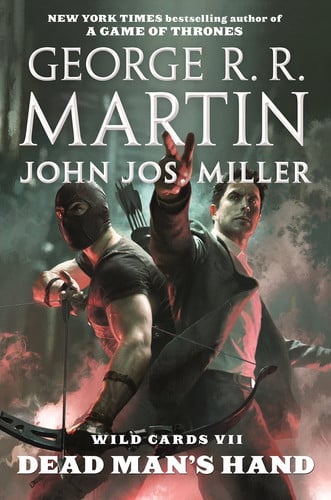
Wild Cards VII: Dead Man's Hand Book Four of the Puppetman Quartet

George R. R. Martin,John Jos. Miller,Wild Cards Trust
Dead Man's Hand combines the writing talents of George R. R. Martin & John Jos. Miller Chrysalis, the glass-skinned queen of the Joker underworld, has been found brutally murdered in her popular restaurant, the Crystal Palace. New two men are out to find her killer: Jay Ackroyd, the Ace private investigator who discovered her ruined body, and the vigilante archer known as the Yeoman, who has been framed for the crime. Their quest leads them on a nightmare odyssey of madness, violence, passion, and political intrigue that will forever alter the fates of Aces and Jokers everywhere. Experience this gripping tale of mystery and suspense, brought to you from the incredible imaginations of George R. R. Martin and John Jos. Miller in their first collaborative novel. EXPLORE THE WILD CARDS UNIVERSE An alien virus has changed the course of history, and the surviving population of Manhattan struggles to understand the new world left in its wake. Natural humans share the rough city with those given extraordinary—and sometimes terrifying—traits. While most manage to coexist in an uneasy peace, not everyone is willing to adapt. The Wild Cards Universe The Original Triad #1 Wild Cards #2 Aces High #3 Jokers Wild The Puppetman Quartet #4: Aces Abroad #5: Down and Dirty #6: Ace in the Hole #7: Dead Man’s Hand The Rox Triad #8: One-Eyed Jacks #9: Jokertown Shuffle #10: Dealer’s Choice #11: Double Solitaire #12: Turn of the Cards The Card Sharks Triad #13: Card Sharks #14: Marked Cards #15: Black Trump #16: Deuces Down #17: Death Draws Five The Committee Triad #18: Inside Straight #19: Busted Flush #20: Suicide Kings The Fort Freak Triad #21: Fort Freak #22: Lowball #23: High Stakes The American Triad #24: Mississippi Roll #25: Low Chicago #26: Texas Hold 'Em
Tor Publishing Group 2017-06-13 352 pages

Valley Forge

MacKinlay Kantor
MACKINLAY KANTOR Pulitzer Prize-winning author of Andersonville VALLEY FORGE Poignant, tender, and powerful, VALLEY FORGE brings into sharp new focus one of the most tensely dramatic episodes of the American Revolution. With warmth and wit, compassion and sensitivity, MacKinlay Kantor evokes the flavor, pulse and texture of the last quarter of the eighteenth century, transporting the reader into the houses and workshops, kitchens and stables, parlors and bedrooms of ordinary citizens. Here are not only the soldiers of Valley Forge, but the panorama of the Revolution itself. George Washington, lamenting the remoteness and lack of valor in the Congress, anticipating new battle; the sprightly, good-humored Martha, always loyal and loving to a fault; the Marquis de Lafayette, whose poise and dignity belied his youth; Baron von Steuben whose halting English made the soldiers laugh, but whose fierce devotion won their respect. And the multitude-young Mum, a sixteen-year-old deserter savagely trampled by Tarleton's Raiders; Malachi Lennan whose gift of a horse gained him entry into Mad Anthony Wayne's Drovers; Billy, the turncoat, wailing for his mother as he was dragged to the gallows. Sons of farmers and tradesmen, trappers and teachers-some too young to fight, and some too old-surge through these pages, giving life, breath, scope and humanity to the American Revolution and the winter at Valley Forge. MacKINLAY KANTOR was born in Webster City, Iowa in 1904. He began to write seriously at sixteen, became a newspaper reporter at seventeen, and an author at twenty-three. Since his first-published novel in 1928, more than forty books have appeared in print, including verse, short stories, novellas, histories, and books for children. His best-selling, and Pulitzer Prize- winning Andersonville was published in 1955. MacKinlay Kantor's other than book accomplishments range from Hollywood screenwriting to police patrolling (N. Y. P. D.), to combat experience (RAF and U.SAF) in two wars. VALLEY FORGE is grandly conceived, but the quality is equal to the concept. The climate of the war, its taste and smell and the harsh texture of its life, are evoked with mystery. Neither souped-up nor toned-down under fashionable pressures, this is an extraordinarily honest and human book. I am greatly impressed.-MARY RENAULT
Speaking Volumes, LLC 2016-11-28 350 pages

Hill of beans: a novel of war and celluloid

Epstein, Leslie
"The film Casablanca opens with the words, "With the coming of the Second World War, many eyes in imprisoned Europe turned hopefully, or desperately, toward the freedom of the Americas." Leslie Epstein's Hill of Beans is the story of how one nation, one industry, and in particular one man responded to that desperate hope. That man is Jack Warner. His impossible goal is to make world events--most importantly, the invasion of North Africa by British and American forces in 1942--coincide with the release of his new film about a group of refugees marooned in Morocco. Arrayed against him are Stalin and Hitler, as well as Josef Goebbels, Franklin Roosevelt, a powerful gossip columnist, and above all a beautiful young woman with a terrible secret. His only weapons are his hutzpah and his heroism as he struggles to bring cinema and city, conflict and conference together in an epic command performance. Hill of Beans is the novel that Leslie Epstein--the son and nephew of Philip and Julius Epstein, the screenwriters of Casablanca--was born to write"--
High Road Books, an imprint of the University of New Mexico Press 2021 335 pages

The white man's guide to white male writers of the Western canon

Schwartz, Dana
How can you tell your Faulkner from your Franzen if you haven't actually read either? Schwartz expounds on the most important (aka white male) writers of western literature. From Shakespeare's greatest mystery to the true meaning of Kafkaesque, she tests your knowledge of which Jonathan-- Franzen, Lethem, or Safran Foer-- hates Twitter and lives in Brooklyn. So instead of politely nodding along next time you make an acquaintance at a housewarming party in Brooklyn, you can roll up your sleeves and get to work schooling them in character arcs and the experimental form of your next great American novel. -- adapted from back cover
Harper Perennial 2019-11-05 241 pages

Trans-Siberian Express

Warren Adler
American cancer specialist Dr. Alex Cousins is on a covert mission to the USSR. His task: to save the life of Soviet Politburo Chief Viktor Moiseyevich Dimitrov. But the tenuous alliance between the two crumbles one night. Alex stumbles upon Dimitrov's sinister plans for a nuclear strike on China. The Russians dispatch Alex on a six-thousand-mile journey aboard the infamous Trans-Siberian Express - thus ensuring he won't get home in time to warn the US of the imminent attack.As the train lumbers east across snow-cloaked mountains, watchful eyes rest on the American doctor. Surrounding him are people beaten and broken by life, each drawn to this emperor of trains in search of a brighter future. But most curious is Anna Petrovna Valentinova, the hauntingly beautiful history professor.The Trans-Siberian Express roars onward through a cavern of hopes and memories. A train attendant yearns for love, a persecuted Jewish couple runs to a new home, and a passionate romance transcending political barriers unfolds under KGB surveillance.
Stonehouse Press 2021-02-23 408 pages

Art & Architecture on 1001 Afternoons in Chicago Essays and Tall Tales of Artists and the Cityscape of The 1920s

Ben Hecht
Sixteen more lost stories by Ben Hecht from the Snickersnee Press, this compilation about Chicago's pioneering Modernist artists, their art and the pioneering skyscrapers punctuating the cityscape. Audiences include 1. Art and cultural historians of early Modernism in Chicago; 2. Short story lovers interested in literary journalism of Ben Hecht at his before-30 Chicago brightest. 3. Chicago history. The 1921-1922 short works reveal Hecht's passion for avant-garde art including German DaDa, show off his unbridled wordsmithery, philosophizing and humor in his salad days before he became Hollywood's most sought-after film writer and script doctor (Scarface, Spellbound, Notorious). Written for his Chicago Daily News column 1001 Afternoons in Chicago, the pieces vary from bar rooom comedy about specific artists to intellectual arguments about Modernism and beauty, subjects unexplored by other Hecht biographers. Uncompiled until rediscovered on microfilm by archival research consultant and Hecht biobibliographer Florice Whyte Kovan, they rejuvenate and contextualize with her historical notes and profuse illustrations. Hecht interviews Primitivist Jerome Blum, visiting Russian painter Nicholas Roerich; satirizes landscape artist George Peyraud, expounds on Dadaist Johannes Van Baader. He features his own illustrators Herman Rosse and Wallace Smith, the latter illustrating Hecht's banned book, Fantasius Mallare. Two-page spreads recall George Grosz's early Americana drawings; works by eccentric Stanislaw Szukalski's, recently a NetFlix subject. No-Jury artists rejected at Art Institute of Chicago, as Hecht laments, receive a two-page cartoon spread. Over 20 artists referenced. Hecht's skyscraper stories track daily construction of the spire-topped Temple Building and extoll the iconic Wrigley Tower. A roman a clef with a surprise ending invokes the extravagant dreams of architect Frank Lloyd Wright. Kovan's quirky landscape-oriented layout varies column height evoking the cityscape. Her research at Smithsonian Archives of American Art, MoMA and Library of Congress establishes that several artist friends became Hollywood artists and set designers. She adds scholarly value with material, 104 reference images including film stills; bibliography, image acknowledgements, internal commentary, endnotes, foreword, afterword, index. The vibrant sundrenched cover is from hand-made painted washi paper by Washington, DC artist Sheila Crider who created it for Kovan's original artist book.
Snickersnee Press 2022-05-09 114 pages

The eighth wonder of the world: a novel

Epstein, Leslie
When Benito Mussolini announces a worldwide competition for a monument to celebrate his victory over Ethiopia, the winning design is an almost unimaginable mile-high tower, La Vittoria, created by the famed American architect, Amos Prince. In his struggle to bring this modern Babel to completion in the face of every conceivable obstaclei̮ncluding Mussolini's wavering support and loss of power, and the vicissitudes of a world warP̮rince will losehis family, his native country, and perhaps even his mind.
Handsel Books/Other Press 2006-10-17 461 pages

The green lantern: a romance of Stalinist Russia

Charyn, Jerome
A Soviet theater troupe dares to put on Shakespeare's King Lear, but shortly before the performance, the actor playing the title role falls ill. The prop manager, a lumbering, largely silent bear of a man — completely inappropriate for the part, according to common perception — finds himself literally thrust into the spotlight. His performance becomes the talk of Moscow, and he falls under the direct scrutiny of Joseph Stalin, who controls whether the show will proceed and the actors will live to give another performance. An audacious winter's tale, The Green Lantern is an exploration of Shakespeare, the Soviet Union, and what it is to "perform," by one of the great American writers.
Thunder's Mouth Press 2004 357 pages

Osnabrück station to Jerusalem

Cixous, Hélène
An inventive literary account of Cixous's remarkable journey to her mother's birthplace Winner, French Voices Award for Excellence in Publication and Translation For about eighty years, the Jonas family of Osnabrück were part of a small but vibrant Jewish community in this mid-size city of Lower Saxony. After the war, Osnabrück counted not a single Jew. Most had been deported and murdered in the camps, others emigrated if they could and if they managed to overcome their own inertia. It is this inertia and failure to escape that Hélène Cixous seeks to account for in Osnabrück Station to Jerusalem. Vicious anti-Semitism hounded all of Osnabrück's Jews long before the Nazis' rise to power in 1933. So why did people wait to leave when the threat was so patent, so in-their-face? Drawn from the stories told to Cixous by her mother, Ève, and grandmother, Rosalie (Rosi), this literary work reimagines fragments of Ève's and Rosi's stories, including the death of Ève's uncle, Onkel André. Piecing together the story of Andreas Jonas from what she was told and from what she envisages, Cixous recounts the tragedy of the one she calls the King Lear of Osnabrück, who followed his daughter to Jerusalem only to be sent away by her and to return to Osnabrück in time to be deported to a death camp. Cixous wanders the streets of the city she had heard about all her life in her mother's and grandmother's stories, digs into its archives, meets city officials, all the while wondering if she should have come. These hesitations and reflections in the present, often voiced in dialogues staged with her own son or daughter, are woven with scenes from her childhood in Algeria and the half-remembered, half-invented stories of the Jonas family, making Osnabrück Station to Jerusalem one of the author's most intensely engaging books. This work received the French Voices Award for excellence in publication and translation. French Voices is a program created and funded by the French Embassy in the United States and FACE (French American Cultural Exchange).
Fordham University Press 2022-06-07 144 pages

All is true: the claims and strategies of realist fiction

Furst, Lilian R.
"All is true," realist writers would say of their work, to which critics now respond: All is art and artifice. Offering a new approach to reading nineteenth-century realist fiction, Lilian R. Furst seeks to reconcile these contradictory claims. In doing so, she clarifies the deceptions, appropriations, intentions, and ultimately the power of literary realism.In close textual analyses of works ranging across European and American literature, including paradigmatic texts by Balzac, Flaubert, George Eliot, Zola, Henry James, and Thomas Mann, Furst shows how the handling of time, the presentation of place, and certain narrational strategies have served the realists’ claim. She demonstrates how readers today, like those a hundred years ago, are convinced of the authenticity of the created illusion by such means as framing, voice, perspective, and the slippage from metonymy to metaphor. Further, Furst reveals the pains the realists took to conceal these devices, and thus to protect their claim to be employing a simple form. Taking into account both the claims and the covert strategies of these writers, All Is True puts forward an alternative to the conventional polarized reading of the realist text—which emerges here as neither strictly an imitation of an extraneous model nor simply a web of words but a brilliantly complex imbrication of the two.A major statement on one of the most enduring forms in cultural history, this book promises to alter not only our view of realist fiction but our understanding of how we read it.
Duke University Press 1995 217 pages

The Pretender's Lady A Novel

Alan Gold
From the author of The Last Testament comes the true love of Bonnie Prince Charlie, her adventures in America and her lasting legacy. In the page-turning popular genre trail-blazed by Antonia Fraser and Phillippa Gregory, The Pretender’s Lady , Alan Gold’s meticulously researched novel, accurately opens history’s pages on a peerless woman who helped change the course of history and whose legend lives on in Scotland today—Flora MacDonald. She was the most famous Scotswoman of her day, single handedly saving Bonnie Prince Charlie. This is her fictionalized life story—her relations with the Prince, her flight to America, Ben Franklin’s influence, and her return to Britain to lobby for peace But what’s hidden from history, revealed now for the first time in Gold’s dazzling new work of fiction, is the result of Flora’s and Charlie’s love: a beautiful and talented boy raised on an American farm. But only she knows his true heritage and his claim to the world’s greatest throne. And only the genius of Ben Franklin understands how to use this naïve boy to change the history of America. Skyhorse Publishing, as well as our Arcade, Yucca, and Good Books imprints, are proud to publish a broad range of books for readers interested in fiction—novels, novellas, political and medical thrillers, comedy, satire, historical fiction, romance, erotic and love stories, mystery, classic literature, folklore and mythology, literary classics including Shakespeare, Dumas, Wilde, Cather, and much more. While not every title we publish becomes a New York Times bestseller or a national bestseller, we are committed to books on subjects that are sometimes overlooked and to authors whose work might not otherwise find a home.
Yucca 2015-07-21 376 pages