152 results for "American History"

White boy: a memoir

Naison, Mark
How does a Jewish boy who spent the bulk of his childhood on the basketball courts of Brooklyn wind up teaching in one of the city's pioneering black studies departments? Naison's odyssey begins as Brooklyn public schools respond to a new wave of Black migrants and Caribbean immigrants, and established residents flee to virtually all-white parts of the city or suburbs. Already alienated by his parents' stance on race issues and their ambitions for him, he has started on a separate ideological path by the time he enters Columbia College. Once he embarks on a long-term interracial relationship, becomes a member of SDS, focuses his historical work on black activists, and organizes community groups in the Bronx, his immersion in the radical politics of the 1960s has emerged as the center of his life. Determined to keep his ties to the Black community, even when the New Left splits along racial lines, Naison joined the fledgling African American studies program at Fordham, remarkable then as now for its commitment to interracial education.This memoir offers more than a participant's account of the New Left's racial dynamics; it eloquently speaks to the ways in which political commitments emerge from and are infused with the personal choices we all make.
Temple University Press 2002-03-08 225 pages

Eros and the Jews: from Biblical Israel to contemporary America

Biale, David
Contradictory stereotypes about Jewish sexuality pervade modern culture, from Lenny Bruce's hip eroticism to Woody Allen's little man with the big libido (and even bigger sexual neurosis). Does Judaism in fact liberate or repress sexual desire? David Biale does much more than answer that question as he traces Judaism's evolving position on sexuality, from the Bible and Talmud to Zionism up through American attitudes today. What he finds is a persistent conflict between asceticism and gratification, between procreation and pleasure. From the period of the Talmud onward, Biale says, Jewish culture continually struggled with sexual abstinence, attempting to incorporate the virtues of celibacy, as it absorbed them from Greco-Roman and Christian cultures, within a theology of procreation. He explores both the canonical writings of male authorities and the alternative voices of women, drawing from a fascinating range of sources that includes the Book of Ruth, Yiddish literature, the memoirs of the founders of Zionism, and the films of Woody Allen. Biale's historical reconstruction of Jewish sexuality sees the present through the past and the past through the present. He discovers an erotic tradition that is not dogmatic, but a record of real people struggling with questions that have challenged every human culture, and that have relevance for the dilemmas of both Jews and non-Jews today.
Basic Books 1992 319 pages

Black Jews in Africa and the Americas

Parfitt, Tudor
Black Jews in Africa and the Americas tells the fascinating story of how the Ashanti, Tutsi, Igbo, Zulu, Beta Israel, Maasai, and many other African peoples came to think of themselves as descendants of the ancient tribes of Israel. Pursuing medieval and modern European race narratives over a millennium in which not only were Jews cast as black but black Africans were cast as Jews, Tudor Parfitt reveals a complex history of the interaction between religious and racial labels and their political uses. For centuries, colonialists, travelers, and missionaries, in an attempt to explain and understand the strange people they encountered on the colonial frontier, labeled an astonishing array of African tribes, languages, and cultures as Hebrew, Jewish, or Israelite. Africans themselves came to adopt these identities as their own, invoking their shared histories of oppression, imagined blood-lines, and common traditional practices as proof of a racial relationship to Jews. Beginning in the post-slavery era, contacts between black Jews in America and their counterparts in Africa created powerful and ever-growing networks of black Jews who struggled against racism and colonialism. A community whose claims are denied by many, black Jews have developed a strong sense of who they are as a unique people. In Parfitt’s telling, forces of prejudice and the desire for new racial, redemptive identities converge, illuminating Jewish and black history alike in novel and unexplored ways.
Harvard University Press 2012 225 pages

The Jewish presence: essays on identity and history

Dawidowicz, Lucy S.
What does it mean to be a Jew? In the twenty essays included here, best-selling author Lucy S. Widowhood examines many aspects of modern Jewish life, concentrating on the central experiences of our era- the search for meaning of one's existence as a Jew;bridging the past and the present; reconciling tradition and the Holocaust. While she describes the evolution of American Judaism and surveys its present condition, the author also shows us the continuities between Old world and New World Judaism as she evokes the modern Jew's struggle between faith and secularism
Harcourt Brace Jovanovich 1978 308 pages

Prophets of the past: interpreters of Jewish history

Brenner, Michael
Prophets of the Past is the first book to examine in depth how modern Jewish historians have interpreted Jewish history. Michael Brenner reveals that perhaps no other national or religious group has used their shared history for so many different ideological and political purposes as the Jews. He deftly traces the master narratives of Jewish history from the beginnings of the scholarly study of Jews and Judaism in nineteenth-century Germany; to eastern European approaches by Simon Dubnow, the interwar school of Polish-Jewish historians, and the short-lived efforts of Soviet-Jewish historians; to the work of British and American scholars such as Cecil Roth and Salo Baron; and to Zionist and post-Zionist interpretations of Jewish history. He also unravels the distortions of Jewish history writing, including antisemitic Nazi research into the "Jewish question," the Soviet portrayal of Jewish history as class struggle, and Orthodox Jewish interpretations of history as divinely inspired. History proved to be a uniquely powerful weapon for modern Jewish scholars during a period when they had no nation or army to fight for their ideological and political objectives, whether the goal was Jewish emancipation, diasporic autonomy, or the creation of a Jewish state. As Brenner demonstrates in this illuminating and incisive book, these historians often found legitimacy for these struggles in the Jewish past.
Princeton University Press 2010-08-22 301 pages

Movie-made Jews: an American tradition

Meyers, Helene
"Movie-Made Jews focuses on a rich, usable American Jewish cinematic tradition. This tradition includes fiction and documentary films that make Jews through antisemitism, Holocaust indirection, and discontent with assimilation, as well as through the unapologetic assertion of Jewishness, queerness, and alliances across race and religion. By selectively revisiting canonical pre-1990 films and amply representing films of the new millennium, Movie-Made Jews illuminates an American Jewish film tradition that includes jazz singers, pawnbrokers, and serious men. It also features those who tremble before G-d, who commit crimes and misdemeanors, who declare Hineini, Here I Am, who do whatever works, who leave and then return to Delancey Street and Liberty Heights. In these pages, those who might be identified as "just Jews" reside alongside those who are traditionally-and sometimes untraditionally-observant. Helene Meyers shows that as we go to our local theater, attend a Jewish film festival, play a DVD, watch streaming videos, Jewishness becomes part of the multicultural mosaic rather than collapsing into a generic whiteness or being represented as a life apart. This engagingly-written book demonstrates that a Jewish movie is neither just a movie nor for Jews only. With incisive analysis of what appears onscreen as well as what happens behind the scenes during production and how audiences respond to what they view, Movie-Made Jews challenges the assumption that American Jewish cinema is a cinema of impoverishment and assimilation. While it's a truism that Jews make movies, this book brings into focus the diverse ways movies make Jews"--
Rutgers University Press 2021-09-17 224 pages

Nine American Jewish thinkers

Konvitz, Milton R.
The nine American Jews of whom Milton Konvitz writes are philosophers, jurists, or rabbis, widely known and readily accepted as American Jewish thinkers. Their work reflects all essential Jewish values. Each person in his own way has dedicated his work to the betterment of life and the advancement of human ideals. In this sense, their Jewishness is not defined by religion alone. Americanism permeated all they thought and all they did. Konvitz argues that in the complex modern world, secularists often serve God more handsomely than do members of synagogues or churches. For example, when the Supreme Court in 1954 (with Felix Frankfurter playing a key role behind the scenes) agreed to outlaw segregation of the races in public schools, was the Court's action secular or religious? When Congress passed the statute known as the Americans with Disabilities Act, requiring equal treatment of handicapped persons, was the action secular or religious? Is a minimum wage act secular or religious? Is Medicaid a secular or a religious act? Konvitz believes the distinction is not useful, or even possible. The book is divided into three parts, reflecting Konvitz's range of intellectual interests. The nine essays offer concise intellectual biographies of three American Jewish philosophers, three Supreme Court Justices, and three rabbis. The philosophers-Horace M. Kallen, Morris Raphael Cohen, and Sidney Hook-are world-renowned. The jurists-Louis D. Brandeis, Benjamin N. Cardozo, and Felix Frankfurter-hold prominent places in American legal history. And the three rabbis-Leo Jung, Robert Gordis, and Jacob Agus-are known wherever Jewish thought is studied. By treating with equal seriousness the lives and writings of both religious and secularist thinkers, the author intentionally minimizes the conventional antagonism and frequent conflict between religion and secularism. An unusual feature of the book is the fact that the author was a close friend of six of the persons whose lives and work are examined, allowing him a perceptive insight into their character and thought. Although the book is about serious subjects, its graceful style makes the contents easily accessible to lay persons as well as scholars and students of Judaica.
Transaction Publishers 2000 173 pages

1929: mapping the Jewish world

Hasia R. Diner,Gennady Estraikh
Winner of the 2013 National Jewish Book Award, Anthologies and Collections The year 1929 represents a major turning point in interwar Jewish society, proving to be a year when Jews, regardless of where they lived, saw themselves affected by developments that took place around the world, as the crises endured by other Jews became part of the transnational Jewish consciousness. In the United States, the stock market crash brought lasting economic, social, and ideological changes to the Jewish community and limited its ability to support humanitarian and nationalist projects in other countries. In Palestine, the anti-Jewish riots in Hebron and other towns underscored the vulnerability of the Zionist enterprise and ignited heated discussions among various Jewish political groups about the wisdom of establishing a Jewish state on its historical site. At the same time, in the Soviet Union, the consolidation of power in the hands of Stalin created a much more dogmatic climate in the international Communist movement, including its Jewish branches. Featuring a sparkling array of scholars of Jewish history, 1929 surveys the Jewish world in one year offering clear examples of the transnational connections which linked Jews to each other—from politics, diplomacy, and philanthropy to literature, culture, and the fate of Yiddish—regardless of where they lived. Taken together, the essays in 1929 argue that, whether American, Soviet, German, Polish, or Palestinian, Jews throughout the world lived in a global context.
New York University Press 2013-08-12 244 pages

Still moving: recent Jewish migration in comparative perspective

Morton Weinfeld
"The aftermath of World War II was a period of massive Jewish migration. More than a million Jews came to settle in the new state of Israel; hundreds of thousands moved to North America, Australia, and France, while tens of thousands resettled themselves elsewhere in Europe and the world. Emigration was, in turn, paralled by large-scale movement among second-generation Jews from the great urban centers to the suburbs. Until recently it has seemed as though the Jewish people had, in the words of the Bible, reached a situation of rest and landed inheritance. However, there is considerable evidence that Jews are still moving: from the former Soviet Union, to and from Israel, and within nations where they have been long resident. Still Moving examines the causes and character of contemporary migration in Israel and throughout the Diaspora.The contributors to this volume adopt a cross-cultural comparative approach. Part 1 establishes the context of the new migration globally with specific concentration on its effects on the institutions of Israeli democracy. Part 2 surveys immigration to Israel in the 1990s with particular emphasis on the wave of Russian emigres since the fall of the Soviet Union. Internal migration from rural to urban centers is also explored. Migration to the Diaspora is covered in part 3. The Jewish identity of Soviet Jews is compared to their American and Canadian counterparts. Economic performance and problems of multigenerational families among emigres are also treated, as are the controversies surrounding politically motivated emigration from Israel. Part 4 focuses on the changing nature of the Diaspora and its relations with Israel. Beyond its grounding in Jewish culture and history, Still Moving frames questions that are central to understanding contemporary migration in general: Does immigration accelerate or retard the abilities of host countries to restructure economically? How does greater ethnic diversity affect the social and cultural life of cities? What factors help immigrants integrate into the wider community? Does immigration contribute to the creation of a marginalized underclass? Still Moving will be essential reading for historians, sociologists, Jewish studies specialists, and policy analysts" --
Routledge 2018-01-24 479 pages

Jews and the American public square: debating religion and republic

Mittleman, Alan
Jews and the American Public Square is a study of how Jews have grappled with the presence of religion, both their own and others, in American public life. It surveys historical Jewish approaches to church-state relations and analyzes Jewish responses to the religion clauses of the First Amendment. The book also explores how the contemporary sociological and political characteristics of American Jews bear on their understanding of the public dimensions of American religion. In addition to a descriptive and analytic approach. the volume is also critical and polemical. Its contributors attack and defend prevailing views, raise critical questions about the political and intellectual positions favored by American Jews, and propose new syntheses. This book captures the current mood of the Jewish community: both committed to the separation of church and state and perplexed about its scope and application. It provides the necessary background for a principled reconsideration of the problem of religion in the public square.
Rowman & Littlefield 2002 375 pages

A spiritual life: a Jewish feminist journey

Feld, Merle
A unique memoir that interweaves poetry, narrative, meditation, and social history, A Spiritual Life explores the complex facets of a Jewish woman's spiritual coming-of-age, capturing the emotional and spiritual reality of contemporary Jews as well as religious seekers of all types. From the experiences of early childhood, to the spiritual awakening of a secular adolescent encountering Jewish tradition, to the alternately funny and searing tales of new-found independence, early married life, young motherhood, and midlife, Feld comments with remarkable honesty and clarity on the many stages of spiritual and artistic exploration and growth. Overarching all these accounts is the picture of how the cycle of the Jewish calendar year comes to provide an ever-renewing source of sustenance for the author's deepening spiritual expression.
State University of New York Press 1999-01-01 264 pages

American Jewish history

Finkelstein, Norman H.
This JPS Guide chronicles the extraordinary history of American Jewry. Finkelstein tells the dramatic 350-year story of the people and events that shaped the lives of today's American Jews. Divided into six time periods, American Jewish History describes Jewish life from the time of the early settlers, to the period of massive immigration that flooded the cities, to the incredible growth of Jews in positions of influence in business, politics, and the arts. This is a story of a people who affected not only the lives of Jews in the U.S. today, but also the course of American history itself. There are over 70 black and white photographs, maps, and charts and more than 120 feature boxes and biographies throughout, as well as timelines, notes, a bibliography, and index. Finkelstein has made the saga of American Jewry much more than a compilation of historical facts. This is wonderfully stimulating journey--a worthwhile adventure for readers of all ages.
Jewish Publication Society 2007 221 pages

Against the grain: a historian's journey

Auerbach, Jerold S.
Against the Grain is a collection of challenging and insightful essays from a reflective historian. Jerold Auerbach, Professor Emeritus at Wellesley College (where he taught for 40 years), writes in the Foreword how his academic career and his time in Israel "each in its own distinctive way converged to liberate me from my past as a non-Jewish Jew." He adds: "Regardless of the subject-law, modern American history, Pueblo Indians, American Judaism, Israel-deference to the conventional wisdom never had been my style. I always enjoyed the stimulation of writing against the grain: discovering hidden meanings, challenging historical and political pieties, and exposing the self-serving ideology that often lurked beneath self-evident truths. Providing intellectual catnip, it also enabled me to reach readers far beyond the narrow confines of academic journals. "My creative work always was done in the solitude of my study, my sanctum within my home. Enclosed within the treasured artifacts, maps, photographs, prints, and books accumulated during decades of research and travel, I explored the historical past that both inspired and reflected my own intellectual trajectory. Virtually every book I have written, to my genuine surprise, contained within it the seed of its successor. That, of course, is discernible only with hindsight-which, after all, is the distinctive attribute of a historian. I invite my family, friends, and interested readers to accompany me to some favorite destinations during my journey." A new book in Quid Pro's Journeys & Memoirs Series, Against the Grain presents this distinctive hindsight in essays and excerpts targeted to a general audience interested in such issues, in addition to historians and college students. Many of the essays were first published in non-academic periodicals and are accessible to this broader audience, though they are nonetheless supported with the prodigious research, evocative prose, and candor of a widely published writer.
Quid Pro Books 2012 256 pages

How sweet it is!

Rosenbaum, Thane
Set in Miami Beach in 1972, this novel follows the Posner family--two Holocaust survivors, Sophie and Jacob, and their son, Adam--doing everything they can to avoid one another in a city with an infinite supply of colorful diversions. In '72 Miami hosted both the Republican and Democratic political conventions and experienced the rise of the counterculture, the Cold War, and the desegregation of the old South. Miami Beach was to be the Posner's salvation. Instead they discover their lives quickly turning into a Disney World of funhouse mirrors and chaotic rides that give them front row seats through a transformational year in American culture, politics, and history.
Mandel Vilar Press 2015 194 pages

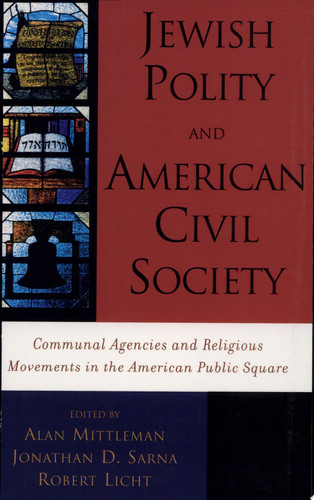
Jewish polity and American civil society: communal agencies and religious movements in the American public sphere

Alan Mittleman,Robert Licht,Jonathan D. Sarna
Jewish Polity and American Civil Society is a study of the civic and political engagements of American Jews as mediated by their communal and denominational institutions. The book explores how the various branches of the organized Jewish community seek to influence public affairs. Over the course of the last century, Jewish agencies and religious movements have tried to shape public debate and public policy on such issues as civil rights, church-state relations, and American foreign policy. The book sets the history of Jewish engagement in these areas into historical context; analyzes the motives, strategies, and tactics of various Jewish groups, and evaluates their successes and failures. The book also explores the underlying idea-the public philosophy-that informs American Jews' understanding of civic and political engagement.
Rowman & Littlefield 2002-07-23 420 pages

Insider/outsider: American Jews and multiculturalism

David Biale,Michael Galchinsky,Susannah Heschel
Twelve distinguished historians, political theorists, and literary critics present new perspectives on multiculturalism in this important collection. Central to the essays (all but one is appearing in print for the first time) is the question of how the Jewish experience can challenge the conventional polar opposition between a majority "white monoculture" and a marginalized "minorities of color multiculture." This book takes issue with such a dichotomy by showing how experiences of American Jews can undo conventional categories. Neither a complaint against multiculturalism by Jews who feel excluded from it, nor a celebration of multiculturalism as the solution to contemporary Jewish problems, Insider/Outsider explores how the Jews' anomalous status opens up multicultural history in different and interesting directions. The goal of the editors has been to transcend the notion of "comparative victimology" and to show the value of a narrative that does not rely on competing histories of persecution. Readers can discover in these essays arguments that will broaden their understanding of Jewish identity and multicultural theory and will enliven the contemporary debate about American culture generally. Twelve distinguished historians, political theorists, and literary critics present new perspectives on multiculturalism in this important collection. Central to the essays (all but one is appearing in print for the first time) is the question of how the Jewish experience can challenge the conventional polar opposition between a majority "white monoculture" and a marginalized "minorities of color multiculture." This book takes issue with such a dichotomy by showing how experiences of American Jews can undo conventional categories. Neither a complaint against multiculturalism by Jews who feel excluded from it, nor a celebration of multiculturalism as the solution to contemporary Jewish problems, Insider/Outsider explores how the Jews' anomalous status opens up multicultural history in different and interesting directions. The goal of the editors has been to transcend the notion of "comparative victimology" and to show the value of a narrative that does not rely on competing histories of persecution. Readers can discover in these essays arguments that will broaden their understanding of Jewish identity and multicultural theory and will enliven the contemporary debate about American culture generally.
University of California Press 1998 280 pages

Jewish emancipation: a history across five centuries

Sorkin, David Jan
The first comprehensive history of how Jews became citizens in the modern world For all their unquestionable importance, the Holocaust and the founding of the State of Israel now loom so large in modern Jewish history that we have mostly lost sight of the fact that they are only part of—and indeed reactions to—the central event of that history: emancipation. In this book, David Sorkin seeks to reorient Jewish history by offering the first comprehensive account in any language of the process by which Jews became citizens with civil and political rights in the modern world. Ranging from the mid-sixteenth century to the beginning of the twenty-first, Jewish Emancipation tells the ongoing story of how Jews have gained, kept, lost, and recovered rights in Europe, North Africa, the Middle East, the United States, and Israel. Emancipation, Sorkin shows, was not a one-time or linear event that began with the Enlightenment or French Revolution and culminated with Jews' acquisition of rights in Central Europe in 1867–71 or Russia in 1917. Rather, emancipation was and is a complex, multidirectional, and ambiguous process characterized by deflections and reversals, defeats and successes, triumphs and tragedies. For example, American Jews mobilized twice for emancipation: in the nineteenth century for political rights, and in the twentieth for lost civil rights. Similarly, Israel itself has struggled from the start to institute equality among its heterogeneous citizens. By telling the story of this foundational but neglected event, Jewish Emancipation reveals the lost contours of Jewish history over the past half millennium.
Princeton University Press 2021-09-14 511 pages

The Jewish past revisited: reflections on modern Jewish historians

David G. Myers,David N. Myers,Sady and Ludwig Kahn Professor of Jewish History David N Myers,David B. Ruderman,Rabbi David B Ruderman, PhD
In this new collection of essays, contemporary historians examine the ways earlier historians have framed, written, and "made" the Jewish past. Probing the ideology and methodology of their professional predecessors, American and Israeli historians offer new perspectives on some of the central figures of twentieth-century Jewish historiography, including Gershom Scholem, S. D. Goitein, Yitzhak Baer, Elias Bickerman, and Cecil Roth, as well as the Israeli "New Historians." Through their critical examinations of the construction of the Jewish past, the contributors to this volume develop important insights into current attitudes toward the dominant canons and ideals of historical scholarship and the future of historiography. They shine new light on the formation of a historical worldview and the "making" of history.
Yale University Press 1998 244 pages

The enduring community: the Jews of Newark and MetroWest

Helmreich, William B.
From its founding in the late seventeenth century, Newark, New Jersey, was a vibrant and representative center of Jewish life in America. Geographically and culturally situated between New York City and its outlying suburbs, Newark afforded Jewish residents the advantages of a close-knit community along with the cultural abundance and social dynamism of urban life. In Newark, all of the representative stages of modern Jewish experience were enacted, from immigration and acculturation to upward mobility and community building. The Enduring Community is a lively and evocative social history of the Jewish presence in Newark as well as an examination of what Newark tells us about social assimilation, conflict and change. Grounded in documentary research, the volume makes extensive use of interviews and oral histories. The author traces the growth of the Jewish population in the pre-Revolutionary period to its settlement of German Jews in the 1840s and Eastern European Jews in the 1880s. Helmreich delineates areas of contention and cooperation between these groups and relates how an American identity was eventually forged within the larger ethnic mix of the city. Jewish population in politics, the establishment of Jewish schools, synagogues, labor unions, charities, and community groups are described together with cultural and recreational life. Despite the formal and emotional bonds that formed over a century, Jewish neighborhoods in Newark did not survive the postwar era. The trek to the suburbs, the erosion of Newark's tax base, and deteriorating services accelerated a movement outward that mirrored the demographic patterns of cities across America. By the time of the Newark riots in 1967, the Jewish presence was largely absent. This volume reclaims a lost history and gives personalized voice to the dreams, aspirations, and memories of a dispersed community. It demonstrates how former Newarkers built new Jewish communities in the surrounding suburbs, an area dubbed "MetroWest" by Jewish leaders. The Enduring Community is must reading for students of Jewish social history, sociologists, urban studies specialists, and readers interested in the history of New Jersey. The book includes archival photographs form the periods discussed.
Transaction Publishers 1999 373 pages