

449 results for "Business"

Fight Back! And Don't Get Ripped Off
Book by Horowitz, David

Higher Education? How Colleges Are Wasting Our Money and Failing Our Kids---and What We Can Do About It
A quarter of a million dollars. It's the going tab for four years at most top-tier colleges. Why does it cost so much and is it worth it? In this provocative investigation, the renowned sociologist Andrew Hacker and New York Times writer Claudia Dreifus make an incisive case that the American way of higher education—now a $420 billion-per-year business—has lost sight of its primary mission: the education of our young people. They probe the true performance of the Ivy League, the baleful influence of tenure, an unhealthy reliance on part-time teachers, and supersized bureaucracies which now have lives of their own. Hacker and Dreifus take readers from Princeton and Harvard to Evergreen State, revealing those institutions that need to adjust their priorities and others that are getting it right, proving that learning can be achieved—and at a much more reasonable price. Higher Education? is a wake-up call and a call to arms.

Principles of Macroeconomics
This book presents concepts logically an intuitively, and avoids excessive reliance on mathematical formulations. Short-run macroeconomic concepts are covered first, before moving on to long-run macroeconomic principles. Students are taught to 'think like an economist' using familiar everyday examples and to apply economic principles in order to understand and explain the world today.

Unlabel Selling You Without Selling Out
From one of the most provocative entrepreneurs of our time, Marc Ecko reveals his formula for building an authentic brand or business in a compelling how-to guide that’s perfect to “educate the next generation of dreamers” ( Kirkus Reviews ). As instructive as it is innovative, Unlabel empowers you to channel your creativity, find the courage to defy convention, and summon the confidence to act and compete in any environment. This visual blueprint teaches you how to grow both creatively and commercially by testing your personal brand against the principles of the Authenticity Formula. Marc Ecko shares the bruising mistakes and remarkable triumphs that reveal the truth behind his success, growing from a misfit kid airbrushing T-shirts in his parents’ garage to the bold creator of two hugely successful branded platforms—Ecko Unltd. and Complex Media. As Ecko explains, it’s not enough to simply merge your inner artist with business savvy, you must understand the anatomy of a brand, starting with its authentic spine. With Unlabel , you will discover your own voice by overcoming fear, take action and deliver on your promises, understand why failure is essential, learn how your product or service makes people feel, and recognize if your nostalgia for the past is hampering your ability to envision your future. Unlabel provides a bold and honest approach to building an authentic personal brand, and a roadmap for growing a bootstrap start-up into a sustainable business.

Evolutionary Psychology in the Business Sciences
All individuals who operate in the business sphere, whether as consumers, employers, employees, entrepreneurs, or financial traders to name a few constituents, share a common biological heritage and are defined by a universal human nature. As such, it is surprising that so few business scholars have incorporated biological and evolutionary-informed theories within their conceptual toolboxes. This edited book addresses this lacuna by culling chapters at the intersection of the evolutionary behavioral sciences and specific business contexts including in marketing, consumer behavior, advertising, innovation and creativity, intertemporal choice, negotiations, competition and cooperation in organizational settings, sex differences in workplace patterns, executive leadership, business ethics, store design, behavioral decision making, and electronic communication. To reword the famous aphorism of T. G. Dobzhansky, nothing in business makes sense except in the light of evolution.

Soccernomics
Why do England lose? Why does Scotland suck? Why doesn't America dominate the sport internationally...and why do the Germans play with such an efficient but robotic style? These are questions every soccer aficionado has asked. Soccer nomics answers them. Using insights and analogies from economics, statistics, psychology, and business to cast a new and entertaining light on how the game works, Soccer nomics reveals the often surprisingly counterintuitive truths about soccer. An essential guide for the 2010 World Cup, Soccer nomics is a new way of looking at the world's most popular game.

Football for a Buck The Crazy Rise and Crazier Demise of the USFL
From Jeff Pearlman--the New York Times best-selling author of Three Ring Circus--comes the rollicking, outrageous story of the USFL, full of larger-than-life characters and you-can't-make-this-up stories featuring some of the biggest celebrities and buffoons in the game. The United States Football League--known fondly to millions of sports fans as the USFL--did not merely challenge the NFL, but cause its owners and executives to collectively shudder. In its three seasons from 1983-85, it secured multiple television deals, drew millions of fans and launched the careers of legends such as Steve Young, Jim Kelly, Herschel Walker, and Reggie White. But then it died beneath the weight of a particularly egotistical and bombastic team owner--a New York businessman named Donald J. Trump. In Football for a Buck, Jeff Pearlman draws on more than four hundred interviews to unearth all the salty, untold stories of one of the craziest sports entities to have ever captivated America. From 1980s drug excess to airplane brawls and player-coach punch outs, to backroom business deals and some of the most enthralling and revolutionary football ever seen, Pearlman transports readers back in time to this crazy, boozy, audacious, unforgettable era of the game. He shows how fortunes were made and lost on the backs of professional athletes and how, forty years ago, Trump was already a scoundrel and a spoiler. For fans of Terry Pluto's Loose Balls or Jim Bouton's Ball Four and of course Pearlman's own stranger-than-fiction narratives, Football for a Buck is sports as high entertainment--and a cautionary tale of the dangers of ego and excess.

Sex Money Kiss
Gene Simmons' autobiography, KISS and Make-Up, was a New York Times bestseller. Here is the long-anticipated follow-up in which Simmons explains the bad deals he made along the way, the reasoning behind everything he did, and the value of hard work, long hours, and dedication to the cause. He is brutally candid, smart, shocking, shameless, insightful, in-your-face, bizarre, crude, pragmatic, human, sympathetic, and wholesome, all at the same time! Kiss, Money and Girls is the perfect business book for our times.

Three Days at Camp David How a Secret Meeting in 1971 Transformed the Global Economy
The former dean of the Yale School of Management and Undersecretary of Commerce in the Clinton administration chronicles the 1971 August meeting at Camp David, where President Nixon unilaterally ended the last vestiges of the gold standard--breaking the link between gold and the dollar--transforming the entire global monetary system. Over the course of three days--from August 13 to 15, 1971--at a secret meeting at Camp David, President Richard Nixon and his brain trust changed the course of history. Before that weekend, all national currencies were valued to the U.S. dollar, which was convertible to gold at a fixed rate. That system, established by the Bretton Woods Agreement at the end of World War II, was the foundation of the international monetary system that helped fuel the greatest expansion of middle-class prosperity the world has ever seen. In making his decision, Nixon shocked world leaders, bankers, investors, traders and everyone involved in global finance. Jeffrey E. Garten argues that many of the roots of America's dramatic retrenchment in world affairs began with that momentous event that was an admission that America could no longer afford to uphold the global monetary system. It opened the way for massive market instability and speculation that has plagued the world economy ever since, but at the same time it made possible the gigantic expansion of trade and investment across borders which created our modern era of once unimaginable progress. Based on extensive historical research and interviews with several participants at Camp David, and informed by Garten's own insights from positions in four presidential administrations and on Wall Street, Three Days at Camp David chronicles this critical turning point, analyzes its impact on the American economy and world markets, and explores its ramifications now and for the future.

World Without Mind
Over the past few decades there has been a revolution in terms of who controls knowledge and information. This rapid change has imperilled the way we think. Without pausing to consider the cost, the world has rushed to embrace the products and services of four titanic corporations. We shop with Amazon; socialise on Facebook; turn to Apple for entertainment; and rely on Google for information. These firms sell their efficiency and purport to make the world a better place, but what they have done instead is to enable an intoxicating level of daily convenience. As these companies have expanded, marketing themselves as champions of individuality and pluralism, their algorithms have pressed us into conformity and laid waste to privacy. They have produced an unstable and narrow culture of misinformation, and put us on a path to a world without private contemplation, autonomous thought, or solitary introspection - a world without mind. In order to restore our inner lives, we must avoid being co-opted by these gigantic companies, and understand the ideas that underpin their success. Elegantly tracing the intellectual history of computer science - from the Descartes and the enlightenment to Alan Turing to Stuart Brand and the hippie origins of today's Silicon Valley - Foer exposes the dark underpinnings of our most idealistic dreams for technology. The corporate ambitions of Google, Facebook, Apple, and Amazon, he argues, are trampling longstanding liberal values, especially intellectual property and privacy. This is a nascent stage in the total automation and homogenization of social, political, and intellectual life. By reclaiming our private authority over how we intellectually engage with the world, we have the power to stem the tide. At stake is nothing less than who we are, and what we will become. There have been monopolists in the past but today's corporate giants have far more nefarious aims. They're monopolists who want access to every facet of our identities and influence over every corner of our decision-making. Until now few have grasped the sheer scale of the threat. Foer explains not just the looming existential crisis but the imperative of resistance.

Millionaire Republican Why Rich Republicans Get Rich--and How You Can Too!
The key to becoming a millionaire republican is to do the opposite of what the masses do. These counterintuitive rules show how to harness the current political, business, and social winds to create a unique plan for success.

Never Leave Well Enough Alone
Never Leave Well Enough Alone, first published in 1951, is the classic introduction to modern industrial design by the 'father' of the movement - Raymond Loewy. Loewy (1893-1986) was responsible for transforming thousands of everyday objects into streamlined masterpieces, many of which are still popular and in-use in daily life today. Examples include corporate logos; packaging for Lucky Strike cigarettes and Pepsodent toothpaste; Studebaker and Greyhound automotive and bus design; buildings and household furnishings; and appliances such as toasters and refrigerators. This new reprint edition is formatted to Loewy's original design of 6 inches by 7 inches - his first foray into book design; and is illustrated throughout with drawings and photographic examples of his work.

Data Science and Digital Business
This book combines the analytic principles of digital business and data science with business practice and big data. The interdisciplinary, contributed volume provides an interface between the main disciplines of engineering and technology and business administration. Written for managers, engineers and researchers who want to understand big data and develop new skills that are necessary in the digital business, it not only discusses the latest research, but also presents case studies demonstrating the successful application of data in the digital business.

Microtrends The Small Forces Behind Tomorrow's Big Changes
The adviser to Senator Hillary Clinton, Bill Gates, and President Bill Clinton proves that small is big by identifying 75 hidden-in-plain-sight trends that are moving America, revealing that the nation is no longer a melting pot but a collection of communities with many individual tastes and lifestyles. "The ideas in his book will help you see the world in a new way." --Bill Clinton "Mark Penn has a keen mind and a fascinating sense of what makes America tick, and you see it on every page of Microtrends ." --Bill Gates In 1982, readers discovered Megatrends . In 2000, The Tipping Point entered the lexicon. Now, in Microtrends , one of the most respected and sought-after analysts in the world articulates a new way of understanding how we live. Mark Penn, the man who identified "Soccer Moms" as a crucial constituency in President Clinton's 1996 reelection campaign, is known for his ability to detect relatively small patterns of behavior in our culture-microtrends that are wielding great influence on business, politics, and our personal lives. Only one percent of the public, or three million people, is enough to launch a business or social movement. Relying on some of the best data available, Penn identifies more than 70 microtrends in religion, leisure, politics, and family life that are changing the way we live. Among them: People are retiring but continuing to work. Teens are turning to knitting. Geeks are becoming the most sociable people around. Women are driving technology. Dads are older than ever and spending more time with their kids than in the past. You have to look at and interpret data to know what's going on, and that conventional wisdom is almost always wrong and outdated. The nation is no longer a melting pot. We are a collection of communities with many individual tastes and lifestyles. Those who recognize these emerging groups will prosper. Penn shows readers how to identify the microtrends that can transform a business enterprise, tip an election, spark a movement, or change your life. In today's world, small groups can have the biggest impact.

Other People's Money and How The Bankers Use It
Louis D. Brandeis was a Supreme Court Justice and a patriot. He wrote "Other People's Money and How Bankers Use It" to warn the American people about the greedy bankers that control the United States and drive us into financial ruin. The book attacked the use of investment funds to promote the consolidation of various industries under the control of a small number of corporations, which Brandeis alleged were working in concert to prevent competition. Brandeis harshly criticized investment bankers who controlled large amounts of money deposited in their banks by middle-class people. The heads of these banks, Brandeis pointed out, routinely sat on the boards of railroad companies and large industrial manufacturers of various products, and routinely directed the resources of their banks to promote the interests of their own companies. These companies, in turn, sought to maintain control of their industries by crushing small businesses and stamping out innovators who developed better products to compete against them. Brandeis supported his contentions with a discussion of the actual dollar amounts--in millions of dollars--controlled by specific banks, industries, and industrialists such as J. P. Morgan, noting that these interests had recently acquired a far larger proportion of American wealth than corporate entities had ever had before. He extensively cited testimony from a Congressional investigation performed by the Pujo Committee, named after Louisiana Representative Arsène Pujo, into self-serving and monopolistic business dealing. Chapter V of the book ("What Publicity Can Do") contains in its opening section a well-known line that has frequently been cited in support of regulation through disclosure obligations: "Sunlight is said to be the best of disinfectants; electric light the most efficient policeman."

Gold Standard How to Rock the World and Run an Empire
The cofounder of True Religion Brand Jeans, Kym Gold uses her story to serve up a firm dose of life and career lessons that helped her build a multimillion-dollar fashion brand from the ground up. Kym Gold’s mantra, “never settle for a no; always look for a yes,” is what led her to co-create True Religion Brand Jeans, a major retail clothing company that sold for close to a billion dollars in 2013. In Gold Standard, Kym finally gives her side of the story of how the once fledgling jeans company that nobody wanted, went on to become a giant revolutionizing player in the fashion industry. As a woman in the boys’ club world of the fickle fashion business, Kym armed herself and became one of True Religion’s majority shareholders and their lead female clothing designer. On Valentine’s Day in 2007, she was served divorce papers by her then husband and had her company ripped from under her—all within an hour. Since then, she has reestablished her place in the industry and catapulted herself into the coveted 1 percent of the richest Americans. In Gold Standard , Kym’s savvy business and fashion branding experience of thirty years gives a behind-the-scenes look into the always changing fashion industry. It also mixes in her compelling personal journey, including her marriage to Mark Burnett before he became TV's biggest mega producer, a compassionate view for women of the pressures of balancing a career, finances, and family. Kym motivates readers to throw the gold gloves on and put up a fight.

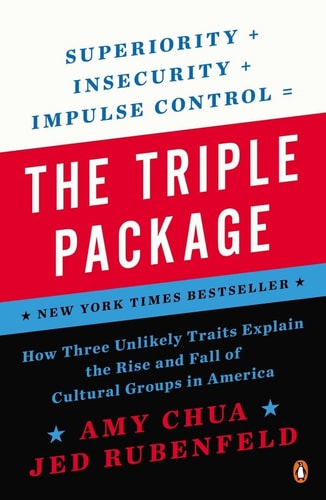
The Triple Package How Three Unlikely Traits Explain the Rise and Fall of Cultural Groups in America
"That certain groups do much better in America than others — as measured by income, occupational status, test scores, and so on — is difficult to talk about. In large part this is because the topic feels racially charged. The irony is that the facts actually debunk racial stereotypes. There are black and Hispanic subgroups in the United States far outperforming many white and Asian subgroups. Moreover, there’s a demonstrable arc to group success — in immigrant groups, it typically dissipates by the third generation — puncturing the notion of innate group differences and undermining the whole concept of 'model minorities.'" Mormons have recently risen to astonishing business success. Cubans in Miami climbed from poverty to prosperity in a generation. Nigerians earn doctorates at stunningly high rates. Indian and Chinese Americans have much higher incomes than other Americans; Jews may have the highest of all. Why do some groups rise? Drawing on groundbreaking original research and startling statistics, The Triple Package uncovers the secret to their success. A superiority complex, insecurity, impulse control—these are the elements of the Triple Package, the rare and potent cultural constellation that drives disproportionate group success. The Triple Package is open to anyone. America itself was once a Triple Package culture. It’s been losing that edge for a long time now. Even as headlines proclaim the death of upward mobility in America, the truth is that the old-fashioned American Dream is very much alive—but some groups have a cultural edge, which enables them to take advantage of opportunity far more than others. • Americans are taught that everyone is equal, that no group is superior to another. But remarkably, all of America’s most successful groups believe (even if they don’t say so aloud) that they’re exceptional, chosen, superior in some way. • Americans are taught that self-esteem—feeling good about yourself—is the key to a successful life. But in all of America’s most successful groups, people tend to feel insecure, inadequate, that they have to prove themselves. • America today spreads a message of immediate gratification, living for the moment. But all of America’s most successful groups cultivate heightened discipline and impulse control. But the Triple Package has a dark underside too. Each of its elements carries distinctive pathologies; when taken to an extreme, they can have truly toxic effects. Should people strive for the Triple Package? Should America? Ultimately, the authors conclude that the Triple Package is a ladder that should be climbed and then kicked away, drawing on its power but breaking free from its constraints. Provocative and profound, The Triple Package will transform the way we think about success and achievement.
Isn't it obvious
This book does for retail what Goldratt's International best-seller did for manufacturing. A breakthrough solution is exposed when some unexpected events force Caroline and Paul, a married couple working for their family's retail business, to make a few small changes in the way things are done. A solution that propels the family's regional chain of stores into a very profitable, rapidly growing, international enterprise. If there is a hint of Jonah, from THE GOAL, reappearing in this novel, it is Henry, the soon-to-retire president and majority owner of the company who logically states that, if you do not deal directly with the core problem, don't expect significant improvement. Eli Goldratt's Theory of Constraints is woven throughout this book but answers are not handed to you. The reader, along with the characters in the book, work through the process together to discover solutions.

Take on the Street How to Fight for Your Financial Future
Arthur Levitt -- chmn. of the Securities & Exchange Comm. (SEC) for 8 years under Pres. Clinton -- provides the best kind of insider information: the kind that can help honest small investors protect themselves from the deliberately confusing ways of Wall Street. Levitt offers the benefits of his own experience, both on Wall Street & as its chief regulator. His straight talk about the ways of stockbrokers (they are salesmen, plain & simple), corporate financial statements (the truth is often hidden), mutual fund managers (remember who they really work for), & other aspects of the business will help to arm everyone with the tools they need to protect -- & enhance -- their financial future. This book is clear & informative; the analysis of investor alternatives is jargon-free.
