898 results for "Evolution"

Michael Jackson's Complete Guide To Single Malt Scotch

Michael Jackson
Michael Jackson is renowned for his pithy wisdom and a remarkable ability to evoke aromas and flavors. This fully revised and expanded edition of Michael Jackson's Complete Guide to Single Malt Scotch is the definitive guide to single malt whisky and its producers worldwide. The completely new introduction incorporates Jackson's most recent research on the origins and evolution of the “water of life,” the nature of aromas and flavors, and regional differences. The book's core is the comprehensive A-to-Z of single malts, arranged by distillery. Each entry offers a new introduction and key information, and features Jackson's evocative, highly regarded tasting notes and ratings. This edition features a refreshed design, specially commissioned photographs of distilleries, and more than 1,000 tasting notes.
Running Press 2004-08-04 448 pages

Emotional

Mlodinow, Leonard
You make hundreds of decisions every day, from what to eat for breakfast to how you should invest, and not one of those decisions would be possible without emotion. It has long been said that thinking and feeling are separate and opposing forces in our behavior. But as Leonard Mlodinow, the best-selling author of Subliminal, tells us, extraordinary advances in psychology and neuroscience have proven that emotions are as critical to our well-being as thinking. How can you connect better with others? How can you make sense of your frustration, fear, and anxiety? What can you do to live a happier life? The answers lie in understanding your emotions. Journeying from the labs of pioneering scientists to real-world scenarios that have flirted with disaster, Mlodinow shows us how our emotions can help, why they sometimes hurt, and what we can learn in both instances. Using deep insights into our evolution and biology, Mlodinow gives us the tools to understand our emotions better and to maximize their benefits. Told with his characteristic clarity and fascinating stories, Emotional explores the new science of feelings and offers us an essential guide to making the most of one of nature's greatest gifts.[Bokinfo]
Random House US 2023-02-14 272 pages

Your Move What Board Games Teach Us about Life

Jonathan Kay,Joan Moriarity
The great board game revolution is here-- What do these games tell us about our society, our relationships, and ourselves? "Games, Jonathan Kay and Joan Moriarity show in this lively and insightful book, are not just fun and games: they allow us to explore the complexities of the world, from evolution to war to climate." - STEVEN PINKER, Johnstone Professor of Psychology, Harvard University, and author of Enlightenment Now: The Case for Reason, Science, Humanism, and Progress "Kay and Moriarity are both skilled writers and elucidators, and their voices are distinct enough to provide the book with a pleasing yin and yang. It's a far more perceptive and intriguing book than it appears at first blush, particularly for those readers who have never thought of games as an artistic medium - at least not one that comments on society." - KIRKUS REVIEWS Board games are among our most ancient and beloved art forms. During the rise of digital media, they fell from prominence for a decade or two but today they are in a new golden age. They're ingeniously designed, beautiful to look at, and exhilarating to play. Games are reclaiming their place in our culture, as entertainment, social activity, and intellectual workout equipment. Alone among all art forms, games require their audience (called "players") to participate. If nobody's playing, there is no game. As a result, games can tell far more about us than our TV shows, movies or music ever could. How does The Game of Life illustrate our changing attitudes about virtue? How does a World War II conflict simulation game explain the shortcomings of a failed novelist? Each chapter of Your Move examines one game, and what it reveals about our culture, history, society, and relationships. The book's two co-authors bring the perspectives of a writer who plays, and a player who writes. Before Jonathan Kay began his distinguished career as an author and commentator, he had a passion for games, and in recent years he has rediscovered them. Meanwhile, Joan Moriarity's career has been spent designing, developing, distributing, art directing, recommending and teaching board games and, recently, writing about them for a wider audience. With its short, punchy essays, and beautiful photographs of the games themselves, every chapter will be a worthwhile read in itself, and the book overall will leave you inspired to discover the truths of your own inner and outer world through play -- whether you're a seasoned veteran or a total newcomer.
Sutherland House Incorporated 2019-09-11 180 pages

Before European hegemony: the world system A. D. 1250-1350

Abu-Lughod, Janet L.
In this important study, Abu-Lughod presents a groundbreaking reinterpretation of global economic evolution, arguing that the modern world economy had its roots not in the sixteenth century, as is widely supposed, but in the thirteenth century economy--a system far different from the European world system which emerged from it. Using the city as the working unit of analysis, Before European Hegemony provides a new paradigm for understanding the evolution of world systems by tracing the rise of a system that, at its peak in the opening decades of the 14th century, involved a vast region stretching between northwest Europe and China. Writing in a clear and lively style, Abu-Lughod explores the reasons for the eventual decay of this system and the rise of European hegemony.
Oxford University Press 1989 443 pages

It's been a good life

Asimov, Isaac
New one-volume autobiography spans Asimov's life for the first time!As one of the most gifted and prolific writers of the twentieth century, Isaac Asimov became legendary for his inexhaustible creativity, wide-ranging intellectual curiosity, and talent for explaining complex subjects in clear, concise prose. While regaling his readers with an incredible opus of almost five hundred entertaining and illuminating science fiction and nonfiction books, he also found time to write a three-volume autobiography. Now these volumes have been condensed into one by Asimov's wife, Janet, who also shares excerpts from letters he wrote to her. Together these writings provide an intimate portrait of a creative genius whose love of learning and playing with ideas is evident on every page. Reading this autobiography is like sitting down with Isaac Asimov and experiencing his witty, engaging, and brilliant personality firsthand. We are treated to many marvelous stories about his upbringing in Depression-era Brooklyn, his early fascination with the new science fiction pulp magazines, the thrill of his first published story, the creation of his well-known story "Nightfall," the genesis of the Foundation series, and the evolution of his creative life as a writer. He also reveals his inner thoughts about and experiences with various luminaries in science and science fiction. Above all, Asimov's autobiography conveys unbounded enthusiasm for his craft, the infectious joy of learning and creating, complete intellectual honesty, his strong humanist convictions, and his infinite fund of good humor and optimism even at the end of his life - all told in the lively clear writing style that was his trademark. Although Janet Jeppson Asimov concludes this work with a shocking revelation about her husband's death, the volume is clearly intended as a celebration - as the title suggests - of a wonderful, creative life. As a poignant coda to this work, Janet has appended one short story that was Isaac's favorite, and his 400th essay on this thoughts about science.
Prometheus Books 2002 309 pages

Escaping the Delta: Robert Johnson and the invention of the blues

Wald, Elijah
Robert Johnson's story presents a fascinating paradox: Why did this genius of the Delta blues excite so little interest when his records were first released in the 1930s? And how did this brilliant but obscure musician come to be hailed long after his death as the most important artist in early blues and a founding father of rock 'n' roll? Elijah Wald provides the first thorough examination of Johnson's work and makes it the centerpiece for a fresh look at the entire history of the blues. He traces the music's rural folk roots but focuses on its evolution as a hot, hip African-American pop style, placing the great blues stars in their proper place as innovative popular artists during one of the most exciting periods in American music. He then goes on to explore how the image of the blues was reshaped by a world of generally white fans, with very different standards and dreams. The result is a view of the blues from the inside, based not only on recordings but also on the recollections of the musicians themselves, the African-American press, and original research. Wald presents previously unpublished studies of what people on Delta plantations were actually listening to during the blues era, showing the larger world in which Johnson's music was conceived. What emerges is a new respect and appreciation for the creators of what many consider to be America's deepest and most influential music.Wald also discusses how later fans formed a new view of the blues as haunting Delta folklore. While trying to separate fantasy from reality, he accepts that neither the simple history nor the romantic legend is the whole story. Each has its own fascinating history, and it is these twin histories that inform this book.
HarperCollins 2005 342 pages

The New Yorker encyclopedia of cartoons

Remnick, David
This monumental, two-volume, slip-cased collection includes nearly 10 decades worth of New Yorker cartoons selected and organized by subject with insightful commentary by Bob Mankoff and a foreword by David Remnick. The is the most ingenious collection of New Yorker cartoons published in book form, The New Yorker Encyclopedia of Cartoons is a prodigious, slip-cased, two-volume, 1,600-page A-to-Z curation of cartoons from the magazine from 1924 to the present. Mankoff--for two decades the cartoon editor of the New Yorker--organizes nearly 3,000 cartoons into more than 250 categories of recurring New Yorker themes and visual tropes, including cartoons on banana peels, meeting St. Peter, being stranded on a desert island, snowmen, lion tamers, Adam and Eve, the Grim Reaper, and dogs, of course. The result is hilarious and Mankoff's commentary throughout adds both depth and whimsy. The collection also includes a foreword by New Yorker editor David Remnick. This is stunning gift for the millions of New Yorker readers and anyone looking for some humor in the evolution of social commentary.
Black Dog and Leventhal Publishers 2018-10-02 760 pages

How are we to live?

Singer, Peter
This assessment of human nature and society suggests that people who take an ethical approach to life often escape from the trap of meaninglessness so prevalent in modern society, finding instead a deeper satisfaction in what they do than those whose goals are narrower and more self-centred. In spelling out what he means by an ethical approach to life, Peter Singer also challenges the view that selfishness is an evolutionary inevitability.
Mandarin 1994 262 pages

Science ink: tattoos of the science obsessed

Zimmer, Carl
"This mind-blowing illustrated collection showcases hundreds of tattoos dedicated to numerous scientific arenas, from evolutionary biology and neuroscience to mathematics and astrophysics, with a brief note from each inked individual highlighting the reasons for selecting the tattoo. Best of all, each example is a leaping-off point for best-selling science essayist and lecturer Zimmer to muse about the subject, whether it's the importance of a tattoo of Darwin's finches or the significance of the uranium atom inked into the chest of a young radiologist"--
Sterling 2014 271 pages

Entre nous

Lévinas, Emmanuel
Entre Nous is a major collection of essays representing the culmination of Emmanuel Levinas's philosophy. Bringing together his most important work in a single volume the book reveals the development of his thought over nearly forty years of committed inquiry. Here he engages with issues of suffering, love, religion, culture, justice, human rights, and legal theory and each issue is discussed in relation to the ethical dimensions of otherness. Like much of his work this text bridges several major gaps in the evolution of Continental philosophy, between modernism and postmodernism, phenomenology and poststructuralism, ethics and ontology.
Bloomsbury Academic 2017 230 pages

Unstoppable us: volume 2: why the world isn't fair

Harari, Yuval N.
Something really strange happened 10,000 years ago, and it changed everything. Why did millions of people agree to obey a few leaders? Where did kings and kingdoms come from? The answer to that is one of the strangest tales you'll ever hear. And it's a true story. Have you ever wondered how we got here? From gathering berries and hunting mammoths, to shopping at supermarkets and letting people tell us what to do? You might hear a lot of people say 'the world isn't fair'. But why isn't it? And how did it become so? In Unstoppable Us- Volume 1 , we learned how humans told stories to become rulers of the world - for good and bad. Now, in this next chapter of the incredible true tale of the Unstoppables, find out how humans learned to control animals like dogs, chicken and cows . . . And how a handful of humans learned to control everyone else. With full-colour illustrations showing the relentless rise and rise of the human race, this is history like you've never experienced it before.
Puffin Books 2024-03-07 187 pages

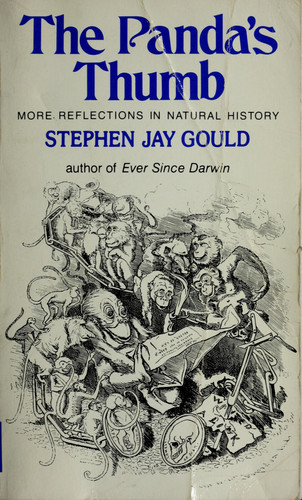
The panda's thumb: more reflections in natural history

Gould, Stephen Jay
A collection of essays by reknown scientist Jay Stephen Gould drawn from his columns in Natural History. The essays deal with topics such as: evolutionary opportunism (nature is a tinkerer, making the most of what's available in the course of adapting to the environment); new information on Darwin and his contemporaries; racism and cultural relativism; the evolutionary pattern of sudden rapid change; the origin of birds or the warm-bloodedness of dinosaurs; and, Teilhard de Chardin as a co-conspirator in the Piltdown hoax.
Norton 1980 343 pages

Ever since Darwin: reflections in natural history

Gould, Stephen Jay
More than any other modern scientists, Stephen Jay Gould has opened up to millions the wonders of evolutionary biology. His genius as an essayist lies in his unmatched ability to use his knowledge of the world, including popular culture, to illuminate the realm of science. Ever Since Darwin, Stephen Jay Gould's first book, has sold more than a quarter of a million copies. Like all succeeding collections by this unique writer, it brings the art of the scientific essay to unparalleled heights.
Norton 1979 285 pages

The tangled bank: an introduction to evolution

Zimmer, Carl
"The Tangled Bank is the first textbook about evolution intended for the general reader. Zimmer, an award-winning science writer, takes readers on a fascinating journey into the latest discoveries about evolution. In the Canadian Arctic, paleontologists unearth fossils documenting the move of our ancestors from sea to land. In the outback of Australia, a zoologist tracks some of the world's deadliest snakes to decipher the 100-million-year evolution of venom molecules. In Africa, geneticists are gathering DNA to probe the origin of our species. In clear, non-technical language, Zimmer explains the central concepts essential for understanding new advances in evolution, including natural selection, genetic drift, and sexual selection. He demonstrates how vital evolution is to all branches of modern biology-from the fight against deadly antibiotic-resistant bacteria to the analysis of the human genome. Richly illustrated with 285 illustrations and photographs, The Tangled Bank is essential reading for anyone who wants to understand the history of life on Earth."-- Publisher's description.
Roberts and Co. Publishers 2010 385 pages

Democracies in flux: the evolution of social capital in contemporary society

Putnam, Robert D.
In his national bestseller Bowling Alone, Robert Putnam illuminated the decline of social capital in the US. Now, in Democracies in Flux, Putnam brings together a group of leading scholars who broaden his findings as they examine the state of social capital in eight advanced democracies around the world. The book is packed with many intriguing revelations. The contributors note, for instance, that waning participation in unions, churches, and political parties seems to be virtually universal, a troubling discovery as these forms of social capital are especially important for empowering less educated, less affluent portions of the population. Indeed, in general, the researchers found more social grouping among the affluent than among the working classes and they find evidence of a younger generation that is singularly uninterested in politics, distrustful both of politicians and of others, cynical about public affairs, and less inclined to participate in enduring social organizations. Yet social capital appears as strong as ever in Sweden, where 40% of the adult population participate in "study circles"--small groups who meet weekly for educational discussions. Social capital--good will, fellowship, sympathy, and social intercourse--is vitally important both for the health of our communities and for our own physical and psychological well being. Offering a panoramic look at social capital around the world, this book makes an important contribution to our understanding of these phenomena and why they are important in today's world.
Oxford University Press 2004 516 pages

The Evolution Of Physics

Albert Elnstein,Leopold Infeld
This work has been selected by scholars as being culturally important, and is part of the knowledge base of civilization as we know it. This work is in the "public domain in the United States of America, and possibly other nations. Within the United States, you may freely copy and distribute this work, as no entity (individual or corporate) has a copyright on the body of the work. Scholars believe, and we concur, that this work is important enough to be preserved, reproduced, and made generally available to the public. We appreciate your support of the preservation process, and thank you for being an important part of keeping this knowledge alive and relevant.
Creative Media Partners, LLC 2022-10-26 342 pages