883 results for "History"

The beginnings of Jewishness: boundaries, varieties, uncertainties

Cohen, Shaye J. D.
In modern times, various Jewish groups have argued whether Jewishness is a function of ethnicity (membership in a descent group, a function of birth), nationality (citizenship in a state, a function of politics), religion (membership in a group characterized by various beliefs and practices), or all three. These fundamental conceptions were already in place in antiquity; the peculiar combination of ethnicity, nationality, and religion that would characterize Jewishness through the centuries first took shape in the second century B.C.E. This book studies the ways in which these elements were understood and applied in the construction of Jewish identity - by Jews, by gentiles and by the state - in such a way that the question "Who was a Jew?" could be variously answered.
University of California Press 1999 426 pages

When light pierced the darkness: Christian rescue of Jews in nazi-occupied Poland

Tec, Nechama
Everyone knows the name of Anne Frank but few people remember anything about the people who sheltered her. Who were the rescuers and what motivated them to risk their lives for persecuted Jews? Clearly such people deserve to be remembered and honored. And clearly an understanding of their motivations may help us cultivate such behavior in our own day. This book focuses on such "righteous Christians." Tec, herself a Holocaust survivor helped by Christians, vividly recreates through hundreds of cases what it was like to pass and hide among Christians and what it was like to rescue Jews. Limiting her compass to Poland, where anti-Semitism was particularly extreme, the author interviewed dozens of people now living in many lands and also examined a vast array of published accounts and unpublished testimonies yielding case histories of over 500 Polish helpers. As the book preserves for posterity the heroism of such people as Celka, the impoverished governess, and her paralyzed father, who took into their one-room apartment a Jewish child, refused to baptize her without her family's permission, and even fed her before they themselves ate, or Dr. Felix Kabus, who developed and frequently performed an operation that camouflaged circumcision, or the famous anti-Semitic author who wrote publicly about what was happening to the Jews, the book fills a gap in our knowledge of the Holocaust.
Oxford University Press 1986 262 pages

Revolutionary Jews from Spinoza to Marx: the fight for a secular world of universal and equal rights

Israel, Jonathan
"In the eighteenth and early nineteenth centuries a small but conspicuous fringe of the Jewish population became the world's most resolute, intellectually driven, and philosophical revolutionaries, among them the pre-Marxist Karl Marx. Yet the roots of their alienation from existing society and determination to change it extend back to the very heart of the Enlightenment, when Spinoza and other philosophers living in a rigid, hierarchical society colored by a deeply hostile theology first developed a modern revolutionary consciousness. Leading intellectual historian Jonathan Israel shows how the radical ideas in the early Marx's writings were influenced by this legacy, which, he argues, must be understood as part of the Radical Enlightenment. He traces the rise of a Jewish revolutionary tendency demanding social equality and universal human rights throughout the Western world. Israel considers how these writers understood Jewish marginalization and ghettoization and the edifice of superstition, prejudice, and ignorance that sustained them. He investigates how the quest for Jewish emancipation led these thinkers to formulate sweeping theories of social and legal reform that paved the way for revolutionary actions that helped change the world from 1789 onward-but hardly as they intended"--
University of Washington Press 2021 549 pages

Golden harvest: events at the periphery of the Holocaust

Gross, Jan Tomasz
The starting point of Jan Tomasz and Irena Grudzinska Gross's Golden Harvest, this haunting photograph in fact depicts a group of peasants--"diggers"--atop a mountain of ashes at Treblinka, where some 800,000 Jews were gassed and cremated. The diggers are searching for gold and precious stones that Nazi executioners may have overlooked. The story captured in this grainy black-and-white photograph symbolizes the vast, continent-wide plunder of Jewish wealth that went hand-in-hand with the Holocaust. The seizure of Jewish assets during World War II occasionally generates widespread attention when Swiss banks are challenged to produce lists of dormant accounts, or national museums are forced to return stolen paintings. But the theft of Europe's Jewish population was not limited to conquering armies, leading banks, or museums. It was perpetrated also by local people, such as those pictured in the photograph.
Oxford University Press 2016 135 pages

The people of the book: philosemitism in England, from Cromwell to Churchill

Himmelfarb, Gertrude
The specific course of the Reformation in England in the 16th-17th centuries brought about interest in the Jewish Bible, i.e. the Old Testament, and the emergence of a self-image held by the British that they constitute a people of the Book, beside the Jews. This, in turn, gave rise to philosemitism, which marked British culture from the days of Cromwell to those of Churchill, being tinged in various tones, from millenarianism to philo-Zionism. However, the tradition of philosemitism in England was accompanied by manifestations of antisemitism; the same people who extolled the Jews opposed their admission to Parliament; people who defended Jewish rights in the 18th-19th centuries often shared anti-Jewish stereotypes of their time; and leaders who sympathized with Zionism could believe in a Jewish conspiracy against Christian civilization. Ch. 4 (pp. 83-117), "Fictional Heroes and Heroines", deals with 19th-century literature and shows how some writers (e.g. Walter Scott, Dickens, Trollope) could combine philosemitic and antisemitic motifs in their literary works.
Encounter Books 2011 183 pages

The last million: Europe's displaced persons from World War to Cold War

Nasaw, David
"In May of 1945, German forces surrendered to the Allied powers, effectively putting an end to World War II in Europe. But the aftershocks of this global military conflict did not cease with the signing of truces and peace treaties. Millions of lost and homeless POWs, slave laborers, political prisoners, and concentration camp survivors overwhelmed Germany, a country in complete disarray. British and American soldiers gathered the malnourished and desperate foreigners, and attempted to repatriate them to Poland, Estonia, Latvia, Lithuania, Ukraine, and the USSR. But after exhaustive efforts, there remained over a million displaced persons who either refused to go home or, in the case of many, had no home to which to return. They would spend the next three to five years in displaced persons camps, divided by nationalities, temporary homelands in exile, with their own police forces, churches, schools, newspapers, and medical facilities. The international community couldn't agree on the fate of the Last Million, and after a year of fruitless debate and inaction, an International Refugee Organization was created to resettle them in lands suffering from labor shortages. But no nations were willing to accept the 200,000 to 250,000 Jewish men, women, and children who remained trapped in Germany. In 1948, the United States, among the last countries to accept anyone for resettlement, finally passed a Displaced Persons Bill - but as Cold War fears supplanted memories of WWII atrocities, the bill only granted visas to those who were reliably anti-communist, including thousands of former Nazi collaborators, Waffen-SS members, and war criminals, while barring the Jews who were suspected of being Communist sympathizers or agents because they had been recent residents of Soviet-dominated Poland. Only after the passage of the controversial UN resolution for the partition of Palestine and Israel's declaration of independence were the remaining Jewish survivors finally able to leave their displaced persons camps in Germany."--
Penguin Press 2020-09-15 654 pages

The last million: Europe's displaced persons from World War to Cold War

Nasaw, David
"In May of 1945, German forces surrendered to the Allied powers, effectively putting an end to World War II in Europe. But the aftershocks of this global military conflict did not cease with the signing of truces and peace treaties. Millions of lost and homeless POWs, slave laborers, political prisoners, and concentration camp survivors overwhelmed Germany, a country in complete disarray. British and American soldiers gathered the malnourished and desperate foreigners, and attempted to repatriate them to Poland, Estonia, Latvia, Lithuania, Ukraine, and the USSR. But after exhaustive efforts, there remained over a million displaced persons who either refused to go home or, in the case of many, had no home to which to return. They would spend the next three to five years in displaced persons camps, divided by nationalities, temporary homelands in exile, with their own police forces, churches, schools, newspapers, and medical facilities. The international community couldn't agree on the fate of the Last Million, and after a year of fruitless debate and inaction, an International Refugee Organization was created to resettle them in lands suffering from labor shortages. But no nations were willing to accept the 200,000 to 250,000 Jewish men, women, and children who remained trapped in Germany. In 1948, the United States, among the last countries to accept anyone for resettlement, finally passed a Displaced Persons Bill - but as Cold War fears supplanted memories of WWII atrocities, the bill only granted visas to those who were reliably anti-communist, including thousands of former Nazi collaborators, Waffen-SS members, and war criminals, while barring the Jews who were suspected of being Communist sympathizers or agents because they had been recent residents of Soviet-dominated Poland. Only after the passage of the controversial UN resolution for the partition of Palestine and Israel's declaration of independence were the remaining Jewish survivors finally able to leave their displaced persons camps in Germany."--
Penguin Press 2020 654 pages

American shtetl: the making of Kiryas Joel, a Hasidic village in upstate New York

Stolzenberg, Nomi M.,Myers, David N.
A compelling account of how a group of Hasidic Jews established its own local government on American soil Settled in the mid-1970s by a small contingent of Hasidic families, Kiryas Joel is an American town with few parallels in Jewish history—but many precedents among religious communities in the United States. This book tells the story of how this group of pious, Yiddish-speaking Jews has grown to become a thriving insular enclave and a powerful local government in upstate New York. While rejecting the norms of mainstream American society, Kiryas Joel has been stunningly successful in creating a world apart by using the very instruments of secular political and legal power that it disavows. Nomi Stolzenberg and David Myers paint a richly textured portrait of daily life in Kiryas Joel, exploring the community's guiding religious, social, and economic norms. They delve into the roots of Satmar Hasidism and its charismatic founder, Rebbe Joel Teitelbaum, following his journey from nineteenth-century Hungary to post–World War II Brooklyn, where he dreamed of founding an ideal Jewish town modeled on the shtetls of eastern Europe. Stolzenberg and Myers chart the rise of Kiryas Joel as an official municipality with its own elected local government. They show how constant legal and political battles defined and even bolstered the community, whose very success has coincided with the rise of political conservatism and multiculturalism in American society over the past forty years. Timely and accessible, American Shtetl unravels the strands of cultural and legal conflict that gave rise to one of the most vibrant religious communities in America, and reveals a way of life shaped by both self-segregation and unwitting assimilation.
Princeton University Press 2024-02-20 496 pages

Rhapsody in schmaltz: Yiddish food and why we can't stop eating it

Wex, Michael
"Bagels, deli sandwiches and gefilte fish are only a few of the Jewish foods to have crossed into American culture and onto American plates. Rhapsody in Schmaltz traces the history and social impact of the cuisine that Yiddish-speaking Jews from Central and Eastern Europe brought to the U.S. and that their American descendants developed and refined. The book looks at how and where these dishes came to be, how they varied from region to region, the role they played in Jewish culture in Europe, and the role that they play in Jewish and more general American culture and foodways today. Rhapsody in Schmaltz traces the pathways of Jewish food from the Bible and Talmud, to Eastern Europe, to its popular landing pads in North America today. With an eye for detail and a healthy dose of humor, Michael Wex also examines how these impact modern culture, from temple to television. He looks at Diane Keaton's pastrami sandwich in Annie Hall, Andy Kaufman's stint as Latke on Taxi and Larry David's Passover seder on Curb Your Enthusiasm, shedding light on how Jewish food permeates our modern imaginations. Rhapsody in Schmaltz is a journey into the sociology, humor, history, and traditions of food and Judaism"--
St. Martin's Press 2016-04-12 297 pages

No joke: making Jewish humor

Wisse, Ruth R.
Humor is the most celebrated of all Jewish responses to modernity. In this book, Ruth Wisse evokes and applauds the genius of spontaneous Jewish joking--as well as the brilliance of comic masterworks by writers like Heinrich Heine, Sholem Aleichem, Isaac Babel, S. Y. Agnon, Isaac Bashevis Singer, and Philip Roth. At the same time, Wisse draws attention to the precarious conditions that call Jewish humor into being--and the price it may exact from its practitioners and audience. Wisse broadly traces modern Jewish humor around the world, teasing out its implications as she explores memorable and telling examples from German, Yiddish, English, Russian, and Hebrew
Princeton University Press 2013-06-02 279 pages

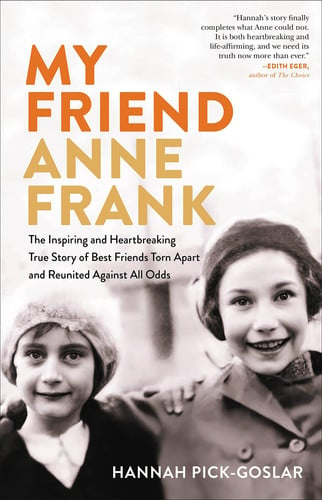
My friend Anne Frank: the inspiring and heartbreaking true story of best friends torn apart and reunited against all odds

Pick-Goslar, Hannah,Kraft, Dina
"In 1933, Hannah Pick-Goslar and her family fled Nazi Germany to live in Amsterdam, where she struck up a close friendship with her next-door neighbor, an outspoken and fun-loving young girl named Anne Frank. For several years, the inseparable pair enjoyed a carefree childhood of games, sleepovers, and treats with the other children in their neighborhood of Rivierenbuurt. But in 1942, Hannah and Anne's lives abruptly changed forever. As the Nazi occupation of Amsterdam progressed, Anne and the Frank family seemingly vanished, leaving behind unmade beds and dishes in the sink--but no trace of Anne's precious diary. Torn from her dear friend without warning, Hannah spent the next two years tormented by questions about Anne's fate, wondering if she had, by some miracle, managed to escape danger. In this long-awaited memoir, Hannah shares the story of her childhood during the Holocaust, from the introduction of anti-Jewish laws in Amsterdam to the gradual disappearance of classmates and, eventually, the Frank family, to Hannah and her family's imprisonment in the Bergen-Belsen concentration camp. As Hannah chronicles the experiences of her own life during and after the war, she provides a searing look at what countless children endured at the hands of the Nazi regime, as well as an intimate, never-before-seen portrait of the most recognizable victim of the Holocaust. Culminating in an astonishing fateful reunion, My Friend Anne Frank is the profoundly moving story of childhood and friendship during one of the darkest periods in the world's history"--Dust jacket flap.
Little, Brown Spark 2023 313 pages

Jews and power

Wisse, Ruth R.
From the Kingdom of David to the Oslo Accords, Ruth Wisse offers a radical new way to think about the Jewish relationship to power. Traditional Jews believed that upholding the covenant with God constituted a treaty with the most powerful force in the universe; this later transformed itself into a belief that, unburdened by a military, Jews could pursue their religious mission on a purely moral plain. Wisse, an eminent professor of comparative literature at Harvard, demonstrates how Jewish political weakness both increased Jewish vulnerability to scapegoating and violence, and unwittingly goaded power-seeking nations to cast Jews as perpetual targets. Although she sees hope in the State of Israel, Wisse questions the way the strategies of the Diaspora continue to drive the Jewish state, echoing Abba Eban's observation that Israel was the only nation to win a war and then sue for peace. And then she draws a persuasive parallel to the United States today, as it struggles to figure out how a liberal democracy can face off against enemies who view Western morality as weakness. This deeply provocative book is sure to stir debate both inside and outside the Jewish world. Wisse's narrative offers a compelling argument that is rich with history and bristling with contemporary urgency.
Nextbook, Schocken 2020-02-04 231 pages

Ruth Maier's diary: a young girl's life under Nazism

Maier, Ruth
Ruth Maier was born into a middle-class Jewish family in interwar Vienna. Following the Anschluss of Austria in March 1938, the world of the substantial Viennese Jewish community crumbled. In early 1939, her sister having left for England, Ruth emigrated to Norway and lived with a family in Lillestrom, about thirty miles from Oslo. Although she loved many things about her new country and its people, Ruth's relationship with her hosts soon turned stale, then sour. Ruth became increasingly isolated in Norway until she met a soul mate, Gunvor Hofmo, who was to become a celebrated poet. Norway itself became a Nazi conquest in April 1940, and Ruth's attempts to join the rest of her family - now in Britain - became ever more urgent. She never left Norway, and in November 1942 she was deported to Auschwitz where she was exterminated on arrival. She had just turned twenty-two. Ruth Maier kept a diary from 1934 until just before she was murdered. Despite being only in her teens she shows a sophisticated understanding of the political forces shaping central Europe as well as extraordinary prescience. The book is much more than just historical documentation, however. In a lucid yet highly lyrical style, with an incisive talent for narrative and a sharp wit, Ruth explores universal themes of isolation, identity, friendship, love, sexuality, desire, morality, justice and sacrifice. Most of all, however, she seeks what it means to be a human being. Published only recently for the first time in Norway, Ruth Maier's Diary is one of the most moving testimonies to emerge from this dark period of European history
Harvill Secker 2009 413 pages

Why are Jews liberals?

Podhoretz, Norman
"In his brilliant and provocative examination of why Jews are liberals, Podhoretz reviews the history of Jewish political attitudes and thoroughly examines the available evidence, demonstrating that all the usual explanations--such as a passion for justice allegedly deriving from the prophets of the Hebrew Bible--are either inadequate or flat-out false. Finally he proposes his own answer to the great puzzle of why most Jews remain as committed to liberalism as ever"--OCLC
Doubleday 2009 337 pages

A chosen few: the resurrection of European Jewry

Kurlansky, Mark
A POWERFUL, DEEPLY MOVING NARRATIVE OF HOPE REBORN IN THE SHADOW OF DESPAIR Fifty years after it was bombed to rubble, Berlin is once again a city in which Jews gather for the Passover seder. Paris and Antwerp have recently emerged as important new centers of Jewish culture. Small but proud Jewish communities are revitalizing the ancient centers of Budapest, Prague, and Amsterdam. These brave, determined Jewish men and women have chosen to settle–or remain–in Europe after the devastation of the Holocaust, but they have paid a price. Among the unexpected dangers, they have had to cope with an alarming resurgence of Nazism in Europe, the spread of Arab terrorism, and the impact of the Jewish state on European life. Delving into the intimate stories of European Jews from all walks of life, Kurlansky weaves together a vivid tapestry of individuals sustaining their traditions, and flourishing, in the shadow of history. An inspiring story of a tenacious people who have rebuilt their lives in the face of incomprehensible horror, A Chosen Few is a testament to cultural survival and a celebration of the deep bonds that endure between Jews and European civilization. “Consistently absorbing . . . A Chosen Few investigates the relatively uncharted territory of an encouraging phenomenon.” –Los Angeles Times “I can think of no book that portrays with such intelligence, historical understanding, and journalistic flair what life has been like for Jews determined to build lives in Europe.” –SUSAN MIRON Forward
Ballantine 2002-03-26 407 pages

The dictionary of Jewish biography

Cohn-Sherbok, Dan
From Abraham to Saul Bellow, from Moses Maimonides to Woody Allen, from the Baal Shem Tov to Albert Einstein, this comprehensive dictionary of Jewish biographies provides a first point of entry into the fascinating richness of the Jewish heritage. Modelled on the highly acclaimed Dictionary of Christian Biography (Continuum 2001) and with the advice of leading Jewish scholars, the Dictionary of Jewish Biography provides a rapid reference to those Jewish men and women who have, over the last four thousand years, contributed to the life of the Jewish people and the history of the Jewish religion. This dictionary will prove essential for general readers interested in the evolution of Judaism from ancient times to the present day, a perfect study aid for students and teachers.
Continuum 2005-06-30 308 pages