198 results for "Hugo"

The Apex Book of World SF 3

Lavie Tidhar
"The Apex Book of SF series has proven to be an excellent way to sample the diversity of world SFF and to broaden our understanding of the genre's potentials." --Ken Liu, winner of the Hugo Award and author of "The Grace of Kings" These stories run the gamut from science fiction, to fantasy, to horror. Some are translations (from German, Chinese, French, Spanish, and Swedish), and some were written in English. The authors herein come from Asia and Europe, Africa and Latin America. Their stories are all wondrous and wonderful, and showcase the vitality and diversity that can be found in the field. They are a conversation, by voices that should be heart. And once again, editor Lavie Tidhar and Apex Publications are tremendously grateful for the opportunity to bring them to our readers. Featuring: Amal El-Mohtar Ange Athena Andreadis Benjanun Sriduangkaew Berit Ellingsen Biram Mboob Crystal Koo Fadzilshah Johanabos Karin Tidbeck Ma Boyong Myra Cakan Nelly Geraldine Garcia-Rosas Swapna Kishore Uko Bendi Udo Xia Jia Zulaikha Nurain Mudzor Cover art by Sophia Tuska.
Apex Publications 2014-06-19 284 pages

Tesseracts (Tesseracts (Paperback))

Merril, Judith
Product Description Each year Tesseract Books chooses a team of editors from among the best of Canada’s writers, publishers and critics to select innovative and futuristic fiction and poetry from the leaders and emerging voices in Canadian speculative fiction. This is the anthology that started it all! Featuring fiction by Élisabeth Vonarburg and Hugo and Nebula award winning authors Spider Robinson, and William Gibson. Review "The reader who ventures into Tesseracts territory is assured of meeting some of our most able and gifted writers in surroundings that are at once wholly strange, and wholly familiar." - The Globe and Mail -"This anthology merits inclusion in any comprehensive collection, and it rewards the curiosity of the casual reader as well." - Locus Magazine - From the Author Hi, I'm Rhea Rose, one of the author's in this collection of science fiction and fantasy short stories. My story is called "Chronos' Christmas" and you can find that science fiction story here. If you google you can find the story available on other sites,too. My story was nominated for the Aurora Award (Canadian award) the year this collection was published, but I lost to Judith Merril who was also nominated and won for this collection. I was happy to see her get it! After all she did select my story for this, the first book in the Tesseracts legacy. Over the years my stories have appeared in many other of the Tesseracts collections. I'm hoping I can get Amazon to post the cover copy here, as they have for this one. About the Author The late Judith Merril is considered one of the most prolific authors and editors in the field of Science Fiction. Born in New York in 1923, she founded the Futurians, a group of SF writers and editors. Her first SF story, ‘That Only a Mother,’ was published in 1948. Judith edited numerous SF anthologies including Dell’s Year’s Best SF from 1956-1967, and was the ‘Books’ columnist for The Magazine of Fantasy and Science Fiction from 1965-69.
EDGE Science Fiction & Fantasy 2002-11-27 292 pages

When Einstein met Kafka: Jewish contributions to the modern world

Moldes, Diego,Capsuto, Steven
"In April 1911, Prague artists, writers, and intellectuals often gathered nightly at the Café Louvre, an intellectual center where music was played and high-level discussions were held. Many of the attendees were German-speaking Jews, such as Franz Kafka and his faithful friend Max Brod, Hugo Bergmann, Oskar Kraus, Franz Werfel, the mathematician Georg Pick, and a new arrival to the city, thirty-two-year-old Albert Einstein. Is it possible that Kafka and Einstein met and exchanged ideas? Did they influence each other from a philosophical or deep-thinking perspective? In neither Kafka's nor Einstein's correspondence there is not even the slightest mention of each other. But Einstein and Kafka, two icons of our modern era, serve as the starting point for this book on the enormous contributions in the fields of the empirical sciences, humanities, letters, and arts by individuals of Jewish origin in modernity. In this book, the reader will encounter numerous names in the pages that all spring from the fountainhead of these two antecedents, the Einsteinian and the Kafkian"--
Mandel Vilar Press 2025-09-16 622 pages

Republican party animal: the "Bad Boy of Holocaust History" blows the lid off Hollywood's secret right-wing underground

Cole, David
"David Stein brought right-wing congressmen, celebrities, writers and entertainment industry figures together for shindigs, closed to outsiders. . . . There was just one problem. Stein was not who he claimed."-- The Guardian "I disagreed with lots of the book and found the depiction of some people to be cruel, but no denying it was also funny, intriguing and eye-opening." --Rory Carroll Author Comandante: Hugo Chavez's Venezuela , reporter for The Guardian In 2013, Republican "hero" David Stein made international headlines when he was unmasked as David Cole, the notorious Jewish Holocaust denier who made an entirely different set of headlines in the 1990s with his videos from within the gates of Auschwitz and his appearances on shows like 60 Minutes and Donahue . After a $25,000 bounty was put on his head by a violent extremist group, Cole left behind the bizarre world of Holocaust revisionism, a landscape populated by Hitler fetishists who Cole himself detested. Then, David Stein the Republican organizer was born. Stein soon became a major force in the closed-door world of Hollywood right-wingers--people who felt as alienated from the mainstream of their profession as Cole had felt as the lone Jewish Holocaust revisionist. Soon enough, Stein was working with major GOP power players and far-right Hollywood A-listers, creating huge private events for the West Coast GOP elite . . . until it all came crashing down when a vengeful former girlfriend outed him publicly. Condemned by those who had previously lauded him, Cole was left with nothing but his story. And here he tells it, warts and all, including the first-ever exposé of the secretive Hollywood far-right underground, "Friends of Abe."
Feral House 2014 320 pages

The End of the Beginning Life, Society and Economy on the Brink of the Singularity

Ben Goertzel,Ted George Goertzel
A deep, diverse edited volume addressing the most critical issues regarding the future of humanity and intelligence -- with chapters authored by a who's-who of leading futurist thinkers and doers. According to Vernor Vinge, Ray Kurzweil and a rapidly increasing chorus of techno-futurists, we are living on the brink of a technological Singularity - a time when machines will become vastly more intelligent than humans. In such a scenario, death, disease and everyday material scarcity will be radically diminished, and life will be dramatically different in many other ways. But what will the path to this amazing future look like? How will human life grow and unfold as technology advances and Singularity approaches? The chapters in this book approach this issue from the perspectives of multiple visionary authors from around the globe, covering topics such as the impact of life extension, the future of money and exchange, the future of human psychology, biological self-modification, intelligence enhancement, automation and escalating unemployment, the possibility of global war between pro and anti technology forces, the impact of future technology on Asia and Africa, the emerging Global Brain, the future of surveillance and privacy, and much more. There are no easy or definite answers here - but lots of fascinating questions to explore. CONTENTS Chapter One: Predicting the Age of Post-Human Intelligences , by Ted Goertzel and Ben Goertzel Chapter Two: A Tale of Two Transitions , by Robin Hanson Chapter Three: Longer Lives on the Brink of Global Population Contraction: A Report from 2040 , by Max More Chapter Four: Implanting Post-Human Intelligence in Human Bodies , by John Hewitt Chapter Five: The Singularity and the Methuselarity: Similarities and Differences , by Aubrey de Grey Chapter Six: Robotics and AI: Impacts Felt on Every Aspect of Our Future World , by Daryl Nazareth Chapter Seven: Robotics, AI, the Luddite Fallacy and the Future of the Job Market , by Wayne Radinsky Chapter Eight: Moral Responsibility and Autonomous Machines , by David Burke Chapter Nine: How Will the Artilect War Start? , by Hugo de Garis Chapter Ten: Return to Eden? Promises and Perils on the Road to Global Superintelligence , by Francis Heylighen Chapter Eleven: Distributing Cognition: From Local Brains to the Global Brain , by Clément Vidal Chapter Twelve: A World of Views: A World of Interacting Post-human Intelligences , by Viktoras Veitas and David Weinbaum (Weaver) Chapter Thirteen: Chinese Perspectives on the Approach to the Singularity , by Mingyu Huang Chapter Fourteen: Africa Today and the Shadow of the Coming Singularity , by Hruy Tsegaye Chapter Fifteen: The World's First Decentralized System for Financial and Legal Transaction , by Chris Odom Chapter Sixteen: Beyond Money: Offer Networks, a Potential Infrastructure for a Post-Money Economy , by Ben Goertzel Chapter Seventeen: Sousveillance and AGI , by Ben Goertzel and Stephan Vladimir Bugaj Chapter Eighteen: The Future of Human Nature , by Ben Goertzel Chapter Nineteen: Capitalism, Socialism, Singularitarianism , by Ted Goertzel Chapter Twenty: Toward a Human-Friendly Post-Singularity World , by Ben Goertzel Chapter Twenty-one: Looking Backward from 2100 , by Ben Goertzel and Ted Goertzel
Humanity+ Press 2015 737 pages

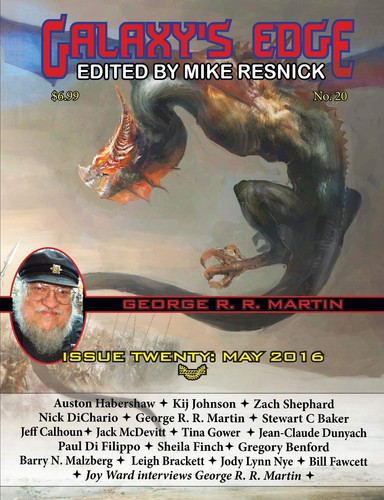
Galaxy's Edge Magazine Issue 20, May 2016 (George R. R. Martin Special)

George R R Martin,McDevitt Jack
A Magazine of Science Fiction and Fantasy ISSUE 12: May 2016 Mike Resnick, Editor Jean Rabe, Assistant Editor Shahid Mahmud, Publisher Stories by: Auston Habershaw, Kij Johnson, Shephard, Nick DiChario, George R. R. Martin, Stewart C Baker, Jeff Calhoun, Jack McDevitt, Tina Gower, Jean-Claude Dunyach, Paul Di Filippo, Sheila Finch Serialization: The Long Tomorrow by Leigh Brackett Columns by: Barry Malzberg, Gregory Benford Book Reviews: Jody Lynn Nye and Bill Fawcett Interview: Joy Ward interviews George R. R. Martin Galaxy's Edge is a Hugo-nominated bi-monthly magazine published by Phoenix Pick, the science fiction and fantasy imprint of Arc Manor, an award winning independent press based in Maryland. Each issue of the magazine has a mix of new and old stories, a serialization of a novel, columns by Barry Malzberg and Gregory Benford, book reviews by Jody Lynn Nye and Bill Fawcett and an interview conducted by Joy Ward.
Arc Manor 2016-05 108 pages

Sailing to Byzantium

Robert Silverberg
FIRST EDITION The world's most distinguished author of the literature of the fantastic presents his most extraordinary stories of worlds lost and dreams fulfilled... In his illustrious forty-five year career as a novelist and author of short fiction, Robert Silverberg has belonged in the company of the best writers of the 20th century. His writing has been compared to Conrad, Huxley, and Orwell. In this definitive collection Silverberg presents the novellas that have won him multiple Hugo and Nebula Award nominations, including his Nebula Award winning achievement, "Sailing To Byzantium." Here are the virtuoso performances of the third phase of Silverberg's astounding the Nebula Award nominee "Homefaring"; the Hugo Award nominee "The Secret Sharer"; "Thomas The Proclaimer" and "We Are For The Dark." If you are a lover of Silverberg's work or are simply looking for a place to begin a relationship with the literature of science fiction and fantasy, this is the place to start.
Underwood-Miller 1985 114 pages

From Benito Mussolini to Hugo Chavez: intellectuals and a century of political hero worship

Hollander, Paul
During the twentieth and twenty-first centuries, political dictators were not only popular in their own countries, but were also admired by numerous highly educated and idealistic Western intellectuals. The objects of this political hero-worship included Benito Mussolini, Adolph Hitler, Joseph Stalin, Mao Zedong, Fidel Castro and more recently Hugo Chavez, among others. This book seeks to understand the sources of these misjudgements and misperceptions, the specific appeals of particular dictators, and the part played by their charisma, or pseudo-charisma. It sheds new light not only on the political disposition of numerous Western intellectuals - such as Martin Heidegger, Eric Hobsbawm, Norman Mailer, Ezra Pound, Susan Sontag and George Bernard Shaw - but also on the personality of those political leaders who encouraged, and in some instances helped to design, the cult surrounding their rise to dictatorship.
Cambridge University Press 2016 325 pages

Life of Mendel

Hugo 1882-1952 Iltis
This work has been selected by scholars as being culturally important and is part of the knowledge base of civilization as we know it. This work is in the public domain in the United States of America, and possibly other nations. Within the United States, you may freely copy and distribute this work, as no entity (individual or corporate) has a copyright on the body of the work. Scholars believe, and we concur, that this work is important enough to be preserved, reproduced, and made generally available to the public. To ensure a quality reading experience, this work has been proofread and republished using a format that seamlessly blends the original graphical elements with text in an easy-to-read typeface. We appreciate your support of the preservation process, and thank you for being an important part of keeping this knowledge alive and relevant.
Creative Media Partners, LLC 2021-09-10 368 pages

The Photoplay

Hugo Münsterberg
It is arbitrary to say where the development of the moving pictures began and it is impossible to foresee where it will lead. What invention marked the beginning? Was it the first device to introduce movement into the pictures on a screen? Or did the development begin with the first photographing of various phases of moving objects? Or did it start with the first presentation of successive pictures at such a speed that the impression of movement resulted?
CreateSpace Independent Publishing Platform 2015-10-19 64 pages

Stagestruck Vampires and Other Phantasms

Suzy McKee Charnas
Hugo, Nebula, and Tiptree award–winning author Suzy McKee Charnas offers up her lush stories in this compelling retrospective story collection. In Stagestruck Vampires , the supernatural and the real intertwine seamlessly. A villainous maestro is redeemed by his lovely, apt pupil in “Beauty and the Opera or The Phantom Beast.” Inside the “Unicorn Tapestry,” a psychotherapist stalks a vampire. A dazzling performance of Tosca is marred by a shocking murder during “A Musical Interlude.” This collection features original work by Charnas—the mystical novelette, “Peregrines,” and two original essays. Also included is a collaborative story on vampire themes, “Advocates,” written with Chelsea Quinn Yarbro, author of the Saint-Germain Chronicles.
Tachyon Publications 2004 328 pages

Harry Harrison Super Pack

Harry Harrison
Harry Harrison was recognized as a Grand Master by the Science Fiction Writer's of America. He was best known for his Deathworld and Stainless Steel Rat series. He was nominated for the Hugo, Nebula, Locus, and Sideways Awards. He was inducted into the Science Fiction Hall of Fame in 2004. This omnibus edition of his work includes four complete novels and six short stories. Both of his best known series Deathworld and The Stainless Steel Rat are represented herein. If you enjoyed this book, you'll want to search on "Positronic Publishing Super Pack" and check out all our other exciting Super Packs!
Wilder Publications 2018-04-03 586 pages

None of the above: a screenplay

Ellison, Harlan
Harlan Ellison's never-before-published 238-page, unproduced screenplay adaptation of Norman Spinrad's Hugo Award-nominated novel BUG JACK BARRON that was to have been directed by Costa-Gavras (Z) for Universal Pictures in the early 1980s. Respected film critic and historian LEONARD MALTIN has written an insightful introduction with input from Ellison on why-after nearly 30 years-the film has still never been made. This paperback book includes Ellison's original casting suggestions from 1983 so you can "see the movie in your mind" with the faces Ellison imagined for each role. This screenplay was reproduced from Harlan Ellison's file copy. The pages originated on a manual typewriter, hence the idiosyncrasies that set them apart from the sanitized, word-processed pages of today.
Edgeworks Abbey 2012 243 pages

The Venezuelan Revolution: 100 Questions, 100 Answers

Boudin, Chesa
There is one country in the Americas that the Bush Administration regards as a significant threat to U.S. interests, and it is not Cuba. Oil-rich Venezuela's democratically-elected government has survived repeated, U.S.-supported attempts to undermine its power, including a short lived military coup. Its leader, President Hugo Chávez, is neither communist nor capitalist, and instead claims to be creating an alternative 21st Century socialism that courts international capital. What is the real story behind this leader of Latin America's lurch to the left? Is it a new petro-populism in the tradition of Peron and Fujimori, or is it truly a progressive, home-grown democratic revolution that will address the massive economic and social inequalities plaguing the region for more than three centuries? The curiosity of a North American living in Venezuela and the expertise of two Venezuelans—one an adviser in the Presidential Palace, and the other a journalist with a weekly column in one of Venezuela's leading newspapers—bring insiders' answers to outsiders' questions, such as: Is Chávez a dictator? What was the role of the Bush Administration in the 2002 military coup? What is Chávez's political platform? Does Chávez work with terrorist governments to undermine U.S. interests?
Thunder's Mouth Press 2006-01-25 153 pages

Palimpsest

Charles Stross
Welcome to the Stasis, the clandestine, near-omnipotent organization that stands at the heart of Charles Stross's Hugo Award-winning novella, Palimpsest. By mastering the mysteries of the Timegate, the Stasis has repeatedly steered mankind away from the brink of utter extinction. Through countless millennia, through the "mayfly flickerings" of innumerable transient civilizations, its members have intervened at critical junctions, reseeding the galaxy with viable potential survivors. In the process, they have reconfigured the basic structure of the universe, all in the name of human continuity. Pierce is a newly recruited member of the Stasis, serving out a complex twenty- year apprenticeship while struggling to find his way through the paradoxical maze of history (and unhistory) that surrounds him. As his once simple existence expands and replicates over vast stretches of time, Pierce uncovers a new and unexpected destiny, one that will embroil him in the larger purposes of the Stasis and in the ultimate, unresolved fate of humanity itself. Skillfully merging the threads of an individual life with the grandest, most overarching concerns, Palimpsest offers both visionary brilliance and narrative excitement in equal measure. Powerfully imagined, beautifully constructed, and written throughout with great economy of means, it is the kind of mind-expanding mini-epic that only science fiction and only a master practitioner like Charles Stross could produce.
Subterranean Press 2011 131 pages

The Objectivist Newsletter 1962-1965

Ayn Rand
The Objectivist Newsletter is a 224-page volume that contains penetrating, philosophical dissection of events and ideas dominating our culture. Among its contents: an elucidation of the two political issues with which the practical fight for freedom should begin; a moving tribute to Marilyn Monroe; illuminating reviews of books by authors as diverse as Victor Hugo and Mickey Spillane; and replies to questions about Objectivism in the "Intellectual Ammunition Department."
Amazon Digital Services LLC - Kdp 2021-05-12 228 pages

The Longest Way Home

Robert Silverberg
Caught in the midst of a rebellion while visiting a friend thousands of miles from home, Joseph, the young heir to the great House Keilloran, one of the Masters who colonized the planet long ago, finds himself fighting for survival in enemy territory, through which he must travel while facing terrible dangers.Robert Silverberg is a SFWA Grandmaster and winner of multiple Hugo and Nebula awards.
Amazon Digital Services LLC - KDP Print US 2019-05-07 292 pages

The nightmare stacks

Stross, Charles
"The Laundry Files' 'fast-paced blend of espionage thrills, mundane office comedy and Lovecraftian horror' (SFX) continues as Hugo Award-winning author Charles Stross assigns a day trader to a permanent position on the night shift ... After stumbling upon the algorithm that turned him and his fellow merchant bankers into vampires, Alex Schwartz was drafted by The Laundry, Britain's secret counter-occult agency that's humanity's first line of defense against the forces of darkness. Dependent on his new employers for his continued existence--as Alex has no stomach for predatory bloodsucking--he has little choice but to accept his new role as an operative-in-training. Dispatched to Leeds, Alex's first assignment is to help assess the costs of renovating a 1950s Cold War bunker into The Laundry's new headquarters. Unfortunately, Leeds is Alex's hometown, and the thought of breaking the news to his parents that he's left banking for civil service, while hiding his undead condition, is causing more anxiety than learning how to live as a vampire secret agent preparing to confront multiple apocalypses. Alex's only saving grace is Cassie Brewer, a drama student appearing in the local Goth Festival who is inexplicably attracted to him despite his awkward personality and massive amounts of sunblock. But Cassie has secrets of her own--secrets that make Alex's night life behaviors seem positively normal ..."-
Orbit 2016-06-23 400 pages