715 results for "Jewish History"

The last million: Europe's displaced persons from World War to Cold War

Nasaw, David
"In May of 1945, German forces surrendered to the Allied powers, effectively putting an end to World War II in Europe. But the aftershocks of this global military conflict did not cease with the signing of truces and peace treaties. Millions of lost and homeless POWs, slave laborers, political prisoners, and concentration camp survivors overwhelmed Germany, a country in complete disarray. British and American soldiers gathered the malnourished and desperate foreigners, and attempted to repatriate them to Poland, Estonia, Latvia, Lithuania, Ukraine, and the USSR. But after exhaustive efforts, there remained over a million displaced persons who either refused to go home or, in the case of many, had no home to which to return. They would spend the next three to five years in displaced persons camps, divided by nationalities, temporary homelands in exile, with their own police forces, churches, schools, newspapers, and medical facilities. The international community couldn't agree on the fate of the Last Million, and after a year of fruitless debate and inaction, an International Refugee Organization was created to resettle them in lands suffering from labor shortages. But no nations were willing to accept the 200,000 to 250,000 Jewish men, women, and children who remained trapped in Germany. In 1948, the United States, among the last countries to accept anyone for resettlement, finally passed a Displaced Persons Bill - but as Cold War fears supplanted memories of WWII atrocities, the bill only granted visas to those who were reliably anti-communist, including thousands of former Nazi collaborators, Waffen-SS members, and war criminals, while barring the Jews who were suspected of being Communist sympathizers or agents because they had been recent residents of Soviet-dominated Poland. Only after the passage of the controversial UN resolution for the partition of Palestine and Israel's declaration of independence were the remaining Jewish survivors finally able to leave their displaced persons camps in Germany."--
Penguin Press 2020-09-15 654 pages

The last million: Europe's displaced persons from World War to Cold War

Nasaw, David
"In May of 1945, German forces surrendered to the Allied powers, effectively putting an end to World War II in Europe. But the aftershocks of this global military conflict did not cease with the signing of truces and peace treaties. Millions of lost and homeless POWs, slave laborers, political prisoners, and concentration camp survivors overwhelmed Germany, a country in complete disarray. British and American soldiers gathered the malnourished and desperate foreigners, and attempted to repatriate them to Poland, Estonia, Latvia, Lithuania, Ukraine, and the USSR. But after exhaustive efforts, there remained over a million displaced persons who either refused to go home or, in the case of many, had no home to which to return. They would spend the next three to five years in displaced persons camps, divided by nationalities, temporary homelands in exile, with their own police forces, churches, schools, newspapers, and medical facilities. The international community couldn't agree on the fate of the Last Million, and after a year of fruitless debate and inaction, an International Refugee Organization was created to resettle them in lands suffering from labor shortages. But no nations were willing to accept the 200,000 to 250,000 Jewish men, women, and children who remained trapped in Germany. In 1948, the United States, among the last countries to accept anyone for resettlement, finally passed a Displaced Persons Bill - but as Cold War fears supplanted memories of WWII atrocities, the bill only granted visas to those who were reliably anti-communist, including thousands of former Nazi collaborators, Waffen-SS members, and war criminals, while barring the Jews who were suspected of being Communist sympathizers or agents because they had been recent residents of Soviet-dominated Poland. Only after the passage of the controversial UN resolution for the partition of Palestine and Israel's declaration of independence were the remaining Jewish survivors finally able to leave their displaced persons camps in Germany."--
Penguin Press 2020 654 pages

No joke: making Jewish humor

Wisse, Ruth R.
Humor is the most celebrated of all Jewish responses to modernity. In this book, Ruth Wisse evokes and applauds the genius of spontaneous Jewish joking--as well as the brilliance of comic masterworks by writers like Heinrich Heine, Sholem Aleichem, Isaac Babel, S. Y. Agnon, Isaac Bashevis Singer, and Philip Roth. At the same time, Wisse draws attention to the precarious conditions that call Jewish humor into being--and the price it may exact from its practitioners and audience. Wisse broadly traces modern Jewish humor around the world, teasing out its implications as she explores memorable and telling examples from German, Yiddish, English, Russian, and Hebrew
Princeton University Press 2013-06-02 279 pages

When light pierced the darkness: Christian rescue of Jews in nazi-occupied Poland

Tec, Nechama
Everyone knows the name of Anne Frank but few people remember anything about the people who sheltered her. Who were the rescuers and what motivated them to risk their lives for persecuted Jews? Clearly such people deserve to be remembered and honored. And clearly an understanding of their motivations may help us cultivate such behavior in our own day. This book focuses on such "righteous Christians." Tec, herself a Holocaust survivor helped by Christians, vividly recreates through hundreds of cases what it was like to pass and hide among Christians and what it was like to rescue Jews. Limiting her compass to Poland, where anti-Semitism was particularly extreme, the author interviewed dozens of people now living in many lands and also examined a vast array of published accounts and unpublished testimonies yielding case histories of over 500 Polish helpers. As the book preserves for posterity the heroism of such people as Celka, the impoverished governess, and her paralyzed father, who took into their one-room apartment a Jewish child, refused to baptize her without her family's permission, and even fed her before they themselves ate, or Dr. Felix Kabus, who developed and frequently performed an operation that camouflaged circumcision, or the famous anti-Semitic author who wrote publicly about what was happening to the Jews, the book fills a gap in our knowledge of the Holocaust.
Oxford University Press 1986 262 pages

The people of the book: philosemitism in England, from Cromwell to Churchill

Himmelfarb, Gertrude
The specific course of the Reformation in England in the 16th-17th centuries brought about interest in the Jewish Bible, i.e. the Old Testament, and the emergence of a self-image held by the British that they constitute a people of the Book, beside the Jews. This, in turn, gave rise to philosemitism, which marked British culture from the days of Cromwell to those of Churchill, being tinged in various tones, from millenarianism to philo-Zionism. However, the tradition of philosemitism in England was accompanied by manifestations of antisemitism; the same people who extolled the Jews opposed their admission to Parliament; people who defended Jewish rights in the 18th-19th centuries often shared anti-Jewish stereotypes of their time; and leaders who sympathized with Zionism could believe in a Jewish conspiracy against Christian civilization. Ch. 4 (pp. 83-117), "Fictional Heroes and Heroines", deals with 19th-century literature and shows how some writers (e.g. Walter Scott, Dickens, Trollope) could combine philosemitic and antisemitic motifs in their literary works.
Encounter Books 2011 183 pages

American shtetl: the making of Kiryas Joel, a Hasidic village in upstate New York

Stolzenberg, Nomi M.,Myers, David N.
A compelling account of how a group of Hasidic Jews established its own local government on American soil Settled in the mid-1970s by a small contingent of Hasidic families, Kiryas Joel is an American town with few parallels in Jewish history—but many precedents among religious communities in the United States. This book tells the story of how this group of pious, Yiddish-speaking Jews has grown to become a thriving insular enclave and a powerful local government in upstate New York. While rejecting the norms of mainstream American society, Kiryas Joel has been stunningly successful in creating a world apart by using the very instruments of secular political and legal power that it disavows. Nomi Stolzenberg and David Myers paint a richly textured portrait of daily life in Kiryas Joel, exploring the community's guiding religious, social, and economic norms. They delve into the roots of Satmar Hasidism and its charismatic founder, Rebbe Joel Teitelbaum, following his journey from nineteenth-century Hungary to post–World War II Brooklyn, where he dreamed of founding an ideal Jewish town modeled on the shtetls of eastern Europe. Stolzenberg and Myers chart the rise of Kiryas Joel as an official municipality with its own elected local government. They show how constant legal and political battles defined and even bolstered the community, whose very success has coincided with the rise of political conservatism and multiculturalism in American society over the past forty years. Timely and accessible, American Shtetl unravels the strands of cultural and legal conflict that gave rise to one of the most vibrant religious communities in America, and reveals a way of life shaped by both self-segregation and unwitting assimilation.
Princeton University Press 2024-02-20 496 pages

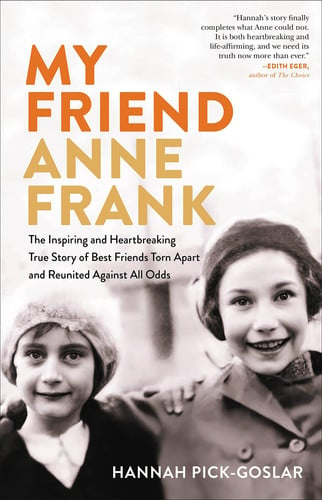
My friend Anne Frank: the inspiring and heartbreaking true story of best friends torn apart and reunited against all odds

Pick-Goslar, Hannah,Kraft, Dina
"In 1933, Hannah Pick-Goslar and her family fled Nazi Germany to live in Amsterdam, where she struck up a close friendship with her next-door neighbor, an outspoken and fun-loving young girl named Anne Frank. For several years, the inseparable pair enjoyed a carefree childhood of games, sleepovers, and treats with the other children in their neighborhood of Rivierenbuurt. But in 1942, Hannah and Anne's lives abruptly changed forever. As the Nazi occupation of Amsterdam progressed, Anne and the Frank family seemingly vanished, leaving behind unmade beds and dishes in the sink--but no trace of Anne's precious diary. Torn from her dear friend without warning, Hannah spent the next two years tormented by questions about Anne's fate, wondering if she had, by some miracle, managed to escape danger. In this long-awaited memoir, Hannah shares the story of her childhood during the Holocaust, from the introduction of anti-Jewish laws in Amsterdam to the gradual disappearance of classmates and, eventually, the Frank family, to Hannah and her family's imprisonment in the Bergen-Belsen concentration camp. As Hannah chronicles the experiences of her own life during and after the war, she provides a searing look at what countless children endured at the hands of the Nazi regime, as well as an intimate, never-before-seen portrait of the most recognizable victim of the Holocaust. Culminating in an astonishing fateful reunion, My Friend Anne Frank is the profoundly moving story of childhood and friendship during one of the darkest periods in the world's history"--Dust jacket flap.
Little, Brown Spark 2023 313 pages

Why aren't Jewish women circumcised? gender and covenant in Judaism

Cohen, Shaye J. D.
Why aren't Jewish women circumcised? This improbable question, first advanced by anti-Jewish Christian polemicists, is the point of departure for this wide-ranging exploration of gender and Jewishness in Jewish thought. With a lively command of a wide range of Jewish sources—from the Bible and the Talmud to the legal and philosophical writings of the Middle Ages to Enlightenment thinkers and modern scholars—Shaye J. D. Cohen considers the varied responses to this provocative question and in the process provides the fullest cultural history of Jewish circumcision available.
University of California Press 2005-09-06 317 pages

Scroll of agony: the Warsaw diary of Chaim A. Kaplan

Kaplan, Chaim A.
Chaim Aron Kaplan, born in 1880 in Belarus, wrote his "Megillat yissurin" ("Scroll of Suffering") in the Warsaw ghetto. A Zionist who emphasized the role of history in Jewish culture, he wrote his diary in Hebrew for future historians, but lost his belief in God and feared that his diary may serve no purpose if the entire Jewish nation is annihilated. He was killed in Treblinka in 1942.
Indiana University Press 1999 410 pages

A Treasury of Jewish folklore: stories, traditions, legends, humor, wisdom, and folk songs of the Jewish people

Ausubel, Nathan
Author of The Jewish Book of Knowledge and The Pictorial History of the Jewish People. "A must for everyone, Christians and Jews alike." --New York Times. This classic collection of more than 800 traditions, legends, parables, and songs, with a glossary of Yiddish and Hebrew words, has remained a favorite gift-giving item and a family treasure for decades. 12 pieces of sheet music.
Crown 1989-01-13 741 pages

Stranger in my own country: a Jewish family in modern Germany

Mounk, Yascha
"A moving and unsettling exploration of a young man's formative years in a country still struggling with its past As a Jew in postwar Germany, Yascha Mounk felt like a foreigner in his own country. When he mentioned that he is Jewish, some made anti-Semitic jokes or talked about the superiority of the Aryan race. Others, sincerely hoping to atone for the country's past, fawned over him with a forced friendliness he found just as alienating. Vivid and fascinating, Stranger in My Own Country traces the contours of Jewish life in a country still struggling with the legacy of the Third Reich and portrays those who, inevitably, continue to live in its shadow. Marshaling an extraordinary range of material into a lively narrative, Mounk surveys his countrymen's responses to "the Jewish question." Examining history, the story of his family, and his own childhood, he shows that anti-Semitism and far-right extremism have long coexisted with self-conscious philo-Semitism. But of late a new kind of resentment against Jews has come out in the open. Unnoticed by much of the outside world, the desire for a "finish line" that would spell a definitive end to the country's obsession with the past is feeding an emphasis on German victimhood. Mounk shows how, from the government's pursuit of a less "apologetic" foreign policy to the way the country's idea of the "Volk" makes life difficult for its immigrant communities, a troubled nationalism is shaping Germany's future"--
Farrar, Straus and Giroux 2014-01-07 261 pages

Abraham's children: race, identity, and the DNA of the chosen people

Entine, Jon
Could our sense of who we are really turn on a sliver of DNA? In our multiethnic world, questions of individual identity are becoming increasingly unclear. Now in ABRAHAM'S CHILDREN bestselling author Jon Entine vividly brings to life the profound human implications of the Age of Genetics while illuminating one of today's most controversial topics: the connection between genetics and who we are, and specifically the question "Who is a Jew?" Entine weaves a fascinating narrative, using breakthroughs in genetic genealogy to reconstruct the Jewish biblical tradition of the chosen people and the hereditary Israelite priestly caste of Cohanim. Synagogues in the mountains of India and China and Catholic churches with a Jewish identity in New Mexico and Colorado provide different patterns of connection within the tangled history of the Jewish diaspora. Legendary accounts of the Hebrew lineage of Ethiopian tribesmen, the building of Africa's Great Zimbabwe fortress, and even the so-called Lost Tribes are reexamined in light of advanced DNA technology. Entine also reveals the shared ancestry of Israelites and Christians. As people from across the world discover their Israelite roots, their riveting stories unveil exciting new approaches to defining one's identity. Not least, Entine addresses possible connections between DNA and Jewish intelligence and the controversial notion that Jews are a "race apart." ABRAHAM'S CHILDREN is a compelling reinterpretation of biblical history and a challenging and exciting illustration of the promise and power of genetic research.
Grand Central Pub 2007-10-24 420 pages

Josephus: the historian and his society

Rajak, Tessa
Josephus, author of the "Jewish War" and the "Jewish Antiquities", belongs equally to Jewish and to Greco-Roman history. A well-to-do priest and Pharisee at Jerusalem, he was a contemporary and chronicler of the great changes which took place in the Roman Empire in the first century AD and a controversial general in the great Jewish revolt of 66-73 against Rome. Tessa Rajak, an ancient historian versed in both Greek and Hebrew, assesses the varied source material to produce a sociological account of the Jewish revolt which casts fresh light on Josephus' attitudes, placing his achievement in the context of both Jewish values and the Greek historical tradition. This second edition includes a substantial new introduction and bibliography.--Amazon.com.
Duckworth 2002-06-28 261 pages

Rembrandt's Jews

Nadler, Steven M.
There is a popular and romantic myth about Rembrandt and the Jewish people. One of history's greatest artists, we are often told, had a special affinity for Judaism. With so many of Rembrandt's works devoted to stories of the Hebrew Bible, and with his apparent penchant for Jewish themes and the sympathetic portrayal of Jewish faces, it is no wonder that the myth has endured for centuries. Rembrandt's Jews puts this myth to the test as it examines both the legend and the reality of Rembrandt's relationship to Jews and Judaism. In his elegantly written and engrossing tour of Jewish Amsterdam—which begins in 1653 as workers are repairing Rembrandt's Portuguese-Jewish neighbor's house and completely disrupting the artist's life and livelihood—Steven Nadler tells us the stories of the artist's portraits of Jewish sitters, of his mundane and often contentious dealings with his neighbors in the Jewish quarter of Amsterdam, and of the tolerant setting that city provided for Sephardic and Ashkenazic Jews fleeing persecution in other parts of Europe. As Nadler shows, Rembrandt was only one of a number of prominent seventeenth-century Dutch painters and draftsmen who found inspiration in Jewish subjects. Looking at other artists, such as the landscape painter Jacob van Ruisdael and Emmanuel de Witte, a celebrated painter of architectural interiors, Nadler is able to build a deep and complex account of the remarkable relationship between Dutch and Jewish cultures in the period, evidenced in the dispassionate, even ordinary ways in which Jews and their religion are represented—far from the demonization and grotesque caricatures, the iconography of the outsider, so often found in depictions of Jews during the Middle Ages and the Renaissance. Through his close look at paintings, etchings, and drawings; in his discussion of intellectual and social life during the Dutch Golden Age; and even through his own travels in pursuit of his subject, Nadler takes the reader through Jewish Amsterdam then and now—a trip that, under ever-threatening Dutch skies, is full of colorful and eccentric personalities, fiery debates, and magnificent art.
The University of Chicago Press 2003-11-03 250 pages

The Jewish emergence from powerlessness

Bauer, Yehuda
The theme of this book is the gradual emergence of the Jewish people from total political powerlessness - a development stretching over nearly 100 years and culminating in the consolidation in the State of Israel. Ironically, Professor Bauer demonstrates, events during this period stemmed in part from a belief in the power of the international Jewish community that never existed - but that motivated both the Germans and, after the war, the British.This is a brief but absorbing study by one of the world's great experts on the Holocaust, who has drawn on a huge body of material to depict one of the unforgettable events in recent history from an arresting and unfamiliar view point.
University of Toronto Press 1979-12-15 89 pages

˜Theœ terrible secret: suppression of the truth about Hitler's "final solution"

Laqueur, Walter
Hidden behind a screen of euphemisms and evasions, of political expediency and psychological denial, the most terrible crime in human history was committed. Despite the shock and outrage that swept the world when the Nazi death camps were first liberated in 1945, the truth about the extermination of European Jewry had been an open secret since at least 1941. Using sources and documents only recently made available, Walter Lacquer examines when and how information about the genocide became known to millions of Germans, international Jewish organizations, leaders of Jewish communities throughout Europe, and top government officials in neutral and Allied countries. Laying bare the lethal combination of disbelief and indifference that met this news, "The Terrible Secret" offers a brilliant and chilling demonstration of paralysis in the face of ultimate evil.
Penguin Books 1982 262 pages