243 results for "Literature"

Fantastic Mr Dahl

Rosen, Michael
"A true genius . . . Roald Dahl is my hero" David Walliams Life story of Roald Dahl, World's No.1 storyteller, creator of Charlie and the Chocolate Factory, Fantastic Mr Fox, Matilda, The BFG, James and the Giant Peach and many more, brought to life by Michael Rosen - author, top children's poet and former Children's Laureate. Written especially for children, with fun pages and illustrations by Quentin Blake. So, how did Roald Dahl get into writing? Where did he get his ideas from? What ingredients in his life turned him into the kind of writer he was? Michael Rosen comes up with some of the answers to these key questions in his lively biography, specially for children, of the world's No.1 storyteller. Full of stories and funny anecdotes from Roald Dahl's school days and family life, Michael Rosen's fascinating observations creates a vivid picture of one of the most famous writers of all time.
Puffin 2012 162 pages

Elie Wiesel: confronting the silence

Berger, Joseph
"As an orphaned survivor and witness to the horrors of Auschwitz, Elie Wiesel (1928-2016) compelled the world to confront the Holocaust with his searing memoir Night. How did this soft-spoken man from a small Carpathian town become such an influential figure on the world stage. Drawing on Wiesel's prodigious literary output and interviews with his family, friends, scholars, and critics, Joseph Berger seeks to answer this question."--
Yale University Press 2023-01-01 342 pages

Sea queens: women pirates around the world

Yolen, Jane
In 1963 Jane Yolen released a book called PIRATES IN PETTICOATS, because the idea of women as pirates fascinated her--but there wasn't much information about these women who made their livelihoods plundering on the high seas. Scholars have dug up a bounty of new information since then, and Jane, still fascinated, revisits the ladies who loot. Discover such great pirates as Artemisia, the Admiral Queen of Persia who sailed the seas from 500 to 480 BC. At one point there was a 10,000 drachma prize for anyone who could capture her. There was Rachel Wall, who ran away from her strict upbringing and became a murderous pirate terrorizing the waters of the Atlantic coastline of America. She was hanged for her deeds. Possibly the most famous woman pirate of all was Grania O'Malley, daughter of an Irish chieftain. She plagued the English and was arrested several times, always gaining her freedom to pirate some more. Meet ten other female pirates on their ships, in battle, and in disguise in this intriguing look at the wayward women of the waves. Christine Joy Pratt's pen-and-ink illustrations are alive with action and excitement. Here be a true and accurate account of the most low-down, scurviest--but the prettiest--black-hearted pirates you'll ever love to read about.
Charlesbridge 2010-07-01 103 pages

12 Edmondstone Street

Malouf, David
Each house, like each place, has its own topography, its own lore. A complex history comes down to us, through household jokes and anecdotes, odd family habits and irrational superstitutions, that forever shapes what we see and the way in which we see it. In his book, David Malouf, one of Australia's most prestigious writers, takes an unsentimental journey into his past. Beginning with his childhood home, he moves on to show other landmarks in his life, and the way places and things create our private worlds. Written with humour and uncompromising intelligence, 12 Edmondstone Street is an unforgettable portrait of one man's life.
Penguin 1986 134 pages

The book of the courtesans: a catalogue of their virtues

Griffin, Susan
From Pulitzer-Prize-nominated author Susan Griffin comes an unprecedented, provocative look at the dazzling world of the West’s first independent women, whose lively liaisons brought them unspoken influence, wealth, and freedom. While they charmed some of Europe’s most illustrious men honing their social skills as well as their sexual ones, the great courtesans gained riches, power, education, and sexual freedom in a time when other women were denied all of these. From Imperia of sixteenth-century Rome, who personified the Renaissance ideal of beauty; Mme. de Pompadour, the arbiter of all things fashionable in eighteenth-century Paris and Versailles; Liane de Pougy, known in France during the Belle Epoque as “Our National Courtesan”; to Sarah Bernhardt, who, following in her mother’s footsteps, supported herself in her early career with a second profession, The Book of the Courtesans tells the life stories and intricacies of the lavish lifestyles of these women. Unlike their geisha counterparts, courtesans neither lived in brothels nor bent their wills to suit their suitors. They were strong- willed, autonomous, and plucky. An open secret, their presence can be felt throughout our culture. The muses who enflamed the hearts and imaginations of our most celebrated artists, they were also artists in their own right. They wrote poetry and novels, invented the cancan at the Moulin Rouge, and presented celebrated acts at the Folies Bergères. They helped to influence and shape the sensibility of modern literature, painting, and fashion. When Greek sculptor Praxiteles wanted to depict Venus he used a famous courtesan as a model, as in later centuries Titian, Veronese, Raphael, Giorgione, and Boucher did when they painted goddesses. When Marcel Proust was a young man it was the courtesan Laure Hayman who took him under her wing, introducing him to the right people, and providing inspiration for one of literature’s greatest masterpieces. And they often had considerable political influence too. When King Louis XV needed advice on foreign affairs or appointments of state he turned to Jeanne du Barry as well as Pompadour. In her witty and insightful prose, as Griffin celebrates these alluring and fascinating women, she restores a lost legacy of women’s history. She gives us the stories of these amazing women who, starting from impoverished or unimpressive beginnings, garnered chateaux, fine coaches, fabulous collections of jewelry, and even aristocratic titles along the way. And through a brilliant exploration of their extraordinary abilities, skills, and talents which Griffin playfully categorizes as their virtues "Timing, Beauty, Cheek, Brilliance, Gaiety, Grace, and Charm" her book explains how, while helping themselves, through their often outrageous, always entertaining examples, the great courtesans not only enriched our cultural heritage but helped to liberate women from the social, sexual, and economic strictures that confined them. Intensively researched and beautifully crafted, The Book of the Courtesans delves into scintillating but often hidden worlds, telling stories gleaned from many sources, including courtesans’ memoirs, presented along with stunning rare photographs to create memorable portraits of some of the most pivotal figures in women’s history.
Broadway Books 2001 269 pages

If all the seas were ink: a memoir

Kurshan, Ilana
At the age of 27, alone in Jerusalem in the wake of a painful divorce, Ilana Kurshan joined the world s largest book club, learning daf yomi, Hebrew for daily page" of the Talmud, a book of rabbinic teachings spanning about 600 years and the basis for all codes of Jewish law. A runner, a reader and a romantic, Kurshan adapted to its pace, attuned her ear to its poetry, and discovered her passions in its pages. She brought the Talmud with her wherever she went, studying in airplanes, supermarket lines, and over a plate of pasta at home, careful not to drip tomato sauce upon discussions about the sprinkling of blood on the Temple altar. By the time she completed the Talmud after seven and a half years, Kurshan was remarried with three young children. With each pregnancy, her Talmud sat perched atop her growing belly. This memoir is a tale of heartache and humor, of love and loss, of marriage and motherhood, and of learning to put one foot in front of the other by turning page after page. Kurshan takes us on a deeply accessible and personal guided tour of the Talmud, shedding new light on its stories and offering insights into its arguments both for those already familiar with the text and for those who have never encountered it. For people of the book both Jewish and non-Jewish If All the Seas Were Ink is a celebration of learning through literature how to fall in love once again.
St. Martin's Press 2017-09 299 pages

The art and politics of science

Varmus, Harold
A Nobel Prize–winning cancer biologist, leader of major scientific institutions, and scientific adviser to President Obama reflects on his remarkable career. A PhD candidate in English literature at Harvard University, Harold Varmus discovered he was drawn instead to medicine and eventually found himself at the forefront of cancer research at the University of California, San Francisco. In this “timely memoir of a remarkable career” ( American Scientist ), Varmus considers a life’s work that thus far includes not only the groundbreaking research that won him a Nobel Prize but also six years as the director of the National Institutes of Health; his current position as the president of the Memorial Sloan-Kettering Cancer Center; and his important, continuing work as scientific adviser to President Obama. From this truly unique perspective, Varmus shares his experiences from the trenches of politicized battlegrounds ranging from budget fights to stem cell research, global health to science publishing.
W. W. Norton 2010-04-27 315 pages

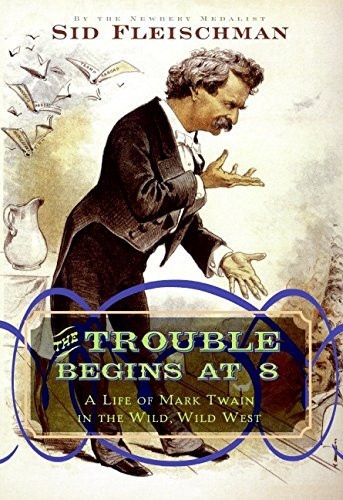
The trouble begins at 8: a life of Mark Twain in the wild, wild West

Fleischman, Sid
"Mark Twain was born fully grown, with a cheap cigar clamped between his teeth." So begins Sid Fleischman's ramble-scramble biography of the great American author and wit, who started life in a Missouri village as a barefoot boy named Samuel Clemens. Abandoning a career as a young steamboat pilot on the Mississippi River, Sam took a bumpy stagecoach to the Far West. In the gold and silver fields, he expected to get rich quick. Instead, he got poor fast, digging in the wrong places. His stint as a sagebrush newspaperman led to a duel with pistols. Had he not survived, the world would never have heard of Tom Sawyer or Huckleberry Finn—or red-headed Mark Twain. Samuel Clemens adopted his pen name in a hotel room in San Francisco and promptly made a jumping frog (and himself) famous. His celebrated novels followed at a leisurely pace; his quips at jet speed. "Don't let schooling interfere with your education," he wrote. Here, in high style, is the story of a wisecracking adventurer who came of age in the untamed West; an ink-stained rebel who surprised himself by becoming the most famous American of his time. Bountifully illustrated.
Greenwillow Books 2008 224 pages

Fascinating: the life of Leonard Nimoy

Michelson, Richard
Once there was a boy named Leonard who loved to sing and to act. His parents were immigrants who felt like aliens in America, and certainly didn't understand Leonard's drive to perform. "Learn to play the accordion," his father told him. "Actors starve, but at least musicians can eke out a living." But Leonard reached for the stars... and caught them. He moved to Hollywood, where he took acting lessons, and drove a taxi and took every role he could get. He worked hard, learned his lines, showed up on time, and studied his craft. Until one day he was offered the role of an alien science officer on a new TV show called Star Trek. Leonard knew what it felt like to be an alien. But did he want the role?
Alfred A. Knopf 2016-09-06 40 pages

What presidents are made of

Piven, Hanoch
This sophisticated and playful nonfiction picture book looks at US presidents! See America’s presidents as never before—made of objects! Using everything from blue jeans to boxing gloves, Hanoch Piven “builds” the characters of eighteen of our nation’s leaders. Revealing anecdotes accompany the creative collages and lend insight to the charismatic personalities of prominent presidents from George Washington to Barack Obama, resulting in an irresistible resource.
Atheneum Books for Young Readers 2004-07-01 40 pages

New York Jew

Kazin, Alfred
In this book, Alfred Kazin, who for more than 30 years has been one of the central figures of America's intellectual life, takes us into his own life and times. His autobiography encompasses a personal story openly told; an inside look at New York's innermost intellectual circles; strong and intimate revelations of many of the most important writers of the century; and brilliantly astute observations of the literary accomplishments, atmosphere, and fads of the 1940s, 50s, and 60s in the context of America's shifting political gales.
Syracuse University Press 1996-08-01 307 pages

Sharuko: Peruvian archaeologist Julio C. Tello = El arqueólogo Peruano Julio C. Tello

Brown, Monica
"A picture biography of Julio C. Tello, considered to be the founder of modern Peruvian archaeology, that traces his life from an early interest in Peru's ancient cultures to his rise as the most distinguished Indigenous social scientist of the twentieth century. A map and an afterword with additional information, photograph, and source list are included."--
Children's Book Press, an imprint of Lee & Low Books, Inc 2020 32 pages

Holocaust literature: a history and guide

Roskies, David G.,Diamant, Naomi
"What is Holocaust literature? When does it begin and how is it changing? Is there an essential core of diaries, eyewitness accounts of the concentration camps, tales of individual survival in hiding? Is it the same everywhere: in the West as in the East, in Australia as in the Americas, in poetry as in prose? Is this literature sacred and sui generis, or can it be studied in the light of other literatures? What of the perpetrators and bystanders, the hidden children, the children of Holocaust survivors: Do they speak with the same authority? What works of Holocaust literature will be read a hundred years from now--and why? Here, for the first time and told from beginning to end, is an historical survey of Holocaust literature in all genres, countries, and major languages. Beginning in wartime, it proceeds from the literature of mobilization and mourning in the Free World to the vast and varied literature produced in the Nazi-occupied ghettos, the bunkers and places of hiding, the transit and concentrations camps. Within weeks of the liberation, in displaced persons camps, a new memorial and testamentary literature begins to take shape. Moving from Europe to Israel, the U.S., and beyond, the authors situate the writings by real and proxy witnesses within three distinct postwar periods: a period of "communal memory," still internal and internecine; a period of "provisional memory" in the '60s and '70s that witnesses the birth of a self-conscious Holocaust genre; to the period of "authorized memory" in which we live today, following the collapse of the Soviet Union (1989-91), and the opening of the US Holocaust Museum (1993). Twenty book covers - first editions in their original languages - and an eminently readable guide to the "first hundred books" together show the multilingual scope, historical depth, the moral and artistic range of this extraordinary body of writing."--Publisher's website.
Brandeis University Press 2012 355 pages

Ex-friends

Podhoretz, Norman
Allen Ginsberg, Lionel and Diana Trilling, Lillian Hellman, Hannah Arendt, and Norman Mailer -- all are ex-friends of Norman Podhoretz, the renowned editor and critic and leading member of the group of New York intellectuals who came to be known as "the Family." As only a family member could, Podhoretz tells the story of these friendships, once central to his life, and shows how the political and cultural struggles of the past fifty years made them impossible to sustain. With wit, piercing insight, and startling honesty, we are introduced as never before to a type of person for whom ideas were often matters of life and death, and whose passing from the scene has left so large a gap in American culture. Podhoretz was the trailblazer of the now-famous journey of a number of his fellow intellectuals from radicalism to conservatism -- a journey through which they came to exercise both cultural and political influence far beyond their number. With this fascinating account of his once happy and finally troubled relations with these cultural icons, Podhoretz helps us understand why that journey was undertaken and just how consequential it became. In the process we get a brilliantly illuminating picture of the writers and intellectuals who have done so much to shape our world. Combining a personal memoir with literary, social, and political history, this unique gallery of stern and affectionate portraits is as entertaining as a novel and at the same time more instructive about postwar American culture than a formal scholarly study. Interwoven with these tales of some of the most quixotic and scintillating of contemporary American thinkers are themes that are introduced, developed, and redeveloped in a variety of contexts, with each appearance enriching the others, like a fugue in music. It is all here: the perversity of brilliance; the misuse of the mind; the benightedness of people usually considered especially enlightened; their human foibles and olympian detachment; the rigors to be endured and the prizes to be won and the prices to be paid for the reflective life. Most people live their lives in a very different way, and at one point, in a defiantly provocative defense of the indifference shown to the things by which intellectuals are obsessed, Norman Podhoretz says that Socrates' assertion that the unexamined life was not worth living was one of the biggest lies ever propagated by a philosopher. And yet, one comes away from Ex-Friends feeling wistful for a day when ideas really mattered and when there were people around who cared more deeply about them than about anything else. Reading of a time when the finest minds of a generation regularly gathered in New York living rooms to debate one another with an articulateness, a passion, and a level of erudition almost extinct, we come to realize how enviable it can be to live a life as poignantly and purposefully examined as Norman Podhoretz's is in Ex-Friends.
Free Press 1999-02-21 244 pages