154 results for "Marketing"

The creative priority: driving innovative business in the real world

Hirshberg, Jerry
How does your company define creativity? Or does creativity define your company? In this book, Jerry Hirshberg - founder and president of Nissan Design International (NDI) - distills his experience as leader of the world's hotbed of automotive innovation and reveals his strategy for designing an organization around creativity. Rather than championing the traditional treatment of creativity as a vital component in business, Hirshberg shows how creativity can become the fundamental organizing principle of business. In The Creative Priority, Hirshberg describes how NDI produced a culture that fostered innovation, enabling his team to produce such cutting-edge designs as Nissan's Altima, Pathfinder, Quest, and Maxima; Ford's Villager; and Infiniti's J30.
HarperBusiness 1998 261 pages

How Marketers Mess with Your... . Marketing Secrets that Are Used to Get Your Attention... and How to Use Them to Your Advantage

Issamar Ginzberg
You are manipulated by marketing all the time. This book will prove it to you- and enable you to use them in your own business to sell more often, and to sell to more people.Don't think you are any different from all the "sheeple"...Most people will pass on and decline to buy the book; only a select few will be willing to risk the high price of this book to learn something new about marketing.All purchasers also receive a certificate good for 100 minutes of exclusive 1:1 consulting time with Marketing Expert and Business Strategist Issamar Ginzberg, a $575.00 Value!Don't think for a minute that the people that have reviewed this book have actually purchased it- most people won't spend this amount of money on a book!There is no questions that you'll agree that this book has taught you the most amazing lesson about marketing you have ever learned!
CreateSpace Independent Publishing Platform 2010-06-15 48 pages

For immediate release: shape minds, build brands, and deliver results with game-changing public relations

Torossian, Ronn
"It is essential that businesses know how to communicate quickly, often preemptively, and effectively to survive-and at a cost that is far lower than comparable marketing and ad campaigns. The first book by the owner of a top 50 PR agency, For Immediate Release, Ronn Torossian reveals how public relations can do just that-while also defining brands; helping companies and individuals court the press or avoid it; growing business without alienating loyal customers; resolving crises quickly; and improving first page results on the most powerful search engine in the world (Google). For Immediate Release will show you how to: Frame the debate and control the conversation Use new and old media in tandem to find your audiences and create highly personal, relevant impressions tailored for them Promote the interests of your brand or business; deter or potentially stop what is not in your interest Build on great press, and avoid or minimize bad press Ensure the first thing people see about your business or brand during an Internet search is exactly what you want them to see Handle a crisis in the most effective and efficient manner See the positive difference effective PR makes through compelling case studies-Louis Vuitton, Fubu, BP, Toyota, Philip Stein, Zappos, and interviews with experts including Dr. Keith Ablow, political strategists Frank Luntz, Roger Stone and Hank Sheinkopf, and many others-and your own business"--
BenBella Books 2011 276 pages

For immediate release: shape minds, build brands, and deliver results with game-changing public relations

Torossian, Ronn,Kelly, Karen
"It is essential that businesses know how to communicate quickly, often preemptively, and effectively to survive-and at a cost that is far lower than comparable marketing and ad campaigns. The first book by the owner of a top 50 PR agency, For Immediate Release, Ronn Torossian reveals how public relations can do just that-while also defining brands; helping companies and individuals court the press or avoid it; growing business without alienating loyal customers; resolving crises quickly; and improving first page results on the most powerful search engine in the world (Google). For Immediate Release will show you how to: Frame the debate and control the conversation Use new and old media in tandem to find your audiences and create highly personal, relevant impressions tailored for them Promote the interests of your brand or business; deter or potentially stop what is not in your interest Build on great press, and avoid or minimize bad press Ensure the first thing people see about your business or brand during an Internet search is exactly what you want them to see Handle a crisis in the most effective and efficient manner See the positive difference effective PR makes through compelling case studies-Louis Vuitton, Fubu, BP, Toyota, Philip Stein, Zappos, and interviews with experts including Dr. Keith Ablow, political strategists Frank Luntz, Roger Stone and Hank Sheinkopf, and many others-and your own business"--
BenBella Books, Inc 2021-03-30 246 pages

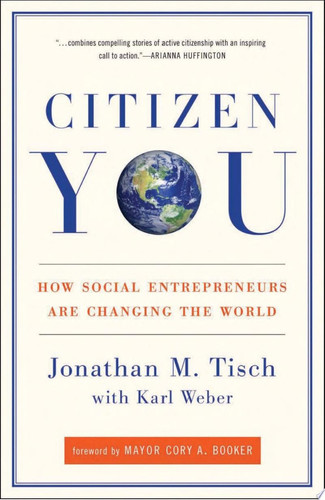
Citizen You How Social Entrepreneurs Are Changing the World

Jonathan Tisch,Karl Weber
Just when the world needs it most, a new style of social engagement is emerging: Active Citizenship. A key member of one of New York’s most civic-minded families—one that has supported many of America’s notable institutions and deserving programs—Jonathan Tisch has devoted a lifetime to “active citizenship.” It’s an idea that uses the power of practical creativity and grassroots participation to solve seemingly intractable problems. In Citizen You , Tisch challenges readers to join this movement and points the way toward making our world a better place, one person and one neighborhood at a time. Tisch has filled Citizen You with accounts of people who you’ll meet, such inspirational individuals as: Scott Harrison, who has used the networking and marketing skills he developed as a night club promoter to help over a million people in the developing world get access for the first time to clean, safe drinking water. Steffi Coplan, whose Broadway2Broadway project brought out the hidden musical talents of kids at an inner city school. Eric Schwarz, who decided to do something about America’s under-performing schools, and parlayed a single classroom mentoring project into the nationwide Citizens Schools movement. Chris Swan, who is training a new generation of “citizen engineers” to make sure that the projects they build aren’t just structurally sound but also environmentally and socially sustainable. Dave Nelson, who traded his role as an executive at IBM for a job at a struggling nonprofit that teaches kids about the power of entrepreneurship—and discovered a host of new challenges and rewards in the process. Through these and many other remarkable stories, you’ll learn how today’s active citizens are transforming thinking about social change. Rather than short-term fixes and hand-me-down charity, they’re striving to build sustainable, systemic solutions to our most challenging problems, building and empowering communities rather than fostering dependency. And they’re using a host of new tools, from online networking and private-public partnerships to corporate engagement and social entrepreneurship, to redefine how change can happen. Citizen You is a potent antidote to pessimism. At a time of unprecedented challenges on the national and world stage, when active citizenship is not a choice but a necessity, Citizen You dares us to reshape the social, political, and intellectual structures that have long confined us, and offers fresh thinking that redefines the very concept of activism. For more information and ideas about how to be an active citizen go to www.citizenyou.org
Crown 2011-05-03 288 pages

Everybody Wants to Go to Heaven but Nobody Wants to Die Bioethics and the Transformation of Health Care in America

Amy Gutmann,Jonathan D Moreno
NOW FEATURING A NEW AFTERWORD, "PANDEMIC ETHICS" From two eminent scholars comes a provocative examination of bioethics and our culture’s obsession with having it all without paying the price. Shockingly, the United States has among the lowest life expectancies and highest infant mortality rates of any high-income nation, yet, as Amy Gutmann and Jonathan D. Moreno show, we spend twice as much per capita on medical care without insuring everyone. A “remarkable, highly readable journey” (Judy Woodruff ) sure to become a classic on bioethics, Everybody Wants to Go to Heaven but Nobody Wants to Die explores the troubling contradictions between expanding medical research and neglecting human rights, from testing anthrax vaccines on children to using brain science for marketing campaigns. Providing “a clear and compassionate presentation” ( Library Journal ) of such complex topics as radical changes in doctor-patient relations, legal controversies over in vitro babies, experiments on humans, unaffordable new drugs, and limited access to hospice care, this urgent and incisive history is “required reading for anyone with a heartbeat” (Andrea Mitchell).
National Geographic Books 2020-11-23 272 pages

The ancient eight: college football's Ivy League and the game they play today

Feinstein, John
Award-winning, bestselling author John Feinstein chronicles a year inside Ivy League Football, unveiling the heart and soul of college football's oldest teams as they compete at an elite level in a conference that prizes tradition -- amid a rapidly changing and increasingly monetized collegiate sports world. The history of the Ivy League dates back to 1869 when Princeton played the first college football game against Rutgers. That storied history, however, is not what this book is about. Rather, The Ancient Eight explores Ivy League football today. Why? Because the conference is underrated. NFL rosters typically feature about a dozen former Ivy players. To play in the league, one must maintain the highest academic standards and be a great football player. The rivalries are as intense as in the SEC or the Big Ten, even if the linemen aren't quite as large. There are arcane rules forbidding participation in the NCAA postseason, not allowing eligible graduate students to play, and scheduling ten straight weeks without a bye. But there is also a genuine purity -- not one that's made up for marketing purposes -- in the Ivy League. Through intimate interviews with players, coaches, and key figures, Feinstein uncovers the unique culture that defines football on the Ivy League gridiron, offering unparalleled access to the remarkable coaching staffs and student-athletes who balance their academic ambitions with their passion for the game. The story of the 2023 season began tragically when longtime Dartmouth coach Buddy Teevens suffered fatal injuries in a bicycle accident, and one of his players, Joshua Balara, died of cancer the same day. But Dartmouth would persist to shockingly win a share of the Ivy championship, along with both Harvard and Yale -- the result of a nail-biting 138th meeting of those two schools in The Game. On the field, inside the locker room, and around campus, The Ancient Eight reveals the phenomenal stories of the young men who play in today's Ivy League and those who coach them.
Hachette Books 2024 246 pages

The Fools of Chelm and Their History

Isaac Bashevis Singer
Assists investors and economic planners in identifying opportunities for agroindustrial investment and in designing related projects and policies. Agroindustry accounts for the majority of manufacturing activity in the developing world and represents an important first step on the path to industrialization. Many developing country governments have restricted their investment in agroindustrial and other development projects because of high debt levels and restrictions on credit. This trend has made private-sector investment crucial. Yet relatively little has been written to assist investors and economic planners in identifying opportunities for agroindustrial investment or in designing effective projects and policies. This book is an operating manual for who design or manage commercial agroindustrial enterprises. The study addresses three fundamental concerns: * The practical steps that must be taken to identify, analyze, and select components of an enterprise, such as marketing, processing, and raw material supply * Methods for assessing the financial viability of the enterprise * The management, administrative, and planning activities involved in establishing a successful enterprise, taking national development objectives and policies into account. The first part of the study examines the basic characteristics of an agroindustrial enterprise and presents analytical techniques both for investing in such enterprises and for managing them. The second part of the study profiles seven major agroindustrial commodities: rice, oilseeds, animal feeds, fruits and vegetables, sugar, ethanol from sugarcane, and coffee. The profiles trace each commodity from raw material through processing and review the structure of the market for each. This is a handy and reliable reference for agroindustry analysts, investors, and managers and will also be useful to teachers, policymakers, and staff members of development banks and other credit institutions.
Farrar, Straus and Giroux (BYR) 1988-12-01 64 pages

Only the rich can play: how Washington works in the New Gilded Age

Wessel, David
"David Wessel's incredible tale of how Washington works-and why the rich keep getting richer-starts when a Silicon Valley entrepreneur concocts an idea that will save money on his taxes and spins it as a way to ostensibly help poor people. He organizes and pays for an effective lobbying effort that pushes his idea into law with little scrutiny or fine-tuning by congressional or Treasury tax experts-and few safeguards against abuse. With an unbeatable pair of high-profile sponsors, bumper-sticker simplicity and deft political marketing, the Opportunity Zone became an unnoticed part of the 2017 Trump tax bill. The gold rush followed immediately thereafter. In Only the Rich Can Play, Wessel follows the money to see who profited from this plan that was supposed to spur development of blighted areas and help people out of poverty: the Mandalay Bay Hotel in Las Vegas, the Portland (Oregon) Ritz-Carlton, the Mall of America, and self-storage facilities-lucrative areas where the one percent can park money profitably and avoid capital gains taxes. And the best part: unlike other provisions for eliminating capital gains taxes (inheritance, for example) you don't have to die to take advantage of this one. Wessel provides vivid portraits of the proselytizers, political influencers, motivational speakers, consultants, real estate dealmakers, and individual money-seekers looking to take advantage of this twenty-first century bonanza. He looks at places for which Opportunity Zones were supposedly designed (Baltimore, for example) and how little money they've drawn. And he finds a couple of places (Erie, PA) where zones are actually doing what they were supposed to, a lesson on how a better designed program might have helped more left-behind places. Readers will feel outraged as Wessel gives us the gritty reality, the dark underbelly of a system tilted in favor of the few, with the many left out in the cold"--
PublicAffairs 2021 337 pages

Recreating motherhood

Rothman, Barbara Katz
Selling "genetically gifted" human eggs on the free market for a hefty price. In vitro fertilization. Fetal rights. Prenatal diagnosis. Surrogacy. All are instances of biomedical and social "advancements" with which we have become familiar in recent years. Yet these issues are often regarded as distinct or only loosely related under the rubric of reproduction. Barbara Katz Rothman demonstrates how they form a complex whole that demands of us in response a woman-centered, class-sensitive way of understanding motherhood. We need a social policy for dealing with mothers and motherhood that is consistent with feminist politics and feminist theory. Her book show how we as a society must first recognize that the real needs of mother, father, and children have been swept aside in an attempt to reduce the complex process of human reproduction to a clinical event that can be controlled by medical technology. Rothman suggests ways to accomplish social and legal change that would allow technological advances to affirm motherhood and the mother-child relationship without cost to women's identity. This new edition of Recreating Motherhood contains exciting updates. Rothman shows how this material is key in understanding the family, not just motherhood. And a new chapter, "Reflections on a Decade," explores how new reproductive technologies combine with new marketing and new genetics to pose troubling social questions.
Rutgers University Press 2000 226 pages

Big food: critical perspectives on the global growth of the food and beverage industry

Simon N. Williams,Marion Nestle
Obesity is a global public health problem of crucial importance. Obesity rates remain high in high-income countries and are rapidly increasing in low- and middle- income countries. Concurrently, the global consumption of unhealthy products, such as soft drinks and processed foods, continues to rise. The ongoing expansion of multinational food and beverage companies, or 'Big Food', is a key factor behind these trends. This collection provides critical insight into the global expansion of 'Big Food', including its incursion into low-and-middle income countries. It examines the changing dynamics of the global food supply, and discusses how low-income countries can alter the 'Big Food'-diet from the bottom-up. It examines a number of issues related to 'Big Food' marketing strategies, including the way in which they advertise to youths and the rural poor. These issues are discussed in terms of their public health implications, and their relation to public health activities, for example 'soda taxes', and the promotion of nutritionally-healthier products. This book was originally published as a special issue of Critical Public Health.
Routledge 2016 157 pages

The technological republic: the crisis of technology and the West

Karp, Alexander C.,Zamiska, Nicholas W.
Our most brilliant engineering minds once collaborated with government to advance world-changing technologies. Their efforts secured the West's dominant place in the geopolitical order. But that relationship has now eroded, with perilous repercussions. Today, the market rewards shallow engagement with the potential of technology. Engineers and founders build photo-sharing apps and marketing algorithms, unwittingly becoming vessels for the ambitions of others. This complacency has spread into academia, politics, and the boardroom. The result? An entire generation for whom the narrow-minded pursuit of the whims of a late capitalist economy has become their calling. In this groundbreaking treatise, Palantir co-founder and CEO Alexander C. Karp and Nicholas W. Zamiska offer a searing critique of our collective abandonment of ambition, arguing that in order for the Westo retain its global edge-and preserve the freedoms we take for granted-the software industry must renew its commitment to addressing our most urgent challenges, including the new arms race of artificial intelligence. Government, in turn, must embrace the most effective features of the engineering mindset that has propelled Silicon Valley's success. Above all, leaders must reject intellectual fragility and preserve space for ideological confrontation. A willingness to risk the disapproval of the crowd, Karp and Zamiska contend, has everything to do with technological and economic outperformance. At once iconoclastic and rigorous, this book will also lift the veil on Palantir and its broader political project from the inside, offering a passionate call for the West to wake up to our new reality.
The Bodley Head 2025-02-20 320 pages

Being direct: making advertising pay

Wunderman, Lester
Lester Wunderman is an advertising legend, the pioneering father of direct marketing, to whom we owe the ubiquity of the American Express card, the creation of the Columbia Record Club, and the high profile of L.L. Bean. The visionary marketing techniques Wunderman conceived and perfected over his long and brilliant career transformed the advertising industry and will shape the interactive marketplace of the future. Here is his own story, in his own words, of how he did it - how he learned to make advertising pay. Direct marketing is a strategy for putting manufacturers directly in touch with consumers - the blueprint for the "disintermediation" of the digital world. Back in the fifties and sixties, while other ad agencies disdained what was then called mail-order selling, Lester Wunderman used his instincts and skills to revolutionize the industry. He was responsible for a number of firsts: He introduced bound-in subscription cards for magazines, founded the first "virtual store", introduced pre-printed newspaper inserts, and persuaded Time Inc. to use an 800 number to sell their magazines. Today, direct marketing accounts for 15 percent of all retail sales worldwide.
Random House 1996 305 pages

The education of millionaires: it's not what you think and it's not too late

Ellsberg, Michael
The myth: If you get into a good college, study hard, and graduate with excellent grades, you will be pretty much set for a successful career. The reality: The biggest thing you won't learn in college is how to succeed professionally. Some of the smartest, most successful people in the country didn't finish college. None of them learned their most critical skills at an institution of higher education. And like them, most of what you'll need to learn to be successful you'll have to learn on your own, outside of school. Michael Ellsberg set out to fill in the gaps by interviewing a wide range of millionaires and billionaires who don't have college degrees, including fashion magnate Russell Simmons, Facebook co-founder Dustin Moskovitz and founding president Sean Parker, WordPress creator Matt Mullenweg, and Pink Floyd songwriter and lead guitarist David Gilmour. Among the fascinating things he learned: How fashion designer Marc Ecko started earning $1000 a week in high school with his own clothing business, and later grew it into an empire. How billionaire Phillip Ruffin went from lowly department store employee with no college degree, to owner of Treasure Island on the Vegas Strip. How John Paul DeJoria went from homelessness to billionaire as founder of John Paul Mitchell Systems Hair Care Products. This book is your guide to developing practical success skills in the real world. Even if you've already gone through college, the most important skills weren't in the curriculum-how to find great mentors, build a world-class network, learn real-world marketing and sales, make your work meaningful (and your meaning work), build the brand of you, master the art of bootstrapping, and more. Learning the skills in this book well is a necessary addition to any education. This book shows you the way, whether you're a high school dropout or a graduate of Harvard Law School.
Portfolio/Penguin 2011 258 pages

Free enterprise: an American history

Glickman, Lawrence B.
"Throughout the twentieth century, 'free enterprise' has been a contested keyword in American politics, and the cornerstone of a conservative philosophy that seeks to limit government involvement into economic matters. Lawrence B. Glickman shows how the idea first gained traction in American discourse and was championed by opponents of the New Deal. Those politicians, believing free enterprise to be a fundamental American value, held it up as an antidote to a liberalism that they maintained would lead toward totalitarian statism. Tracing the use of the concept of free enterprise, Glickman shows how it has both constrained and transformed political dialogue. He presents a fascinating look into the complex history, and marketing, of an idea that forms the linchpin of the contemporary opposition to government regulation, taxation, and programs such as Medicare."--Publisher's web-site
Yale University Press 2019-08-20 340 pages