115 results for "Public Policy"

So much to do: a full life of business, politics, and confronting fiscal crises

Ravitch, Richard
Every city and every state needs a Richard Ravitch. In sixty years on the job, whether working in business or government, he was the man willing to tackle some of the most complex challenges facing New York. Trained as a lawyer, he worked briefly for the House of Representatives, then began his career in his family's construction business. He built high-profile projects like the Whitney Museum and Citicorp Center but his primary energy was devoted to building over 40,000 units of affordable housing including the first racially integrated apartment complex in Washington, D.C. He dealt with architects, engineers, lawyers, bureaucrats, politicians, union leaders, construction workers, bankers, and tenants—virtually all of the people who make cities and states work. It was no surprise that those endeavors ultimately led to a life of public service. In 1975, Ravitch was asked by then New York Governor Hugh Carey to arrange a rescue of the New York State Urban Development Corporation, a public entity that had issued bonds to finance over 30,000 affordable housing units but was on the verge of bankruptcy. That same year, Ravitch was at Carey's side when New York City's biggest banks said they would no longer underwrite its debt and he became instrumental to averting the city's bankruptcy. Throughout his career, Ravitch divided his time between public service and private enterprise. He was chairman of the Metropolitan Transportation Authority from 1979 to 1983 and is generally credited with rebuilding the system. He turned around the Bowery Savings Bank, chaired a commission that rewrote the Charter of the City of New York, served on two Presidential Commissions, and became chief labor negotiator for Major League Baseball. Then, in 2008, after Governor Eliot Spitzer resigned in a prostitution scandal and New York State was in a post-financial-crisis meltdown, Spitzer's successor, David Paterson, appointed Ravitch Lieutenant Governor and asked him to make recommendations regarding the state's budgeting plan. What Ravitch found was the result of not just the economic downturn but years of fiscal denial. And the closer he looked, the clearer it became that the same thing was happening in most states. Budgetary pressures from Medicaid, pension promises to public employees, and deceptive budgeting and borrowing practices are crippling our states' ability to do what only they can do—invest in the physical and human infrastructure the country needs to thrive. Making this case is Ravitch's current public endeavor and it deserves immediate attention from both public officials and private citizens.
PublicAffairs 2014-04-29 254 pages

Classics in the theory of public finance

Richard Abel Musgrave,Alan T. Peacock
This book was prepared mainly for specialists on the assumption that it would provide the background to an important neglected field of discussion in public finance. Since it was first published in 1958, the theory of public goods and its implications for public policy have become incorporated in the main body of the economic analysis of public finance in the literature. A glance at the footnotes of some of the standard textbooks on public finance indicates that this assembly of articles has not been in vain. Probably the most influential part of this collection has been the papers concerned with the theory of public expenditure, which contains two closely related elements. The first is as a part of welfare economics: under what conditions can Pareto optimality be achieved in an economic system in which some goods supplied are indivisible? The other strand of thought is concerned with the positive theory of the public sector: how can economic analysis be used in order to explain how the size and composition of the budget is actually determined?
Macmillan in association with the International Economic Association 1958 244 pages

The New Democracy

Walter E. 1873-1919 Weyl
This work has been selected by scholars as being culturally important, and is part of the knowledge base of civilization as we know it. This work is in the "public domain in the United States of America, and possibly other nations. Within the United States, you may freely copy and distribute this work, as no entity (individual or corporate) has a copyright on the body of the work. Scholars believe, and we concur, that this work is important enough to be preserved, reproduced, and made generally available to the public. We appreciate your support of the preservation process, and thank you for being an important part of keeping this knowledge alive and relevant.
Creative Media Partners, LLC 2022-10-27 382 pages

Pollution in a promised land: an environmental history of Israel

Tal, Alon
Virtually undeveloped one hundred years ago, Israel, the promised "land of milk and honey," is in ecological disarray. In this gripping book, Alon Tal provides--for the first time ever--a history of environmentalism in Israel, interviewing hundreds of experts and activists who have made it their mission to keep the country's remarkable development sustainable amid a century of political and cultural turmoil.The modern Zionist vision began as a quest to redeem a land that bore the cumulative effects of two thousand years of foreign domination and neglect. Since then, Israel has suffered from its success. A tenfold increase in population and standard of living has polluted the air. The deserts have bloomed but groundwater has become contaminated. Urban sprawl threatens to pave over much of the country's breathtaking landscape. Yet there is hope. Tal's account considers the ecological and tactical lessons that emerge from dozens of cases of environmental mishaps, from habitat loss to river reclamation. Pollution in a Promised Land argues that the priorities and strategies of Israeli environmental advocates must address issues beyond traditional green agendas.
University of California Press 2002-08-01 546 pages

The paradox of American democracy: elites, special interests, and the betrayal of the public trust

Judis, John B.
John B. Judis, one of our most insightful political commentators, most rational and careful thinkers, and most engaged witnesses in Washington, has taken on a challenge that even the most concerned American citizens shrink from: forecasting the American political climate at the turn of the century. The Paradox of American Democracy is a penetrating examination of our democracy that illuminates the forces and institutions that once enlivened it and now threaten to undermine it. It is the well-reasoned discussion we need in this era of unrestrained expert opinions and ideologically biased testimony. The disenchantment with our political system can be seen in decreasing voter turnout, political parties co-opted by consultants and large contributors, the corrupting influence of "soft money," and concern for national welfare subverted by lobbying organizations and special-interest groups. Judis revisits particular moments -- the Progressive Era, the New Deal, the 1960s -- to discover what makes democracy the most efficacious and, consequently, most inefficacious. What has worked in the past is a balancing act between groups of elites --- trade commissions, labor relations boards, policy groups -- whose mandates are to act in the national interest and whose actions are governed by a disinterested pursuit of the common good. Judis explains how the displacment of such elites by a new lobbying community in Whashington has given rise to the cynicism that corrodes the current political system. The Paradox of American Democracy goes straight to the heart of every political debate in this country.
Pantheon Books 2000-02-15 305 pages

Essays in Taxation

Edwin Robert Anderson Seligman
This work has been selected by scholars as being culturally important, and is part of the knowledge base of civilization as we know it. This work is in the "public domain in the United States of America, and possibly other nations. Within the United States, you may freely copy and distribute this work, as no entity (individual or corporate) has a copyright on the body of the work. Scholars believe, and we concur, that this work is important enough to be preserved, reproduced, and made generally available to the public. We appreciate your support of the preservation process, and thank you for being an important part of keeping this knowledge alive and relevant.
Creative Media Partners, LLC 2022-10-27 452 pages

David Dickson's and James M. Smith's Farming

David Dickson,James Monroe Smith
This work has been selected by scholars as being culturally important, and is part of the knowledge base of civilization as we know it. This work is in the "public domain in the United States of America, and possibly other nations. Within the United States, you may freely copy and distribute this work, as no entity (individual or corporate) has a copyright on the body of the work. Scholars believe, and we concur, that this work is important enough to be preserved, reproduced, and made generally available to the public. We appreciate your support of the preservation process, and thank you for being an important part of keeping this knowledge alive and relevant.
Creative Media Partners, LLC 2022-10-27 252 pages

All in a Life-time

Morgenthau, Henry,Strother, French
"All in a Life-time" offers a rare and compelling glimpse into the world of early 20th-century diplomacy and United States foreign relations. Written by Henry Morgenthau and French Strother, this political memoir chronicles a distinguished career in public service. As a key figure during World War I, Morgenthau provides firsthand accounts and insightful observations on critical historical events. His experiences as an ambassador offer a unique perspective on the complexities of international relations and the challenges of representing the United States on the world stage. This meticulously prepared print republication allows readers to delve into the past and gain a deeper understanding of the historical context that shaped the 20th century. "All in a Life-time" remains a vital resource for anyone interested in biography, United States history, and the intricacies of public policy. Its enduring appeal lies in its timeless exploration of leadership, diplomacy, and the pursuit of a life dedicated to service. This work has been selected by scholars as being culturally important, and is part of the knowledge base of civilization as we know it. This work is in the public domain in the United States of America, and possibly other nations. Within the United States, you may freely copy and distribute this work, as no entity (individual or corporate) has a copyright on the body of the work. Scholars believe, and we concur, that this work is important enough to be preserved, reproduced, and made generally available to the public. We appreciate your support of the preservation process, and thank you for being an important part of keeping this knowledge alive and relevant.
Anson Street Press 2025-03-29 324 pages

Theorists of economic growth from David Hume to the present: with a perspective on the next century

Rostow, W. W.
This history of theories and theorists of economic growth elucidates the economic theory, economic history, and public policy observations of the renowned scholar W. W. Rostow. Looking at the economic growth theories of the classic economists up to 1870, Rostow compares Hume and Adam Smith, Malthus and Ricardo, and J.S. Mill and Karl Marx. He then examines the period 1870-1939 and its economic theorists, including Schumpeter, Colin Clark, Kuznets, and Harrod, and surveys the three forms of growth analysis in the postwar era: formal models, statistical morphology, and development theories. This authoritative overview also includes an agenda of unresolved problems in growth analysis and a description of the five major tasks statesmen will confront over the next several generations.
Oxford University Press 1990 712 pages

Racism, dissent, and Asian Americans from 1850 to the present: a documentary history

Foner,PhilipSheldon,1910-1994,Rosenberg,Daniel,1953-
Drawing from a broad range of articles, speeches, short stories, pamphlets, sermons, debates, laws, public statements, Supreme Court decisions and conventions, this documentary history demonstrates the persistence of a humanist, if not an anti-racist, pulse in American society in the face of discriminatory government policy and prevalent anti-Asian ideology and treatment. Focusing on support for the rights of Japanese and Chinese immigrants and their descendants, the book traces a 130-year period, culminating with the governmental redress for survivors of the Japanese evacuation and internment during WWII. Foner and Rosenberg highlight expressions from the clergy, the labor movement, the abolitionists, and public figures such as Wendell Phillips, Charles Sumner, Frederick Douglass, Mark Twain, John Stuart Mill, Norman Thomas and Carey McWilliams. It includes material never before published showing Black support for Asian rights and demonstrates the consistency of the Industrial Worker of the World's solidarity with Chinese and Japanese-American workers. It is also the first work to give serious treatment to clergymen's efforts against anti-Asian discrimination. After the introduction, Foner discusses law and dissent. The next four sections are devoted to statements by public figures, the views of the clergy, the labor movement and African-Americans. The final section covers relocation and protest. The book provides a valuable contribution to the debates on American dissent in general and against racism in particular, the meaning of American nationality, the criminality of the evacuation and internment of Japanese-Americans during World War II and the immigration policies of the United States government.
Greenwood Press 1993-04-30 311 pages

The Shifting and Incidence of Taxation

Edwin Robert Anderson Seligman
This work has been selected by scholars as being culturally important, and is part of the knowledge base of civilization as we know it. This work is in the "public domain in the United States of America, and possibly other nations. Within the United States, you may freely copy and distribute this work, as no entity (individual or corporate) has a copyright on the body of the work. Scholars believe, and we concur, that this work is important enough to be preserved, reproduced, and made generally available to the public. We appreciate your support of the preservation process, and thank you for being an important part of keeping this knowledge alive and relevant.
Creative Media Partners, LLC 2022-10-27 348 pages

Fatherlands: state-building and nationhood in nineteenth-century Germany

Green, Abigail
Fatherlands explores the nature of identity in nineteenth-century Germany, and has crucial implications for our understanding of nationalism, German unification and the German state in the modern era. It approaches these questions from a new and important angle, that of the non national territorial state, exploring the state-building process in non-Prussian Germany. The issues covered range from railway construction and German industrialization, to the modernization of German monarchy, the emergence of a free press, the development of a modern educational system, and the role of monuments, museums and public festivities.
Cambridge University Press 2001 386 pages

Maria Stuart

Zweig, Stefan
"Mary Stuart's execution remains an entirely unacceptable crime morally (...) However, it is equally difficult to deny that the destruction of Mary Stuart was a prudent course of action from a public policy standpoint. Because, regrettably, in politics, the determining issue is not the correctness of a legislation, but its success." Stefan Zweig was enchanted with Mary Stuart, whose life he perceived as immensely paradoxical and from whom he perceived a "inexhaustible attraction of mystery." Thus, he investigated the queen of Scotland and Elizabeth I's fierce rival through the lens of a novelistic biography. Zweig is the undisputed master of this genre: he meticulously details the tumultuous life of this amazing woman, who culminated on the scaffold. Biography Stefan Zweig (1881-1942) was born into a Jewish commercial family in Vienna. He created poetry, stories, plays, and essays, all of which were burned by the Nazis in 1933. He resided in Salzburg from 1919 until 1934, then moved to England and then to Brazil in 1941. His epic works, like his historical miniatures and biographical works, made him famous. He deliberately put up his life in Petrópolis, Brazil, on February 23, 1942.
Independently published 2021-04-05 596 pages

Liberalism And The Challenge Of Fascism

Salwyn Schapiro J
This work has been selected by scholars as being culturally important, and is part of the knowledge base of civilization as we know it. This work is in the "public domain in the United States of America, and possibly other nations. Within the United States, you may freely copy and distribute this work, as no entity (individual or corporate) has a copyright on the body of the work. Scholars believe, and we concur, that this work is important enough to be preserved, reproduced, and made generally available to the public. We appreciate your support of the preservation process, and thank you for being an important part of keeping this knowledge alive and relevant.
Creative Media Partners, LLC 2022-10-27 446 pages

Imperial Russia's Jewish question, 1855-1881

Klier, John Doyle
The reform era in Russia (1855-1881) witnessed the emancipation of the serfs, economic and social change, the reform of all imperial institutions, and the growth of national identity among Russians and the Empire's expanding Jewish population. Consequently, the 'Jewish Question' became one of most hotly debated topics in Russia. Attitudes toward the Jews which evolved during this period persisted up to the Revolution and beyond. This book, based on exhaustive archival research of materials published during the period, studies the interplay of public opinion and official policy. The author examines the attitudes of all sectors of Russian educated society towards the Jews. He also explores how a new group, the Russian Jewish intelligentsia, sought to define a modern Jewish identity in the midst of a multi-ethnic Empire.
Cambridge University Press 1995 534 pages

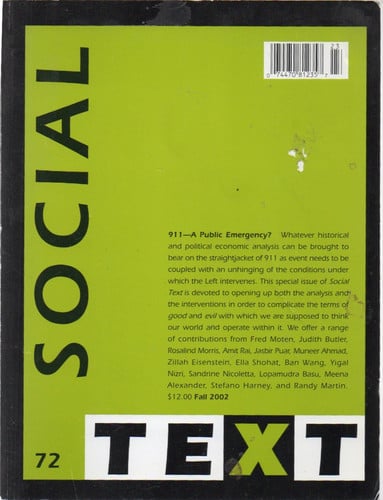
911 a Public Emergency?

Brent Hayes Edwards,Stefano Harney,Randy Martin,Ella Shohat,Timothy Mitchell,Fred Moten
Since September 11, public discourse has often been framed in terms of absolutes: an age of innocence gives way to a present under siege, while the United States and its allies face off against the Axis of Evil. This special issue of Social Text aims to move beyond these binaries toward thoughtful analysis. The editors argue that the challenge for the Left is to develop an antiterrorism stance that acknowledges the legacy of U.S. trade and foreign policy as well as the diversity of the Muslim faith and the dangers presented by fundamentalism of all kinds. Examining the strengths and shortcomings of area, race, and gender studies in the search for understanding, this issue considers cross-cultural feminism as a means of combating terrorism; racial profiling of Muslims in the context of other racist logics; and the homogenization of dissent. The issue includes poetry, photographic work, and an article by Judith Butler on the discursive space surrounding the attacks of September 11. This impressive range of contributions questions the meaning and implications of the events of September 11 and their aftermath. Contributors . Muneer Ahmad, Meena Alexander, Lopamudra Basu, Judith Butler, Zillah Eisenstein, Stefano Harney, Randy Martin, Rosalind C. Morris, Fred Moten, Sandrine Nicoletta, Yigal Nizri, Jasbir K. Puar, Amit S. Rai, Ella Shohat, Ban Wang
Duke University Press 2002-09-20 208 pages

Europe in crisis: bolt from the blue?

Berend, T. Iván
This book analyzes the European Great Recession of 2008-12, its economic and social causes, its historical roots, and the policies adopted by the European Union to find a way out of it. It contains explicit debates with several economists and analysts on some of the most controversial questions about the causes of the crisis and the policies applied by the European Union. It presents the cases of Iceland, Greece, and Ireland, the countries that first declined into crisis in Europe, each of them in a different way. Iceland is a case study for reckless banking practices, Greece of reckless public spending, and Ireland of reckless household indebtedness. At least seven other countries, mostly from the peripheries of Europe, had similarly reckless banking and spending practices. In the center of the book are the economic and social causes of the crisis. Contemporary advanced capitalism became financialized, de-industrialized and globalized and got rid of the "straitjacket" of regulations. Solid banking was replaced by high-risk, "casino-type" activity. The European common currency also had a structural problem - monetary unification without a federal state and fiscal unification. The other side of the same coin is European hyper-consumerism. A new lifestyle emerged during two super-prosperous periods in the 1950s to 1960s, and during the 1990s to 2006. Trying to find an exit policy, the European Union turned to strict austerity measures to curb the budget deficit and indebtedness. This book critically analyzes the debate around austerity policy. The creation of important supranational institutions, and of a financial supervisory authority and stability mechanisms, strengthens integration. The correction of the euro's structural mistake by creating a quasi-fiscal unification is even more important. The introduction of mandatory fiscal rules and their supervision promises a long-term solution for a well-functioning common currency. These measures, meanwhile, create a two-tier European Union with a fast-track core. This book suggests that the European Union will emerge stronger from the crisis. This book will be of particular interest to students and researchers of economics, history, political science and international finance, but will also prove profitable reading for practitioners and the interested public. Book jacket.
Routledge 2013 169 pages

Communists in closets: queering the history 1930s-1990s

Aptheker, Bettina
"Communists in Closets: Queering the History 1930s-1990s explores the history of gay, lesbian and non-heterosexual people in the Communist Party in the United States The Communist Party banned LGBT people from membership beginning in 1938 when it cast them off as "degenerates." It persisted in this policy until 1991 when the Party split apart in the wake of the collapse of the Soviet Union and the socialist countries of Eastern Europe. During this 60- year ban, gays and lesbians who did join the Communist Party were deeply closeted within it, as well as in their public lives as both queer and Communist. By the late 1930s the Communist Party had a membership approaching 100,000 and tens of thousands of more people moved in its orbit through the Popular Front against fascism, anti-racist organizing, especially in the south, and its widely read cultural magazine, The New Masses. Based on a decade of archival research, correspondence, and interviews, Bettina Aptheker explores this history, also pulling from her own experience as a closeted lesbian in the Communist Party in the 1960s and 70s. Ironically, and in spite of this homophobia individual Communists laid some of the political and theoretical foundations for lesbian and gay liberation, and contributed significantly to peace, social justice, civil rights, Black and Latinx liberation movements. This book will be of interest to students, scholars, and general readers in political history, gender studies and the history of sexuality"--
Routledge Taylor & Francis Group 2023 255 pages

Cause and Meaning in the Social Sciences

Ernest Gellner
This volume focuses on key conceptual issues in the social sciences, such as Winch's idea of a social science, structuralism, Malinowski and Evans-Pritchard, and the concept of kinship. In particular it deals with such problems as the relationship of nature and culture, the relevance of concepts drawn from within a given society to its understanding, and the relation of theory to time.
Routledge 2006-02-28 240 pages