87 results for "Science"

Humanitarian intervention and legitimacy wars: seeking peace and justice in the 21st century

Falk, Richard A.
"In the aftermath of the Cold War there has been a dramatic shift in thinking about the maintenance of peace and security on a global level. This shift is away from a preoccupation with how to prevent major wars between sovereign states to a preoccupation about non-state transnational warfare and violence and strife within states in a world order that continues to be juridically and politically delimited by spatial ideas of national sovereignty and national independence as signified by international boundaries. In this book, Richard Falk draws upon these changes to examine the ethics and politics of humanitarian intervention in the 21st Century. As well as analysing the theoretical and conceptual basis of the responsibility to protect, the book also contains a number of case studies looking at Iraq, Afghanistan, Kosovo and Syria. The final section explores when humanitarian intervention can succeed and the changing nature of international political legitimacy in countries such as India, Tibet, South Africa and Palestine.This book will be of interest to students of International Relations theory, Peace Studies and Global Politics. "--
Routledge 2015 223 pages

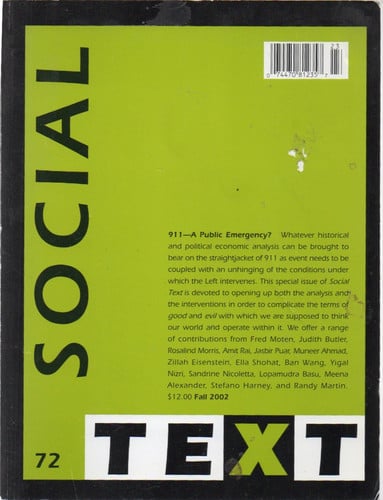
911 a Public Emergency?

Brent Hayes Edwards,Stefano Harney,Randy Martin,Ella Shohat,Timothy Mitchell,Fred Moten
Since September 11, public discourse has often been framed in terms of absolutes: an age of innocence gives way to a present under siege, while the United States and its allies face off against the Axis of Evil. This special issue of Social Text aims to move beyond these binaries toward thoughtful analysis. The editors argue that the challenge for the Left is to develop an antiterrorism stance that acknowledges the legacy of U.S. trade and foreign policy as well as the diversity of the Muslim faith and the dangers presented by fundamentalism of all kinds. Examining the strengths and shortcomings of area, race, and gender studies in the search for understanding, this issue considers cross-cultural feminism as a means of combating terrorism; racial profiling of Muslims in the context of other racist logics; and the homogenization of dissent. The issue includes poetry, photographic work, and an article by Judith Butler on the discursive space surrounding the attacks of September 11. This impressive range of contributions questions the meaning and implications of the events of September 11 and their aftermath. Contributors . Muneer Ahmad, Meena Alexander, Lopamudra Basu, Judith Butler, Zillah Eisenstein, Stefano Harney, Randy Martin, Rosalind C. Morris, Fred Moten, Sandrine Nicoletta, Yigal Nizri, Jasbir K. Puar, Amit S. Rai, Ella Shohat, Ban Wang
Duke University Press 2002-09-20 208 pages

Europe in crisis: bolt from the blue?

Berend, T. Iván
This book analyzes the European Great Recession of 2008-12, its economic and social causes, its historical roots, and the policies adopted by the European Union to find a way out of it. It contains explicit debates with several economists and analysts on some of the most controversial questions about the causes of the crisis and the policies applied by the European Union. It presents the cases of Iceland, Greece, and Ireland, the countries that first declined into crisis in Europe, each of them in a different way. Iceland is a case study for reckless banking practices, Greece of reckless public spending, and Ireland of reckless household indebtedness. At least seven other countries, mostly from the peripheries of Europe, had similarly reckless banking and spending practices. In the center of the book are the economic and social causes of the crisis. Contemporary advanced capitalism became financialized, de-industrialized and globalized and got rid of the "straitjacket" of regulations. Solid banking was replaced by high-risk, "casino-type" activity. The European common currency also had a structural problem - monetary unification without a federal state and fiscal unification. The other side of the same coin is European hyper-consumerism. A new lifestyle emerged during two super-prosperous periods in the 1950s to 1960s, and during the 1990s to 2006. Trying to find an exit policy, the European Union turned to strict austerity measures to curb the budget deficit and indebtedness. This book critically analyzes the debate around austerity policy. The creation of important supranational institutions, and of a financial supervisory authority and stability mechanisms, strengthens integration. The correction of the euro's structural mistake by creating a quasi-fiscal unification is even more important. The introduction of mandatory fiscal rules and their supervision promises a long-term solution for a well-functioning common currency. These measures, meanwhile, create a two-tier European Union with a fast-track core. This book suggests that the European Union will emerge stronger from the crisis. This book will be of particular interest to students and researchers of economics, history, political science and international finance, but will also prove profitable reading for practitioners and the interested public. Book jacket.
Routledge 2013 169 pages

The future of art in a postdigital age: from Hellenistic to Hebraic consciousness

Alexenberg, Mel
This book offers a prophetic vision of a postdigital future that reveals a paradigm shift from the Hellenistic to the Hebraic roots of Western culture. Alexenberg surveys new art forms emerging from a postdigitial age and explores postdigital perspectives rising from creative encounters between art, science, technology, and human consciousness.
Intellect 2011 270 pages

Confessions of a born-again pagan

Kronman, Anthony T.
We live in an age of disenchantment. The number of self-professed "atheists" continues to grow. Yet many still feel an intense spiritual longing for a connection to what Aristotle called the "eternal and divine." For those who do, but demand a God that is compatible with their modern ideals, a new theology is required. This is what Anthony Kronman offers here, in a book that leads its readers away from the inscrutable Creator of the Abrahamic religions toward a God whose inexhaustible and everlasting presence is that of the world itself. Kronman defends an ancient conception of God, deepened and transformed by Christian belief--the born-again paganism on which modern science, art, and politics all vitally depend. Brilliantly surveying centuries of Western thought--from Plato to Augustine, Aquinas, and Kant, from Spinoza to Nietzsche, Darwin, and Freud--Kronman recovers and reclaims the God we need today.
Yale University Press 2016-10-25 1161 pages