115 results for "Science"

Essays on Marx's Theory of Value

Isaak Illich Rubin
Isaak Illich Rubin (12 June 1886, Dinaburg, now Latvia - 27 November 1937, Aktobe, now Kazakhstan) was a Soviet Marxian economist. His main work Essays on Marx's Theory of Value was published in 1924. He was executed in 1937 during the course of the Great Purge, but his ideas have since been rehabilitated. Rubin's main work emphasised the importance of Marx's theory of commodity fetishism in the labor theory of value. Against those who counterposed Marx's early interest in alienation with his later economic theory, Rubin argued that Marx's mature economic work represented the culmination of his lifetime project to understand how human creative power is shaped, defined, and limited by social structures, which take on a uniquely "objective" economic form under capitalism. Significantly, Rubin is at pains to argue that simple commodity production is not a historical phenomenon that developed into capitalism, as it is often understood by both Marxists and critics of Marx; rather, it is a theoretical abstraction that explains one aspect of a fully developed capitalist economy. The concept of value, as understood by Rubin, cannot exist without the other elements of a full-blown capitalist economy: money, capital, the existence of a proletariat, and so on. Rubin's work was never reissued in the Soviet Union after 1928, but in 1972 Essays on Marx's Theory of Value was translated into English by Fredy Perlman and Milos Samardzija. This work became a foundation stone of the "value-form" approach to Marxist theory, exemplified by Hans-Georg Backhaus, Chris Arthur, Geert Reuten, and the "Konstanz-Sydney" group (Michael Eldred, Mike Roth, Lucia Kleiber, and Volkbert Roth). In this interpretation of Marx, "it is the development of the forms of exchange that is seen as the prime determinant of the capitalist economy rather than the content regulated by it". Capitalism is here understood as a method of regulating human labor by giving it the social form of an exchangeable commodity (the "value-form"), rather than a disguised or mystified system that is otherwise similar in content to other class-based societies. According to Arthur, the rediscovery of Rubin's "masterly exegesis" was "the most important single influence on the value form approach to Capital". (wikipedia.org)
IndoEuropeanPublishing.com 2019-01-15 216 pages

Varieties of Marxism

Shlomo Avineri
The essays included in this volume are based on papers delivered at the International Symposium on Varieties of Marxism, held at the Van Leer Jerusalem Foundation on June 16-19,1974, and dedicated to the memory of George Lichtheim. When the idea of such a symposium was first raised, the organizers planned to have George Lichtheim as one of the main speakers at the event. In our last and brief meeting in London, I suggested this to him and Lichtheim gave his consent to attend the symposium, though at that time no date was yet fixed. His tragic death a few months later left a gap not only in the program of the symposium but in Marxist studies generally; it was felt that per haps one way of paying tribute to his contribution to the study of a subject so near to his mind would be to name the symposium in his memory and devote an introductory paper to an attempt at an intel lectual portrait of George Lichtheim as an historian of ideas. The volume as published includes all papers delivered at the sym posium, with the excep,tion of the papers of J. L. Talmon (Jerusalem) on 'Marxism and Nationalism' and Gajo Petrovic (Zagreb) on 'Yugo slav Marxism'. Appended is also a short obituary written by me on Lichtheim for the journal Political Science published by the American Political Science Association.
Springer Netherlands 2011-10-12 404 pages

Thomas Paine, Author of the Declaration of Independence

Joseph 1889- Lewis
This work has been selected by scholars as being culturally important and is part of the knowledge base of civilization as we know it. This work is in the public domain in the United States of America, and possibly other nations. Within the United States, you may freely copy and distribute this work, as no entity (individual or corporate) has a copyright on the body of the work. Scholars believe, and we concur, that this work is important enough to be preserved, reproduced, and made generally available to the public. To ensure a quality reading experience, this work has been proofread and republished using a format that seamlessly blends the original graphical elements with text in an easy-to-read typeface. We appreciate your support of the preservation process, and thank you for being an important part of keeping this knowledge alive and relevant.
Creative Media Partners, LLC 2021-09-09 328 pages

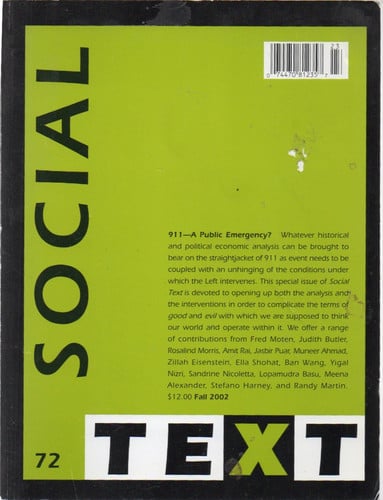
911 a Public Emergency?

Brent Hayes Edwards,Stefano Harney,Randy Martin,Ella Shohat,Timothy Mitchell,Fred Moten
Since September 11, public discourse has often been framed in terms of absolutes: an age of innocence gives way to a present under siege, while the United States and its allies face off against the Axis of Evil. This special issue of Social Text aims to move beyond these binaries toward thoughtful analysis. The editors argue that the challenge for the Left is to develop an antiterrorism stance that acknowledges the legacy of U.S. trade and foreign policy as well as the diversity of the Muslim faith and the dangers presented by fundamentalism of all kinds. Examining the strengths and shortcomings of area, race, and gender studies in the search for understanding, this issue considers cross-cultural feminism as a means of combating terrorism; racial profiling of Muslims in the context of other racist logics; and the homogenization of dissent. The issue includes poetry, photographic work, and an article by Judith Butler on the discursive space surrounding the attacks of September 11. This impressive range of contributions questions the meaning and implications of the events of September 11 and their aftermath. Contributors . Muneer Ahmad, Meena Alexander, Lopamudra Basu, Judith Butler, Zillah Eisenstein, Stefano Harney, Randy Martin, Rosalind C. Morris, Fred Moten, Sandrine Nicoletta, Yigal Nizri, Jasbir K. Puar, Amit S. Rai, Ella Shohat, Ban Wang
Duke University Press 2002-09-20 208 pages

I Was a Communist for the FBI The Unhappy Life and Times of Matt Cvetic

Daniel J. Leab
Who is Matt Cvetic? Hero? Scoundrel? Mole? The man who loosely provided the inspiration for the B-Grade cult movie I Was a Communist for the FBI had a life that was marred by alcoholism, damaged expectations, and greed. Cvetic, at the request of the FBI, joined a Pittsburgh branch of the CPUSA in 1943. He became one of many plants in the Party during that decade and gained the nickname "Pennsylvania's most significant mole." However, because of his erratic behavior, the FBI fired him in 1950, at which time he surfaced and suddenly became a celebrity through his testimony before the HUAC hearing. Journalist Richard Rovere described Cvetic as a "kept witness," a term that fits those who "made a business of being witnesses," thereby "befouling due process." Cvetic was the subject of a multipart series in the Saturday Evening Post. The articles bordered on fiction, but they gave Cvetic the national exposure he needed to secure a screen deal. Warner Brothers bought the story, made the movie, and enhanced Cvetic's celebrity as pop icon. In the mid-1950s, Cvetic was discredited as a witness by the courts. His career ended and he found a new niche on the Radical Right, yet he died in 1962 after years of fighting to uphold his image with the media. Today Cvetic's image is dimly remembered as he continues to fight "the Red Menace" on late-night television. Leab juxtaposes Cvetic's real life with his reel life. He chronicles his fall from grace, yet admits that Cvetic's life offers fascinating and useful insights into the creation, merchandising, and distribution of a reckless professional witness. Leab also writes about Cvetic's life prior to his involvement with the FBI, his glory days, and shows that there is much to be learned from the story of an "anti-Communist icon."
Pennsylvania State University Press 2008 184 pages

Socialism The Nation Of Fatherless Children

David Goldstein
This work has been selected by scholars as being culturally important, and is part of the knowledge base of civilization as we know it. This work was reproduced from the original artifact, and remains as true to the original work as possible. Therefore, you will see the original copyright references, library stamps (as most of these works have been housed in our most important libraries around the world), and other notations in the work. This work is in the public domain in the United States of America, and possibly other nations. Within the United States, you may freely copy and distribute this work, as no entity (individual or corporate) has a copyright on the body of the work. As a reproduction of a historical artifact, this work may contain missing or blurred pages, poor pictures, errant marks, etc. Scholars believe, and we concur, that this work is important enough to be preserved, reproduced, and made generally available to the public. We appreciate your support of the preservation process, and thank you for being an important part of keeping this knowledge alive and relevant.
Creative Media Partners, LLC 2017-08-25 392 pages

Dissenter in Zion From the Writings of Judah L. Magnes

Arthur A. Goren
For nearly half a century, until his death in October 1948, Judah Magnes occupied a singular place in Jewish public life. He won fame early as a preacher and communal leader, but abandoned these pursuits at the height of his influence for the roles of political dissenter and moral gadfly. During World War I he became an outspoken pacifist and supporter of radical causes. Settling permanently in Palestine in 1922, he was a founder and the first president of the Hebrew University. Increasingly, he viewed rapprochement with the Arabs as the practical and moral test of Zionism, and the formation of a bi-national state of Arabs and Jews became his chief political goal. His life interests thus focused on the core issues that confronted and still confront the Jewish people: group survival in democratic America, the direction and character of the return to Zion, and the reconciliation of universal ideals with Jewish aspirations and needs. Dissenter in Zion draws upon a rich corpus of private letters, personal journals, and diaries to offer a moving account of an eloquent and sensitive person grappling with the great questions of the day and of an activist striving to translate private moral feelings into public deeds through politics and diplomacy. We see Magnes disagreeing with Brandeis over the leadership and direction of American Zionism and with Weizmann and Ben-Gurion over ways to achieve peaceful relations with the Arabs; defending himself against charges by Einstein that he was mismanaging the affairs of the Hebrew University; and persistently negotiating with Arab leaders, trying to reach a compromise on the eve of the establishment of the State of Israel. Dissenter in Zion also contains a biographical essay on Magnes by Arthur Goren, assessing his ideas and motives and placing him in the context of his times. It shows Magnes's profundity without covering up his weaknesses, his lifelong tactic for courting repeated defeat in favor of long-term goals that could not come to pass in his lifetime.
Harvard University Press 1982-02-05 569 pages

Religion and Humane Global Governance

R. Falk
Falk argues that the failure to achieve what he terms "humane global governance" is partially due to the exclusion of religious and spiritual dimensions of human experience from the study and practice of government. The book begins with a section on dominant world order trends and tendencies with respect to global governance. This is followed by consideration of the extent to which these recent world order trends that are shaping the historical situation at the end of the second millennium are also creating a new, unexpected opening for religious and spiritual energies, a development that has problematic as well as encouraging aspects. This religious resurgence is also discussed as part of the double-edged relevance of religion to global governance. The final section argues in support of the inclusion of emancipatory religious and spiritual perspectives in world order thinking and practice, along with an enumeration of potential contributions.
Palgrave Macmillan US 2014-01-14 191 pages

The Dimensions of Liberty

Oscar Handlin,Mary Handlin
Using the ability of the individual to take action as a working measure of the extent of liberty at any time, Oscar Handlin and Mary Handlin identify and describe numerous factors that have had an important effect on American freedom since colonial days. In defining the broad dimensions of the conception, they investigate, among other subjects, the significance of the idea that the state derived power from the consent of the governed, the early concept of the Commonwealth, the later one of police powers, the roles played by governmental institutions, churches, secret lodges, voluntary associations of all kinds, immigration, the professions, continuing social and physical mobility, and the growth of wealth.
Harvard University Press 2013-10 204 pages

History of Socialism in The United States

Morris Hillquit
This work has been selected by scholars as being culturally important, and is part of the knowledge base of civilization as we know it. This work is in the "public domain in the United States of America, and possibly other nations. Within the United States, you may freely copy and distribute this work, as no entity (individual or corporate) has a copyright on the body of the work. Scholars believe, and we concur, that this work is important enough to be preserved, reproduced, and made generally available to the public. We appreciate your support of the preservation process, and thank you for being an important part of keeping this knowledge alive and relevant.
Creative Media Partners, LLC 2022-10-27 370 pages

Your Money and Your Life, a Manual for the Middle Classes

Gilbert Seldes
This work has been selected by scholars as being culturally important and is part of the knowledge base of civilization as we know it. This work is in the public domain in the United States of America, and possibly other nations. Within the United States, you may freely copy and distribute this work, as no entity (individual or corporate) has a copyright on the body of the work. Scholars believe, and we concur, that this work is important enough to be preserved, reproduced, and made generally available to the public. To ensure a quality reading experience, this work has been proofread and republished using a format that seamlessly blends the original graphical elements with text in an easy-to-read typeface. We appreciate your support of the preservation process, and thank you for being an important part of keeping this knowledge alive and relevant.
Creative Media Partners, LLC 2018-11-09 364 pages

History Choice and Commitment

Felix Gilbert
Leopold von Ranke (1795-1886), generally recognized as the founder of the school of modern critical historical scholarship, and Jacob Burckhardt (1818-1897), the great Swiss proponent of cultural interpretation, are fathers of modern history--giants of their time who continue to exert an immense influence in our own. They are usually seen as contrasts, Ranke as representative of political history and Burckhardt of cultural history. In five essays, each flowing gracefully into the next, the distinguished historian Felix Gilbert shows that such contrasts are oversimplifications. Despite their interest in different aspects of the past, Ranke's and Burckhardt's views arose from common elements in the first half of the nineteenth century, the time in which they grew up and in which their first masterworks attracted such wide attention. This concise volume clarifies the beginnings of history as an autonomous discipline, while forcing us to examine our views on basic questions in historical scholarship. In the case of Ranke, relating his work to his times counteracts the current tendency to disregard the difference between the historical concepts of the eighteenth and nineteenth centuries. By focusing on this difference, Gilbert emphasizes the originality and novelty of Ranke's ideas about history. Although Burckhardt is often portrayed as an intellectually lonely figure, this book reveals the importance of relating his thought to the intellectual trends of his time. Originally published in 1990. The Princeton Legacy Library uses the latest print-on-demand technology to again make available previously out-of-print books from the distinguished backlist of Princeton University Press. These editions preserve the original texts of these important books while presenting them in durable paperback and hardcover editions. The goal of the Princeton Legacy Library is to vastly increase access to the rich scholarly heritage found in the thousands of books published by Princeton University Press since its founding in 1905.
Harvard University Press 1977-02-05 555 pages