157 results for "Science"

The Jewish Religion

M. Friedlander
In this authoritative guide to Judaism, respected scholar M. Friedlander provides a comprehensive overview of Jewish history, beliefs, and practices. This book is an indispensable resource for anyone seeking a deeper understanding of one of the world's oldest and most influential religions. This work has been selected by scholars as being culturally important, and is part of the knowledge base of civilization as we know it. This work is in the "public domain in the United States of America, and possibly other nations. Within the United States, you may freely copy and distribute this work, as no entity (individual or corporate) has a copyright on the body of the work. Scholars believe, and we concur, that this work is important enough to be preserved, reproduced, and made generally available to the public. We appreciate your support of the preservation process, and thank you for being an important part of keeping this knowledge alive and relevant.
Creative Media Partners, LLC 2023-07-18 544 pages

Dogma in medieval Jewish thought: from Maimonides to Abravanel

Kellner, Menachem Marc
This essay in the history of ideas seeks to trace the development of creed formation in Judaism from its inception with Moses Maimonides (1135-1204) to the beginning of the sixteenth-century, when systematic attention to the problem disappeared from the agenda of Jewish intellectuals. Dr Kellner describes, analyses, and compares the dogmatic systems of Maimonides, Duran, Crescas, Albo, Bibado, Abravanel, among others. English translations are presented for relevant texts, which, for the most part, have never before been critically edited or translated.
Oxford University Press 1986-09-01 310 pages

Jewish girls coming of age in America, 1860-1920

Klapper, Melissa R.
Jewish Girls Coming of Age in America, 1860—1920 draws on a wealth of archival material, much of which has never been published—or even read—to illuminate the ways in which Jewish girls’ adolescent experiences reflected larger issues relating to gender, ethnicity, religion, and education. Klapper explores the dual roles girls played as agents of acculturation and guardians of tradition. Their search for an identity as American girls that would not require the abandonment of Jewish tradition and culture mirrored the struggle of their families and communities for integration into American society. While focusing on their lives as girls, not the adults they would later become, Klapper draws on the papers of such figures as Henrietta Szold, founder of Hadassah; Edna Ferber, Pulitzer Prize-winning author of Showboat ; and Marie Syrkin, literary critic and Zionist. Klapper also analyzes the diaries, memoirs, and letters of hundreds of other girls whose later lives and experiences have been lost to history. Told in an engaging style and filled with colorful quotes, the book brings to life a neglected group of fascinating historical figures during a pivotal moment in the development of gender roles, adolescence, and the modern American Jewish community.
New York University Press 2005 310 pages

From ghetto to emancipation: historical and contemporary reconsiderations of the Jewish community

David N. Myers,William Rowe
The central addressed the conference question by reported on in this book was posed by Salo Wittmayer Baron, then a young Jewish historian, in his 1928 essay "Ghetto and Emancipation". In it he challenged what he called "the lachrymose conception" of Jewish history in which the Jewish Middle Ages were all evil and Jewish post-Emancipation was all good. In asserting that medieval Jews possessed "more rights than the great bulk of the population...and enjoyed full internal autonomy" in the corporatist order of medieval civilization, he also found much to criticize in the loss of communal autonomy and the recasting of Judaism into a narrow confessional mold in the wake of the Enlightenment. In other words, how can a group seeking to preserve a measure of collective identity survive within a liberal society that values individual rights and obligations above all else? This became the basis for a conference in 1995 at the University of Scranton attended by a distinguished roster of scholars on various fields of Jewish studies from across the United States.
University of Scranton Press 1997 159 pages

They Must Go

Rabbi Meir Kahane,Meir Kahane
"Every day," writes Rabbi Meir Kahane, "the Arabs of Israel move closer to becoming a majority. Are we [Israel] committed to national suicide? Should we allow demography, geography, and democracy to push Israel closer to the abyss? According to Rabbi Kahane, Israel can only be sustained by a permanent Jewish majority and a small, insignificant, and placid Arab minority. But the Arab population continues to grown quantitatively and qualitatively. They feel no ties for a state that breathes Jewishness. They mockingly accept moneys from the National Insurance Institute for medical services, tuition, and social welfre; yet they pay little or no tax. Even worse, they openly vow to destroy the Jewish state - not with bullets or bombs, but with the democratic vote. Is there a solution? Rabbi Kahane insists, "Yes." In this explosive manifesto Rabbi Kahane sets forth the only plan to save Israel. Israeli Arabs would be given the options of accepting noncitizenship, leaving willingly with compensation, or being forcibly expelled without compensation. Controversial? Yes. Could the Arabs be convinced to leave? "We will not come to the Arabs to request, argue, or convince," says Kahane. "For Jews and Arabs in Israel there is only one answer - separation. Jews in their land, Arabs in theirs. Separation. Only separation." They Must Go was written in 1980 while Rabbi Meir Kahane was jailed in Ramle Prison by the Israeli government under an unprecedented administrative detention order that imprisoned him without a trial, without his being informed of any specific charge, and without opportunity to know or to question any alleged evidence or witness. His crime: his philosophy concerning the danger that exists to the state of Israel by the very presence of its large and growing Arab population. Rabbi Kahane's ideas were suppressed, twisted, defamed, and subjected to emotional and hysterical diatribes by people who were too frightened to consider them intelligently or to debate them intellectually. Is there a time bomb ticking away relentlessly in the Holy Land? Can Arabs and Jews ultimately coexist in a Jewish-Zionist state? Rabbi Kahane's only answer: "They Must Go."
www.bnpublishing.com 2019-04-08 292 pages

Hate: The Rising Tide of Anti-Semitism in France (and What It Means for Us)

Weitzmann, Marc
"From an award-winning journalist, a provocative, deeply reported expose of the history and present crisis of anti-Semitism in France--and its dire consequences for the rest of Europe. Hate explores the alarming history and present predicament of anti-Semitism in France. By examining the issue at local, international, and personal levels--interviewing everyday French men and women as well as powerful leaders such as National Front president Marine Le Pen--Weitzmann attempts to understand how nine Jews have been murdered by French citizens in the last eight years, and how France has become the number one country from which Western jihadists flee to join ISIS and other extremist Middle Eastern organizations. How do contemporary French Jews grapple with these troubling facts, and with the historical legacies of the French Revolution, the Holocaust, and the Gaullist "Arab-French policy"? While internationally minded consumers of the news may have some knowledge of the events Weitzmann describes--including the 2013 "Day of Anger" and the rise of France's popular, and famously anti-Semitic, comedian Dieudonne M'bala M'bala--these controversies are largely unknown in the States, and utterly shocking in the unity Weitzmann gives them here. In his hands, these events are not just the story of French anti-Semitism, but that of the breakdown of a major Western power, of the dark side of our global age"--
Houghton Mifflin Harcourt 2019 290 pages

The Jewish Community of New York City

Judah Leon Magnes
Magnes' book provides a comprehensive look at the Jewish community in turn-of-the-century New York. From their religious practices to their political involvement, this book traces the lives of Jewish immigrants and their descendants as they struggled to reconcile their Jewish identity with their American experience. With analytical depth and riveting anecdotes, this book is an indispensable read for historians and anyone interested in the Jewish experience in America. This work has been selected by scholars as being culturally important, and is part of the knowledge base of civilization as we know it. This work is in the "public domain in the United States of America, and possibly other nations. Within the United States, you may freely copy and distribute this work, as no entity (individual or corporate) has a copyright on the body of the work. Scholars believe, and we concur, that this work is important enough to be preserved, reproduced, and made generally available to the public. We appreciate your support of the preservation process, and thank you for being an important part of keeping this knowledge alive and relevant.
Creative Media Partners, LLC 2023-07-18 24 pages

Moving kings

Cohen, Joshua
The year is 2015, and 21-year-olds Yoav and Uri have just completed their compulsory military service in the Israel Defense Forces. In keeping with national tradition, they take a year off for rest, recovery, and travel. They come to New York City and begin working for Yoav's distant cousin, David King-a proud American patriot, Republican, and Jew, and the recently divorced proprietor of King's Moving Inc., a heavyweight in the Tri-State area's moving and storage industries. What starts off as a profitable if eerily familiar job-an "Occupation"-quickly turns violent, when they encounter one homeowner seeking revenge
Fitzcarraldo Editions 2017-07 237 pages

German Jews Beyond Judaism

George L. Mosse
Jews were emancipated at a time when high culture was becoming an integral part of German citizenship. German Jews felt a powerful urge to integrate, to find their Jewish substance in German culture and craft an identity as both Germans and Jews. In this reprint edition, based on the 1983 Efroymson Memorial Lectures given at Hebrew Union College-Jewish Institute of Religion in Cincinnati, George Mosse argues that they did this by adopting the concept of Bildung-the idea of intellectual and moral self-cultivation-and combining it with key Enlightenment ideas such as optimism about human potential, individualism and autonomy, and a connection between knowledge and morality through aesthetics. Personal friendships could be devoted to common pursuit of Bildung and become a means of overcoming differences, becoming a means for integration into German society. Mosse traces how Jewish artists, writers, and thinkers actively sought to participate in German culture and communicate these ideals through popular culture, scholarship, and political activity. From the historical biographies, novels, and short stories of Stefan Zweig and Emil Ludwig; to the psychoanalysis of Freud, which sought to subject irrationality to reason; to the revolutionary thought of Walter Benjamin-Jews sought to influence a mass political culture that was fast drifting into irrationality. As individualism was subsumed into nationalism, and eventually the German political right's racist version of nationalism, German-Jewish dialogue became more difficult. Jews remained idealistic as German society became less rational, their ideas corresponded less and less to the realities of German life, and they drifted out of the mainstream into an intellectual isolation. Yet out of this German-Jewish dialogue, what had once been part of German culture became a central Jewish heritage. The ideal of cultivating a personal identity beyond religion and nationality, the liberal outlook on society and politics, and the desire to transcend history by stressing what united rather than divided individuals and nations infiltrated Jewish life became an inspiration for many men and women searching to humanize their society and their own lives. Mosse's lectures trace the emergence of a form of Jewishness which resisted cultural ghettoization in favor of the pursuit of that which is universally human.
Hebrew Union College Press 1997 98 pages

From Suburb to Shtetl The Jews of Boro Park

Egon Mayer,William B. Helmreich
"From Suburb to Shtetl" is an outstanding ethnography that moves beyond simple demographics. Mayer weaves an intricate tapestry of how family, school, and community leaders influence each other. Whether discussing the role of the rebbe or the matchmaker, those who know these communities will find what he says as relevant today as it was when first penned. This is hardly surprising, for the ultra-Orthodox community takes great pride in not changing, in maintaining itself as it was in Europe despite the allure of modern American society. His discussion of synagogue life is particularly informative and evocative. Those in charge of helping immigrants adopted the path of least resistance, allowing and even encouraging them to retain their identities except for those few aspects that might threaten the country's national interests. The American Orthodox community was tremendously augmented by the arrival from Europe, after World War Two, of thousands of Orthodox Jews who remained devoted to that way of life. Egon Mayer was himself part of a smaller, but significant group of Jews who came to the U.S. and settled mostly in Boro Park in the wake of the 1956 Hungarian Revolution. The interaction between the Hasidim and their less fervent Orthodox counterparts described and analyzed in this volume tells us a great deal about how people negotiate their beliefs, values, and norms when forced into close contact with each other in an urban setting within the larger American culture. By exploring these and many other related issues Mayer has given us the chance to assess and forecast the future of American Jewish life as a whole.
Taylor & Francis Group 2017-10-12 214 pages

Covenantal Rights: A Study in Jewish Political Theory

Novak, David
Covenantal Rights is a groundbreaking work of political theory: a comprehensive, philosophically sophisticated attempt to bring insights from the Jewish political tradition into current political and legal debates about rights and to bring rights discourse more fully into Jewish thought. David Novak pursues these aims by presenting a theory of rights founded on the covenant between God and the Jewish people as that covenant is constituted by Scripture and the rabbinic tradition. In doing so, he presents a powerful challenge to prevailing liberal and conservative positions on rights and duties and opens a new chapter in contemporary Jewish political thinking. For Novak, "covenantal rights" are rooted in God's primary rights as creator of the universe and as the elector of a particular community whose members relate to this God as their sovereign. The subsequent rights of individuals and communities flow from God's covenantal promises, which function as irrevocable entitlements. This presents a sharp contrast to the liberal tradition, in which rights flow above all from individuals. It also challenges the conservative idea that duties can take precedence over rights, since Novak argues that there are no covenantal duties that are not backed by correlative rights. Novak explains carefully and clearly how this theory of covenantal rights fits into Jewish tradition and applies to the relationships among God, the covenanted community, and individuals. This work is a profound and provocative contribution to contemporary religious and political theory.
Princeton University Press 2009-11-22 248 pages

The scepter shall not depart from Judah: perspectives on the persistence of the political in Judaism

Mittleman, Alan
The title of political theorist Alan L. Mittleman's captivating new book is drawn from the patriarch Jacob's blessing to his children and grandchildren. The blessing contains the promise that Judah will become a royal house, perhaps forever. Kings, of course, ceased in Israel, but politics did not. Regime replaced regime. National independence was compromised and lost, regained and lost again. Yet the attention to things political was never lost. Old texts were applied to new political realities. Political awareness and thought, constantly transformed and adapted to new historical exigencies, persisted among the Jews. In The Scepter Shall Not Depart from Judah , Mittleman looks at some of the central problems of political philosophy-such as fundamental rights and the common good-from the point of view of rabbinic Judaism. At the same time, he considers conceptual issues in Judaism-such as covenant and tradition-from the perspective of political philosophy. Mittleman's sources range from the ancient rabbis to contemporary political theorists, making this volume an important one for courses and research in both Jewish studies and political theory.
Lexington Books 2000-02-09 185 pages

On Being Free

Steinsaltz, Adin
With his typical grace and sparkling wit, Talmudic master and rabbi Steinsaltz explores in these collected essays topics ranging from the nature of Jewish identity and the character of the state of Israel to interpretations of the five megillot (Ruth, Song of Songs, Ecclesiastes, Lamentations, and Esther). Included here are two interviews that provide glimpses into the intensity that marks the life and work of this great teacher. Highly recommended. Copyright 1995 Reed Business Information, Inc.
Jason Aronson, Inc. 1997 264 pages

Matters of life and death: a Jewish approach to modern medical ethics

Dorff, Elliot N.
The International Society for Science and Religion has selected Matters of Life and Death as an element of the ISSR Library. The mission of the ISSR Library is "to provide a comprehensive resource for scholars, students, and interested lay readers in the area of science and the human spirit."The incredible medical breakthroughs of today, like genetic engineering, in-vitro fertilizations, and cloning have transformed long-held beliefs on the nature of both life and death, raising difficult moral and religious questions. In Matters of Life and Death Elliot Dorff thoroughly addresses this unavoidable confluence of medical technology and Jewish law and ethics. Elliot N. Dorff, Rabbi (Jewish Theological Seminary), PhD (Columbia University), is rector and Sol and Anne Dorff Distinguished Professor of Philosophy at the American Jewish University (formerly the University of Judaism) in Los Angeles. Among the twelve books he has written are four award-winning books on Jewish ethics and law published by The Jewish Publication Society: Matters of Life and Death (1998) on Jewish medical ethics; To Do the Right and the Good (2002) on Jewish social ethics; Love Your Neighbor and Yourself on Jewish personal ethics; and For the Love of God and People: A Philosophy of Jewish Law (2007). He has also edited 10 books, including Contemporary Jewish Ethics and Morality (Oxford, 1995) and Contemporary Jewish Theology (Oxford, 1999), co-edited by Louis Newman, who also co-edited with Dorff the first three volumes of the Jewish Choices, Jewish Voices series. Since 1984, Rabbi Dorff has served on the Rabbinical Assembly's Committee on Jewish Law and Standards, and has served as its Chair since 2007. He has also served on several federal advisory commissions dealing with the ethics of health care, sexual responsibility, and research on human subjects. He is a member of the State of California's Ethics Committee on embryonic stem cell research. He is married to Marlynn, and they have four children and seven grandchildren.
Jewish Publication Society 1998 456 pages

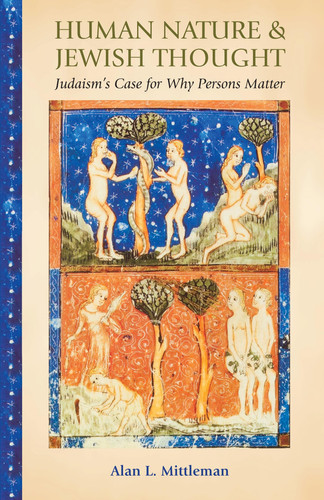
Human nature & Jewish thought: Judaism's case for why persons matter

Mittleman, Alan
This book explores one of the great questions of our time: How can we preserve our sense of what it means to be a person while at the same time accepting what science tells us to be true-namely, that human nature is continuous with the rest of nature? What, in other words, does it mean to be a person in a world of things? Alan Mittleman shows how the Jewish tradition provides rich ways of understanding human nature and personhood that preserve human dignity and distinction in a world of neuroscience, evolutionary biology, biotechnology, and pervasive scientism. These ancient resources can speak to Jewish, non-Jewish, and secular readers alike. Science may tell us what we are, Mittleman says, but it cannot tell us who we are, how we should live, or why we matter. Traditional Jewish thought, in open-minded dialogue with contemporary scientific perspectives, can help us answer these questions. Mittleman shows how, using sources ranging across the Jewish tradition, from the Hebrew Bible and the Talmud to more than a millennium of Jewish philosophy. Among the many subjects the book addresses are sexuality, birth and death, violence and evil, moral agency, and politics and economics. Throughout, Mittleman demonstrates how Jewish tradition brings new perspectives to-and challenges many current assumptions about-these central aspects of human nature. A study of human nature in Jewish thought and an original contribution to Jewish philosophy, this is a book for anyone interested in what it means to be human in a scientific age.
Princeton University Press 2015 215 pages

A history of the Jews in the English-speaking world: Great Britain

Rubinstein, W. D.
Deals also with British antisemitism from Cromwell's time to the present. There were objections against the admission of Jews to England in 1655, as well as attempts to restrict their rights in the 17th-18th centuries. Discusses pre-World War I antisemitic writers (e.g. G.K. Chesterton, H. Belloc) and the eugenics movement. Racial antisemitism was almost non-existent before 1914. Antisemitism reached a peak in Britain in 1917-22, but it was milder than in other Western countries. Relates, also, to left-wing antisemitism between the two World Wars. Ch. 3 (pp. 280-363), "Anglo-Jewry and the Holocaust, 1933-1945", deals with the reactions of Jews and non-Jews to the rise of Nazism and the Holocaust. Nazi antisemitism aroused revulsion in British society, even among conservatives and pro-Germans. States that Britain did more for refugees from Germany than any other country. British Jewry did all it could to rescue Jews to the extent that it understood their situation. During the war and the hostilities in the Middle East, there was an upsurge of antisemitism in the country but it receded in the 1950s. Contends that antisemitism in Britain was always a marginal phenomenon.
Macmillan 1996 539 pages

The rabbi's wife: the rebbetzin in American Jewish life

Schwartz, Shuly Rubin
2006 National Jewish Book Award, Modern Jewish Thought Long the object of curiosity, admiration, and gossip, rabbis' wives have rarely been viewed seriously as American Jewish religious and communal leaders. We know a great deal about the important role played by rabbis in building American Jewish life in this country, but not much about the role that their wives played. The Rabbi’s Wife redresses that imbalance by highlighting the unique contributions of rebbetzins to the development of American Jewry. Tracing the careers of rebbetzins from the beginning of the twentieth century until the present, Shuly Rubin Schwartz chronicles the evolution of the role from a few individual rabbis' wives who emerged as leaders to a cohort who worked together on behalf of American Judaism. The Rabbi’s Wife reveals the ways these women succeeded in both building crucial leadership roles for themselves and becoming an important force in shaping Jewish life in America.
New York University Press 2006-01-01 312 pages

Tales of the neighborhood: Jewish narrative dialogues in late antiquity

Hasan-Rokem, Galit
In this lively and intellectually engaging book, Galit Hasan-Rokem shows that religion is shaped not only in the halls of theological disputation and institutions of divine study, but also in ordinary events of everyday life. Common aspects of human relations offer a major source for the symbols of religious texts and rituals of late antique Judaism as well as its partner in narrative dialogues, early Christianity, Hasan-Rokem argues. Focusing on the "neighborhood" of the Galilee that is the birthplace of many major religious and cultural developments, this book brings to life the riddles, parables, and folktales passed down in Rabbinic stories from the first half of the first millennium of the Common Era.
University of California Press 2003-02-06 208 pages

Conversations with My Body Essays on My Life as a Jewish Woman

Elana Sztokman
Elana Sztokman arrived in Israel in 1993 as a young religious mother wearing a long skirt and a hat covering her hair. Today, nearly 30 years later, after spending years fighting for women's rights in Orthodoxy, writing books about gender in religion, and eventually leaving that world behind, she confronts the personal struggles behind the public persona, revealing the traumas from her past that affected her entire relationship with her body. From two-time winner of the National Jewish Book Council Award comes a refreshing and very personal exploration of cultures of the female body in Jewish life. This collection of essays - marking the 25-year anniversary of her feminist awakening and spanning a diverse career of research, writing, and advocacy around Jewish women's experiences - offers political and personal insights and retrospectives on some of the most burning issues today. Topics include: sexuality, relationships, body-image, body-cover, ritual immersion, fat-shaming, slut-shaming, domestic violence, and sexual abuse. Elana brings her characteristic honesty, courage, wit, and profound insight into her writing, and shares some of her own traumas that set her on a sometimes tortuous life path.
Lioness Books 2022-09 362 pages