776 results for "Science"

Public philosophy: essays on morality in politics

Sandel, Michael J.
Liberals often worry that inviting moral and religious argument into the public sphere runs the risk of intolerance and coercion. These essays respond to that concern by showing that substantive moral discourse is not at odds with progressive public purposes, and that a pluralist society need not shrink from engaging the moral and religious convictions that its citizens bring to public life.
Harvard University Press 2005-11-30 292 pages

Contingency, hegemony, universality: contemporary dialogues on the Left

Butler, Judith
"What is the contemporary legacy of Gramsci's notion of hegemony? How can universality be reformulated now that its spurious versions have been so thoroughly criticized?" "In this ground-breaking project, Judith Butler, Ernesto Laclau and Slavoj Zizek engage in a dialogue on central questions of contemporary philosophy and politics. Their essays, organized as three contributions each that respond to one another, range over the Hegelian legacy in contemporary critical theory, the theoretical dilemmas of multiculturalism, the universalism-versus-particularism debate, the strategies of the left in a globalized economy, and the relative merits of post-structuralism and Lacanian psychoanalysis for a critical social theory." "While the rigour and intelligence with which Butler, Laclau and Zizek approach their work is as formidable as one would expect, Contingency, Hegemony, Universality benefits additionally from their clear sense of energy and enjoyment in a revealing and often unpredictable exchange. Book jacket"--
Verso 2011-01-10 329 pages

Morality Restoring the Common Good in Divided Times

Jonathan Sacks
A distinguished religious leader's "brilliant, urgent" (The Washington Post) case for reconstructing a shared framework of values. With liberal democracy embattled, our public discourse growing increasingly toxic, family life breaking down, and drug abuse and depression on the rise, many fear what the future holds. In Morality , respected faith leader and public intellectual Jonathan Sacks traces today's crisis to our loss of a strong, shared moral code and our elevation of self-interest over the common good. Sacks leads readers from ancient Greece to the Enlightenment to the present day to show that there is no liberty without morality and no freedom without responsibility, arguing that we all must play our part in rebuilding a common moral foundation. A major work of philosophy, this is an inspiring vision of a world in which we can all find our place and face the future without fear.
Basic Books 2022-08-30 384 pages

Passionate declarations: essays on war and justice

Zinn, Howard
"From the bestselling author of A People's History of the United States comes this selection of passionate, honest, and piercing essays looking at American political ideology." " Howard Zinn brings to Passionate Declarations the same astringent style and provocative point of view that led more than a million people to buy his book A People's History of the United States. He directs his critique here to what he calls "American orthodoxies" -- that set of beliefs guardians of our culture consider sacrosanct: justifications for war, cynicism about human nature and violence, pride in our economic system, certainty of our freedom of speech, romanticization of representative government, confidence in our system of justice. Those orthodoxies, he believes, have a chilling effect on our capacity to think independently and to become active citizens in the long struggle for peace and justice." -- Book Jacket.
Perennial 2003 341 pages

Past and present: the challenges of modernity, from the Pre-Victorians to the Postmodernists

Himmelfarb, Gertrude
"Past and Present brings together almost two dozen newly collected essays by the distinguished American historian and cultural critic, Gertrude Himmelfarb. Their common theme is the intriguing, often unexpected ways in which the past illuminates the present. The novelist William Faulkner wrote that "The past is never dead. It's not even past." In these essays, Himmelfarb shows the truth of this statement. She helps us find a new perspective on contemporary issues by bringing to bear a trenchant analysis of debates and thinkers of the past. She allows the past to inform the present without distorting either past or present. The essays, unified by the common theme of present and past, are varied. The topics range from the disorders of modern democracy to the challenges of postmodernism, from the Victorian ethos to the Jewish question. The thinkers range from Edmund Burke to Leo Strauss, from Cardinal Newman to Lionel Trilling. The political figures range from Benjamin Disraeli to Winston Churchill, from the American founders to Queen Elizabeth II. The underlying premise and principle of the essays is the conviction that the pursuit of knowledge and truth, however difficult or discomforting, eminently matters, in the "practical life,"as Trilling put it,as in the "moral life."Past and Presentis a notable contribution to this endeavor-to understanding where we have been, where we are now, and where we may be-or should be-going"--
Encounter Books 2017 240 pages

How to Beat the Democrats, and Other Subversive Ideas

David Horowitz
Behind all the "bipartisanship, " dimpled-chad Democrats are sharpening their knives for the fall election. But David Horowitz is back with an indispensable manual for wartime politics. If the Democrats thought we'd forget who demoralized our military, eviscerated the CIA, and let America become a playground for terrorists, they're in for a rude awakening. For Democrats, politics is permanent war. Every conflict is a contest for power, every battle is about burying their enemies -- Republicans. With racial shakedown artists and intolerant "progressives" rearing their heads at home -- and terrorists striking at us from abroad -- Horowitz's uncompromising and principled commitment to freedom is more needed than ever. Horowitz's opening salvo shows why the Democrats can't be trusted with the nation's security. For years, the party has subordinated sound defense policy to a radical ideology untamed even by September 11. Horowitz's unmatched strategic powers are on full display in his enumeration of the principles for a winning political campaign, which he then applies to the specific issues that shape elections. Returning to the subject of war, he concludes with an exposi of the anti-American escapades of Noam Chomsky and his comrades of the unrepentant left.
Spence Publishing Company 2002 261 pages

The large, the small and the human mind

Penrose, Roger
Roger Penrose's original and provocative ideas about the large-scale physics of the Universe, the small-scale world of quantum physics and the physics of the mind have been the subject of controversy and discussion. These ideas were proposed in his best-selling books The Emperor's New Mind and Shadows of the Mind. In this book, he summarises and updates his current thinking in these complex areas to present a masterful summary of those areas of physics in which he feels there are major unresolved problems. Through this, he introduces radically new concepts which he believes will be fruitful in understanding the workings of the brain and the nature of the human mind. These ideas are challenged by three distinguished experts from different backgrounds: Abner Shimony and Nancy Cartwright as philosophers of science and Stephen Hawking as a theoretical physicist and cosmologist. Roger Penrose concludes with a response to their thought-provoking criticisms.
Cambridge University Press 2000-04-28 201 pages

The postmodern turn: new perspectives on social theory

Steven Seidman
Counter The Postmodern Turn gathers together in one volume some of the most important statements of the postmodern approach to human studies. In addressing postmodern social theory and emphasising the social role of knowledge, this book abandons the disciplinary boundaries separating the sciences and the humanities. The first collection of its kind, it provides the classic essays of authors such as Lyotard, Haraway, Foucault and Rorty. Contributors include well-known theorists in the fields of sociology, anthropology, women's and gay studies, philosophy, and history.
Cambridge University Press 1994-11-25 312 pages

The drowned and the saved

Levi, Primo
"In his final book before his death, Primo Levi returns once more to his time at Auschwitz in a moving meditation on memory, resiliency, and the struggle to comprehend unimaginable tragedy. Drawing on history, philosophy, and his own personal experiences, Levi asks if we have already begun to forget about the Holocaust. His last book before his death, Levi returns to the subject that would define his reputation as a writer and a witness. Levi breaks his book into eight essays, ranging from topics like the unreliability of memory to how violence twists both the victim and the victimizer. He shares how difficult it is for him to tell his experiences with his children and friends. He also debunks the myth that most of the Germans were in the dark about the Final Solution or that Jews never attempted to escape the camps. As the Holocaust recedes into the past and fewer and fewer survivors are left to tell their stories, The Drowned and the Saved is a vital first-person testament. Along with Elie Wiesel and Hannah Arendt, Primo Levi is remembered as one of the most powerful and perceptive writers on the Holocaust and the Jewish experience during World War II. This is an essential book both for students and literary readers. Reading Primo Levi is a lesson in the resiliency of the human spirit."--Publisher description.
Simon & Schuster Paperbacks 2017-06-20 190 pages

The Seekers The Story of Man's Continuing Quest to Understand His World Knowledge Trilogy (3)

Daniel J. Boorstin
A New York Times Notable Book of the Year From the author of The Discoverers and The Creators , an incomparable history of man's essential questions: "Who are we?" and "Why are we here?" Daniel J. Boorstin, the bestselling and Pulitzer Prize-winning author of The Americans , introduces us to some of the great pioneering seekers whose faith and thought have for centuries led man's search for meaning. Moses sought truth in God above while Sophocles looked to reason. Thomas More and Machiavelli pursued truth through social change. And in the modern age, Marx and Einstein found meaning in the sciences. In this epic intellectual adventure story, Boorstin follows the great seekers from the heroic age of prophets and philosophers to the present age of skepticism as they grapple with the great questions that have always challenged man.
Knopf Doubleday Publishing Group 1999-10-26 368 pages

Science And Human Values

Jacob Bronowski
Science and Human Values is a thought-provoking book by Jacob Bronowski that explores the relationship between science and human values. The author argues that science is not just a collection of facts and theories, but a way of thinking that shapes our understanding of the world and our place in it. He contends that science and human values are intimately connected, and that science has the power to transform our understanding of ourselves and the world around us.The book is divided into five chapters, each of which explores a different aspect of the relationship between science and human values. The first chapter discusses the nature of scientific inquiry and the role of imagination in scientific discovery. The second chapter examines the relationship between science and art, arguing that both are essential to our understanding of the world. The third chapter explores the ethical implications of scientific research, particularly in the areas of genetics and nuclear physics.The fourth chapter examines the role of science in shaping our understanding of human nature, while the final chapter discusses the implications of scientific progress for our future as a species. Throughout the book, Bronowski emphasizes the importance of human values in shaping scientific research and the need for scientists to be mindful of the ethical implications of their work.Overall, Science and Human Values is a thought-provoking and insightful book that challenges readers to think deeply about the relationship between science and human values. It is a must-read for anyone interested in the role of science in our lives and the ethical implications of scientific research.The Impact Of Science On Ethics And Human Values.This scarce antiquarian book is a facsimile reprint of the old original and may contain some imperfections such as library marks and notations. Because we believe this work is culturally important, we have made it available as part of our commitment for protecting, preserving, and promoting the world's literature in affordable, high quality, modern editions, that are true to their original work.
Literary Licensing, LLC 2011-09 98 pages

Reflections on gender and science

Keller, Evelyn Fox
Why are objectivity and reason characterized as male and subjectively and feeling as female? How does this characterization affect the goals and methods of scientific enquiry? This groundbreaking work explores the possibilities of a gender-free science and the conditions that could make such a possibility a reality. "Keller’s book opens up a whole new range of ideas for anyone who cares to think about the history of science, that is, the history of the modern world. . . Let us be glad to be in times when such a sparkling, innovative. . . book can be produced, a book to start all of us thinking in new directions.”--Ian Hacking, New Republic "A brilliant and sensitive undertaking that does credit not only to feminist scholarship but, in the end, to science as well.”--Barbara Ehrenreich, Mother Jones "This book represents the expression of a particular feminist perspective made all the more compelling by Keller’s evident commitment to and understanding of science. As a lively and important contribution to the scholarship of science, it will undoubtedly stimulate argument and controversy.”--Helen Longino, Texas Humanist "Provocative arguments, presented with authority.”-- Kirkus Reviews "Consistently thoughtful, provocative, and interconnected. . . A well-made book that will be useful in upper-level undergraduate and graduate women’s studies, philosophy, and history of science.”--E.C. Patterson, Choice "Written with grace and clarity, [this book] will stand as an important contribution to feminist theory, to the sociology of knowledge and to the continuing critique of the established scientific method.”--Lillian B. Rubin "A powerful book.”--Jessie Bernard
Yale University Press 1985 193 pages

Fashionable nonsense: postmodern intellectuals' abuse of science

Sokal, Alan D.
From Jacques Lacan and Julia Kristeva to Luce Irigaray and Jean Baudrillard, the authors document the errors made by some postmodernists using science to bolster their arguments and theories. Fashionable Nonsense dispels the notion that scientific theories are mere "narratives" or social constructions, and explores the abilities and the limits of science to describe the conditions of existence. --from publisher description.
Picador 1998 300 pages

Atom and void: essays on science and community

Oppenheimer, J. Robert
J. Robert Oppenheimer was one of the outstanding physicists of his generation. He was also an immensely gifted writer and speaker, who thought deeply about the way that scientific discoveries have changed the way people live and think. Displaying his subtlety of thought and expression as do few other documents, this book of his lectures discusses the moral and cultural implications of developments in modern physics. Originally published in 1989. The Princeton Legacy Library uses the latest print-on-demand technology to again make available previously out-of-print books from the distinguished backlist of Princeton University Press. These editions preserve the original texts of these important books while presenting them in durable paperback and hardcover editions. The goal of the Princeton Legacy Library is to vastly increase access to the rich scholarly heritage found in the thousands of books published by Princeton University Press since its founding in 1905.
Princeton University Press 1989 155 pages

All life is problem solving

Popper, Karl R.
'Never before has there been so many and such dreadful weapons in so many irresponsible hands.' - Karl Popper, from the Preface All Life is Problem Solving is a stimulating and provocative selection of Popper's writings on his main preoccupations during the last twenty-five years of his life. This collection illuminates Popper's process of working out key formulations in his theory of science, and indicates his view of the state of the world at the end of the Cold War and after the collapse of communism.
Routledge 1999 171 pages

Debating Darwin's Doubt A Scientific Controversy that Can No Longer be Denied

David Klinghoffer
In 2013 Stephen Meyer's book Darwin's Doubt: The Explosive Origin of Animal Life and the Case for Intelligent Design became a national bestseller, provoking a wide-ranging debate about the adequacy of Darwinian theory to explain life's history. In Debating Darwin's Doubt: A Scientific Controversy that Can No Longer Be Denied , leading scholars in the intelligent design community respond to critiques of Meyer's book and show that the core challenge posed by Meyer remains unanswered: Where did the influx of information essential to the creation of new body plans come from? In addition to ten chapters by Stephen Meyer, Debating Darwin's Doubt also includes contributions from biologists Richard Sternberg, Douglas Axe, and Ann Gauger; philosopher of biology Paul Nelson; mathematicians William Dembski and David Berlinski; and Center for Science and Culture research coordinator Casey Luskin. In forty-four chapters, these contributing authors explore topics such as orphan genes, cladistics, small shelly fossils, protein evolution, the length of the Cambrian explosion, the God-of-the-Gaps objection to intelligent design, and criticisms raised by proponents of theistic evolution. Anyone who wants to understand the cutting-edge of current scientific debates over modern Darwinian theory needs to read this book.
Discovery Institute Press 2015 350 pages

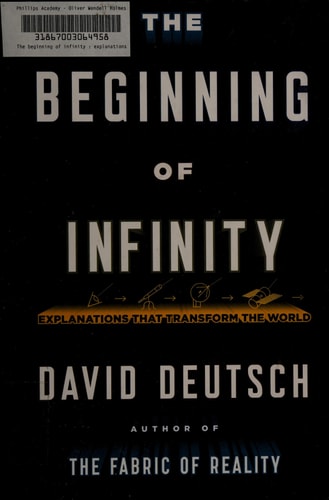
The beginning of infinity: explanations that transform the world

Deutsch, David
"A bold and all-embracing exploration of the nature and progress of knowledge from one of today's great thinkers. Throughout history, mankind has struggled to understand life's mysteries, from the mundane to the seemingly miraculous. In this important new book, David Deutsch, an award-winning pioneer in the field of quantum computation, argues that explanations have a fundamental place in the universe. They have unlimited scope and power to cause change, and the quest to improve them is the basic regulating principle not only of science but of all successful human endeavor. This stream of ever improving explanations has infinite reach, according to Deutsch: we are subject only to the laws of physics, and they impose no upper boundary to what we can eventually understand, control, and achieve. In his previous book, The Fabric of Reality, Deutsch describe the four deepest strands of existing knowledge-the theories of evolution, quantum physics, knowledge, and computation-arguing jointly they reveal a unified fabric of reality. In this new book, he applies that worldview to a wide range of issues and unsolved problems, from creativity and free will to the origin and future of the human species. Filled with startling new conclusions about human choice, optimism, scientific explanation, and the evolution of culture, The Beginning of Infinity is a groundbreaking book that will become a classic of its kind"--
Viking 2011 487 pages

Inference to the best explanation

Lipton, Peter
How do we go about weighing evidence, testing hypotheses, and making inferences? According to the model of Inference to the Best Explanation, we work out what to infer from the evidence by thinking about what would actually explain that evidence, and we take the ability of a hypothesis to explain the evidence as a sign that the hypothesis is correct. In Inference to the Best Explanation, Peter Lipton gives this important and influential idea the development and assessment it deserves. The second edition has been substantially enlarged and reworked, with a new chapter on the relationship between explanation and Bayesianism, and an extension and defence of the account of contrastive explanation. It also includes an expanded defence of the claims that our inferences really are guided by diverse explanatory considerations, and that this pattern of inference can take us towards the truth. This edition of Inference to the Best Explanation has also been updated throughout and includes a new bibliography.
Routledge/Taylor and Francis Group 2004 219 pages

Doing physics: how physicists take hold of the world

Krieger, Martin H.
Doing Physics makes concepts of physics easier to grasp by relating them to everyday knowledge. Addressing some of the models and metaphors that physicists use to explain the physical world, Martin H. Krieger describes the conceptual world of physics by means of analogies to economics, anthropology, theater, carpentry, mechanisms such as clockworks, and machine tool design. The interaction of elementary particles or chemical species, for example, can be related to the theory of kinship—who can marry whom is like what can interact with what. Likewise, the description of physical situations in terms of interdependent particles and fields is analogous to the design of a factory with its division of labor among specialists. For the new edition, Krieger has revised the text and added a chapter on the role of mathematics and formal models in physics. Doing Physics will be of special interest to economists, political theorists, anthropologists, and sociologists as well as philosophers of science.
Indiana University Press 2012-11-19 218 pages