3395 results for "Children"

On Gull Beach

Jane Yolen
Mass Books Picture Book/Series Must Reads Winner! "Gently explores a human's place within the chain of being." -- PUBLISHERS WEEKLY In ON BIRD HILL, Yolen and Marstall took readers on a surreal journey with a boy and his dog, as they stopped, looked, and noticed things along their path, ultimately discovering the miracle a hatching baby bird. ON DUCK POND continues the journey of the boy and dog, this time in a new place--a serene pond, filled with birds, frogs, turtles, and other creatures going about their quiet business. Their intrusion stirs the pond into a cacophony of activity, reaching a climactic chaos before slowly settling back to a quiet equilibrium. This beautiful and enchanting sequel is sure to delight ON BIRD HILL fans and millions of readers of Jane's popular classics. As with all Cornell Lab Publishing Group books, 35% of net proceeds from the sale of this title goes directly to the Cornell Lab to support projects such as children's educational and community programs. Photographs and fascinating information on New England Beach habitat life: - Sea Stars - Blue-Blooded Horseshoe Crab - Hermit Crab - Jonah Crab - Fiddler Crab Bird QR free Android and iOS download to follow along with sounds of the following birds: - Herring Gull - Sanderling - Willet - Snowy Egret How you can help our beaches and wildlife information 35% of the net proceeds from every Cornell Lab Publishing Group book purchase will support projects such as children's educational and community programs. About the ON BIRD HILL & BEYOND SERIES The ON BIRD HILL & BEYOND series invites children to reclaim the freedom to explore, wander and adventure outdoors. Created especially for the Cornell Lab of Ornithology - the world leader in the study, appreciation, and conservation of birds - by New York Times bestselling author Jane Yolen and renowned illustrators Bob Marstall and Elizabeth Dulemba. The series artfully engages the senses to see, feel, hear, and touch the natural world and the life within. Back matter contains information on birds and wildlife depicted with full-color photos and "How You Can Help" suggestions for budding naturalists and birders. RAVE REVIEWS FOR ON BIRD HILL... "... expressively captures a luminous moment of discovery in the natural world. On Bird Hill leaves space for the imagination and underscores the surprising wonder found in everyday moments. -- School Library Journal "It's a sweetly surreal meditation on the everyday wonders that await in the wild."--Publisher's Weekly "Beautiful and enchanting."--Hooked on Books "It opens your eyes to the extraordinary in the ordinary of nature. I look forward to more books in the series..."--NC Teacher Stuff
WunderMill, Incorporated 2019-03-27 36 pages

On Duck Pond

Jane Yolen
Eureka! Silver Award Winner From New York Times bestselling children's author Jane Yolen, and award-winning illustrator, Bob Marstall, ON DUCK POND is the first sequel to the acclaimed ON BIRD HILL. ON BIRD HILL took readers on a surreal journey with a boy and his dog, as they stopped, looked, and noticed things along their path, ultimately discovering the miracle a hatching baby bird.ON DUCK POND continues their journey, this time in a new place--a serene pond, filled with birds, frogs, turtles, and other creatures going about their quiet business. Their intrusion stirs the pond into a cacophony of activity, reaching a climactic chaos before slowly settling back to a quiet equilibrium. This beautiful and enchanting sequel is sure to delight ON BIRD HILL fans and millions of readers of Jane's popular classics. 35% of the net proceeds from every Cornell Lab Publishing Group book purchase will support projects such as children's educational and community programs. Pond Wildlife to discover in this book: Mallard Wood Duck American Black Duck Green-Winged Teal Hooded Merganser American Wigeon Gladwell Great Blue Heron Great Egret Red-Winged Blackbird American Box Turtle Red-eared Slider Eastern Gray Squirrel Eastern Cottontail Raccoon American Bullfrog White-tailed Deer Dragonfly About the ON BIRD HILL & BEYOND SERIES The ON BIRD HILL & BEYOND series invites children to reclaim the freedom to explore, wander and adventure outdoors. Created especially for the Cornell Lab of Ornithology - the world leader in the study, appreciation, and conservation of birds - by New York Times bestselling author Jane Yolen and renowned illustrators Bob Marstall and Elizabeth Dulemba. The series artfully engages the senses to see, feel, hear, and touch the natural world and the life within. Back matter contains information on birds and wildlife depicted with full-color photos and "How You Can Help" suggestions for budding naturalists and birders. RAVE REVIEWS FOR ON BIRD HILL... "... expressively captures a luminous moment of discovery in the natural world. On Bird Hill leaves space for the imagination and underscores the surprising wonder found in everyday moments. -- School Library Journal "It's a sweetly surreal meditation on the everyday wonders that await in the wild."--Publisher's Weekly "Beautiful and enchanting."--Hooked on Books "It opens your eyes to the extraordinary in the ordinary of nature. I look forward to more books in the series..."--NC Teacher Stuff
WunderMill, Incorporated 2019-03-27 32 pages

Monster Academy

Jane Yolen,Heidi E. Y. Stemple
Come along with Principal Frank N. Stein into a bright, energetic classroom where the class pet is a big purple boa constrictor, recess is in a swamp, and class bats help build a Creepy Castle in the Monster Maker's Lab. When Tornado Jo, a new student, roars into class, a storm is brewing. Who could ever guess that her new best friend will be a vampire, and she'll help him find his missing fang? Award-winning writer Jane Yolen teams up with her daughter, Heidi, to present colorful monster children who have familiar human issues such as making friends and learning to help others. In a final twist, Tornado Jo -- the worst behaved student -- is revealed to be an out-of-control human, not a monster after all. Oh, no! Monsters are more afraid of humans than we are of them! Everybody runs! Laugh-aloud humor is enhanced by John McKinley's highly imaginative illustrations loaded with fun and hidden jokes tucked into the art. An irresistible romp from start to finish!
Scholastic, Inc. 2018

Creepy Monsters, Sleepy Monsters

Jane Yolen
"There’s plenty in this scary-sweet book to please children all year round." — Kirkus Reviews Creep, gurgle, crawl, tumble! Meet two young monsters who are far from scary — they’re too busy having fun. They go to school, play outside with their friends, and eat after-school snacks. But they also have a bedtime, whether or not they’re ready for it! Young children and parents alike will find much to identify with as they follow these lovable little monsters getting ready for bed. With wildly colorful illustrations full of whimsy and warmth, Kelly Murphy brings Jane Yolen’s gently rhyming tale to rambunctious life.
National Geographic Books 2013-07-09 32 pages

James Rhodes' playlist: the rebels and revolutionaries of sound

Rhodes, James
A visually stunning introduction to classical music from piano maestro and bestselling author James Rhodes. " Rhodes makes classical music accessible, relatable, and exciting . It is hard not to be swept up - Rhodes writes with such enthusiasm and thoughtfulness that readers will be dying to listen to the Spotify playlist he shares ... Rhodes makes history and music come alive. Surreal, psychedelic collages ... make the book an eye-popping visual experience as well. A dynamic and infectious introduction to classical music. " - Kirkus Bach. Mozart. Beethoven. Old guys with curly wigs, right? But trust me: those composers were the original rock stars. Let me introduce you to some of the most breathtaking and magnificent pieces of music ever created. We'll meet the rebels and revolutionaries who wrote them - did you know Beethoven peed into a chamber pot he kept under his piano? - and find out why they're responsible for every track on your phone today. The world of classical music is going to blow your mind. So take some time out to listen to the online playlist I've curated for you as you read. Bach, Mozart, Beethoven, Chopin, Schubert, Rachmaninoff and Ravel: the perfect introduction to classical music. With jaw-dropping artwork and avant-garde design, this visually exquisite celebration of classical music is encased in a stunning slipcase and features a large fold-out poster as well as an accompanying online playlist of the pieces being discussed. It's the perfect gift for older children and adults alike who want to explore classical music, but aren't quite sure where to begin.
Wren & Rook 2019-10-03 72 pages

Island life: inspirational interiors

Hicks, India
The very idea of life on a tropical island appeals to popular fantasy: the sea, the sky, the sand, the tranquillity, the escape-from-it-all...Mental images abound at the mere mention: white linen and straw hats; hibiscus and palm trees; languid cocktails taken on the verandah; the intensity of colours and the sound of the sea. This fantasy is reality to India Hicks, David Flint Wood and their two children. Over the past five years, India and David have impeccably restored, built or redecorated three houses and one hotel on the island. Each interior reflects India's keen sense of colour and style, inherited in part from her father, David Hicks, and influenced by her travels with David Flint Wood to India and Africa, and from the wealth of Caribbean style that surrounds them. 'Island Life' celebrates India's unique style, which mixes classic European and Caribbean influences, and their houses and the island are beautifully portrayed by leading photographer David Loftus. Following a unique design influenced by the authors' meticulously made sketchbooks and journals, a mix of tracing paper (used innovatively to recreate some of India's designs), gloss and uncoated papers are combined to give the book a novel approach. This is the first book to reveal the secrets of India's style which have long been championed by style gurus such as Ralph Lauren, who shot his catalogue at their home, and Martha Stewart.
Pavilion 2003-10-08 192 pages

If all the seas were ink: a memoir

Kurshan, Ilana
At the age of 27, alone in Jerusalem in the wake of a painful divorce, Ilana Kurshan joined the world s largest book club, learning daf yomi, Hebrew for daily page" of the Talmud, a book of rabbinic teachings spanning about 600 years and the basis for all codes of Jewish law. A runner, a reader and a romantic, Kurshan adapted to its pace, attuned her ear to its poetry, and discovered her passions in its pages. She brought the Talmud with her wherever she went, studying in airplanes, supermarket lines, and over a plate of pasta at home, careful not to drip tomato sauce upon discussions about the sprinkling of blood on the Temple altar. By the time she completed the Talmud after seven and a half years, Kurshan was remarried with three young children. With each pregnancy, her Talmud sat perched atop her growing belly. This memoir is a tale of heartache and humor, of love and loss, of marriage and motherhood, and of learning to put one foot in front of the other by turning page after page. Kurshan takes us on a deeply accessible and personal guided tour of the Talmud, shedding new light on its stories and offering insights into its arguments both for those already familiar with the text and for those who have never encountered it. For people of the book both Jewish and non-Jewish If All the Seas Were Ink is a celebration of learning through literature how to fall in love once again.
St. Martin's Press 2017-09 299 pages

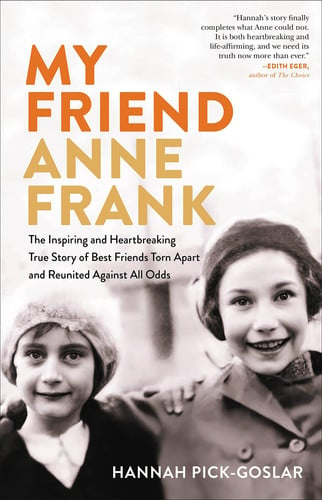
My friend Anne Frank: the inspiring and heartbreaking true story of best friends torn apart and reunited against all odds

Pick-Goslar, Hannah,Kraft, Dina
"In 1933, Hannah Pick-Goslar and her family fled Nazi Germany to live in Amsterdam, where she struck up a close friendship with her next-door neighbor, an outspoken and fun-loving young girl named Anne Frank. For several years, the inseparable pair enjoyed a carefree childhood of games, sleepovers, and treats with the other children in their neighborhood of Rivierenbuurt. But in 1942, Hannah and Anne's lives abruptly changed forever. As the Nazi occupation of Amsterdam progressed, Anne and the Frank family seemingly vanished, leaving behind unmade beds and dishes in the sink--but no trace of Anne's precious diary. Torn from her dear friend without warning, Hannah spent the next two years tormented by questions about Anne's fate, wondering if she had, by some miracle, managed to escape danger. In this long-awaited memoir, Hannah shares the story of her childhood during the Holocaust, from the introduction of anti-Jewish laws in Amsterdam to the gradual disappearance of classmates and, eventually, the Frank family, to Hannah and her family's imprisonment in the Bergen-Belsen concentration camp. As Hannah chronicles the experiences of her own life during and after the war, she provides a searing look at what countless children endured at the hands of the Nazi regime, as well as an intimate, never-before-seen portrait of the most recognizable victim of the Holocaust. Culminating in an astonishing fateful reunion, My Friend Anne Frank is the profoundly moving story of childhood and friendship during one of the darkest periods in the world's history"--Dust jacket flap.
Little, Brown Spark 2023 313 pages

Japan's new middle class

Vogel, Ezra F.
This classic study on the sociology of Japan remains the only in-depth treatment of the Japanese middle class. Now in a fiftieth-anniversary edition that includes a new foreword by William W. Kelly, this seminal work paints a rich and complex picture of the life of the salaryman and his family. In 1958, Suzanne and Ezra Vogel embedded themselves in a Tokyo suburb, living among and interviewing six middle-class families regularly for a year. Tracing the rapid postwar economic growth that led to hiring large numbers of workers who were provided lifelong employment, the authors show how this phenomenon led to a new social class—the salaried men and their families. It was a well-educated group that prepared their children rigorously for the same successful corporate or government jobs they held. Secure employment and a rising standard of living enabled this new middle class to set the dominant pattern of social life that influenced even those who could not share it, a pattern that remains fundamental to Japanese society today.
Rowman & Littlefield Publishers, Inc 2013-07-18 346 pages

Believing is seeing: observations on the mysteries of photography

Morris, Errol
"Academy Award-wining filmmaker Errol Morris investigates the hidden truths behind a series of documentary photographs. In Believing Is Seeing Academy Award-winning director Errol Morris turns his eye to the nature of truth in photography. In his inimitable style, Morris untangles the mysteries behind an eclectic range of documentary photographs, from the ambrotype of three children found clasped in the hands of an unknown soldier at Gettysburg to the indelible portraits of the WPA photography project. Each essay in the book presents the reader with a conundrum and investigates the relationship between photographs and the real world they supposedly record. During the Crimean War, Roger Fenton took two nearly identical photographs of the Valley of the Shadow of Death-one of a road covered with cannonballs, the other of the same road without cannonballs. Susan Sontag later claimed that Fenton posed the first photograph, prompting Morris to return to Crimea to investigate.
Penguin Press 2011 310 pages

Feed My Dear Dogs

Emma Richler
In Feed My Dear Dogs, Emma Richler returns to the life of the Weiss family, first introduced to readers in her debut–and much-celebrated–book, Sister Crazy, through a series of interconnected stories narrated by Jemima (Jem) Weiss. The Weisses are a tight unit of seven: father Yaakov, a gruff sportswriter whose love for his children is manifest in his stern instructions and impromptu boxing lessons; mother Frances, a wise and gentle beauty adored by her family, almost to the point of obsession by her husband; Ben, the most heroic of the siblings, by virtue of birth-order and also for knowing the answer to all questions; Jude, Jem’s almost-twin, who is only fifteen months older than she and the most serious of the children, careful to point out the anti-Semitic leanings of Jem’s literary heroes; Jem, the narrator, who would prefer to never leave the comforting confines of her family; delicate yet hilarious Harriet, Jem’s only sister, who can sound like a little old lady or a sultry vixen, depending on what movie she’s quoting; and Gus, the frail little boy who completes the circle at the beginning of the book with his birth and arrival home from the hospital. Feed My Dear Dogs beings with the family in London, where eight-year-old Jem and her sister attend a convent school to the consternation of most of the nuns, since not only are the Weiss children not Catholic, but, most perplexingly, they are half-Jewish. Not surprisingly, Jem prefers home to school. At home she is surrounded by the books she loves, (particularly Tintin and Le Morte d’Arthur) and the comforts only a big, happy family can provide. Soon, however, the family departs for Canada –“Dad’s country,” as the children see it–where together they begin a new life, shuttling between a Montreal townhouse and a country home, and adapting to their new land –even creating the “Weiss on Ice” hockey team. No matter where the family is, each member is fiercely loyal to home. From the use of short notes: “Out. Back soon. – Jude” to a simple “I’ll be up in my room!” yelled down the stairs, to Yaakov’s frantic bellowing of “Frances!” through the house, the family keeps close tabs on its members, which also allows Jem to subconsciously control it: “. . . my universe still the Universe, a place I wander with a slight swagger.” But the comfort and security of family can’t last forever, Jem learns in high school, as Jude plans an extensive travel itinerary for himself and Ben contemplates moving out on his own. Meanwhile, Jem’s burgeoning feminism pits her against her father and brothers while she battles with a burden of guilt over the near-drowning death of her youngest brother. Spiraling into a breakdown by the story’s tragically beautiful end, Jem discovers that families simply can not remain fixed, like the stars in the galaxies, unchanged forever. Intermingled through the story of the Weiss family are Jem’s (and her siblings’) encyclopedic knowledge of history, literature, film, religion and language. Richler also interweaves the almost mythic life story of Frances, the family’s matriarch, into the book, and provides glimpses into Jem’s troubled mind through a series of present-day conversations with her therapist, all of which serve to create a fully drawn portrait of Jem, her mother and the bond between them and the family as a whole.
Knopf Canada 2005 502 pages

Think a Second Time

Dennis Prager
What are the two great lies of the 20th century? Is there a solution to evil? What matters more, blood or love? Can a good man go to a striptease show? Do you think you have the answers? ...Think a second time. Dennis Prager, theologian and philosopher turned talk-show host, is one of the most brilliant and compelling voices in America today. His extraordinarily popular radio show with the signature sign-off, "Think a second time," coupled with his own biweekly newsletter, has firmly established him as a fixture in intellectual communities nationwide. In Think a Second Time , Prager blends a rigorous and scholarly education with utterly original thinking on current events. From the dangers of idealism to the roots of extremism to his thoughts on God and an afterlife, Prager offers challenging answers to up-to-the-minute questions: Should a single woman have a child? Why don't good homes always produce good children? Is America really racist? Why does the Holocaust not negate the existence of God? Now, with an entirely new section on the precedent-setting "Baby Richard" custody case and an exploration of the issue of blood versus love, Prager continues to demonstrate his ability to draw clear moral lines in the sands of our very troubled times.
HarperCollins 1996-08-30 352 pages

The diary of Dawid Sierakowiak: five notebooks from the Łódź ghetto

Sierakowiak, Dawid
"In the evening I had to prepare food and cook supper, which exhausted me totally. In politics there's absolutely nothing new. Again, out of impatience I feel myself beginning to fall into melancholy. There is really no way out of this for us." This is Dawid Sierakowiak's final diary entry. Soon after writing it, the young author died of tuberculosis, exhaustion, and starvation--the Holocaust syndrome known as "ghetto disease." After the liberation of the Lodz Ghetto, his notebooks were found stacked on a cookstove, ready to be burned for heat. Young Sierakowiak was one of more than 60,000 Jews who perished in that notorious urban slave camp, a man-made hell which was the longest surviving concentration of Jews in Nazi Europe.The diary comprises a remarkable legacy left to humanity by its teenage author. It is one of the most fastidiously detailed accounts ever rendered of modern life in human bondage. Off mountain climbing and studying in southern Poland during the summer of 1939, Dawid begins his diary with a heady enthusiasm to experience life, learn languages, and read great literature. He returns home under the quickly gathering clouds of war. Abruptly Lodz is occupied by the Nazis, and the Sierakowiak family is among the city's 200,000 Jews who are soon forced into a sealed ghetto, completely cut off from the outside world. With intimate, undefended prose, the diary's young author begins to describe the relentless horror of their predicament: his daily struggle to obtain food to survive; trying to make reason out of a world gone mad; coping with the plagues of death and deportation. Repeatedly he rallies himself against fear and pessimism, fighting the cold, disease, and exhaustion which finally consume him. Physical pain and emotional woe hold him constantly at the edge of endurance. Hunger tears Dawid's family apart, turning his father into a thief who steals bread from his wife and children.The wonder of the diary is that every bit of hardship yields wisdom from Dawid's remarkable intellect. Reading it, you become a prisoner with him in the ghetto, and with discomfiting intimacy you begin to experience the incredible process by which the vast majority of the Jews of Europe were annihilated in World War II. Significantly, the youth has no doubt about the consequence of deportation out of the ghetto: "Deportation into lard," he calls it. A committed communist and the unit leader of an underground organization, he crusades for more food for the ghetto's school children. But when invited to pledge his life to a suicide resistance squad, he writes that he cannot become a "professional revolutionary." He owes his strength and life to the care of his family.
Oxford University Press 1996-11-07 271 pages

The last million: Europe's displaced persons from World War to Cold War

Nasaw, David
"In May of 1945, German forces surrendered to the Allied powers, effectively putting an end to World War II in Europe. But the aftershocks of this global military conflict did not cease with the signing of truces and peace treaties. Millions of lost and homeless POWs, slave laborers, political prisoners, and concentration camp survivors overwhelmed Germany, a country in complete disarray. British and American soldiers gathered the malnourished and desperate foreigners, and attempted to repatriate them to Poland, Estonia, Latvia, Lithuania, Ukraine, and the USSR. But after exhaustive efforts, there remained over a million displaced persons who either refused to go home or, in the case of many, had no home to which to return. They would spend the next three to five years in displaced persons camps, divided by nationalities, temporary homelands in exile, with their own police forces, churches, schools, newspapers, and medical facilities. The international community couldn't agree on the fate of the Last Million, and after a year of fruitless debate and inaction, an International Refugee Organization was created to resettle them in lands suffering from labor shortages. But no nations were willing to accept the 200,000 to 250,000 Jewish men, women, and children who remained trapped in Germany. In 1948, the United States, among the last countries to accept anyone for resettlement, finally passed a Displaced Persons Bill - but as Cold War fears supplanted memories of WWII atrocities, the bill only granted visas to those who were reliably anti-communist, including thousands of former Nazi collaborators, Waffen-SS members, and war criminals, while barring the Jews who were suspected of being Communist sympathizers or agents because they had been recent residents of Soviet-dominated Poland. Only after the passage of the controversial UN resolution for the partition of Palestine and Israel's declaration of independence were the remaining Jewish survivors finally able to leave their displaced persons camps in Germany."--
Penguin Press 2020-09-15 654 pages

The last million: Europe's displaced persons from World War to Cold War

Nasaw, David
"In May of 1945, German forces surrendered to the Allied powers, effectively putting an end to World War II in Europe. But the aftershocks of this global military conflict did not cease with the signing of truces and peace treaties. Millions of lost and homeless POWs, slave laborers, political prisoners, and concentration camp survivors overwhelmed Germany, a country in complete disarray. British and American soldiers gathered the malnourished and desperate foreigners, and attempted to repatriate them to Poland, Estonia, Latvia, Lithuania, Ukraine, and the USSR. But after exhaustive efforts, there remained over a million displaced persons who either refused to go home or, in the case of many, had no home to which to return. They would spend the next three to five years in displaced persons camps, divided by nationalities, temporary homelands in exile, with their own police forces, churches, schools, newspapers, and medical facilities. The international community couldn't agree on the fate of the Last Million, and after a year of fruitless debate and inaction, an International Refugee Organization was created to resettle them in lands suffering from labor shortages. But no nations were willing to accept the 200,000 to 250,000 Jewish men, women, and children who remained trapped in Germany. In 1948, the United States, among the last countries to accept anyone for resettlement, finally passed a Displaced Persons Bill - but as Cold War fears supplanted memories of WWII atrocities, the bill only granted visas to those who were reliably anti-communist, including thousands of former Nazi collaborators, Waffen-SS members, and war criminals, while barring the Jews who were suspected of being Communist sympathizers or agents because they had been recent residents of Soviet-dominated Poland. Only after the passage of the controversial UN resolution for the partition of Palestine and Israel's declaration of independence were the remaining Jewish survivors finally able to leave their displaced persons camps in Germany."--
Penguin Press 2020 654 pages

Armies of the young: child soldiers in war and terrorism

Rosen, David M.
Children have been recruited for fighting throughout history - as soldiers in regular and guerilla armies, in armed revolts, and for political terrorism. However, these children cannot always be viewed as victims of remorseless and criminal leaders. In some situations, joining the fighting is the best or the only alternative for the young. Ch. 2 (pp. 19-56), "Fighting for Their Lives: Jewish Child Soldiers of World War II", discusses children's participation in the Jewish resistance during the Holocaust. Using mainly material from resistance and partisan groups in Lithuania, Poland, and Belarus, shows that joining the fighters was sometimes the Jewish children's only hope for survival. The children were motivated by necessity and a sense of honor and duty. Zionist and leftist movements, in particular Hashomer Hatzair, which headed the resistance in many ghettos, cultivated independence and militancy of the young and were especially inclined to draw children into their ranks.
Rutgers University Press 2005 199 pages

Language play

Crystal, David
In this exhilarating and often hilarious book, David Crystal examines why we devote so much time and energy to language games, how professionals make a career of them, and how young children instinctively take to them. Crystal makes a simple argument-that since playing with language is so natural, a natural way to learn language is to play with it-while he discusses puns, crosswords, lipograms, comic alphabets, rhymes, funny voices taken from dialect and popular culture, limericks, anagrams, scat singing, and much more.
University of Chicago Press 2001-06-11 248 pages

The science of perception and memory: a pragmatic guide for the justice system

Reisberg, Daniel
"A robbery victim tries to remember how the crime unfolded and who was present at the scene. A medical patient recalls the doctor saying that the pain in her side wasn't worrisome, and now that the tumor is much larger, she's suing. An investigation of insider trading hinges on someone's memory of exactly what was said at a particular business meeting. In these and countless other examples, our ability to remember our experiences is crucial for the justice system. The problem, though, is that perception and memory are fallible. How often do our eyes or memories deceive us? Is there some way to avoid these errors, perhaps by gathering our memory-based evidence in just the right way? Can we specify the circumstances in which perceptual or memory errors are more or less likely to occur? Professor Daniel Reisberg tackles these questions, drawing on the available science and also his experience in training attorneys. He provides detailed pragmatic advice that will prove helpful to law enforcement, prosecutors, defenders, and anyone else who hopes to maximize the quality of the evidence available to the courts--whether the evidence is coming from witnesses, victims, or defendants. This book is carefully rooted in research but written in a way that will make it fully accessible to non-scientists working in the justice system. Early chapters provide an overview of the relevant science--including how the research proceeds--and a broad portrait of how perception and memory function. Later chapters offer practical solutions for navigating situations involving eyewitness identifications, remembered conversations, evidence obtained from interviews with children, confession evidence and, along with it, the risks of false confession"--
Oxford University Press 2014 368 pages