1247 results for "Science"

The Curtain Falls Last Days of the Third Reich

Folke Bernadotte
""The Curtain Falls: Last Days Of The Third Reich"" is a historical account of the final days of Nazi Germany, written by Swedish diplomat and humanitarian, Folke Bernadotte. The book provides a detailed and personal perspective of the events leading up to the fall of Hitler's regime, including the military campaigns, political negotiations, and the atrocities committed by the Nazi regime. Bernadotte's firsthand experiences as a mediator between the Allies and Nazi officials, as well as his interactions with key figures such as Himmler and Goebbels, offer unique insight into the inner workings of the Nazi government during its final days. The book also delves into the aftermath of the war and the Nuremberg Trials, providing a comprehensive look at the end of one of the darkest periods in human history. Overall, ""The Curtain Falls"" is a compelling and informative read for anyone interested in the history of World War II and the downfall of the Third Reich.This scarce antiquarian book is a facsimile reprint of the old original and may contain some imperfections such as library marks and notations. Because we believe this work is culturally important, we have made it available as part of our commitment for protecting, preserving, and promoting the world's literature in affordable, high quality, modern editions, that are true to their original work.
Literary Licensing, LLC 2011-04 168 pages

American Raj America & the Muslim World

Eric S. Margolis
Shortlisted for the 2009 Governor General's Award for Non-Fiction Revised with new materials for this edition! "Covers all the main themes, ideas, places, and personalities that have shaped the area over the last century... Comprehensive, clearly written, with a strong perspective from years of experience comparing reality with rhetoric, American Raj is an excellent start for anyone wishing to understand the many inter-related ideas and forces that shape the US empire's actions in the Muslim World." -- Political Affairs "[T]he culmination of veteran journalist and foreign policy expert Eric S. Margolis' years of feet-on-the-ground reporting and analysis in the Middle East and Asia. Margolis brings the weight of his authority on the Middle East to answer the question, 'How did we get to this place in history and this ancient conflict be resolved?'" -- The Hill Times From the veteran journalist, Middle East policy expert and author of War at the Top of the World , comes a bluntly honest, provocative and timely book about how to resolve the conflict between the West and the Muslim world. American Raj takes the reader into the thinking and worldview of anti-Western Islamic radicals, identifies the historical, political and religious factors that have played such a huge role in generating mutual hostilities, and offers a blue print for resolution.
Key Porter Books 2009 432 pages

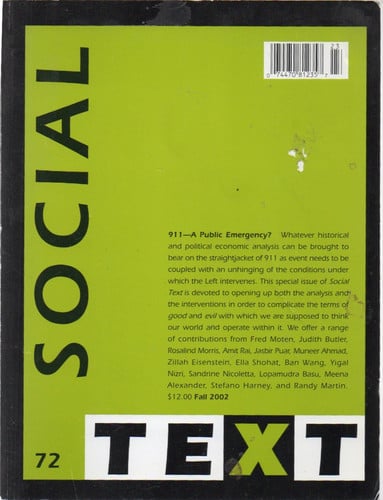
911 a Public Emergency?

Brent Hayes Edwards,Stefano Harney,Randy Martin,Ella Shohat,Timothy Mitchell,Fred Moten
Since September 11, public discourse has often been framed in terms of absolutes: an age of innocence gives way to a present under siege, while the United States and its allies face off against the Axis of Evil. This special issue of Social Text aims to move beyond these binaries toward thoughtful analysis. The editors argue that the challenge for the Left is to develop an antiterrorism stance that acknowledges the legacy of U.S. trade and foreign policy as well as the diversity of the Muslim faith and the dangers presented by fundamentalism of all kinds. Examining the strengths and shortcomings of area, race, and gender studies in the search for understanding, this issue considers cross-cultural feminism as a means of combating terrorism; racial profiling of Muslims in the context of other racist logics; and the homogenization of dissent. The issue includes poetry, photographic work, and an article by Judith Butler on the discursive space surrounding the attacks of September 11. This impressive range of contributions questions the meaning and implications of the events of September 11 and their aftermath. Contributors . Muneer Ahmad, Meena Alexander, Lopamudra Basu, Judith Butler, Zillah Eisenstein, Stefano Harney, Randy Martin, Rosalind C. Morris, Fred Moten, Sandrine Nicoletta, Yigal Nizri, Jasbir K. Puar, Amit S. Rai, Ella Shohat, Ban Wang
Duke University Press 2002-09-20 208 pages

Evolutionary Socialism

Eduard Bernstein
Evolutionary Socialism was Bernstein's most significant work, and it set the stage for the Democratic Socialism of today. In Evolutionary Socialism, Bernstein was principally concerned with refuting Karl Marx's predictions about the imminent and inevitable demise of capitalism. Bernstein warned that a violent proletarian revolution, as in France in 1848, produced only reactionary successes, which undermined workers' interests. Therefore, he rejected revolution and instead insisted the best strategy to be patiently building up a durable social movement working for continuous nonviolent incremental change.
Lulu.com 2021-07-15 108 pages

Louder Voices The Corporate Welfare Bums

David Lewis
In 1972, federal NDP leader David Lewis launched an attack on Canada's corporate welfare system, citing the millions of dollars in government subsidies to the wealthy Aluminum Company of Canada, Canadian Westinghouse, and the Michelin Tire Company. Later Lewis added Shell Canada, Denison Mines, Cominco, Dofasco, Falconbridge, Bell Canada, Canadian General Electric and dozens of others to his list of corporate giants permitted by government to escape paying their fair share of income taxes. In Louder Voices: The Corporate Welfare Bums Lewis provided the detailed facts and analysis supporting his charge that "government and big business are holding hands--in your pocket."
James Lorimer Limited, Publishers 1972-01-01 118 pages

I Was a Communist for the FBI The Unhappy Life and Times of Matt Cvetic

Daniel J. Leab
Who is Matt Cvetic? Hero? Scoundrel? Mole? The man who loosely provided the inspiration for the B-Grade cult movie I Was a Communist for the FBI had a life that was marred by alcoholism, damaged expectations, and greed. Cvetic, at the request of the FBI, joined a Pittsburgh branch of the CPUSA in 1943. He became one of many plants in the Party during that decade and gained the nickname "Pennsylvania's most significant mole." However, because of his erratic behavior, the FBI fired him in 1950, at which time he surfaced and suddenly became a celebrity through his testimony before the HUAC hearing. Journalist Richard Rovere described Cvetic as a "kept witness," a term that fits those who "made a business of being witnesses," thereby "befouling due process." Cvetic was the subject of a multipart series in the Saturday Evening Post. The articles bordered on fiction, but they gave Cvetic the national exposure he needed to secure a screen deal. Warner Brothers bought the story, made the movie, and enhanced Cvetic's celebrity as pop icon. In the mid-1950s, Cvetic was discredited as a witness by the courts. His career ended and he found a new niche on the Radical Right, yet he died in 1962 after years of fighting to uphold his image with the media. Today Cvetic's image is dimly remembered as he continues to fight "the Red Menace" on late-night television. Leab juxtaposes Cvetic's real life with his reel life. He chronicles his fall from grace, yet admits that Cvetic's life offers fascinating and useful insights into the creation, merchandising, and distribution of a reckless professional witness. Leab also writes about Cvetic's life prior to his involvement with the FBI, his glory days, and shows that there is much to be learned from the story of an "anti-Communist icon."
Pennsylvania State University Press 2008 184 pages

Arabia's Rising Under the Banner of the First Imam

Catherine Shakdam
"A superb synthesis that distills the essence of Islam in theory and practice. Arabia's Rising by Catherine Shakdam provides a concise yet comprehensive understanding of the Islamic worldview. Written in small segmented truth-bytes, which can be assimilated by lay and academic audiences, the author weaves past, present, and future seamlessly in a captivating narrative of cosmic consequence." Dr. John Andrew Morrow, Senior scholar of Islam
CreateSpace Independent Publishing Platform 2015-10-21 274 pages

Is NAFTA Constitutional?

Bruce Ackerman,David Golove
By a vote of 61 to 38, the Senate joined the House in declaring that "Congress approves...the North American Free Trade Agreement." The vote was virtually unnoticed, since the real battle over NAFTA was in the House. But there is a puzzle here. The President, the Framers assure us, "shall have Power, by and with the Advice and Consent of the Senate, to make Treaties, provided two thirds of the Senators present concur." Whatever happened to the Treaty Clause? Bruce Ackerman and David Golove tell the story of the Treaty Clause's being displaced in the twentieth century by a modern procedure in which the House of Representatives joins the Senate in the process of consideration, but simple majorities in both Houses suffice to commit the nation. This is called the Congressional-Executive Agreement, and is a response to a sea change in public opinion during and after World War II. This agreement substituted for a failed constitutional amendment that would have required all treaties to be approved by majorities in both Houses rather than by two-thirds of the Senate. The modern Congressional-Executive Agreement was self-consciously developed in order to make formal constitutional amendment unnecessary. So, is NAFTA constitutional? This book is reprinted from the Harvard Law Review .
Harvard University Press 2013-10 129 pages

From Protest to Power Personal Reflections on a Life in Politics

Bob Rae
In January of 1996, when Bob Rae declared he was stepping down as the leader of the Ontario New Democratic Party, the media was full of praise for the former premier of Ontario. In From Protest to Power , Rae provides a surprising, frank look back at his time in politics. Shedding light on his rise to power from radical student politics to becoming the leader of the first NDP government to hold power in Ontario. He takes a look at his incredible life from Rhodes Scholar at Oxford and studying with philosopher Isaiah Berlin to his life as a family man.In the fall of 2006, with Bob Rae running for the federal leadership of the Liberal Party, it is time for us to examine his remarkable life once more. A life that has been motivated by the belief that politics and public service matter.As he says in the new introduction, ?I am running because I care deeply about my country. I want it to stay strong. I want it to stay together. And I want to play whatever part I can to help make those things happen.?Learn more about what makes Bob run.
Penguin Group (Canada) 1997 366 pages

The Torch-Bearers

Bernard Lazare
The Torch-Bearers tells the story of an itinerant Anarchist preacher who comes to the corrupt city of Geronta in the company of a fellow vagabond, where he begins preaching in parables, that being his preferred method of enlightenment. He hears a number of other story-tellers narrating their own parables, to which he opposes his own in order to expose their ideological flaws. Here, presented in English for the first time in a superb translation by Brian Stableford, is one of the most interesting novels of the Symbolist Movement--the elaborate fruit of author Bernard Lazare's wholehearted commitment to both Symbolist and Anarchist ideals. This striking literary experiment, testing the hypothesis that the raw materials of myth, legend and folklore, which had been redeployed and pastiched so successfully by the Movement, could be adapted to Anarchist purposes.
Snuggly Books 2018-12-04 256 pages

Acknowledgements A Cultural Memoir and Other Essays

Barbara Kay
ACKNOWLEDGEMENTS: A Cultural Memoir and Other Essays is a collection of previously unpublished writing by National Post columnist Barbara Kay. This wide-ranging selection includes original essays - notably the title essay, a mini-memoir of the cultural and intellectual influences that shaped Kay's worldview - as well as a discursive ramble through the bizarre subculture of the pit bull advocacy movement. In between, readers familiar with Kay's weekly columns over the last ten years will find elaborated commentaries on her niche subjects: the negative impact of feminism on our public institutions and families, the erosion of academic integrity in the universities and our politically correct "rights" culture's sub-version of social and civic reciprocity in Canadian communities.
Barbara Kay 2015-05-30 218 pages

After the wars: reconstruction in Afghanistan, Indochina, Central America, Southern Africa, and the Horn of Africa

Lake, Anthony
The end of the Cold War is reverberating far beyond its European theatre--in the killing fields of Afghanistan, Indochina, Central America, Southern Africa & the Horn of Africa. For some of these people, peace has come already; for others it is in sight. But beyond peacemaking lie the delicate challenges of peacekeeping & huge tasks of political, social, & economic reconstruction--& construction--in some of the world's poorest areas. The roots of these wars were deeply embedded in indigenous strife & history, but the superpowers--by adding their own ideological & strategic agenda--intensified the bloodshed. The results of the conflicts are appalling: nearly 3 million dead (2.5 million of them civilians); 16 million refugees; battered people, towns, & transport; a generation of unschooled youth & unskilled adults; countrysides planted with explosives; & teeming cities lacking in jobs & essential services. In this, the sixteenth volume in ODC's U.S.-Third World Policy Perspective series, the authors provide valuable timely analysis of the differing problems of polity & economy confronting the governments of these devastated countries. In short, Cyrus R. Vance calls it "a stimulating & provocative book."
Transaction Publishers 1990-01-30 197 pages

Germany: the empire within

Shlaes, Amity
The re-unification of Germany has awakened conflicting emotions. This book looks at how the movement is affecting people on a personal and populations on a national level. The author describes the organizations that were set up to facilitate relations between family and friends who were divided by the intra-German border. She gives an account of a German rally in the Sudetenland and notes the force of the movement among populations living beyond the German borders. She also shows in striking counterpoint the life of the few remaining Jews still living in Germany, a reminder, if such was needed, of the terrible evil of which fanatical nationalism is capable.
Cape 1991 196 pages