14302 results for "History"

Religion and the rise of capitalism

Friedman, Benjamin M.
"Where do our ideas about economics and economic policy come from? Critics of contemporary economics complain that belief in free markets, among economists and many ordinary citizens too, is a form of religion. It turns out that there is something to the idea: not in the way the critics mean, but in a deeper, more historically grounded sense. Contrary to the conventional historical view of economics as entirely a secular product of the Enlightenment, religion exerted a powerful influence from the outset. Benjamin M. Friedman demonstrates that the foundational transition in thinking about what we now call economics, beginning in the eighteenth century, was decisively shaped by the hotly contended lines of religious thought within the English-speaking Protestant world. Beliefs about God-given human character, about our destiny after this life, and about the purpose of our existence, were all under challenge in the world in which Adam Smith and his contemporaries lived. Those debates explain the puzzling behavior so many of our fellow citizens whose views about economic policies, and whose voting behavior too, seems sharply at odds with what would be to their own economic benefit. Understanding the origins of the relationship between religious thinking and economic thinking, together with its ongoing consequences, provides insights into our current economic policy debates and ways to shape more functional policies for all citizens"--
Alfred A. Knopf 2021 534 pages

Bad news: how woke media is undermining democracy

Ungar-Sargon, Batya
"Bad News is a response to Thomas Frank's 2004 book "What's the Matter with Kansas." I ask the same question he asked about the right, but about the left: Why is the media obsessed with racism, even though it's getting objectively better by every measure we have? I argue that the liberal media is mainstreaming a woke culture war based on ideas that were relegated to the academic fringe as recently as a decade ago because it's in their economic interests to do so. It explores how digital media and social media supplied journalists, now part of the American elite, with an alternative way to feel like heroes while further consolidating power and wealth in the hands of the few rather than the many. The book then explores the larger context of the great American class divide, and how journalism has been both a product and accelerator of inequality"--
Encounter Books 2021 301 pages

Pain Killer

Meier, Barry
Between 1999 and 2017, an estimated 250,000 Americans died from overdoses involving prescription painkillers, a plague ignited by Purdue Pharma's aggressive marketing of OxyContin. Families, working class and wealthy, have been torn apart, businesses destroyed, and public officials pushed to the brink. Meanwhile, the drugmaker's owners, Raymond and Mortimer Sackler, whose names adorn museums worldwide, made enormous fortunes from the commercial success of OxyContin. In Pain Killer, Barry Meier tells the story of how Purdue turned OxyContin into a billion-dollar blockbuster. Powerful narcotic painkillers, or opioids, were once used as drugs of last resort for pain sufferers. But Purdue launched an unprecedented marketing campaign claiming that the drug's long-acting formulation made it safer to use than traditional painkillers for many types of pain. That illusion was quickly shattered as drug abusers learned that crushing an Oxy could release its narcotic payload all at once. Even in its prescribed form, Oxy proved fiercely addictive. As OxyContin's use and abuse grew, Purdue concealed what it knew from regulators, doctors, and patients. Here are the people who profited from the crisis and those who paid the price, those who plotted in boardrooms and those who tried to sound alarm bells. A country doctor in rural Virginia, Art Van Zee, took on Purdue and warned officials about OxyContin abuse. An ebullient high school cheerleader, Lindsey Myers, was reduced to stealing from her parents to feed her escalating Oxy habit. A hard-charging DEA official, Laura Nagel, tried to hold Purdue executives to account. In Pain Killer, Barry Meier breaks new ground in his decades-long investigation into the opioid epidemic. He takes readers inside Purdue to show how long the company withheld information about the abuse of OxyContin and gives a shocking account of the Justice Department's failure to alter the trajectory of the opioid epidemic and protect thousands of[Bokinfo]
Random House US 2023 240 pages

We the living

Rand, Ayn
Depicting the daily struggle of the individual against a tyrannical dictatorship, We the Living shows the terrible impact of a revolution on three people who demand the right to live their own lives and pursue their happiness. Kira, determined to maintain her independence and courageous in the face of starvation and poverty; Leo, upper class and paralysed by state repression; and Andrei, an idealistic communist and officer in the secret police who nonetheless wants to help his friends.
Penguin 2010 450 pages

A history of the modern world

Palmer, R. R.,Colton, Joel
This brilliant and highly readable history of modern Europe in its international setting explores the heritage of the West since the Renaissance, closely relating the trajectories of individual nations to European civilization as a whole.For this eighth edition, Professors Palmer and Colton have revised their classic account in light of recent momentous events (the dissolution of the Soviet Union, the end of the Cold War, the near-demise of communism, the reunification of Germany) and the transformed world that has emerged in their wake. On the brink of the twenty-first century, this world faces new challenges - among them, the fragile environment and the population explosion. By means of its incomparable depth and scope, this volume provides a superior context for understanding the past, negotiating the present and preparing for the future.
McGraw-Hill 1995 1259 pages

A history of the Holocaust

Bauer, Yehuda
The author traces the roots of anti-Semitism that burgeoned through the ages and provides a comprehensive description of how and why the Holocaust occurred. This history is intensified by moving documentation, including passages from diaries left by concentration camp inmates as their only living testimony to the horrors they endured, plus tales of individual heroism amid unparalleled adversity. The revised edition contains all new art -- maps, charts, tables, graphs. All art elements and text contain updated, more accurate statistics. It's easier to read and navigate. Lastly, there are two 8-page inserts (16 pages total) of black-and-white photographs.
Franklin Watts 2001 432 pages

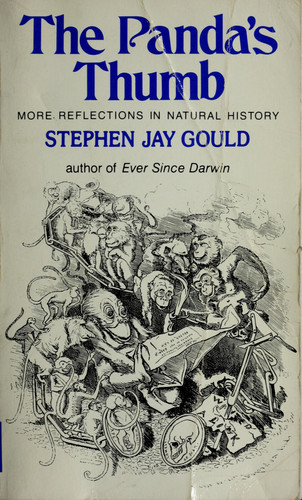
The panda's thumb: more reflections in natural history

Gould, Stephen Jay
A collection of essays by reknown scientist Jay Stephen Gould drawn from his columns in Natural History. The essays deal with topics such as: evolutionary opportunism (nature is a tinkerer, making the most of what's available in the course of adapting to the environment); new information on Darwin and his contemporaries; racism and cultural relativism; the evolutionary pattern of sudden rapid change; the origin of birds or the warm-bloodedness of dinosaurs; and, Teilhard de Chardin as a co-conspirator in the Piltdown hoax.
Norton 1980 343 pages

The Hamptons: food, family, and history

Lauren, Ricky
Back in print, this classic book of seaside lifestyle offers Lauren’s ideas for entertaining, cooking, and living by the sea. This is a beautiful look into seaside living inspired by the world of Lauren’s family beach home. In the charming coastal town of Amagansett, the Lauren family’s beach house is rich in history, both personal and regional. Drawing on the artistic legends of the Hamptons, and its rich history of famous artists and writers, Lauren celebrates the area’s culture and her family’s connection to it. Lauren opens the doors to her family kitchen, with more than 100 recipes, sharing her culinary secrets and favorite beach-styled dishes, as well as decorating techniques for creating the perfect table setting and dining atmosphere. Featuring original photography, artwork, and beloved family snapshots, and full of creativity and ideas, this book is sure to inspire everyone who dreams of living by the sea.
Rizzoli International Publications 2025-04-22 256 pages

The birder's handbook: a field guide to the natural history of North American birds : including all species that regularly breed north of Mexico

Ehrlich, Paul R.
This is the most complete and authoritative reference book about the birds of North America—up to date and in field-guide format. The Birder's Handbook is the first of its kind: a portable library of fascinating information not included in your identification guide. For each of the 646 species of birds that breed in North America, The Birder's Handbook will tell you at a glance: * Where the bird nests, and which sex(es) build(s) the nest; * How many eggs the bird lays, what they look like, which patent incubates and for how long, and how the young are cared for; * Food preferences and foraging habits. You will also find information about displays and mating, wintering, conservation status, and much more. In addition, The Birder's Handbook contains some 250 short essays covering all aspects of avian natural history.
Simon & Schuster 1988 785 pages

A monetary history of the United States, 1867-1960

Friedman, Milton
Writing in the June 1965 issue of the "Economic Journal", Harry G. Johnson begins with a sentence seemingly calibrated to the scale of the book he set himself to review: 'The long-awaited "Monetary History of the United States" by Friedman and Schwartz is in every sense of the term a monumental scholarly achievement - monumental in its sheer bulk, monumental in the definitiveness of its treatment of innumerable issues, large and small ...monumental, above all, in the theoretical and statistical effort and ingenuity that have been brought to bear on the solution of complex and subtle economic issues'.Friedman and Schwartz marshaled massive historical data and sharp analytics to support the claim that monetary policy - steady control of the money supply - matters profoundly in the management of the nation's economy, especially in navigating serious economic fluctuations. In their influential chapter 7, "The Great Contraction" - which Princeton published in 1965 as a separate paperback - they address the central economic event of the century, the Depression. According to Hugh Rockoff, writing in January 1965: 'If Great Depressions could be prevented through timely actions by the monetary authority (or by a monetary rule), as Friedman and Schwartz had contended, then the case for market economies was measurably stronger.' Milton Friedman won the Nobel Prize in Economics in 2000 for work related to "A Monetary History " as well as to his other Princeton University Press book, "A Theory of the Consumption Function" (1957). Review: "A monumental scholarly accomplishment... [sets] a new standard for the writing of monetary history.
Princeton University Press 1971 860 pages

A monetary history of the United States: 1867-1960

Friedman, Milton
Writing in the June 1965 issue of the "Economic Journal", Harry G. Johnson begins with a sentence seemingly calibrated to the scale of the book he set himself to review: 'The long-awaited "Monetary History of the United States" by Friedman and Schwartz is in every sense of the term a monumental scholarly achievement - monumental in its sheer bulk, monumental in the definitiveness of its treatment of innumerable issues, large and small ...monumental, above all, in the theoretical and statistical effort and ingenuity that have been brought to bear on the solution of complex and subtle economic issues'.Friedman and Schwartz marshaled massive historical data and sharp analytics to support the claim that monetary policy - steady control of the money supply - matters profoundly in the management of the nation's economy, especially in navigating serious economic fluctuations. In their influential chapter 7, "The Great Contraction" - which Princeton published in 1965 as a separate paperback - they address the central economic event of the century, the Depression. According to Hugh Rockoff, writing in January 1965: 'If Great Depressions could be prevented through timely actions by the monetary authority (or by a monetary rule), as Friedman and Schwartz had contended, then the case for market economies was measurably stronger.' Milton Friedman won the Nobel Prize in Economics in 2000 for work related to "A Monetary History " as well as to his other Princeton University Press book, "A Theory of the Consumption Function" (1957). Review: "A monumental scholarly accomplishment... [sets] a new standard for the writing of monetary history.
Princeton University Press 1963 860 pages

The world must know: the history of the Holocaust as told in the United States Holocaust memorial museum

Berenbaum, Michael
Opened in April 1993, on the fiftieth anniversary of the Warsaw ghetto uprising, the United States Holocaust Memorial Museum in Washington, D.C., summons all who enter its portals to rise to an important and extraordinary challenge: to remember and immortalize the 6 million Jews and millions of other Nazi victims of World War II - Gypsies, Poles, homosexuals, the handicapped, Jehovah's Witnesses, political and religious dissidents, Soviet prisoners of war - who were murdered in the most horrifying event of our time: the Holocaust. 'The World Must Know' depicts the evolution of the Holocaust comprehensively, as it is presented in the United States Holocaust Memorial Museum - the living memorial to the victims of the Holocaust that tells a story the world must know in the most moving and powerful visual and verbal way." "Drawing on the museum's artifacts and its extensive eyewitness testimony collection, the second largest in the world, and including over 200 photographic images from the museum's collections, 'The World Must Know' details the four major historical participants: the perpetrator, the bystander, the rescuer, and, above all, the victim. The 'World Must Know' journeys back to a time when Jewish culture thrived in Europe, to family Shabbat dinners and joyous Passover celebrations where the lighting of the candles was done before unshuttered windows, and proceeds to that point when the most unspeakable evil in history began, and then bears witness to the most horrifying shattering of innocent lives. Starting with the rise of nazism, The 'World Must Know' reveals the human stories of the Holocaust, documenting the range of psychological extremes from the evil of the Nazi doctors who staffed the death camps and determined "who shall live and who shall die," to the nobility of ordinary citizens, like those in the village of Le Chambon-sur-Lignon, France, who risked their own lives by offering their homes as havens to refugee Jews, to the horror of entire families as they received sudden orders to pack up only what they could carry, leave their homes, and report to a train station for "resettlement in the East," a euphemism for deportation to Auschwitz, Treblinka, Sobibor, and other death or concentration camps. The powerful and evocative images in 'The World Must Know' tell the stories of hope and death - the grim reality of the ghettos, the mass murders of the mobile killing units, the concentration camps, and the death camps, as well as the brave and heart-wrenching stories of resistance and rescue, through which we see the human necessity for - and the ultimate power of - personal choice." "More than a catalogue of the museum's exhibit, 'The World Must Know' is a study and exploration of the Holocaust that fulfills the commandment from those who perished, which seared the souls of those who survived: Remember. Do not let the world forget. This is a significant contribution to our understanding of the history of the Holocaust that will not only memorialize the past by educating the generations that follow but also transform the future by sensitizing those who will shape it. That is the challenge to, and the responsibility of, all survivors everywhere."
Little, Brown 1993 240 pages