8468 results for "History"

A river no more: the Colorado River and the West

Fradkin, Philip L.
Here is the definitive history of the development of the Colorado River and the excessive claims made on its waters from its source in the Wyoming Rockies, to the California and Arizona borders, to a point just short of the Gulf of California in Mexico where it evaporates in the sand. Ever increasing demands on the river render this new edition all too timely. Philip Fradkin has updated this valuable book with a new preface.
University of California Press 1996 360 pages

We Are Not Afraid The Story of Goodman, Schwerner, and Chaney, and the Civil Rights Campaign for Mississippi

Seth Cagin,Philip Dray
We Are Not Afraid is the story of the 1964 killing of James Chaney, Andrew Goodman, and Michael Schwerner in Philadelphia, Mississippi, at the hands of Ku Klux Klansmen and the local cops. Described as "one of the best books on the civil rights movement," the murders it describes inspired the acclaimed film, Mississippi Burning. The events surrounding this seminal event have re-entered public debate due to the recent conviction of manslaughter by Klansman and Imperial Wizard, Edgar Ray Killen, for his part in orchestrating the murders. As America struggles to honestly confront its history of racism, there has never been a more timely moment to reissue this fully updated edition of We Are Not Afraid. From the roles played by such figures as Martin Luther King, Jr. and Robert Kennedy to the remarkable courage of the Freedom Riders, this book relates the definitive story of a nation's ongoing battle for true democracy.
PublicAffairs 2006-04-26 500 pages

Being Jewish after the destruction of Gaza

Beinart, Peter
"In Peter Beinart's view, one story dominates Jewish communal life: that of persecution and victimhood. It is a story that erases much of the nuance of Jewish religious tradition and warps our understanding of Israel and Palestine. After Gaza, where Jewish texts, history and language have been deployed to justify mass slaughter and starvation, Beinart argues, Jews must tell a new story. After this war, whose horror will echo for generations, they must do nothing less than offer a new answer to the question: What does it mean to be a Jew?Beinart imagines an alternate narrative, which would draw on other nations' efforts at moral reconstruction and a different reading of Jewish tradition. A story in which Israeli Jews have the right to equality, not supremacy, and in which Jewish and Palestinian safety are not mutually exclusive but intertwined. One that recognizes the danger of venerating states at the expense of human life." --
Atlantic Books 2025 172 pages

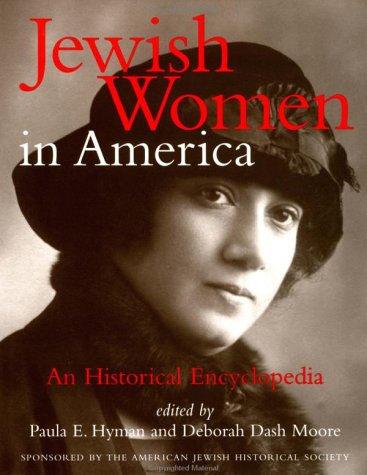
Jewish women in America: an historical encyclopedia

Paula Hyman,Deborah Dash Moore,Phyllis Holman Weisbard,American Jewish Historical Society
This encyclopedia provides the first standard reference work on the lives, history and activities of Jewish women in the United States. Covering a period which extends from the arrival of the first Jewish women in North America in 1654 to the present, this two-volume set presents the most comprehensive and detailed portrait of American Jewish women ever published, and brings together for the first time the wealth of recent scholarship on this subject. Includes: * Biographical entries on over 800 individual women. * 128 topical articles on organizations such as Hadassah, the National Council of Jewish Women, Mizrachi, and the Ladies' Garment Workers' Union. * Major essays on Jewish women's participation in the movement for women's suffrage, social reform, civil rights, and the recent women's movement. * The activities of Jewish women in politics, business, education, the arts, and religion. * A readable, inviting format with over 500 large photographs. * Bibliographies at the end of each entry which include overviews of major scholarship in the field, complete citations of more general works and citations of additional bibliographical and reference sources. * The comprehensive index includes citations to every substantive discussion in the entries as well as all proper names appearing in the text, such as organizations, book, song and film titles, schools, and individuals. The "Encyclopedia" provides information on American Jewish women in all fields of endeavor, and pays special attention to the work of women in the arts, academics, law, the labor movement, education, science, medicine, journalism and publishing, and on the lives of ordinary Jewish women during all time periods and in all regions of the United States.
Routledge 1997 1770 pages

Occupy

Chomsky, Noam
PRAISE FOR NOAM CHOMSKY'S OCCUPY AND ZUCCOTTI PARK PRESS: "Having spent so much time thinking about and engaging with social movements, Chomsky is both optimistic about the energy of Occupy and realistic about the challenges it faces. He appreciates the "just do it" ethos and embraces its radical approach to participatory democracy...What makes Chomsky's perspective so interesting, aside from the wealth of his political experience, is the range of his interests. He draws from examples around the world to demonstrate his points. ...It's a big agenda that Occupy has identified, nothing less than a complete renewal of U.S. society and the U.S. role in the world. Chomsky sees not only the radical agenda but also the radical practice of the Occupiers. "Part of what functioning, free communities like the Occupy communities can be working for and spreading to others is just a different way of living, which is not based on maximizing consumer goods, but on maximizing values that are important for life," he concludes in this valuable set of remarks and interviews." --John Feffer, Foreign Policy in Focus, Pick Review "For decades, Chomsky has been marginalized for his insightful, levelheaded, and accurate observations about how our society functions. In Occupy , Chomsky... sets the record straight. And he's got an answer for everything. "It's necessary," Chomsky warns, "to get out into the country and get people to understand what this is about, and what they can do about it, and what the consequences are of not doing anything about it." Occupy begins with a powerful editor's note from Greg Ruggiero, who comments on 'the heartlessness and inhumanity of the system, ' where 'people's stolen homes are sold off to the highest bidder.' And if it isn't obvious to those who are still asking what the demands of Occupy Wall Street are, Ruggiero puts it plainly: 'Occupy embodies a vision of democracy that is fundamentally antagonistic to the management of society as a corporate-controlled space that funds a political system to serve the wealthy, ignore the poor.' One can only cringe at the thought of what will happen if we continue to ignore the wisdom of Noam Chomsky. He gives a clue in Occupy ...." --The Coffin Factory, The Magazine for People who Love Books Occupy is another vital contribution from Chomsky to the literature of defiance and protest, and a red-hot rallying call to forge a better, more egalitarian future. --Alternet Chomsky advocates intelligent activism by those who see the divorce between public policy and public opinion. He is both optimistic and realistic towards this "first major public response to 30 years of class war." --IRISH TIMES, PICK REVIEW " Occupy , is at once a vivid portrait of the now-global movement and a practical guide to intelligent activism, infused with Chomsky's signature meditations on everything from how the wealthiest 1% came to steer society to what a healthy democracy would look like to how we can separate money from politics. Alongside Chomsky's words are some of the most moving and provocative photographs from the Occupy movement. ... [One of] 10 essential books on protest." --Maria Popova, Brain Pickings In Occupy , Chomsky discusses the cornerstone issues, questions and demands that have been driving ordinary Americans to critique the influence of the 1%. The book begins and ends with Chomsky celebrating the life and work of his longtime friend and colleague, Howard Zinn, author of A People's History of the United States. As a call to action, Chomsky encourages people to continue organizing, to continue struggling, and to continue defending citizenship and community-driven democracy from predation from the relentless encroachments of wealth and corporate power.
Zuccotti Park Press 2012 125 pages

Facing the beast: courage, faith, and resistance in a new dark age

Wolf, Naomi
"From New York Times bestselling author Naomi Wolf, Facing the Beast is a devastating, detailed account of wrongthink, deplatforming, and an unexpected political, personal, and spiritual transformation that followed during one of the most divisive times in American history. In this uncompromising investigation into today's most urgent issues, Naomi Wolf uses her own wildly politicized pilgrimage-from New York Times bestselling author and high-level Democratic consultant to a journalist cast out from the elite political and social circles she once moved through-as a stunning narrative framework that is both chilling and incisive. Wolf's sin? Doing the job that good journalists once prided themselves on: asking questions, challenging authority, and, during one of the most politically divisive moments in modern history, exposing the many failures of the public health response during the COVID-19 pandemic by chronicling the dangerous descent of our democracy into tyranny, censorship, and totalitarianism. Unable to remain silent in the shadows and unwilling to collude with the mainstream, Wolf bravely covers topics that few other writers dare to address critically for fear of being deplatformed. Facing the Beast explores reproductive rights, medical freedom, the uncurious thought-policing of the "progressive" left, the Second Amendment, the criminal relationship between the FDA and Pfizer-Wolf's clear writing repeatedly shines light in the dark corners of our fractured society. A decades-long champion of free speech, freedom of the press, and the Constitution, Wolf found herself not only in the midst of a political rebirth but a spiritual transformation as well-one in which the events of the day could only be described in terms of good, evil, and a metaphysical quest on the nature of reality. For readers of Matt Taibbi, Glenn Greenwald, and Bari Weiss, Facing the Beast is a fearless indictment of legacy media and the political class, as well as a brutal reminder that searching for and defending the truth can be dangerous. "Naomi Wolf is one of the bravest, clearest-thinking people I know. The reason you hear the forces of repression so desperately trying to dismiss her is because she is right."-Tucker Carlson"--
Chelsea Green Publishing 2023 232 pages

How to Think about the Great Ideas From the Great Books of Western Civilization

Mortimer J. Adler
Time magazine called Mortimer J. Adler a ''philosopher for everyman.'' In this guide to considering the big questions, Adler addresses the topics all men and women ponder in the course of life, such as ''What is love?'', ''How do we decide the right thing to do?'', and, ''What does it mean to be good?'' Drawing on his extensive knowledge of Western literature, history, and philosophy, the author considers what is meant by democracy, law, emotion, language, truth, and other abstract concepts in light of more than two millennia of Western civilization and discourse. Adler's essays offer a remarkable and contemplative distillation of the Great Ideas of Western Thought.
ReadHowYouWant.com 2010-10-19 428 pages

Freud: conflict and culture

Roth, Michael
Few figures have had as decisive and fundamental an impact on the course of modern cultural history as Sigmund Freud. Freudian theory and psychoanalytic thinking inform the ways in which we perceive ourselves and our society, and remain vital and relevant to some of our most pressing societal issues and concerns, from drug abuse and aggression to gender and sexuality. Yet few figures have inspired such sustained controversy and intense debate as Freud has, and his theoretical and cultural legacies continue to be hotly contested. The exhibition "Sigmund Freud: Conflict and Culture," mounted by the Library of Congress, explores the influence of Freud and psychoanalysis on twentieth-century culture and examines some of his central ideas concerning the individual and society. Contemporary evaluations, emerging from changes in scientific knowledge and ideological priorities, have changed the way we view Freud's contributions to our understanding of self and society. This volume, meant to reflect the lively and eclectic spirit of the show, is a gathering of variously challenging, erudite, and amusing essays by scholars, critics, and writers. Grouped into four broad parts, the essays exemplify the diversity of approaches to Freudian theory and psychoanalysis. "Freud Writing and Working" concentrates on the sources he drew upon, his writing, rhetoric, and work habits. The pieces in "Interpretation, Suggestion, and Agency" deal with the evolution of Freud's theories and technique. "Absorption and Diffusion" concerns the spread of psychoanalysis, its reception, and its effects on our culture. "Contested Legacies" presents a variety of perspectives on what Freud has left to our time, and the conflicts resulting from our shifting conceptions of gender, the mind, and science. Freud: Conflict and Culture presents a fascinating spectrum of views on one of the most influential figures of the modern age.
Knopf 1998-10-06 273 pages

American dreamers: how the left changed a nation

Kazin, Michael
This work, a panoramic history of liberal politics in America analyzes the impact of major movements throughout the past two centuries, from abolitionism and industrial age labor disputes to the civil rights movement and the emergence of alternative political groups. It is a history of the American left, of the reformers, radicals, and idealists who have fought for a more just and humane society, from the abolitionists to Michael Moore and Noam Chomsky, that gives us a revelatory new way of looking at two centuries of American politics and culture. The author, an American historian, takes us from abolitionism and early feminism to the labor struggles of the industrial age, through the emergence of anarchists, socialists, and communists, right up to the New Left in the 1960s and '70s. While the history of the left is a long story of idealism and determination, it has also been, in the traditional view, a story of movements that failed to gain support from mainstream America. In this book the author tells a new history: one in which many of these movements, although they did not fully succeed on their own terms, nonetheless made lasting contributions to American society that led to equal opportunity for women, racial minorities, and homosexuals; the celebration of sexual pleasure; multiculturalism in the media and the schools; and the popularity of books and films with altruistic and antiauthoritarian messages. This book helps us to understand our political history and the people who made it.
Vintage 2012-09-04 329 pages

If the South Had Won the Civil War

Kantor, McKinlay
The Past is a strange place indeed . . . everything could have been so different so easily.Just a touch here and a tweak there . . . .MacKinlay Kantor, Pulitzer Price-winning author and master storyteller, shows us how the South could have won the Civil how two small shifts in history (as we know it) in the summer of 1863 could have turned the tide for the Confederacy. What would have happened to the Union, to Abraham Lincoln, to the people of the North and South, to the world?If the South Had Won the Civil War originally appeared in Look magazine nearly half a century ago. It immediately inspired a deluge of letters and telegrams from astonished readers, and became an American Classic overnight. Published in book form soon after, Kantor's masterpiece has been unavailable for a decade. Now, this much requested classic is once again available for a new generation of readers, and features a stunning cover by acclaimed Civil War artist Don Troiani, a new introduction by award-winning alternate history author Harry Turtledove, and fifteen superb illustrations by the incomparable Dan Nance.It all begins on that fateful afternoon of Tuesday, May 12, 1863, when a deplorable equestrian accident claims the life of General Ulysses S. Grant . . . .
Bantam Books 2000-01

The Complete Beatles Recording Sessions The Official Story of the Abbey Road Years 1962-1970

Mark Lewisohn
One of the most important documentaries on rock music ever published, this is EMI Records' official diary-format history of every Beatles recording session. Researched from hundreds of unreleased Abbey Road archive tapes, featuring thousands of previously unpublished studio documents and interviews with many of the key recording personnel. Over 350 colour and black-and-white photographs and illustrations, including rare photos by Linda McCartney and the first facsimile reproductions of Abbey Road recording sheets, tape boxes, album sleeve roughs, memos, contracts, press releases, and much more.
EMI 2004 204 pages

The Ottomans: khans, caesars, and caliphs

Baer, Marc David
"Ever since an Ottoman army led by Mehmed II conquered Constantinople in 1453, it has been common to see the Ottoman Empire as the Islamic, Asian antithesis of the Christian, European West. But in reality the Ottoman dynasty ruled a multiethnic, multilingual, and multireligious empire that stretched across parts of Europe, Africa, and Asia. The Ottomans: Sultans, Khans, and Caesars offers a bold new history of this empire that straddled East and West for nearly five hundred years and negotiated the challenges of religious difference in ways that had a profound influence on the emergence of our modern world. As historian Marc David Baer shows, the Ottomans enjoyed a tripartite inheritance as they rose from a frontier principality to a world empire. The dynasty's origins can be traced to the tribes of Turks and Tatars pushed westward into Anatolia by Mongol expansion in the thirteenth and fourteenth centuries. But it was equally indebted to the Islamic scholars and Sufi sheikhs who proselytized Islam across this region and legitimated Ottoman rule. And from the Byzantine empire they supplanted, the Ottomans borrowed bureaucracy, culture, and claims to universal rule as the successors of Rome. Ottoman rulers did not only call themselves khans and sultans, but also caliphs, emperors, and caesars. The Ottomans managed their diverse empire by striking a delicate balance: amid a profoundly hierarchal society, they pioneered the principles and practices of toleration of religious minorities, even as they also freely used religious conversion to integrate conquered peoples into the imperial project. Indeed, the Ottomans were the only world empire to rely on converts to make up its ruling dynasty and to populate its military and administrative leadership. By receiving them as converts to Islam, they brought everyone from Byzantine and Serbian royalty to enslaved captives to common herdsmen into the elite fold as princesses, statesmen, and battlefield commanders. It was only in the final decades of the nineteenth century that the Ottomans began to turn away from this approach, trying to save the empire by making it into an exclusively Ottoman Muslim polity, and then into a Turkish one. The tragic consequence was ethnic cleansing and genocide, and the dynasty's demise in the wake of the First World War. For better and for worse, the Ottoman Empire was as magnificent and as horrible as any of its European contemporaries. The Ottomans reveals its history in full, showing how again and again it remade the world from the Renaissance and the Enlightenment to the dawn of a brutal century world war"--
Basic Books 2021 543 pages

Gingerbread for Liberty! - How a German Baker Helped Win the American Revolution

Mara Rockliff
Celebrate America's 250th anniversary with this stirring picture book biography about a forgotten hero of the American Revolution who rose to the occasion and served his country, not with muskets or canons, but with gingerbread! Christopher Ludwick was a German-born American patriot with a big heart and a talent for baking. When cries of "Revolution!" began, Christopher was determined to help General George Washington and his hungry troops. Not with muskets or cannons, but with gingerbread! Cheerfully told by Mara Rockliff and brought to life by Vincent Kirsch's inventive cut-paper illustrations, Gingerbread for Liberty is the story of an unsung hero of the Revolutionary War who changed the course of history one loaf at a time.
HarperCollins Publishers 2026-06-09 32 pages

Hooked on Hollywood: discoveries from a lifetime of film fandom

Maltin, Leonard
"In Hooked on Hollywood, Maltin opens up his personal archive to take readers on a fascinating journey through film history. He first interviewed greats of Hollywood as a precocious teenager in 1960s New York City. Early Maltin interviews had literally been stored in his garage for more than 40 years until GoodKnight Books brought them to light for the first time in this volume to entertain readers and inform future film scholars. In addition, key feature articles from Maltin's newsletter Movie Crazy are published here for the first time, providing new perspectives on the Warner Bros. classics Casablanca and Gold Diggers of 1933 as well as many other masterpieces--and bombs--from Hollywood history. Finally, Maltin looks back at what he considers Hollywood's "overlooked" studio, RKO Radio Pictures, which gave us such classics as King Kong and the many dance musicals of Astaire and Rogers. In Leonard's unique and witty style, he looks at dozens of obscure RKO features from the 1930s, including saucy pre-Codes, musicals, comedies, and mysteries. Leonard Maltin's love of movies and vast knowledge about their history shines through from the first page to the last in this unique volume, which includes 150 rare photos and a comprehensive index."--
GoodKnight Books 2018 384 pages

Leo Strauss on political philosophy: responding to the challenge of positivism and historicism

Strauss, Leo
"Leo Strauss is known primarily for reviving classical political philosophy through careful analyses of works by ancient thinkers. As with his published writings, Strauss’s seminars devoted to specific philosophers were notoriously dense, accessible only to graduate students and scholars with a good command of the subject. In 1965, however, Strauss offered an introductory course on political philosophy at the University of Chicago. Using a conversational style, he sought to make political philosophy, as well as his own ideas and methods, understandable to those with little background on the subject. Leo Strauss on Political Philosophy brings together the lectures that comprise Strauss’s “Introduction to Political Philosophy.” Strauss begins by emphasizing the importance of political philosophy in determining the common good of society and critically examining the two most powerful contemporary challenges to the possibility of using political theory to learn about and develop the best political order: positivism and historicism. In seeking the common good, classical political philosophers like Plato and Aristotle did not distinguish between political philosophy and political science. Today, however, political philosophy must contend with the contemporary belief that it is impossible to know what the good society really is. Strauss emphasizes the need to study the history of political philosophy to see whether the changes in the understanding of nature and conceptions of justice that gradually led people to believe that it is not possible to determine what the best political society is are either necessary or valid. In doing so, he ranges across the entire history of political philosophy, providing a valuable, thematically coherent foundation, including explications of many canonical thinkers, such as Auguste Comte and Immanuel Kant, about whom Strauss did not write extensively in his published writings." -- Jacket.
The University of Chicago Press 2018-07-23 232 pages

Command The Politics of Military Operations from Korea to Ukraine

Lawrence Freedman
Using examples from a wide variety of conflicts, Lawrence Freedman shows that successful military command depends on the ability not only to use armed forces effectively but also to understand the political context in which they are operating. Command in war is about forging effective strategies and implementing them, making sure that orders are appropriate, well-communicated, and then obeyed. But it is also an intensely political process. This is largely because how wars are fought depends to a large extent on how their aims are set. It is also because commanders in one realm must possess the ability to work with other command structures, including those of other branches of the armed forces and allies. In Command, Lawrence Freedman explores the importance of political as well as operational considerations in command with a series of eleven vivid case studies, all taken from the period after 1945. Over this period, the risks of nuclear escalation led to a shift away from great power confrontations and towards civil wars, and advances in communication technologies made it easier for higher-level commanders to direct their subordinates. Freedman covers defeats as well as victories. Pakistani generals tried to avoid surrender as they were losing the eastern part of their country to India in 1971. Iraq's Saddam Hussein turned his defeats into triumphant narratives of victory. Osama bin Laden escaped the Americans in Afghanistan in 2001. The UK struggled as a junior partner to the US in Iraq after 2003. We come across insubordinate generals, such as Israel's Arik Sharon, and those in the French army in Algeria, so frustrated with their political leadership that they twice tried to change it. At the other end of the scale, Che Guevara in Congo in 1966 and Igor Girkin in Ukraine in 2014 both tried to spark local wars to suit their grandiose objectives. Freedman ends the book with a meditation on the future of command in a world that is becoming increasingly reliant on technologies like artificial intelligence. A wide-ranging and insightful history of the changing nature of command in the postwar era, this will stand as a definitive account of a foundational concept in both military affairs and politics.
Oxford University Press 2023-11-16 624 pages

Ticket to ride: inside the Beatles' 1964 tour that changed the world

Kane, Larry
INCLUDES DOWNLOADABLE ORIGINAL AUDIO INTERVIEWS WITH THE AUTHOR AND THE BEATLES IN 1964 In 1964-1965, Larry Kane was the only American reporter, broadcast or newspaper, to travel with the Fab Four on every stop of their North American tour. In Ticket to Ride , Kane tells the story of what it was like to literally live with the four young men who would leave an indelible mark on contemporary music. Weaving in the voices of the Beatles themselves and covering the electrifying action of the road-the performances, the mischief, and all the players who cropped up along the way during those key years that catapulted the Beatles to major success – Ticket to Ride is unlike any other book on the Beatles. The story is told from the perspective of a seasoned journalist, who at the time of the tour was just coming into his own in a nation that was bracing for the Vietnam War, the civil rights movement, and a radical shift in rock-and-roll music. Twenty-one and eager to cover “big news ” Kane unknowingly was in the process of covering one of the biggest music events in history. Ticket to Ride is an inside account of these exciting years during the career of the band that redefined rock and roll. A must-have for Beatles fans, this paperback edition includes a foreword by the legendary Dick Clark, a CD of bonus interview material, rare photographs, and an appendix detailing tour schedules.
Backbeat 2014-08 272 pages

True believer: Stalin's last American spy

Marton, Kati
“Relevant...fascinating...vividly reconstructed.” — The New York Times Book Review “Riveting reading...a mesmerizing look at Cold War espionage.” — USA TODAY This astonishing real-life spy thriller, filled with danger, misplaced loyalties, betrayal, treachery, and pure evil, with a plot twist worthy of John le Carré, is relevant today as a tale of fanaticism and the lengths it takes us to. True Believer reveals the life of Noel Field, an American who betrayed his country and crushed his family. Field, once a well-meaning and privileged American, spied for Stalin during the 1930s and '40s. Then, a pawn in Stalin’s sinister master strategy, Field was kidnapped and tortured by the KGB and forced to testify against his own Communist comrades. How does an Ivy League-educated, US State Department employee, deeply rooted in American culture and history, become a hardcore Stalinist? The 1930s, when Noel Field joined the secret underground of the International Communist Movement, were a time of national collapse: ten million Americans unemployed, rampant racism, retreat from the world just as fascism was gaining ground, and Washington—pre FDR—parched of fresh ideas. Communism promised the righting of social and political wrongs and many in Field’s generation were seduced by its siren song. Few, however, went as far as Noel Field in betraying their own country. With a reporter’s eye for detail, and a historian’s grasp of the cataclysmic events of the twentieth century, Kati Marton captures Field’s riveting quest for a life of meaning that went horribly wrong. True Believer is supported by unprecedented access to Field family correspondence, Soviet Secret Police records, and reporting on key players from Alger Hiss, CIA Director Allen Dulles, and World War II spy master, “Wild Bill” Donovan—to the most sinister of all: Josef Stalin. A story of another time, this is a tale relevant for all times.
Simon & Schuster 2016-09-06 289 pages