1807 results for "Mystery"

You don't know me

Magnanti, Brooke Leigh
'Hugely impressive . . . Brooke writes the kind of women we want to see in crime fiction' Russel McLean A body is found and questions must be answered - the conspiracy runs right to the top . . . Miri Goldstein was a call girl with connections to powerful men. Now that she's dead, some can breathe more easily. But the grave is not always good at keeping secrets. As the media dig into Miri's past, her old friend Denise worries that her own will rise to the surface. Meanwhile in Scotland, controversial forensic pathologist Harriet Hitchin is put in a bind when the body turns up on her patch. Police think they have their killer but Harriet is certain they made a mistake. If she's wrong, it will end her career. If she's right it could cost her life. The case will play games with all who come near and force them to ask - how many of us are living a lie? With taut pace and a twisted sense of humour, You Don't Know Me is a sexy thriller from someone who knows exactly what it means to live a double life.
Orion Books 2017-09-05 288 pages

Nursery Crimes

Ayelet Waldman
"Ayelet Waldman has given birth to a fresh new franchise with her Mommy-Track mysteries. Juliet Applebaum is smart, fearless, and completely candid about life as a full-time mom with a penchant for part-time detective work."--Sue Grafton A public defender turned stay-at-home mom, Juliet Applebaum is bored with playdates and trips to the park--so near the end of her second pregnancy, she gets off the mommy track to track down a murderer. . . . Juliet isn't too surprised when her feisty, tantrum-throwing two-year old daughter doesn't get into Hollywood's premier preschool--but she's shocked and suspicious when the school's principal is killed in a hit-and-run accident. Against the advice of her screenwriter husband, and with her rambunctious toddler in tow, Juliet heads to the local playground to dig up some dirt on a disgruntled studio executive whose daughter wasn't offered a place in the school. But she has some surprising new suspects to consider when her investigation takes her into a seedy on-line newsgroup--and the most dangerous parts of the human heart. " Juliet is] a lot like Elizabeth Peters's warm and humorous Amelia Peabody--a brassy, funny, quick-witted protagonist."-- Houston Chronicle
Berkley Prime Crime 2001 234 pages

Empire of lies

Klavan, Andrew
Sustained by a deep religious faith, Jason Harrow has built a stable family and become a pillar of principle and patriotism in the Midwest. Then the phone rings, and his past is on the other end of the line. A woman with whom he once shared a life of violence and desire claims her daughter is missing—and Jason is the one man who can find her. Returning to New York City, Jason finds himself entangled in a murderous conspiracy only he can see and only he can stop—a plot that bizarrely links his private passions to the turmoil of a world at war. Hunted by terrorists and by the police, Jason has only hours to unravel an ex-lover’s lies and face the unbearable truth: In order to prevent a savage attack on his country, he’s going to have to risk his decency, his sanity, and his life.
Harcourt 2008 383 pages

Hollywood and LeVine

Bergman, Andrew
A trip to the West Coast lands Jack LeVine in a tangled Hollywood murder webAfter nearly a decade of churning out hits, Warner Bros. screenwriter Walter Adrian wants a raise on his weekly $2,500 salary. He thinks a thousand dollars more is fair--but the studio's counteroffer is low, and dropping fast. Something is wrong, and he thinks it may have to do with communism. Though he insists he isn't a Red, Adrian has no way of proving it. He flees to New York to ask the advice of high school buddy Jack LeVine, private eye. LeVine is broke, and has no sympathy for his wealthy friend, but he agrees to fly West to investigate his old classmate's trouble. When he arrives, Adrian hangs dead from the gallows at the Western set on the Warners' backlot. Behind his friend's death LeVine finds a shadowy Cold War conspiracy, and a city far darker than anything Hollywood puts on screen.
Arrow Books 1977-01-01 216 pages

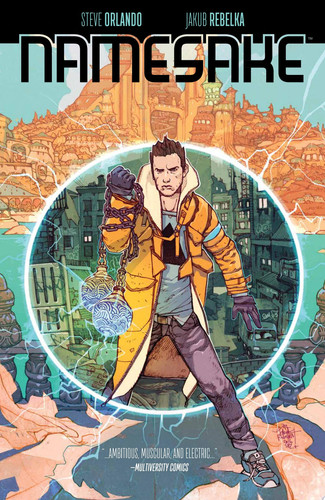
Namesake

Orlando, Steve (Comic book writer)
Jordan Molossus lived to avoid his fathers. Now he’ll traverse two worlds to put them in the ground. Every seven years, a supernatural parallel world called Ektae aligns itself with Earth, bringing magic and mayhem . . . it’s a celebration that Jordan Molossus wants nothing to do with. Until now, Jordan was an orphan, born on Ektae and abandoned on Earth, but that all changes when a package arrives on his doorstep containing two magical cast-iron urns. Jordan now has one week to travel into Ektae and spread the ashes of his parents while uncovering the mystery as to why he was orphaned, all the while being chased by the demons of their past. Namesake is an urban fantasy revenge epic written by Steve Orlando ( Midnighter, Supergirl ) and illustrated by Jakub Rebelka that runs completely on fists and hearts, full of high-octane action and affecting pathos.
BOOM! Studios 2017-08-22 112 pages

Kleinzeit

Hoban, Russell
On a day like any other, Kleinzeit gets fired. Hours later he finds himself in hospital with a pair of adventurous pyjamas and a recurring geometrical pain. Here he falls instantly in love with a beautiful night nurse called Sister. And together they are pitched headlong into a wild and flickering world of mystery ... Kleinzeit. In German that means 'hero'. Or 'smalltime'. It depends on whom you ask. 'Russell Hoban is our Ur-novelist, a maverick voice that is like no other' SUNDAY TELEGRAPH
Bloomsbury 2001 192 pages

The President's Plane Is Missing

Robert J. Serling
A crisis unlike any other... Like his many of his forbearers, President Jeremy Haines is weighed down by the solemn duties of his post.The threat of both the Soviet Union and China is a precarious situation and one mistake could lead the U.S into another long war.It seems the strain is too much, and unusual for Haines, he decides to take a week long vacation to Palm Springs, California for some R&R.But even more uncharacteristically, Haines declines to bring any reporter with him; the norm for him, while in office.Gunther Damon, news superintendent of the Washington Bureau of International Press is definitely suspicious.While not much a writer himself, Damon knows how to run a well-oiled team of reporters.And his gut instinct has never been wrong.In the early hours of the morning, President Haines' plane goes missing.As the search for bodies goes on, the crew is slowly but surely accounted for; but no sign of President Haines.And then as one of Damon's reporters find out, a body of unknown man is found amongst the wreckage.But it's not President Haines' body.In fact, the body is not of anyone who should've been on that plane. The corpse's identity is a complete mystery.Which raises another mystery - where is the President of the United States?Set in the middle of the cold war, The President's Plane is Missing is a thrilling and suspenseful mystery. Praise for Robert J Serling 'High level of suspense and excitement.' - De Moines Sunday Register 'Serling has spun another winner' - Publisher's Weekly '...keeps you guessing til the end' - Arizona Daily Star 'Aviation buffs will revel in this thoroughgoing chronicle' - Kirkus Robert J Serling was born in 1918 in Cortland, New York and was a novelist and aviation writer. He is the author of a number of airline histories and several novels, including The President's Plane Is Missing, which was adapted in 1973 as a made-for-TV film, and Air Force One Is Haunted.
Independently Published 2017-03-15 279 pages

The Peasants' Revolt of 1381

Richard Barrie Dobson
"This lengthy and detailed collection of original documents provides a basic handbook to the story, significance and problems of the English Peasants' Revolt of 1381. Although one of the most famous and dramatic episodes in English history, the great revolt of 1381 is still a largely unsolved mystery. Hitherto the original authorities for the history of the rebellion have been allowed to rest in unnecessary obscurity: and it seems due time to restore the Peasants' Revolt to the comments of its participants and observers. These extracts therefore exploit all the available types of evidence for the history of the 1381 Revolt, ranging from the trial records of captured rebels to contemporary poems. Fortunately the great majority of the primary chronicles for the rebellion, as well as a representative selection from surviving governmental and legal archives, can be presented within the covers of one book. With few exceptions these documents have been especially translated from the original Latin or Norman-French texts - almost all of which are difficult of access or out of print. In several cases translations have been made directly from unpublished records in the Public Record Office, London. The Peasants' Revolt has been examined primarily for its own sake; and at the heart of this book lie the various and often contradictory accounts of the outbreak of the rising in Kent and Essex, the rebels entry into London and the final great confrontation between the young Richard I| and Wat Tyler at Smithfield. But considerable attention is paid to the risings in East Anglia and elsewhere in England as well as to the political and social background of the revolt. The suppression and aftermath of the rebellion are also illustrated in detail. Indirectly this collection of documents therefore provides an insight into the economic status and social aspirations of the late mediaeval English peasantry. The work includes detailed chronological tables (the most ambitious yet attempted), a select guide to sources, three maps and a detailed bibliography. The author's introduction discusses the implications of the revolt in general terms and its significance as an early example of a pre-industrial popular movement. A warning is sounded against any too crude a sociology of rebellion; and the book ends with a series of very different and often hilariously misconceived interpretations of the Peasants' Revolt - from Gower and Froissart, Thomas Paine and Robert Southey to Engels and William Morris."-Publisher.
Macmillan 1970 427 pages

Tales of good and evil, help and harm

Hallie, Philip P.
Tales of Good and Evil focuses on what Hallie calls the "lucid mystery" of those who choose to help others in need, through the life stories of three people. Hallie tries to understand the ambiguous decency of Major Julius Schmahling, the German officer in charge of Chambon, who looked the other way as the villagers did their rescue work. He follows his portrait of the major with a riveting account of Joshua James, the Massachusetts man who in the early nineteenth. century founded the Life-Saving Rescue Service, later institutionalized by the Coast Guard, in which he and his crew of oarsmen regularly risked life and limb saving the passengers and sailors of ships foundering off the coast in violent storms. The final section of the book is a profile of Hallie's Connecticut neighbor, Katchen Coley, who founded The Connection, an organization devoted to rehabilitating drug- and alcohol-dependent young men and women. Tales of Good and. Evil is also the story of Hallie himself, as he tries to understand his own ambiguous moral actions, first as a child in the Jewish ghetto of Chicago, fighting to protect himself and his younger brother from anti-Semitic bullies, then as a World War II artilleryman, and finally as a philosopher of ethics who realized he could be coldly objective in studying the viciousness of human beings throughout history. In this study in moral ambiguity, written with great eloquence, we see a distinguished ethicist's concern with grasping the essence of good and evil both in daily life and under extraordinary circumstances.
HarperCollins World 1999 256 pages

Virgil: a life

Levi, Peter
Born in 70 BC, in a small village near Mantua, Publius Vergilius Maro—Virgil—grew up to be hailed as the greatest Roman poet. And although his work has influenced Western literature for two millennia, little is known about the man himself. Who was the man who created the Aeneid—one of the most important poems in Western literature—and such universal phrases as “love conquers all” and “fortune favors the bold?” Peter Levi here reconstructs the poet's life, from a childhood largely shrouded in mystery to his work as a great literary genius and revolutionary poet, by examining archaeological and historical evidence from Augustan Rome, as well as through close readings of the poet's own work. “Virgil is an intensely personal poet, yet he is anonymous . . . My aim is not so ambitious as to try and restore his prestige single-handed. It has simply been to try to understand him in his original context.” In this highly acclaimed, nowclassic biography, Peter Levi discards the myths and brilliantly reveals the life of Virgil and the extraordinary times during which he lived.
Tauris Parke Paperbacks 2012-05-08 261 pages

Metamorphosis: a natural and human history

Harman, Oren Solomon
""How many creatures walking on this earth / Have their first being in another form?" the Roman poet Ovid asked two thousand years ago. He could not have known the full extent of the truth: Today, biologists estimate a stunning three-quarters of all animal species on earth undergo some form of metamorphosis. But why do tadpoles transform into frogs, caterpillars into butterflies, elvers into eels, immortal jellyfish from sea sprigs to medusae and back again, growing younger and younger in frigid ocean depths? Why must creatures go through massive destruction and remodeling to become who they are? Tracing a path from Aristotle--who rejected the possibility of metamorphosis--to Darwin to today, historian of science Oren Harman explores that central mystery. Metamorphosis, however, isn't just a biological puzzle: It takes us to the very heart of questions of being and identity, whatever kind of change we may undergo. Metamorphosis is a new classic of natural history: a book that, by unveiling a mystery of nature, causes us to relearn ourselves"--Publisher's description.
John Murray 2025-10-23 400 pages

Endless Universe (Abandoned): Rewriting Cosmic History

Steinhardt, Paul J. & Neil Turok
Two world-renowned scientists present an audacious new vision of the cosmos that “steals the thunder from the Big Bang theory.” — Wall Street JournalThe Big Bang theory—widely regarded as the leading explanation for the origin of the universe—posits that space and time sprang into being about 14 billion years ago in a hot, expanding fireball of nearly infinite density. Over the last three decades the theory has been repeatedly revised to address such issues as how galaxies and stars first formed and why the expansion of the universe is speeding up today. Furthermore, an explanation has yet to be found for what caused the Big Bang in the first place.In Endless Universe , Paul J. Steinhardt and Neil Turok, both distinguished theoretical physicists, present a bold new cosmology. Steinhardt and Turok “contend that what we think of as the moment of creation was simply part of an infinite cycle of titanic collisions between our universe and a parallel world” ( Discover ). They recount the remarkable developments in astronomy, particle physics, and superstring theory that form the basis for their groundbreaking “Cyclic Universe” theory. According to this theory, the Big Bang was not the beginning of time but the bridge to a past filled with endlessly repeating cycles of evolution, each accompanied by the creation of new matter and the formation of new galaxies, stars, and planets.Endless Universe provides answers to longstanding problems with the Big Bang model, while offering a provocative new view of both the past and the future of the cosmos. It is a “theory that could solve the cosmic mystery” ( USA Today ).
Doubleday 2006 224 pages

Five Men of Frankfort

M. E. Ravage
With Three New Appendices. Few Jewish names in the history of Europe have attracted more fame, more conspiracy theories, rumors, and mystery than the name Rothschild. This biography, written by a leading Jewish historian, pulls no punches in telling the true story of the banking dynasty, once known as the "financiers of nations." Cutting through all the myths and exaggeration which have surrounded the Rothschilds, Five Men of Frankfort reveals how the four Rothschild sons spread throughout Europe-to London, Paris, Vienna, and Naples, to set up a banking network which inaugurated the system of moving money internationally through simultaneous deposits and withdrawals. British indebtedness to the Rothschilds for their help in defeating Napoleon was then exploited by getting the British government to persuade the other nations of Europe-including the Austrian, Prussian, and Russian governments-to start using the Rothschilds as bankers and as the providers of their national loans and debt. Although this book ends its narrative at the beginning of the nineteenth century, this new edition has three new appendices which reveal the full extent of the Rothschild business empire to the present day. These appendices reveal in an astonishing amount of detail how this Jewish family from Frankfort ended up loaning money to governments on five continents, and their role in modern-day financial transactions across the world. This book strips away the myths which surround the Rothschilds, and provides a sober assessment of why this banking house has become the foremost subject of conspiracy theories around the globe.
Blurb, Incorporated 2019-03-31 346 pages

On Nature: Great Writers on the Great Outdoors

Lee Gutkind
Includes 20 distinguished contemporary writers who have connected with nature & learned why we are inextricably attached to it. In "Against Nature," Joyce Carol Oates explains why writers generally resist nature as a topic. Diane Ackerman swims with a right whale & her calf. John McPhee explores the mystery of the Loch Ness monster & the people who obsess over it. Sherry Simpson looks at the conflict-riddled business of trapping & killing Alaskan wolves. Also, essays by: Mark Doty, Barry Lopez, Vaclav Havel, Bill Bryson, Deborah Archer, Sue Ellen Campbell, Leslie Leyland Fields, John Hales, Hal Herring, Edward Hoagland, Kurt Hoelting, Paul Lindholdt, Leslie Roberts, Lucy Wilson Sherman, & Sandi Wisenberg.
Putnam 2002-01-01 256 pages

Into the Mirror The Life of Master Spy Robert P. Hanssen

Lawrence Schiller
"On February 18, 2001, the FBI finally arrested Hanssen and charged him with selling to the Russians - over a period of more than twenty years - top-secret, classified information. Nothing that has been reported to date about this ordinary-looking but tormented man has revealed the astonishing facts that Lawrence Schiller and Norman Mailer - collaborators on the Pulitzer Prize-winning The Executioner's Song and Oswald's Tale-uncovered during their nine-month investigation into the life of this complex man. In seeking to solve this almost impenetrable mystery, Schiller and Mailer spent hundreds of hours interviewing members of Hanssen's family as well as his closest friends, colleagues, and fellow church members. They traveled to Moscow to interview a key member of the KGB who had handled the spy they knew only as "Ramon Garcia."".
HarperCollins Publishers 2002 317 pages

Speculation, trading, and bubbles

Scheinkman, José Alexandre
As long as there have been financial markets, there have been bubbles--those moments in which asset prices inflate far beyond their intrinsic value, often with ruinous results. Yet economists are slow to agree on the underlying forces behind these events. In this book José A. Scheinkman offers new insight into the mystery of bubbles. Noting some general characteristics of bubbles--such as the rise in trading volume and the coincidence between increases in supply and bubble implosions--Scheinkman offers a model, based on differences in beliefs among investors, that explains these observations. Other top economists also offer their own thoughts on the issue: Sanford J. Grossman and Patrick Bolton expand on Scheinkman's discussion by looking at factors that contribute to bubbles--such as excessive leverage, overconfidence, mania, and panic in speculative markets--and Kenneth J. Arrow and Joseph E. Stiglitz contextualize Scheinkman's findings.
Columbia University Press 2014 119 pages

In a land without dogs the cats learn to bark

Garfinkel, Jonathan
"In 1975, Gary Ruckler attends classes at Moscow State University as part of the first American Fulbright program in the USSR. Here he befriends Anna, her boyfriend Zaza, and their enigmatic friend Aslan. When Aslan mysteriously disappears into the mountains of Kazbegi, Georgia, Gary is swept up in events beyond his understanding and control. Fifteen years later, Tamar and Giorgi struggle through the "lost" decade of the 1990s in Tbilisi. Through three civil wars, a refugee crisis, and near-total societal collapse, the pair come of age in the underground arts scene. Then Tamar meets Rachel Grabinsky, head of an international pro-democracy NGO, who changes her life forever. In Toronto, 2003, Tamar and Rachel's son Joseph uncover astonishing truths about a woman they thought they knew. Who was Rachel Grabinsky? What was she really doing in Georgia? And how was she connected to Gary Ruckler? Part political mystery and part family drama, In a Land Without Dogs the Cats Learn to Bark is an energetic, gritty, and darkly funny novel that unfolds across multiple generations and explores the fractured nature of identity, the necessity of lies, and the bloody legacy of the Soviet Empire."--
Anansi 2023 413 pages