58,196 results in 0.07 seconds

The silent world of doctor and patient

Katz, Jay
In this eye-opening look at the doctor-patient decision-making process, physician and law professor Jay Katz examines the time-honored belief in the virtue of silent care and patient compliance. Historically, the doctor-patient relationship has been based on a one-way trust—despite recent judicial attempts to give patients a greater voice through the doctrine of informed consent. Katz criticizes doctors for encouraging patients to relinquish their autonomy, and demonstrates the detrimental effect their silence has on good patient care. Seeing a growing need in this age of medical science and sophisticated technology for more honest and complete communication between physician and patients, he advocates a new, informed dialogue that respects the rights and needs of both sides. In a new foreword to this edition of The Silent World of Doctor and Patient , Alexander Morgan Capron outlines the changes in medical ethics practice that have occurred since the book was first published in 1984, paying particular attention to the hotly debated issues of physician-assisted suicide and informed consent in managed care.
Johns Hopkins University Press 2002-11 263 pages

Evolving dharma: meditation, Buddhism, and the next generation of enlightenment

Michaelson, Jay
"Evolving Dharma is a next-generation book about meditation, Buddhism, and the contemplative path. It explores how the dharma (the path, the way, the teachings of the Buddha) has evolved in astonishing ways and how dharma practice evolves in one's own life. Instead of approaching the dharma as spirituality, therapy, or self-help, scholar and practicing Buddhist Jay Michaelson presents it as a set of technologies for upgrading the brain, for physically enhancing its capacity for wisdom and compassion. In the last twenty years, Buddhism has exploded well beyond its former boundaries. Meditation is being taught to prisoners, cancer patients, and children. It is being practiced online--by geeks, hipsters, and punks; by atheists, Christians, and Jews; by people who are not "spiritual." It's not even "Buddhism" anymore, having evolved out of its original religious context and into dozens of new ones. Evolving Dharma is the first book to take stock of these trends, and to speak in real-life terms about how they affect the practice of meditation and the path to upgrading the mind. Michaelson is fearless, unorthodox, and irreverent, yet his book is also based on his decade of meditation practice and teaching as well as his ten years of work as an LGBT activist. Including forays into neuroscience and cultural criticism and Michaelson's personal stories of his five months spent in silent retreat, life-changing realizations, pain, joy, and insight, this is not an ironic, wading-into-spirituality memoir but a thoughtful, important work that takes its subject seriously, both as discipline and as individual narrative. Chapter titles include "The Dharma Evolves By Disappearing," "The Evolution of Enlightenment," and "When Every Mystical State You've Ever Wanted Isn't Enough.""--
Evolver Editions 2013-10-15 245 pages

Day of Atonement

Rayner, Jay
Ingredients: It is the early Sixties. Down the side of a dilapidated synagogue in North-west London, a great partnership is born. Apart, Mal Jones and Solly Princeton are two teenage no-hopers scrabbling about in the dirt. Together they are dynamite: a world-beating team who turn a company selling chicken-soup machines to the Jewish mothers of Edgware into an international hotel and leisure empire. But success is never simple. Before long pressures draw them away from the comforts of their roots. They find themselves cutting corners, taking risks and breaking the law. Finally Mal has to confront his life, his friendship with Solly and where their very different ambitions have led them. Thirty-five years later as sunset ushers in the beginning of Yom Kippur, the Jewish day of atonement, Mal, his fortune gone, picks over the ruins of his past with his niece, Natasha. He tells her the story of the Sinai Corporation, of his best friend and business partner, Solly, and at last begins to ask himself: how far must you go before you lose faith in yourself?
Studio 28 2015 480 pages

Rise of ISIS: a threat we can't ignore

Sekulow, Jay
The world's wealthiest and most powerful jihadists, ISIS originated within Al Qaeda with the goal of creating an Islamic state across Iraq and Syria and unrelenting jihad on Christians. This book gives a better understanding of the modern face of terror, and provides an overview of the laws of war and war crimes. These laws differentiate between the guilty and innocent, and explain why the US military and the Israeli Defense Forces are often limited in their defensive measures.
Howard Books 2014-10-14 128 pages

Kissing kosher

Meltzer, Jean
"Avital Cohen isn't wearing underpants--woefully, for unsexy reasons. Chronic pelvic pain has forced her to sideline her photography dreams and her love life. It's all she can do to manage her family's kosher bakery, Best Babka in Brooklyn, without collapsing. She needs hired help. And distractingly handsome Ethan Lippmann seems the perfect fit. Except Ethan isn't there to work--he's undercover, at the behest of his ironfisted grandfather. Though Lippmann's is a household name when it comes to mass-produced kosher baked goods, they don't have the charm of Avital's bakery. Or her grandfather's world-famous pumpkin spice babka recipe. As they bake side by side, Ethan soon finds himself more interested in Avital than in stealing family secrets, especially as he helps her find the chronic pain relief--and pleasure--she's been missing. But perfecting the recipe for romance calls for leaving out the lies...even if coming clean means risking everything"--
Mira 2023 412 pages

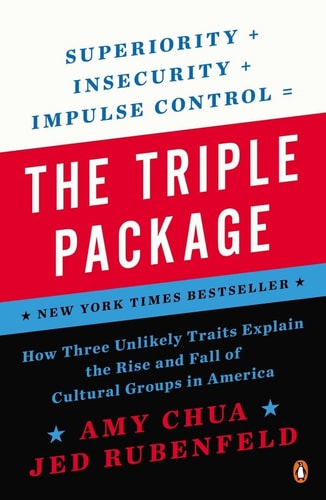
The Triple Package How Three Unlikely Traits Explain the Rise and Fall of Cultural Groups in America

Amy Chua,Jed Rubenfeld
"That certain groups do much better in America than others — as measured by income, occupational status, test scores, and so on — is difficult to talk about. In large part this is because the topic feels racially charged. The irony is that the facts actually debunk racial stereotypes. There are black and Hispanic subgroups in the United States far outperforming many white and Asian subgroups. Moreover, there’s a demonstrable arc to group success — in immigrant groups, it typically dissipates by the third generation — puncturing the notion of innate group differences and undermining the whole concept of 'model minorities.'" Mormons have recently risen to astonishing business success. Cubans in Miami climbed from poverty to prosperity in a generation. Nigerians earn doctorates at stunningly high rates. Indian and Chinese Americans have much higher incomes than other Americans; Jews may have the highest of all. Why do some groups rise? Drawing on groundbreaking original research and startling statistics, The Triple Package uncovers the secret to their success. A superiority complex, insecurity, impulse control—these are the elements of the Triple Package, the rare and potent cultural constellation that drives disproportionate group success. The Triple Package is open to anyone. America itself was once a Triple Package culture. It’s been losing that edge for a long time now. Even as headlines proclaim the death of upward mobility in America, the truth is that the old-fashioned American Dream is very much alive—but some groups have a cultural edge, which enables them to take advantage of opportunity far more than others. • Americans are taught that everyone is equal, that no group is superior to another. But remarkably, all of America’s most successful groups believe (even if they don’t say so aloud) that they’re exceptional, chosen, superior in some way. • Americans are taught that self-esteem—feeling good about yourself—is the key to a successful life. But in all of America’s most successful groups, people tend to feel insecure, inadequate, that they have to prove themselves. • America today spreads a message of immediate gratification, living for the moment. But all of America’s most successful groups cultivate heightened discipline and impulse control. But the Triple Package has a dark underside too. Each of its elements carries distinctive pathologies; when taken to an extreme, they can have truly toxic effects. Should people strive for the Triple Package? Should America? Ultimately, the authors conclude that the Triple Package is a ladder that should be climbed and then kicked away, drawing on its power but breaking free from its constraints. Provocative and profound, The Triple Package will transform the way we think about success and achievement.
Penguin 2015-01-27 352 pages

If Kennedy lived: the first and second terms of President John F. Kennedy : an alternate history

Greenfield, Jeff
From one of the country's most brilliant political commentators, the national bestselling author of Then Everything Changed , comes an extraordinary, thought-provoking look at John F. Kennedy's presidency - after November 22nd 1963. In Then Everything Changed , Jeff Greenfield created a 'riveting' ( The New York Times ), 'captivating' (Doris Kearns Goodwin) exploration of three modern political alternate histories. Based on memoirs, histories, oral histories, fresh reporting, and his own deep knowledge of the players, the book looked at the tiny hinges of history - and the extraordinary changes that would have resulted if they had gone another way. Now Greenfield presents his most compelling narrative of all, about the historical event that has rivited us for fifty years. What if John F. Kennedy had not been killed on that fateful day? What would the 1964 campaign have looked like? Would changes have been made to the ticket? How would a Kennedy second term have approached Vietnam, civil rights, the Cold War? What would Kennedy have had to give up - and what would he have gained? With powerful enemies against him, would his indiscreet private life finally have become public? How would his health issues have affected his presidency? And what small turns of fate in the days and years before Dallas might have kept him from ever reaching the White House in the first place? As in Then Everything Changed , the answers Greenfield provides, the scenarios he develops, are startlingly realistic, rich in detail, shocking in their projections, but always deeply, remarkably plausible - and a pure delight to read. It is a tour de force of American political history. Acclaim for Then Everything Changed 'Shrewdly written, often riveting, gripping . . . Thanks to Mr. Greenfield's own familiarity with American politics and a lot of energetic research, he turns these twists of fate into accelerating historical snowballs that rumble through our recent history, altering the social landscape in ways both small and large.' Michiko Kakutani, The New York Times 'Not only thoughtful and sophisticated, but marked by the author's enthusiasm. Greenfield is having fun here, and you can feel it on every page. His scenarios are relentlessly grounded in plausibility. This is a book political junkies will adore.' Bryan Burrough, The Washington Post 'Satisfying, entertaining, insightful. The key to Greenfield's success is that he knows his politics and the strengths and weaknesses of leaders. Greenfield's storytelling is compelling and his research superb.' The Miami Herald 'Historians have long been tantalized by the what-ifs of history. In the hands of this tremendously gifted storyteller, Then Everything Changed will captivate the reader every step along the way.' Doris Kearns Goodwin 'You expect intelligence and a devilish sense of humor and a profound knowledge of political history from Jeff Greenfield. But there is a deeper, haunting quality to this book as well. By adding a simple twist of fate, Greenfield brings fresh - and exhilarating - insights to the history of our times.' Joe Klein, columnist, Time 'Jeff Greenfield has taken the 'what-if' game and turned it into something else entirely - a trio of thought-provoking, interesting, and downright clever scenarios that remind us just how much individuals do matter.' Bob Schieffer, moderator, Face the Nation
G. P. Putnam's Sons 2013 249 pages

The Arm Inside the Billion-Dollar Mystery of the Most Valuable Commodity in Sports

Jeff Passan
Yahoo’s lead baseball columnist offers an in-depth look at the most valuable commodity in sports—the pitching arm—and how its vulnerability to injury is hurting players and the game, from Little League to the majors. Every year, Major League Baseball spends more than $1.5 billion on pitchers—five times more than the salary of every NFL quarterback combined. Pitchers are the game’s lifeblood. Their import is exceeded only by their fragility. One tiny band of tissue in the elbow, the ulnar collateral ligament, is snapping at unprecedented rates, leaving current big league players vulnerable and the coming generation of baseball-playing children dreading the three scariest words in the sport: Tommy John surgery. Jeff Passan traveled the world for three years to explore in-depth the past, present, and future of the arm, and how its evolution left baseball struggling to wrangle its Tommy John surgery epidemic. He examined what compelled the Chicago Cubs to spend $155 million on one arm. He snagged a rare interview with Sandy Koufax, whose career was cut short by injury at thirty, and visited Japan to understand how another baseball-mad country treats its prized arms. And he followed two major league pitchers, Daniel Hudson and Todd Coffey, throughout their returns from Tommy John surgery. He exposes how the baseball establishment long ignored the rise in arm injuries and reveals how misplaced incentives across the sport stifle potential changes. Injuries to the UCL start as early as Little League. Without a drastic cultural shift, baseball will continue to lose hundreds of millions of dollars annually to damaged pitchers, and another generation of children will suffer the same problems that vex current players. Informative and hard-hitting, The Arm is essential reading for everyone who loves the game, wants to keep their children healthy, or relishes a look into how a large, complex institution can fail so spectacularly.
HarperCollins 2017-04-04 384 pages

The Rocket That Fell to Earth Roger Clemens and the Rage for Baseball Immortality

Jeff Pearlman
A fearless, hard-nosed Texan with a 98-mph fastball and a propensity to throw at the heads of opposing hitters, Roger “the Rocket” Clemens won 354 games, an unprecedented seven Cy Young Awards, and two World Series trophies over the course of twenty-four seasons. But the statistics and hoopla obscured a far darker story—one of playoff chokes, womanizing (including a long-term affair with a teenage country singer), violent explosions, steroid and human growth hormone use...and an especially dark secret that Clemens spent a lifetime trying to hide: a family tragedy involving drugs and, ultimately, death. In The Rocket That Fell to Earth , New York Times bestselling author Jeff Pearlman reconstructs the pitcher's life—from his Ohio childhood to the mounds of Fenway Park and Yankee Stadium—to reveal a flawed and troubled man whose rage for baseball immortality took him to superhuman heights before he crashed down to earth.
HarperCollins 2010-03-16 368 pages

C Street The Fundamentalist Threat to Democracy

Jeff Sharlet
'A gripping political thriller, a masterpiece of investigative journalism' Peter Manseau, author of Rag and Bone The secretive Christian fundamentalist group known as 'The Family' is leading a new crusade for 'God-led government'.Jeff Sharlet, author The Family (more than 100,000 copies sold worldwide), is the only journalist to have reported from insidethe organisation. The Family garnered intense media coverage in 2009 when theirtownhouse on Washington's C Street was central to three Republican sex scandals. Now Sharlet uncovers the convert efforts of C Street to transform the very fabric of Western democracy, with the Family, steeped in the influence and corruption usually associated with the notorious lobbing industry, fueling political fundamentalism from within government. When Barack Obama took office, headlines declared the age of culture wars over. In C Street, Sharlet show why these conflicts endure and why they matter now-from Uganda, where culture warriors are determined to eradicate homosexuality, to the battle for the soul of America's armed forces. Reporting with exclusive sources and explosives documents, Sharlet reveals the terrifying new front-lines of fundamentalism. PRAISE FOR THE FAMILY 'This expose of the hidden face of Christian fundamentalism is authoritative and alarming.' The Age 'One of the most compelling and brilliantly researched exposes you'll ever read.' Barbara Ehrenreich, author of Smile or Die
University of Queensland Press 2010 344 pages

How to write one song

Tweedy, Jeff
There are few creative acts more mysterious and magical than writing a song. Tweedy believes that the difference between one song and many songs isn't a cute semantic trick-- it's an important distinction that can simplify a notoriously confusing art form. The idea of becoming a songwriter can seem daunting, but approached as a focused, self-contained event, the mystery and fear subsides, and songwriting becomes an exciting pursuit. Here he brings readers into the intimate process of writing one song: lyrics, music, and putting it all together. Doing so allows you to access the deep sense of wonder that remains at the heart of this fulfilling, artistic act. -- adapted from jacket.
Faber & Faber 2020 158 pages

The ages of globalization: geography, technology, and institutions

Sachs, Jeffrey
"Today's most urgent problems are fundamentally global. They require nothing less than concerted, planetwide action if we are to secure a long-term future. But humanity's story has always been on a global scale, and this history deeply informs the present. In this book, Jeffrey D. Sachs, renowned economist and expert on sustainable development, turns to world history to shed light on how we can meet the challenges and opportunities of the twenty-first century. Sachs takes readers through a series of six distinct waves of technological and ideological change, starting with the very beginnings of our species and ending with reflections on present-day globalization. Along the way, he considers how the interplay of geography, technology, and institutions influenced the Neolithic revolution; the spread of land-based empires; the opening of sea routes from Europe to Asia and the Americas; and the industrial age. The dynamics of these past waves, Sachs contends, give us new perspective on the ongoing processes taking place in our own time-and how we should work to guide the change we need. In light of this new understanding of globalization, Sachs emphasizes the need for new methods of international governance and cooperation to achieve economic, social, and environmental objectives aligned with sustainable development. The Ages of Globalization is a vital book for all readers aiming to make sense of our rapidly changing world"--
Columbia University Press 2020 262 pages

What's It All About, Charlie Brown? Peanuts Kids Look at America Today

Jeffrey H. Loria
Interspersing commentary from the author and the Peanuts strips of Charles Schulz, this book looks at changes in American attitudes, ideas, inspirations, and social phenomena over the past years. Lucy on psychiatry; Charlie on love; Snoopy on leisure-time activities; politics, school, and education; home, sports, religion, culture and business—the whole of American life is viewed realistically and sometimes idealistically through the eyes of the Peanuts kids.
Henry Holt 1968 160 pages

Reactionary modernism: technology, culture, and politics in Weimar and the Third Reich

Herf, Jeffrey
Explores the paradox inherent in the German fascists' rejection of the rationalism of the Enlightenment while fully embracing modern technology. By associating technology with the Germans rather than the Jews, with beautiful form rather than the formlessness of the market, and with a strong state rather than a predominance of economic values and institutions, right-wing intellectuals reconciled Germany's strength with its romantic soul and national identity. Includes discussion on the transformation of anti-capitalist rhetoric to anti-Jewish rhetoric. See the index for references to antisemitism, and especially ch. 6, "Werner Sombart: Technology and the Jewish Question".
Cambridge University Press 1984 251 pages

Against therapy

Masson, J. Moussaieff
In this book the author suggests that the techniques and aims of psychotherapy are open to abuse. He regards it as self-evident that the therapist makes demands on the patient that cannot be fulfilled and that the financial exigencies of the relationship are open to corruption. Masson sets out to show that abuse of one form or another is built into the very fabric of psychotherapy, that it is the nature of therapy to distort another person's reality and that since it is the therapist's task to change people this can only be done according to the therapists' own notions and prejudices, so the psychological process is necessarily corrupt.
Fontana 1990 320 pages