14302 results for "History"

The 12th planet

Sitchin, Zecharia
Over the years, startling evidence has been unearthed, challenging established notions of the origins of Earth and life on it and suggesting the existence of a superior race of beings who once inhabited our world. The product of thirty years of intensive research, The 12th Planet is the first book in Zecharia Sitchin's prophetic Earth Chronicles series--a revolutionary body of work that offers indisputable documentary proof of humanity's extraterrestrial forefathers. Travelers from the stars, they arrived eons ago, and planted the genetic seed that would ultimately blossom into a remarkable species...called Man. The 12th Planet brings to life the Sumerian civilization, presenting millennia-old evidence of the existence of Nibiru, the home planet of the Anunnaki and of the landings of the Anunnaki on Earth every 3,600 years, and reveals a complete history of the solar system as told by these early visitors from another planet. Zecharia Sitchin's Earth Chronicles series, with millions of copies sold worldwide, deal with the history and prehistory of Earth and humankind. Each book in the series is based upon information written on clay tablets by the ancient civilizations of the Near East. The series is offered here, for the first time, in highly readable, hardbound collector's editions with enhanced maps and diagrams.
Bear & Co 1991-05-01 384 pages

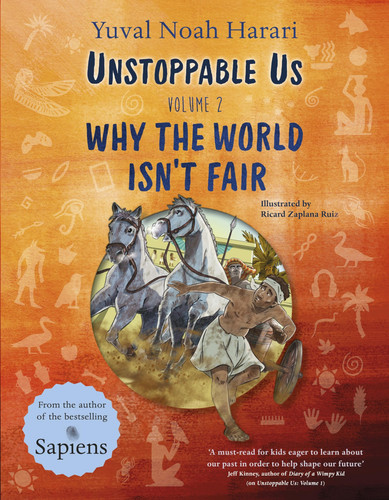
Unstoppable us: volume 2: why the world isn't fair

Harari, Yuval N.
Something really strange happened 10,000 years ago, and it changed everything. Why did millions of people agree to obey a few leaders? Where did kings and kingdoms come from? The answer to that is one of the strangest tales you'll ever hear. And it's a true story. Have you ever wondered how we got here? From gathering berries and hunting mammoths, to shopping at supermarkets and letting people tell us what to do? You might hear a lot of people say 'the world isn't fair'. But why isn't it? And how did it become so? In Unstoppable Us- Volume 1 , we learned how humans told stories to become rulers of the world - for good and bad. Now, in this next chapter of the incredible true tale of the Unstoppables, find out how humans learned to control animals like dogs, chicken and cows . . . And how a handful of humans learned to control everyone else. With full-colour illustrations showing the relentless rise and rise of the human race, this is history like you've never experienced it before.
Puffin Books 2024-03-07 187 pages

The birth of Korean cool: how one nation is conquering the world through pop culture

Hong, Euny
A revised edition of this celebrated cultural history features a new afterword and three new chapters focusing on the global K-pop phenomenon BTS, as well as the Academy Award–winning film Parasite and the hit Netflix series Squid Game. In this fresh, funny, and insightful cultural history, Euny Hong recounts how South Korea vaulted itself into the twenty-first century, becoming a global leader in business, technology, education, and pop culture. Along the way we meet teachers, cultural critics, Michelin-starred chefs, pop music superstars, and government ministers in charge of creating boy bands with highly synchronized dance moves. The strict rigors of the Korean education system now lead to a society that works and plays hard—with a Ministry of Culture that churns out movies, television dramas, pop bands, and video games exported throughout the world. The Birth of Korean Cool reveals how a really uncool country became cool, and how a nation that once banned miniskirts, long hair on men, and rock and roll could come to be known for its pop music and the smartphone in everyone’s pocket. This revised edition features a new afterword and three new chapters focusing on the global K-pop phenomenon BTS, as well as the Academy Award-winning film Parasite and the hit Netflix series Squid Game.
Picador 2025-04 352 pages

A Bright Room Called Day

Tony Kushner
From the Pulitzer Prize-winning author of Angels in America comes this powerful portrayal of individual dissolution and resolution in the face of political catastrophe. "Tony Kushner's A BRIGHT ROOM CALLED DAY ... is unabashedly political, thought-provoking, a little scary, and frequently a good deal of theatrical fun ... BRIGHT ROOM is ... an examination of Nazi Germany in an attempt to shed insight on our own time. It's brash, audacious, and, depending on your politics, anything from infuriatingly naïve to intoxicatingly visionary. In its 1932-33 span, it tells of a group of Berlin artists and friends, with varying degrees of communist leanings, and of the changes in their lives as democracy falls and Adolph Hitler takes over." -Sid Smith, Chicago Tribune "It's fun to see a show this engaged. This passionate and ready to talk. Wild, uneven, pugnacious, ragged, committed, smart, dumb, satirical, and utterly serious ... Always dramatically and intellectually forceful. And most important, always passionately committed. More than a diatribe against Reagan or a falling-into-the-Nazi-abyss history play, A BRIGHT ROOM CALLED DAY is an assertion of the need for commitment." -Anthony Adler, The Reader
Broadway Play Publishing 2015 102 pages

Mind and cosmos: why the materialist neo-Darwinian conception of nature is almost certainly false

Nagel, Thomas
The modern materialist approach to life has conspicuously failed to explain such central mind-related features of our world as consciousness, intentionality, meaning, and value. This failure to account for something so integral to nature as mind, argues philosopher Thomas Nagel, is a major problem, threatening to unravel the entire naturalistic world picture, extending to biology, evolutionary theory, and cosmology. Since minds are features of biological systems that have developed through evolution, the standard materialist version of evolutionary biology is fundamentally incomplete. And the cosmological history that led to the origin of life and the coming into existence of the conditions for evolution cannot be a merely materialist history, either. An adequate conception of nature would have to explain the appearance in the universe of materially irreducible conscious minds, as such. Nagel's skepticism is not based on religious belief or on a belief in any definite alternative. In Mind and Cosmos, he does suggest that if the materialist account is wrong, then principles of a different kind may also be at work in the history of nature, principles of the growth of order that are in their logical form teleological rather than mechanistic. In spite of the great achievements of the physical sciences, reductive materialism is a world view ripe for displacement. Nagel shows that to recognize its limits is the first step in looking for alternatives, or at least in being open to their possibility.--Publisher description.
Oxford University Press 2012-11-22 130 pages

Beethoven: the philosophy of music

Adorno, Theodor W.
Beethoven is a classic study of the composer's music, written by one of the most important thinkers of our time. Throughout his life, Adorno wrote extensive notes, essay fragments and aides-memoires on the subject of Beethoven's music. This book brings together all of Beethoven's music in relation to the society in which he lived. Adorno identifies three periods in Beethoven's work, arguing that the thematic unity of the first and second periods begins to break down in the third. Adorno follows this progressive disintegration of organic unity in the classical music of Beethoven and his contemporaries, linking it with the rationality and monopolistic nature of modern society. Beethoven will be welcomed by students and researchers in a wide range of disciplines - philosophy, sociology, music and history - and by anyone interested in the life of the composer.
Polity Press 1998-09-16 268 pages

Mind change: how digital technologies are leaving their mark on our brains

Greenfield, Susan
"Google. Facebook. Twitter. Repeat. We live in a world unimaginable even a few decades ago, one like no other in human history. It's a parallel world where we can be on the move in the real world, yet always hooked into an alternative time and place. And although it's a two-dimensional world of sight and sound, it offers instant information, connected identities, and constant novelty. In this world, our screen technologies are increasingly where we work, where we unwind, where we relieve our boredom and where we learn. The subsequent transformation in how we live and think is a vitally important issue, perhaps even the most important issue of our time. When toddlers are given iPads, and adults spend ten hours a day staring at a screen, can we afford to assume that our brave new screen technologies are harmless tools? Blending a wide range of scientific studies, news events, and cultural criticism with brio and verve, Mind Change presents an incisive snapshot of the global 'now.' Greenfield examines how the dawn of the Digital Age has already altered our cultural landscape, fueled an epidemic of oversharing, and transformed how we learn, remember and spread information -- and how these innovations are changing our physical brains. A warning cry, a shot across the bow, and a call to action, Mind Change explores the social, cultural and physiological ramifications of our new digital lifestyle"--
Random House 2015-02-10 348 pages

War horse: the making of the motion picture

Steven Spielberg
Brimming with more than 140 dramatic images, this is the stunning, visual companion to Steven Spielberg's epic adventure, set in rural England and Europe, about a young man and his horse and their separate journeys through the battlefields of the First World War. One of the great stories of friendship and war, the successful novel War Horse not only inspired the award-winning stage play, but also inspired one of the great directors in film history to commit his talent, vision, and resources to make this extraordinary movie, which was shot in the countryside of England. "I first fell in love with the story of War Horse because I was moved by the relationship between a boy and an animal in Michael Morpurgo's novel and the screenplay by Richard Curtis and Lee Hall," writes Steven Spielberg in his foreword. "But, ultimately, I made it because of what the book and the screenplay say about courage. I t is about the courage of the horse Joey and what he endures to survive, and the courage of Albert in his attempt to find his best friend in a time of war. With every frame of this film, it was my hope to issue a call for courage in our daily lives. A call to ‘be brave.'" Additional forewords by producer Kathleen Kennedy, novelist Michael Morpurgo, and co-screenwriter Richard Curtis reveal their feelings about the story and the process of moving it from page to screen. The main body of the book is divided into three sections: Part 1: Joey's Journey —A visual retelling, along with script excerpts and filmmakers' comments, of the journey taken by Joey, the horse trained by his beloved Albert, from the striking verdant countryside of Dartmoor, Devon, to training in the British cavalry, to trench warfare in France. Part 2: The Making of War Horse —An insider's glimpse of the movie-making process highlighted with fascinating insights from the international cast and the crew about the casting, locations, costumes, horse training, and much more. Part 3: The History of War Horses —An illuminating section on the role of horses in battle, illustrated with iconic images from history, vivid drawings, paintings and photographs. This beautiful book is a testament to what can be done when people become impassioned about a goal. As producer Kathleen Kennedy expresses in her foreword: " War Horse was one of those unusual productions that comes together in an incredibly short time, and for all the right reasons. Everyone involved understood the film's potential, the richness of the characters, the depth of emotion, and the strength of the story's message."
Newmarket Press 2011-12-27 144 pages

The swerve: how the Renaissance began

Greenblatt, Stephen
In this book the author transports readers to the dawn of the Renaissance and chronicles the life of an intrepid book lover who rescued the Roman philosophical text On the Nature of Things from certain oblivion. In this work he has crafted both a work of history and a story of discovery, in which one manuscript, plucked from a thousand years of neglect, changed the course of human thought and made possible the world as we know it. Nearly six hundred years ago, a short, genial, cannily alert man in his late thirties took a very old manuscript off a library shelf, saw with excitement what he had discovered, and ordered that it be copied. That book was the last surviving manuscript of an ancient Roman philosophical epic, On the Nature of Things, by Lucretius, a beautiful poem of the most dangerous ideas: that the universe functioned without the aid of gods, that religious fear was damaging to human life, and that matter was made up of very small particles in eternal motion, colliding and swerving in new directions. The copying and translation of this ancient book, the greatest discovery of the greatest book-hunter of his age, fueled the Renaissance, inspiring artists such as Botticelli and thinkers such as Giordano Bruno; shaped the thought of Galileo and Freud, Darwin and Einstein; and had a revolutionary influence on writers such as Montaigne and Shakespeare and even Thomas Jefferson.
Bodley Head 2011 356 pages

The Norton Shakespeare Tragedies + the Norton Shakespeare Histories

Stephen Greenblatt,Walter Cohen,Jean E. Howard,Gordon McMullan,Katharine Eisaman Maus,Suzanne Gossett
Product Description Both an enhanced digital edition―the first edited specifically for undergraduates―and a handsome print volume, The Norton Shakespeare, Third Edition, provides a freshly edited text, acclaimed apparatus, and an unmatched value. The attractive print and digital bundle offers students a great reading experience at an affordable price in two ways―a hardcover volume for their dorm shelf and lifetime library, and a digital edition ideal for in-class use. Students can access the ebook from their computer, tablet, or smartphone via the registration code included in the print volume at no additional charge. As one instructor summed it up, “It’s a long overdue step forward in the way Shakespeare is taught.” Book Description with The Norton Shakespeare Digital Edition registration card About the Author Stephen Greenblatt (Ph.D. Yale) is Cogan University Professor of the Humanities at Harvard University. Also General Editor of The Norton Anthology of English Literature, he is the author of eleven books, including Tyrant, The Rise and Fall of Adam and Eve: The Story that Created Us, The Swerve: How the World Became Modern (winner of the 2011 National Book Award and the 2012 Pulitzer Prize); Shakespeare's Freedom; Will in the World: How Shakespeare Became Shakespeare; Hamlet in Purgatory; Marvelous Possessions: The Wonder of the New World; Learning to Curse: Essays in Early Modern Culture; and Renaissance Self-Fashioning: From More to Shakespeare. He has edited seven collections of criticism, including Cultural Mobility: A Manifesto, and is a founding coeditor of the journal Representations. His honors include the MLA’s James Russell Lowell Prize, for both Shakespearean Negotiations: The Circulation of Social Energy in Renaissance England and The Swerve, the Sapegno Prize, the Distinguished Humanist Award from the Mellon Foundation, the Wilbur Cross Medal from the Yale University Graduate School, the William Shakespeare Award for Classical Theatre, the Erasmus Institute Prize, two Guggenheim Fellowships, and the Distinguished Teaching Award from the University of California, Berkeley. He was president of the Modern Language Association of America and is a fellow of the American Academy of Arts and Sciences, the American Philosophical Society, and the American Academy of Arts and Letters. Walter Cohen (Ph.D. Berkeley) is Professor of English at the University of Michigan, Ann Arbor, and Professor of Comparative Literature Emeritus at Cornell University, where he received the Clark Distinguished Teaching Award. He is the author of Drama of a Nation: Public Theater in Renaissance England and Spain, as well as numerous journal articles on Renaissance literature, literary criticism, the history of the novel, and world literature. He has recently completed a critical study entitled A History of European Literature: The West and the World from Antiquity to the Present. Jean E. Howard (Ph.D., Yale) is the George Delacorte Professor in the Humanities at Columbia University. A past president of the Shakespeare Association of America, she is the author of numerous books on Renaissance drama, including Shakespeare’s Art of Orchestration: Stage Technique and Audience Response (1984), The Stage and Social Struggle (1994), Engendering a Nation: A Feminist Account of Shakespeare’s English Histories, with Phyllis Rackin (1997), Theater of a City: The Places of London Comedy 1598–1642 (2007), and Marx and Shakespeare with Crystal Bartolovich (2012). She is at work on a book about the English history play from Shakespeare to Caryl Churchill and another on the invention of Renaissance tragedy. Katharine Eisaman Maus (Ph.D. Johns Hopkins) is James Branch Cabell Professor of English at the University of Virginia. She is the author of Being and Having in Shakespeare; Inwardness and Theater in the English Renaissance; and Ben Jonson and the Roman Frame of Mind; editor of a volume of Renaissance tragedies; an
W W Norton & Co Inc 2015-10-01 1232 pages

Totem and Taboo

Sigmund Freud
"Totem and Taboo" is a collection of four essays by Sigmund Freud that were published together in German in 1913. Freud sought to apply his theories of psychoanalysis to the study of anthropology and early human history. The four essays cover a wide range of topics. In "The Horror of Incest", Freud examines the varied and common rules in primitive cultures that limit contact between members of the same family. In "Taboo and Emotional Ambivalence," Freud posits that primitive cultures and their attitudes about magical objects are similar to the behavior of people with neurotic psychological conditions in the modern world. In "Animism, Magic and the Omnipotence of Thought," Freud draws comparisons between the primitive belief in magic and magical animals to obsessive and compulsive disorders. Finally, in "The Return of Totemism in Childhood," Freud, influenced by one of Charles Darwin's theories about the male-dominated arrangement of early human societies, looks for parallels with his own Oedipus complex theory in the structure of primitive cultures. A classic and influential work of early psychoanalysis, "Totem and Taboo" is an important read for students of both psychology and social anthropology.
Lulu.com 2022-10-24 172 pages

The dialectic of sex: the case for feminist revolution

Firestone, Shulamith
"Beginning with a look at the radical and grassroots history of the first wave (with its foundation in the abolition movement of the time), Firestone documents its major victory, the granting of the vote to women in 1920, and the fifty years of ridicule that followed. She goes on to deftly synthesize the work of Freud, Marx, de Beauvoir, and Engels to create a cogent argument for feminist revolution. Identifying women as a caste, she declares that they must seize the means of reproduction?for as long as women (and only women) are required to bear and rear children, they will be singled out as inferior. Ultimately she presents feminism as the key radical ideology, the missing link between Marx and Freud, uniting their visions of the political and the personal."--
Farrar, Straus and Giroux 2003-03-05 216 pages

My age of anxiety: fear, hope, dread, and the search for peace of mind

Stossel, Scott
The author recounts his lifelong battle with anxiety, showing the many manifestations of the disorder as well as the countless treatments that have been developed to counteract it, and provides a history of the efforts of scientists, philosophers, and writers to understand this common form of mental illness. He reports on famous individuals who struggled with anxiety, as well as on the afflicted generations of his own family. This portrait of anxiety reveals the anguish it produces, and describes anxiety's human toll, it's crippling impact, its devasting power to paralyze, while at the same time exploring how those who suffer from it find ways to manage and control it. Here the author guides us across the terrain of an affliction that is pervasive (it is the most common form of officially classified mental illness), yet too often misunderstood. -- From book jacket.
Alfred A. Knopf 2013 400 pages

The big goodbye: Chinatown and the last years of Hollywood

Wasson, Sam
"From the New York Times bestselling author of Fifth Avenue, Five A.M. and Fosse comes the revelatory account of the making of a modern American masterpiece. Chinatown is the Holy Grail of 1970s cinema. Its twist ending is the most notorious in American film and its closing line of dialogue the most haunting. Here for the first time is the incredible true story of its making. In Sam Wasson's telling, it becomes the defining story of the most colorful characters in the most colorful period of Hollywood history. Here is Jack Nicholson at the height of his powers, as compelling a movie star as there has ever been, embarking on his great, doomed love affair with Anjelica Huston. Here is director Roman Polanski, both predator and prey, haunted by the savage death of his wife, returning to Los Angeles, the scene of the crime, where the seeds of his own self-destruction are quickly planted. Here is the fevered dealmaking of "The Kid" Robert Evans, the most consummate of producers. Here too is Robert Towne's fabled script, widely considered the greatest original screenplay ever written. Wasson for the first time peels off layers of myth to provide the true account of its creation. Looming over the story of this classic movie is the imminent eclipse of the '70s filmmaker-friendly studios as they gave way to the corporate Hollywood we know today. In telling that larger story, The Big Goodbye will take its place alongside classics like Easy Riders, Raging Bulls and The Devil's Candy as one of the great movie-world books ever written. Praise for Sam Wasson: "Wasson is a canny chronicler of old Hollywood and its outsize personalities...More than that, he understands that style matters, and, like his subjects, he has a flair for it." - The New Yorker "Sam Wasson is a fabulous social historian because he finds meaning in situations and stories that would otherwise be forgotten if he didn't sleuth them out, lovingly." - Hilton Als"--
Flatiron Books 2020-02-04 397 pages

Survivor : Auschwitz, the Death March and my fight for freedom

Pivnik, Sam
An extraordinary story of survival against all odds, full of life and heart in the face of death We've heard it all before. We've read the book, we've seen the movie. Yet we haven't. That's the thing about human stories: each is unique. Sam's is remarkable. Not just the death camps, but his escape from them. And that he could build a life afterwards. - The Big Issue In September 1939, Hitler's Germany invaded Poland. It was Sam Pivnik's thirteenth birthday, and his life was turned upside down overnight. He was first transported to a ghetto in his home town of Bedzin, then another. He then spent a harrowing six months on Auschwitz's notorious Rampkommando, before being sent to work at the brutal Furstengrube mining camp. As the Third Reich collapsed, he took part in the 'Death March' that took him west - only to board the prison ship Cap Arcona which was mistakenly sunk by the Royal Air Force in 1945, as they believed SS members to be on board. Each of these experiences could have proved fatal. Many brought Sam on the verge of death. But he survived, against all odds, and built a life from himself after the War. In Survivor he tells his incredible story. ------ Survivor has moved readers all around the world: 'This should be read and re-read for generations' - ⭐⭐⭐⭐⭐ 'A man with dignity. A book that is raw and unflinching. A staggering account of Nazi obsession with the obliteration of a people. It left me profoundly sad and angry for what happened, and grateful that because of survivors such as Sam Pivnik, this episode in history can and will not be forgotten.' - ⭐⭐⭐⭐⭐ 'A huge 5 stars for a story that had to be told. There is simply far too much to say to do Sam, his book, or the nightmare of the war justice.' - ⭐⭐⭐⭐⭐
Hodder & Stoughton 2013 303 pages

Supreme ambition: Brett Kavanaugh and the conservative takeover

Marcus, Ruth
The Washington Post journalist and legal expert Ruth Marcus goes behind the scenes to document the inside story of the Brett Kavanaugh confirmation battle and the Republican plot to take over the Supreme Court—thirty years in the making—in this “i mpressively reported, highly insightful, and rollicking good read” ( The New York Times Book Review ). In the summer of 2018 the Kavanaugh drama unfolded so fast it seemed to come out of nowhere. With the power of the #MeToo movement behind her, a terrified but composed Christine Blasey Ford walked into a Senate hearing room to accuse Kavanaugh of sexual assault. This unleashed unprecedented fury from a Supreme Court nominee who accused Democrats of a “calculated and orchestrated political hit.” But behind this showdown was a much bigger one. The Washington Post journalist and legal expert Ruth Marcus documents the thirty-year mission by conservatives to win a majority on the Supreme Court and the lifelong ambition of Brett Kavanaugh to secure his place in that victory. The reporting in Supreme Ambition is full of revealing and weighty headlines, as Marcus answers the most pressing questions surrounding this historical moment: How did Kavanaugh get the nomination? Was Blasey Ford’s testimony credible? What does his confirmation mean for the future of the court? Were the Democrats outgunned from the start? On the way, she uncovers secret White House meetings, intense lobbying efforts, private confrontations on Capitol Hill, and lives forever upended on both coasts. This “extraordinarily detailed” ( The Washington Post ) page-turner traces how Brett Kavanaugh deftly maneuvered to become the nominee and how he quashed resistance from Republicans and from a president reluctant to reward a George W. Bush loyalist. It shows a Republican party that had concluded Kavanaugh was too big to fail, with senators and the FBI ignoring potentially devastating evidence against him. And it paints a picture of Democratic leaders unwilling to engage in the no-holds-barred partisan warfare that might have defeated the nominee. In the tradition of The Brethren and The Power Broker , Supreme Ambition is the definitive account of a pivotal moment in modern history, one that will shape the judicial system of America for generations to come.
Simon & Schuster Paperbacks 2020-11-17 490 pages

The Case for Mars The Plan to Settle the Red Planet and Why We Must

Robert Zubrin
The Case for Mars makes living in space seem more possible than ever in this updated 25th anniversary edition, featuring the latest information on the planet's exploration and the drive to send humans there. Since the beginning of human history, Mars has been an alluring dream—the stuff of legends, gods, and mystery. The planet most like ours, it had long been thought impossible to reach, let alone explore and inhabit. But that is changing fast. In February 2021, the American rover Perseverance will touch down on Mars. Equipped with a powerful suite of scientific instruments—including some that will attempt to make oxygen from the Martian atmosphere—the rover also carries a helicopter that will take spectacular panoramic movies from the air. Most exciting of all, a spectrometer onboard may find evidence of fossils left behind by microbes millions of years ago, when the planet was warm and wet, proving at last that life on Earth is not unique, but a general phenomenon in the universe. Meanwhile, in Boca Chica, Texas, Elon Musk’s SpaceX has created a shipyard that is building and testing the vessels that will take humans to Mars before this decade is out. Leading space exploration expert Robert Zubrin crafted the daring blueprint for humanity’s reach to the Red Planet twenty-five years ago, when he first published The Case for Mars . Now, in this updated edition, he looks to the future once more to describe how—in an era when the American space program and private companies like SpaceX are racing to send astronauts to Mars—our first colonies there are imminent. In the grand tradition of successful explorers, Zubrin calls for a travel-light and live-off-the-land approach to Martian settlement. He explains how scientists can use present-day technology to send humans to Mars, produce fuel and oxygen on the planet’s surface with its own natural resources, build bases and communities, and one day, terraform—or alter the atmosphere of the planet in order to pave the way for sustainable life. As a landmark new mission opens the decisive campaign to take humans to the Red Planet, Zubrin lays out a comprehensive plan to build life on a new world.
Simon and Schuster 2021-02-02 448 pages

Hitler and the Holocaust

Wistrich, Robert S.
Robert Wistrich begins his history of the Holocaust by exploring the origins of anti-Semitism in Europe, and especially in Germany, to try explain how millions of Jews came to be killed systematically by the Third Reich. In the process of relating these events, he provides new and incisive answers to a number of central questions concerning the Shoah that have emerged over recent years: who, inside and outside Nazi Germany, knew that Jews were being murdered; how responsibility for the genocide should be divided between Hitler himself and ordinary Germans; and how historians have tried to make sense of the Holocaust. The book concludes by considering the legacy of Nazi crimes since 1945: the Nuremburg trials, the impact of the Holocaust on Diaspora Jewry (particularly in Israel and America), and the rise of neo-Nazism and Holocaust-denial.
The Modern Library 2003 295 pages

The Batman Vault A Museum-in-a-Book with Rare Collectibles from the Batcave

Greenberger Robert,Matthew Manning
Jump in the Batmobile and get ready for a wild ride—this is a complete and in-depth look at the development of America's most popular super hero. From his vigilante days to his television stardom, from Dark Knight to mentor, this memorabilia- and anecdote-packed collection follows the masked man on his crime-fighting career, and charts the history of the comics and movies that bear his name. How can one man be at times so vengeful, compassionate, determined, inspirational, and a true hero when he doesn't possess special powers? Over the decades since his first appearance in the 1939, Batman and his alter-ego Bruce Wayne have thrilled readers with their adventures, close calls, dramatic storylines, and even death! Ultimately, the history of Batman is the history of America from the twentieth century to today. With removable artifacts and never-before-seen sketches, notes, and plans, The Batman Vault is the perfect gift for the genuine fan of all ages.
Running Press 2009-10-06 192 pages