7908 results for "Science"

The language of new media

Manovich, Lev
A stimulating, eclectic accountof new media that finds its origins in old media, particularly the cinema. In this book Lev Manovich offers the first systematic and rigorous theory of new media. He places new media within the histories of visual and media cultures of the last few centuries. He discusses new media's reliance on conventions of old media, such as the rectangular frame and mobile camera, and shows how new media works create the illusion of reality, address the viewer, and represent space. He also analyzes categories and forms unique to new media, such as interface and database. Manovich uses concepts from film theory, art history, literary theory, and computer science and also develops new theoretical constructs, such as cultural interface, spatial montage, and cinegratography. The theory and history of cinema play a particularly important role in the book. Among other topics, Manovich discusses parallels between the histories of cinema and of new media, digital cinema, screen and montage in cinema and in new media, and historical ties between avant-garde film and new media.
MIT 2002-02-22 354 pages

Feynman's rainbow: a search for beauty in physics and in life

Mlodinow, Leonard
In the early 1980's, Leonard Mlodinow came to the California Institute of Technology to begin a postdoctoral fellowship. Mlodinow had written a groundbreaking Ph.D. thesis, but he was afraid he was simply not smart enough to be at Caltech. In danger of losing himself watching hours of Rockford Files reruns while waiting for one good idea, Mlodinow took his doubts and insecurities to Caltech's intimidating resident genius and iconoclast, Richard Feynman. So began a pivotal year in a young man's life and a year of awakening. In the funny, inspiring, and revelatory book, Leonard Mlodinow looks back at the time he shared with Feynman: the ideas they explored, the views of life and physics they exchanged, and what Mlodinow learned from a mentor who had not only helped shape the landscape of physics, but whose mind was drawn to all aspects of human experience. In a series of fascinating, sprawling exchanges, Feynman delved into the nature of science, creativity, love, mathematics, happiness, God, art, pleasures and ambition. And as the relationship between the older scientist and Mlodinow deepened - at one point the two crashed a wedding buffet together - their conversations took on a sense of urgency. For while Mlodinow was floundering, Feynman was battling cancer - and confronting his own mortality.
Warner Books 2003 171 pages

Legacy How French Canadians Shaped North America

Andre Pratte,Jonathan Kay
A ground-breaking work of nation building, this unique biographical book by many of English and French Canada's best-known writers and thinkers -- Margaret Atwood, Lucien Bouchard, Dr. Samantha Nutt, Ken Dryden, etc. -- tells the story of the extraordinary legacy of the French contribution to our very way of life. In 1913, schoolgirls found a heavy metal plaque peeking out of the soil in St-Pierre, South Dakota. On it they saw engraved characters and signs they could not decipher. They took the plaque back home, and somehow, it found its way into the hands of a local historian who immediately realized the importance of the artifact. One hundred and seventy years earlier, French-Canadian explorer Pierre Gaultier de la Vérendrye had written about his travels to the west in search of the elusive "Western Sea." In his journal, he remembered: "I placed upon a hillock near the fort a lead plaque with the arms and inscription of the King." That was the plaque found by the children, the proof that de la Vérendrye was the first white man to set eyes on the Rockies, 60 years before Lewis and Clark's famous expedition. Traces of the French-Canadians' contribution to North American history can be found in all regions of the continent. More often than not, we are unaware of or indifferent towards these signs. Yet the descendants of the French travelled farther than one would expect, exploring the land and a wide variety of fields of human activity (science, arts, economy, etc.). Through their audacity, their courage and their determination, they shaped Canada -- and, to a smaller but still significant extent -- the United States. In a unique partnership with Les Éditions La Presse, Legacy is the story of a dozen French-Canadian pioneers, from the era of Nouvelle-France up to the 20th century. This ambitious book project will take the form of a series of biographical essays written by Canadian personalities and leading authors. Through the lives of these extraordinary persons, the authors will reflect on the French-Canadian legacy. They are all convinced that Canada would not be what it is today were it not for these French-speaking Canadians who explored the land, hung on to their culture while respecting that of others, longed for peace, fought with courage, and stood up for a brand of humanism that helped shape the country we live in today.
McClelland & Stewart 2019-08-20 352 pages

Actual minds, possible worlds

Bruner, Jerome S.
In this characteristically graceful and provocative book, Jerome Bruner, one of the principal architects of the cognitive revolution, sets forth nothing less than a new agenda for the study of mind. According to Professor Bruner, cognitive science has set its sights too narrowly on the logical, systematic aspects of mental life--those thought processes we use to solve puzzles, test hypotheses, and advance explanations. There is obviously another side to the mind--a side devoted to the irrepressibly human acts of imagination that allow us to make experience meaningful. This is the side of the mind that leads to good stories, gripping drama, primitive myths and rituals, and plausible historical accounts. Bruner calls it the "narrative mode," and his book makes important advances in the effort to unravel its nature. Drawing on recent work in literary theory, linguistics, and symbolic anthropology, as well as cognitive and developmental psychology Professor Bruner examines the mental acts that enter into the imaginative creation of possible worlds, and he shows how the activity of imaginary world making undergirds human science, literature, and philosophy, as well as everyday thinking, and even our sense of self. Over twenty years ago, Jerome Bruner first sketched his ideas about the mind's other side in his justly admired book On Knowing: Essays for the Left Hand. Actual Minds, Possible Worlds can be read as a sequel to this earlier work, but it is a sequel that goes well beyond its predecessor by providing rich examples of just how the mind's narrative mode can be successfully studied. The collective force of these examples points the way toward a more humane and subtle approach to the investigation of how the mind works.
Harvard University Press 1986 201 pages

The origins of Nazi genocide: from euthanasia to the final solution

Friedlander, Henry
A history of the T4 program, or "euthanasia program", in Nazi Germany - that is, the murder of handicapped persons by the Nazis. This program was preceded by the politicization of science, which incorporated popular prejudices into "scientific" theories and declared some individuals and even "racial" groups, like Jews and Gypsies, to be "valueless"; by the eugenic movement; and by the misuse of scientific hypotheses by politicians. The policy of exclusion of the "racially inferior" stood at the center of the Nazi utopia. The "euthanasia program", implemented in 1939-40, paved the way for the mass extermination of Jews and Gypsies in 1942-44. Many of those involved in the T4 program (e.g. Franz Stangl) were later involved in the operation of the death camps. Special attention is devoted to the murder of handicapped Jews. These, progressively excluded from the public welfare system and from the medical institutions, were concentrated in 1939-40 in special Jewish hospitals and later killed in the course of the "euthanasia program".
University of North Carolina Press 1995-01-01 421 pages

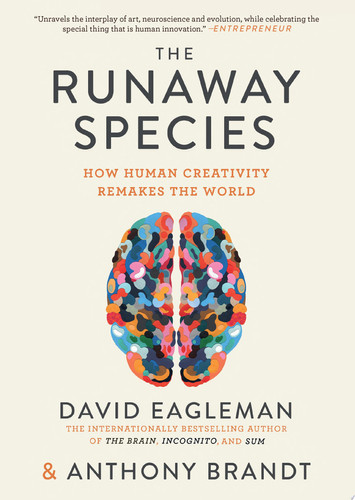
The Runaway Species How Human Creativity Remakes the World

David Eagleman,Anthony Brandt
This enlightening examination of creativity looks “at art and science together to examine how innovations . . . build on what already exists and rely on three brain operations: bending, breaking and blending” ( The Wall Street Journal ) The Runaway Species is a deep dive into the creative mind, a celebration of the human spirit, and a vision of how we can improve our future by understanding and embracing our ability to innovate. David Eagleman and Anthony Brandt seek to answer the question: what lies at the heart of humanity’s ability—and drive—to create? Our ability to remake our world is unique among all living things. But where does our creativity come from, how does it work, and how can we harness it to improve our lives, schools, businesses, and institutions? Eagleman and Brandt examine hundreds of examples of human creativity through dramatic storytelling and stunning images in this beautiful, full–color volume. By drawing out what creative acts have in common and viewing them through the lens of cutting–edge neuroscience, they uncover the essential elements of this critical human ability, and encourage a more creative future for all of us. “ The Runaway Species approach[es] creativity scientifically but sensitively, feeling its roots without pulling them out.” — The Economist
Catapult 2018-06-19 304 pages

Smithsonian intimate guide to human origins

Zimmer, Carl
New discoveries in the field of human evolution are changing our understanding of human origins almost daily. What does all this new knowledge about our species mean? Science journalist Zimmer offers an illuminating journey through our ancestry, beginning 65 million years ago with the first primates and ending today, as we enter a new phase of evolution. Along the way he re-examines the major steps in human evolution, as hominids began to stand upright, fashion tools and develop consciousness. What's most intriguing, he concludes, is that fossils are no longer the sole source of information about our origins--part of the story of where we came from turns out to be inscribed in our own DNA!--From publisher description.
Smithsonian Books 2005 176 pages

The Mind of a Mnemonist A Little Book about a Vast Memory

A R Luria
Product Description The Mind of a Mnemonist is a rare phenomenon―a scientific study that transcends its data and, in the manner of the best fictional literature, fashions a portrait of an unforgettable human being. Review A distinguished Soviet psychologist's study…[of a] young man who was discovered to have a literally limitless memory and eventually became a professional mnemonist. Experiments and interviews over the years showed that his memory was based on synesthesia (turning sounds into vivid visual imagery), that he could forget anything only by an act of will, that he solved problems in a peculiar crablike fashion that worked, and that he was handicapped intellectually because he could not make discriminations, and because every abstraction and idea immediately dissolved into an image for him. It is all fascinating and delightful. ( New Yorker) Luria's essay is a model of lucid presentation and is an altogether convincing description of a man whose whole personality and fate was conditioned by an intellectual idiosyncrasy. ( Times Literary Supplement) [A] compassionate and vivid portrait. ( Los Angeles Times Book Review) A welcome re-issue of an English translation of Alexander Luria's famous case-history of hypermnestic man. The study remains the classic paradigm of what Luria called 'romantic science,' a genre characterized by individual portraiture based on an assessment of operative psychological processes. The opening section analyses in some detail the subject's extraordinary capacity for recall and demonstrates the association between the persistence of iconic memory and a highly developed synaesthesia. The remainder of the book deals with the subject's construction of the world, his mental strengths and weaknesses, his control of behaviour and his personality. The result is a contribution to literature as well as to science. ( Psychological Medicine) About the Author A. R. Luria was Professor of Psychology at Lomonosov Moscow State University. Jerome Bruner is University Professor at New York University.
Harvard University Press 1989-12 160 pages

C. Wright Mills

Stanley Aronowitz
C.Wright Mills (1917-63) was one of the great sociologists and leading public intellectuals of the last century. His contribution to the sociology of power elites, industrial relations, bureaucracy, social structure and personality, reformist and revolutionary politics and the sociological imagination are seminal. These three volumes, edited by one of America's most influential sociologists and cultural commentators, provides an unparalleled resource for understanding the intellectual relevance of Mill's writings. Mill's engagement with contemporary issues and his sociological vision emerge powerfully. The challenge he offers to sociologists is reassessed and reaffirmed. This is a landmark collection which provides a timely and masterful critical assessment of Mills's contribution.
SAGE 2004-09-23 374 pages

Language City The Fight to Preserve Endangered Mother Tongues in New York

Ross Perlin
From the co-director of the Endangered Language Alliance, a captivating portrait of contemporary New York City through six speakers of little-known and overlooked languages, diving into the incredible history of the most linguistically diverse place ever to have existed on the planet Half of all 7,000-plus human languages may disappear over the next century and--because many have never been recorded--when they're gone, it will be forever. Ross Perlin, a linguist and co-director of the Manhattan-based non-profit Endangered Language Alliance, is racing against time to map little-known languages across the most linguistically diverse city in history: contemporary New York. In Language City , Perlin recounts the unique history of immigration that shaped the city, and follows six remarkable yet ordinary speakers of endangered languages deep into their communities to learn how they are maintaining and reviving their languages against overwhelming odds. Perlin also dives deep into their languages, taking us on a fascinating tour of unusual grammars, rare sounds, and powerful cultural histories from all around the world. Seke is spoken by 700 people from five ancestral villages in Nepal, a hundred of whom have lived in a single Brooklyn apartment building. N'ko is a radical new West African writing system now going global in Harlem and the Bronx. After centuries of colonization and displacement, Lenape, the city's original Indigenous language and the source of the name Manhattan ("the place where we get bows"), has just one fluent native speaker, bolstered by a small band of revivalists. Also profiled in the book are speakers of the Indigenous Mexican language Nahuatl, the Central Asian minority language Wakhi, and the former lingua franca of the Lower East Side, Yiddish. A century after the anti-immigration Johnson-Reed Act closed America's doors for decades and on the 400th anniversary of New York's colonial founding, Perlin raises the alarm about growing political threats and the onslaught of "killer languages" like English and Spanish. Both remarkable social history and testament to the importance of linguistic diversity, Language City is a joyful and illuminating exploration of a city and the world that made it.
Grove/Atlantic, Incorporated 2025-02-11 432 pages

The system: who rigged it, how we fix it

Reich, Robert B.
"Millions of Americans have lost confidence in our political and economic system. After years of stagnant wages, volatile job markets, and an unwillingness to deal with profound threats such as climate change, there is a mounting sense that the system is fixed, serving only those select few with enough money to secure a controlling stake. With the characteristic clarity and passion that has made him a central civil voice, Robert B. Reich shows how wealth and power have interacted to install an elite oligarchy, eviscerate the middle class, and undermine democracy. Using Jamie Dimon, the chairman and CEO of JPMorgan Chase as an example, Reich exposes how those at the top propagate myths about meritocracy, national competitiveness, corporate social responsibility, and the "free market," to distract most Americans from their accumulation of extraordinary wealth, and power over the system. Instead of answering the call to civic duty, they have chosen to uphold self-serving policies that line their own pockets and benefit their bottom line. Reich's objective is not to foster cynicism, but rather to demystify the system so that we might instill fundamental change and demand that democracy works for the majority once again"--
Alfred A. Knopf 2020-03-24 206 pages

Requiem for the American dream: the 10 principles of concentration of wealth & power

Chomsky, Noam
In his first major book on the subject of income inequality, Noam Chomsky skewers the fundamental tenets of neoliberalism and casts an eye on the economic facts of life. What are the ten principles of concentration of wealth and power at work in America today? They're simple enough: reduce democracy, shape ideology, redesign the economy, shift the burden onto the poor and middle classes, attack the solidarity of the people, let special interests run the regulators, engineer election results, use fear and the power of the state to keep the rabble in line, manufacture consent, marginalize the population. In Requiem for the American Dream, Chomsky devotes a chapter to each of these ten principles, and adds readings from some of the core texts that have influenced his thinking to bolster his argument. Chomsky and his editors, the filmmakers Peter Hutchison, Kelly Nyks, and Jared P. Scott, spent countless hours together over the course of five years, from 2011 to 2016. After the release of the film version, Chomsky and the editors returned to the many hours of tape and transcript and created a document that included three times as much text as was used in the film.
Seven Stories Press 2017 172 pages

ESSAYS OF MICHEL DE MONTAIGNE

MONTAIGNE, MICHEL DE
Essays of Michel de Montaigne, Volumes 2 and 3 Translated by Charles Cotton and edited by William Carew Hazlitt, these volumes of Michel de Montaigne's Essays delve into the human condition through a variety of thought-provoking topics. Volume 2 includes essays on subjects such as sorrow, idleness, and the nature of our affections. Volume 3 explores themes including the force of imagination, the punishment of cowardice, and the philosophical inquiry into death. Each essay offers a unique perspective on human nature, often drawing from Montaigne's personal reflections and classical sources.
Independently published 2024-06-16 115 pages

Sexual revolution: modern fascism and the feminist fightback

Penny, Laurie
'Captivating, emphatic and deeply inspiring, Sexual Revolution lifted me greatly by envisioning the possibilities of our moment' V (formerly Eve Ensler) 'Brilliant; vital; revolutionary' Kate Manne _________________ This is a story about how modern masculinity is killing the world, and how feminism can save it. It's a story about sex and power and trauma and resistance and persistence. Sex and gender are changing, and the world is changing with them. In this time of crisis, we are also witnessing a productive transformation: a revolutionary change in how we define gender, sex, consent and whose bodies matter.This sexual revolution is a threat to the social and economic order. It undermines the existing power structures and weakens the authority of institutions from the waged workplace to the nuclear family. No wonder the far right is fighting back so hard.Told with Laurie Penny's trademark urgency and candour, Sexual Revolution is a hand-grenade of a book: both a manifesto for social change and a story of how feminism can save us.
Bloomsbury Publishing 2022 297 pages

The three trillion dollar war: the true cost of the Iraq conflict

Stiglitz, Joseph E.
The true cost of the Iraq War is $3 trillion rather than the $50 billion projected by the White House. Apart from its tragic human toll, the Iraq War will be staggeringly expensive in financial terms. This sobering study by Nobel Prize winner Joseph E. Stiglitz and Harvard professor Linda J. Bilmes casts a spotlight on expense items that have been hidden from the U.S. taxpayer, including not only big-ticket items like replacing military equipment (being used up at six times the peacetime rate) but also the cost of caring for thousands of wounded veterans for the rest of their lives. Shifting to a global focus, the authors investigate the cost in lives and economic damage within Iraq and the region. Finally, with the chilling precision of an actuary, the authors measure what the U.S. taxpayer's money would have produced if instead it had been invested in the further growth of the U.S. economy. Written in language as simple as the details are disturbing, this book will forever change the way we think about the war.
W.W. Norton 2008-02-17 311 pages