1524 results for "History"

A life with history

Blum, John Morton
The author of such classic works as The Republican Roosevelt, V Was for Victory, and Years of Discord, John Morton Blum is one of a small group of intellectuals who for more than a quarter of a century dominated the writing of American political history. Writing now of his own career, Blum provides a behind-the-scenes look at Ivy League education and political power from the 1940s to the 1980s. Blum insightfully recounts a long and distinguished journey that began at Phillips Academy, where he first realized he could make a career of teaching and writing history. He tells how young men were socialized to the values of the Northeastern establishment in those years before World War II, and how as a non-practicing Jew he learned to overcome bigotry both at Andover and at Harvard, which then had no Jewish professors. In 1957 Blum joined the faculty of Yale University's history department, widely regarded as the nation's best, where he became both influential and popular and where his students included one future U.S. president as well as others who aspired to the office. He reveals much about the inner workings of Ivy League education and tells of controversies over the Vietnam War and the Black Panthers, his role in Eugene McCarthy's presidential campaign, and how he searched for common ground between reactionary faculty and radical students. More than a recounting of a singular life, Blum's story explains how political history was researched and written during the second half of the twentieth century, describing how the discipline evolved, gained ascendancy, and was challenged as historical fashions changed. It also offers revealing glimpses of such prominent academics as Kingman Brewster, Arthur Schlesinger, Jr., C. Vann Woodward, and William Sloan Coffin. Over a distinguished career, Blum witnessed considerable change in elite educational institutions, where minorities and women were grossly underrepresented when he first entered academia. In a memoir brimming with insight and laced with humor, he looks back at the academy—"not a refuge from reality but an alternative reality"—as he reflects upon his intellectual journey and his contributions to the study and writing of twentieth-century American history.
University Press of Kansas 2004 283 pages

Socialism from Below

Hal Draper
The divisions running through the history of the socialist movement between reformists and revolutionaries, authoritarians and democrats, putschists and gradualists-the divisions and disputes which have provided the categories in terms of which the history of the movement has been written-are secondary. The important distinction is between those socialists who looked for some outside authority which would hand down salvation to the grateful masses from above and those who saw the key to the reform of existing society in the struggle from below for self-emancipation. Behind the question: "What do we mean by socialism?" lies a more important question. What do we mean by democracy?
Center for Socialist History 2002 386 pages

Carrier Clash

Eric Hammel
CARRIER CLASH The Invasion of Guadalcanal & the Battle of the Eastern Solomons August 1942 Eric Hammel The Battle of the Eastern Solomons was history's third carrier clash. A collision of U.S. Navy and Imperial Navy carriers in the wake of the invasion of Guadalcanal-whose airfield the United States desperately needed and the Japanese desperately wanted back-the battle was waged at sea and over Guadalcanal's besieged Marine-held Lunga Perimeter on August 24, 1942. Based upon the first half of Eric Hammel's acclaimed 1987 battle narrative, Guadalcanal: The Carrier Battles, and in large part upon important new information obtained from both Japanese and American sources, Carrier Clash unravels many of the mysteries and misconceptions that have veiled this complex battle for more than a half century. Beginning with detailed descriptions of the history of the aircraft carrier, the development of carrier-air tactics, the training of carrier pilots, and numerous operational considerations that defined the way carrier battles had to be fought, Carrier Clash takes the reader into the air with brave U.S. Navy fighter pilots as they protect their ships and the Guadalcanal invasion fleet against determined Japanese air attacks on August 7 and 8, 1942. After he sets the stage for the August 24 Battle of the Eastern Solomons, author Hammel puts the reader right into the cockpits of U.S. Navy Dauntless dive-bombers as they dive on the Imperial Navy light carrier Ryujo-and hit the ship with 500-pound bombs! Once again, in this strange tit-for-tat battle, U.S. Navy Wildcat fighter pilots must defend their ships against an onslaught by Imperial Navy Val dive-bomber pilots determined to sink the U.S. carriers, or die trying. Hammel's coverage of the bomb damage to the USS Enterprise and subsequent fire-fighting and rescue efforts by her crew are especially compelling. Carrier Clash is the definitive combat history of the Battle of the Eastern Solomons, history's third battle (of only five) between American and Japanese aircraft carriers. Critical Acclaim for Carrier Clash: The Invasion of Guadalcanal and the Battle of the Eastern Solomons, August 1942: The Bookwatch says: Carrier Clash takes the reader into the air with brave U.S. Navy pilots . . . [It] is an important contribution to the military history of World war II's battle for control of the Pacific. The Book World says: Carrier Clash is a stark revelation of a complex encounter. Military Magazine says: Mr. Hammel presents the entire battle in a clear, easy-to-follow manner while interjecting interesting views of the [Battle of the Eastern Solomons] as seen by the participants on both sides. Military Review says: The book is loaded with great charts (maps), order of battle, and other hard to find details. Although Hammel describes the land and surface ship battles, his forte is his vivid descriptions of the aerial dogfights during the [Guadalcanal] invasion and the Battle of the Eastern Solomons. Canadian Military History says: Eric Hammel continues his tradition of exciting, well crafted books on the Pacific War with this account of the carrier battles that accompanied the American landings on Guadalcanal. . . . There is no denying that this is a cracking good read and an excellent companion to Hammel's other books on the Guadalcanal Campaign. Sea Power says: Acclaimed military historian Eric Hammel presents a landmark history of the Battle of the Eastern Solomons . . . Drawing on newly declassified information from U.S. and Japanese sources, and on numerous other archival sources, Hammel brings a fresh perspective to the outcome of the war as a whole. . . . [He] describes with precision and insight the key events in the Guadalcanal/Eastern Solomons campaigns, the strategic implications of the battle, and the impact on the overall battle plans of both adversaries.
Pacifica Military History 2009-06 394 pages

Harvest of a decade: Disraelia and other essays

Laqueur, Walter
This is a selection of essays written during the first decade of the twenty-first century, by a figure widely acknowledged as the conscience of European liberalism. In Walter Laqueur's lifetime, there have been more acutely dangerous situations, such as the coming of a world war or the seemingly unstoppable march to victory of totalitarian regimes, than in any other previous epoch. Such immediate dangers may not exist at the present time. But long-term trends are equally or even more threatening, as we now see in the ability of small groups of people, unprecedented in history, to inflict enormous damage. This is the underlying essence of Laqueur's thinking, as expressed in this new volume. As Laqueur observes, one learns from long experience that the worst does not always happen, and if it does, probably not in one's lifetime. Ideas and intellectual fashions emerging from the groves of academe, particularly in America can seem wrongheaded and often out of touch with the real world. This growing isolation causes growing bitterness, alienation, and a feeling of impotence on the part of intellectuals, which turns into greater radicalization and farfetched thinking. Laqueur fortunately does not fall into this trap. The articles and essays selected for this volume deal with a variety of topics. They do not entirely reflect Laqueur's interests, which during this period were more in the cultural field than in politics. However, politics intrude irrespective of the author's predilections. Laqueur deals with unpleasant truths in concrete geopolitical settings, but poignantly takes his stand with the men and women who strive to overcome self-censorship in the search for accurate judgment.
Transaction Publishers 2012 255 pages

Forbidden city: the golden age of Chinese nightclubs

Robbins, Trina
From the late 1930's to the early 1960's, Chinese nightclubs fourished in San Francisco's Chinatown. They were the first, and in those days the only venues for talented Asians who sang or danced professionally. Asian entertainers came from everywhere to perform in Chinatown, and they all found a home in the Chinese Nightclubs. For publicity purposes, many of the entertainers were compared to famous Caucasian stars. They were billed as "The Chinese Fred Astair and Ginger Rogers," "the Chinese Frank Sinatra", the "Chinese Sophie Tucker." They sang and danced for the GIs during the war, and Hollywood stars like Ronald Reagan and Jane Wyman came to their shows. In this book the men and women who performed in the nightclubs from 1937 to 1964, tell their stories in their own words. Forbidden city brings back to life an age of glamour and a long neglected slice of Asian-American history.
Hampton Press 2010 156 pages

The culture of forgetting: Helen Demidenko and the Holocaust

Manne, Robert
The storm of controversy over Helen Demidenko and her novel, 'The Hand that Signed the Paper,' raised huge cultural and political questions. Robert Manne, the influential historian and commentator, was a key participant in that debate. In 'The Culture of Forgetting, Manne tells the fascinating story of Demidenko's triumphal march into the honors list of Australian literature, the furious argument she provoked, and her astonishing unmasking as Helen Darville, the daughter of English immigrants. In his pursuit of the truth, Manne is driven by one inescapable question: what is the relationship between 'The Hand that Signed the Paper' and the greatest tragedy of twentieth-century Europe, the Holocaust? 'The Culture of Forgetting' is a powerful and moving book about fiction and free speech, a deeply personal response to the Demidenko puzzle, and a brilliant account of the history at the heat of the affair.
Text Pub. Co 1996 196 pages

From Dreyfus to Vichy: the remaking of French Jewry, 1906-1939

Hyman, Paula
From the close of the Dreyfus Affair to the outbreak of World War II, the French Jewish community was profoundly altered by the immigration of Eastern European Jews. Bringing with them ethnic definitions of Jewish identity and notions of political activism, the immigrants stimulated a major transformation- demographic, socio-economic, institutional, and ideological- in a French Jewish community that has practiced an ideology of assimilation since the mid-nineteenth century. This book explores this process of transformation against the backdrop of the increasingly xenophobic climate of France at the beginning of the twentieth century. It shows how the French setting shaped the meeting of native and immigrant Jews, and explores why that confrontation proved more difficult in France than in the Anglo-Saxon countries. Drawing on new archival sources, the author deals not only with the politics of native and immigrant Jews, but with their social history as well. This work adds a comparative dimension to previous studies of Jewish immigration, most of which have focused on North America, and also provides a view of France from the vantage point of one of her most significant minorities. -- Publisher description.
Columbia University Press 1979 338 pages

The Betrayal of the American Right (Large Print Edition)

Murray Rothbard
LARGE PRINT EDITION! More at LargePrintLiberty.com This remarkable piece of history will change the way you look at American politics. It shows that the corruption of American "conservatism" began long before George W. Bush ballooned the budget and asserted dictatorial rights over the country and the world. The American Right long ago slid into the abyss.Betrayal of the American Right is the full story, and the author is none other than Murray N. Rothbard, who witnessed it all first hand. He tells his own story and reveals that machinations behind the subversion of an anti-state movement into one that cheers statism of the worst sort.The book was written in the mid-1970s and is only now published for the first time. Each time a prospective publisher promised to go ahead, the deal fell through. Even so, it has been privately circulated for the 30 years since it was written - and everyone lucky enough to own a copy of the manuscript knew he had a treasure.People who have read it swear that it is the best account ever how the old right was subverted to become a propaganda branch of the state, not just recently but fifty years ago. So Rothbard's account is not only a critical historical document; it also has explosive explanatory power.
CreateSpace Independent Publishing Platform 2007 256 pages

The Jewish women prisoners of Ravensbrück: who were they?

Buber Agassi, Judith
A study based on ca. 700 personal stories of Jewish survivors of Ravensbrück, including ca. 200 testimonies held in the Yad Vashem archives; information from memoirs; and interviews conducted with survivors after the war or during 1997-2005 by Agassi and the team of scholars from Israel and Germany who worked with her, as well as with relatives of survivors who are no longer alive. The percentage of Jews among Ravensbrück prisoners was small, thus this camp was sometimes neglected by scholars of the Holocaust. Divides the history of the Ravensbrück camp (1939-45) into five periods, and presents a sociological portrait of the Jewish population in each period. Gives the distribution of the Jewish prisoners by countries of origin, reasons for arrest and incarceration, age, marital status, etc. Dwells on the prisoners in the satellite camps, the evacuation marches in the last stage of the war, and the rescue of some of the prisoners by Count Bernadotte in February-March 1945. Notes manifestations of antisemitism on the part of some non-Jewish prisoners. There was little group-wide social organization among non-political Jewish prisoners in Ravensbrück, only small group relationships. Resistance was limited to small-scale sabotage at in work places. Nonetheless, the very survival in Ravensbrück constituted a type of heroism.
Texas Tech University Press 2014 334 pages

Marines at war: 20 true heroic tales of U.S. Marines in combat, 1942-1983

Hammel, Eric M.
Marines at War 20 True, Heroic Tales of U.S. Marines in Combat 1942 - 1983 by Eric Hammel 272 pages with Maps ISBN 978-0-935553-40-6 In twenty hard-hitting, action-packed true, heroic stories, Eric Hammel chronicles the making of the modern U.S. Marine Corps from the desperate Guadalcanal landings in 1942 to the tragic bombing of the Marine headquarters in Beirut in 1983. Excerpted from all of Hammel's books on Marine Corps battles and a number of articles he wrote over the years for Leatherneck and other magazines, this collection includes stories of ground combat in the South Pacific, Korea, Vietnam, and Beirut, as well as tales of Marine aviators in action in three wars. Marines at War will prove to be inspiring to Marines, former Marines, friends of the U.S. Marine Corps, and any other reader of military history who wants to know what war looks like from the bottom up. Eric Hammel is well known to military-history readers for the way he blends riveting accounts of men at the bloody spearpoint with the big picture. His blending fact with analysis is the essence of his writing. Several of the chapters in Marines at War are rendered in the actual words of combat Marines.
Pacifica Press 1999 236 pages

Dyed in crimson: football, faith, and remaking Harvard's America

Eleff, Zev
"In 1926, Harvard athletic director Bill Bingham chose former Crimson All-American Arnold Horween as coach of the university's moribund football team. The pair instilled a fresh culture, one based on merit rather than social status, and in the virtues of honor and courage over mere winning. Yet their success challenged entrenched ideas about who belonged at Harvard and, by extension, who deserved to lay claim to the American dream. Zev Eleff tells the story of two immigrants' sons shaped by a vision of an America that rewarded any person of virtue. As a player, the Chicago-born Horween had led Harvard to its 1920 Rose Bowl victory. As a coach, he faced intractable opposition from powerful East Coast alumni because of his values and midwestern, Jewish background. Eleff traces Bingham and Horween's careers as student-athletes and their campaign to wrest control of the football program from alumni. He also looks at how Horween undermined stereotypes of Jewish masculinity and dealt with the resurgent antisemitism of the 1920s"--
University of Illinois Press 2023-02-28 284 pages

Race, class and power: Harold Wolpe and the radical critique of apartheid

Friedman, Steven
Over four decades ago, radical scholars began to suggest a new way of looking at South African society - one that blamed the economic power of those who owned property for the racial bondage of the black majority. Their work, and the debates it triggered, are mostly forgotten, but they and their critics have much to say that sheds lights on today's South African realities. Harold Wolpe was arguably the most influential theorist of this generation. His writings played a major role in a revolution in thought, and his celebrated escape from prison in the 1960s made him a symbol of alternative action. Race, Class and Power clearly and insightfully examines Wolpe's work in the political, intellectual, and social contexts in which it was developed and to which it gave form. Drawing on interviews with those who Wolpe worked with, disagreed with, and inspired, the book also maps his influence on ideas and the culture that emerged in anti-apartheid circles in the 1970s. Harold Wolpe's writings are a prism through which South African society can be viewed, and this book is an intellectual biography both of Wolpe and of South Africa's left. It also assesses and engages with the ongoing impact of Wolpe's ideas into the post-apartheid present. Moreover, it suggests how Wolpe's work can move us towards a way of thinking about and acting upon South Africa's realities differently.
University of KwaZulu-Natal Press 2015 368 pages

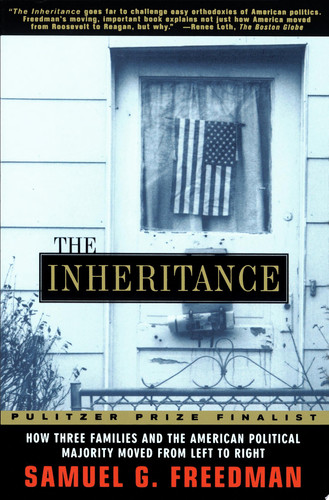
The inheritance: how three families and America moved from Roosevelt to Reagan and beyond

Freedman, Samuel G.
Orphan in the new world (Silvio Burigo) -- Liverpool on the Hudson (Lizzie Sanford Garrett) -- The dreamer and his son (Joseph Obrycki) -- The sewing room (Lizzie Garrett) -- The physics of cynicism (Joseph Obrycki) -- Worth two (Silvio Burigo) -- Voices from downstairs (Richie Garrett) -- Recessive genes (Silvio Burigo/Lorraine and Frank Trotta) -- Address as destiny (Vilma and Jack Maeby) -- Fence and basement (Silvio Burigo/Lorraine and Frank Trotta) -- Senator Clearwater (Richie Garrett) -- Uncle Paulie's Porch (Frank Trotta Jr.) -- The State Street Gang (Leslie Maeby) -- Poor snob (Tim Carey) -- Enchantment and its opposite (Frank Trotta Jr.) -- Incumbent protection (Leslie Maeby) -- Red suspenders (Tim Carey).
Simon & Schuster 1996 464 pages