3040 results for "Biography"

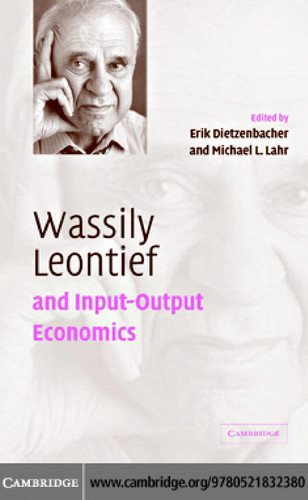
Wassily Leontief and input-output economics

Wassily Leontief,Erik Dietzenbacher,Michael L. Lahr
Wassily Leontief (1905–1999) was the founding father of input-output economics, for which he received the Nobel Prize in 1973. This book offers a collection of papers in memory of Leontief by his students and close colleagues. The first part, 'Reflections on Input-Output Economics', focuses upon Leontief as a person and scholar as well as his personal contributions to economics. It includes contributions by Nobel Laureate Paul A. Samuelson who shares his memories of a young Professor Leontief at Harvard and ends with the last joint interview with Wassily and his wife, to date previously unpublished. The second part, 'Perspectives of Input-Output Economics', includes theoretical and empirical research inspired by Leontief's work and offers a wide-ranging sample of the state of interindustry economics, a field Leontief founded. This is a strong collection likely to appeal to a wide range of professionals in universities, government, industry and international organizations.
Cambridge University Press 2004-03-25 396 pages

I thought we were making movies, not history

Mirisch, Walter
This is a moving, star-filled account of one of Hollywood’s true golden ages as told by a man in the middle of it all. Walter Mirisch’s company has produced some of the most entertaining and enduring classics in film history, including West Side Story , Some Like It Hot , In the Heat of the Night , and The Magnificent Seven . His work has led to 87 Academy Award nominations and 28 Oscars. Richly illustrated with rare photographs from his personal collection, I Thought We Were Making Movies, Not History reveals Mirisch’s own experience of Hollywood and tells the stories of the stars—emerging and established—who appeared in his films, including Natalie Wood, John Wayne, Peter Sellers, Sidney Poitier, Steve McQueen, Marilyn Monroe, and many others. With hard-won insight and gentle humor, Mirisch recounts how he witnessed the end of the studio system, the development of independent production, and the rise and fall of some of Hollywood’s most gifted (and notorious) cultural icons. A producer with a passion for creative excellence, he offers insights into his innovative filmmaking process, revealing a rare ingenuity for placating the demands of auteur directors, weak-kneed studio executives, and troubled screen sirens. From his early start as a movie theater usher to the presentation of such masterpieces as The Apartment , Fiddler on the Roof , and The Great Escape , Mirisch tells the inspiring life story of his climb to the highest echelon of the American film industry. This book assures Mirisch’s legacy—as Elmore Leonard puts it—as “one of the good guys.” Best Books for Special Interests, selected by the American Association of School Librarians, and Best Books for General Audiences, selected by the Public Library Association
University of Wisconsin Press 2008-04-10 449 pages

Generation exodus: the fate of young Jewish refugees from Nazi Germany

Laqueur, Walter
Relates the multiple ways adopted by young German Jews (born mainly between 1914-28) to escape from Nazi Germany. Their destinations included Palestine, Great Britain, the USA, South America, and China. Dwells on the routes of escape - sometimes dangerous, and on the organizational framework of the escape - sometimes part of a political underground. Some young persons managed to survive in Germany. Many Jews, both those who escaped and those who remained in Germany, joined the anti-Nazi struggle in multiple forms - from the underground in Berlin to joining up with the Red Army. Many countries of destination were reluctant to accept the refugees, in part due to antisemitism. Other possible frameworks (e.g. communists) were also not eager to help Jews. The majority of the émigrés did not return to Germany after the war.
Brandeis University Press, Published by University Press of New England 2001 345 pages

Approaching Eye Level

Gornick, Vivian
Seminal essays on loneliness, living in New York, friendship, feminism, and writing from nonfiction master Vivian Gornick Vivian Gornick's Approaching Eye Level is a brave collection of personal essays that finds a quintessentially contemporary woman (urban, single, feminist) trying to observe herself and the world without sentiment, cynicism, or nostalgia. Whether walking along the streets of New York or teaching writing at a university, Gornick is a woman exploring her need for conversation and connection—with men and women, colleagues and strangers. She recalls her stint as a waitress in the Catskills and a failed friendship with an older woman and mentor, and reconsiders her experiences in the feminist movement, while living alone, and in marriage. Turning her trademark sharp eye on herself, Gornick works to see her part in things—how she has both welcomed and avoided contact, and how these attempts at connections have enlivened and, at times, defeated her. First published in 1996, Approaching Eye Level is an unrelentingly honest collection of essays that finds Gornick at her best, reminding us that we can come to know ourselves only by engaging fully with the world.
Picador USA 2020-03-03 164 pages

Half deaf, completely mad: the chaotic genius of Australia's most legendary producer

Cohen, Tony,Olson, John (Producer-engineer)
The music and mayhem behind the seminal sounds of Nick Cave and the Bad Seeds, Models, The Go-Betweens, Hunters & Collectors, Cold Chisel, The Saints, The Cruel Sea and so many more 'The most obsessive, single-minded character I've ever seen, outside of the mirror' -Nick Cave 'I first met Nick Cave ... at Richmond Recorders in January. I appeared shoeless, red-eyed and late. As usual. The grand piano was overflowing with bits of metal, microphone stands, anything that wasn't nailed down. "That should sound interesting," I said. It was the start of a great love affair.' Maverick music producer-engineer Tony Cohen defined Australia's punk and rock sounds in the late '70s, '80s and '90s. His long and celebrated career took him from the studios of Melbourne and Sydney to West Berlin and London's Abbey Road, working with innumerable bands up until his death in 2017. In candid reflections, Tony shares details of his decades-long relationship with Nick Cave (The Boys Next Door, The Birthday Party, Nick Cave and the Bad Seeds) and provides behind-the-scenes access to recordings by Billy Thorpe and the Aztecs, Cat Stevens, Jim Keays, Lobby Loyde, The Ferrets, Split Enz, Laughing Clowns, Models, Magazine, The Reels, The Go-Betweens, Hunters & Collectors, Cold Chisel, Beasts of Bourbon, The Saints, X, Michael Hutchence, The Cruel Sea, TISM, Paul Kelly and so many more. Half Deaf, Completely Mad is a hilarious, tragic and triumphant memoir that reveals a chaotic genius who lived hard and LOUD.
Schwartz Books 2023 233 pages

Saved

Bullimore, Tony
The dramatic rescue of Tony Bullimore in January 1997 was the exhilarating climax to one of the most remarkable survival stories of modern times. When Bullimore's yacht Exide Challenger capsized in the icy vastness of the Southern Ocean, he had been at sea for two months, competing in the Vendée Globe around-the-world race. Sheltering in a tiny air pocket in the upturned hull, some 2,500 kilometers from the southwest coast of Australia, he now prepared for his loneliest challenge. Saved takes us deep into the trauma of Tony Bullimore¹s ordeal as he unfolds the events of his own past against the dramatic events that, hour by hour for nearly five days, were speeding him ever closer to his fate. Gripping and inspiring, Saved is the story of a true survivor.
Warner 1998 304 pages

Secret places: my life in New York and New Guinea

Schneebaum, Tobias
In the swamps of Asmat in West New Guinea, Tobias Schneebaum--traveler, writer, painter, explorer--finds the way of life that suits him best. Secret Places reels readers into a world of storytellers and sorcerers, cannibals and carvers, a place where Schneebaum discovers his soulmates and his own soul. Looking back at a life of wild adventure, Schneebaum seeks in Secret Places to intertwine the varied strands of his experience, pondering the parallel universes of his experience as a gay Jewish New Yorker and his years among the Asmat. The result illuminates both worlds--as when he juxtaposes the Asmat celebration of the spirits of the dead with a New York City plagued by AIDS and its own sad spirits.
University of Wisconsin Press 2000 158 pages

Crusoes in Siberia

Soros, Tivadar
If you want to know where the brothers Paul and George Soros got their business skills, look no further than this little adventure story told by their father. In simple, understated style, Tivadar Soros tells how he and his companions broke out of their Siberian prisoner-of-war camp at the time of the Russian Revolution and traveled on foot through inhospitable mountains to freedom. And this was just preparation for the equally horrendous conditions that Tivadar and his family endured in World War II. -- "As a schoolboy, I used to join my father in the swimming pool after school, and after swimming he would regale me with an installment of his adventures. In this way they became an important part of my childhood." (George Soros) -- "I and my brother consider it to be our good fortune to grow up observing how our father lived and dealt with the problems of the world." (Paul Soros)
Mondial 2010 93 pages

Theo: the autobiography of Theodore Bikel

Bikel, Theodore
An award-winning actor on screen and stage ( The Defiant Ones , The African Queen , The Sound of Music , My Fair Lady , Fiddler on the Roof ), an activist for civil rights and progressive causes worldwide, and a singer whose voice has won him great applause, Theodore Bikel here tells his own compelling life story. Born in Austria, raised in Palestine, educated in England, and with a stellar career in the United States and around the world, Bikel offers a personal history parallel to momentous events of the twentieth century. In an eloquent, fiercely committed voice, he writes of the Third Reich, the birth of the State of Israel, the McCarthy witch hunts of the 1950s, and the tumultuous 1960s in America. In a new postscript to this paperback edition, he looks at recent events in the Middle East and takes both sides to task for their excesses.
University of Wisconsin Press 2002-09-05 452 pages

With the Weathermen: the personal journal of a revolutionary woman

Stern, Susan
Drugs. Sex. Revolutionary violence. From its first pages, Susan Stern's memoir With the Weathermen provides a candid, first-hand look at the radical politics and the social and cultural environment of the New Left during the late 1960s. The Weathermen--a U.S.-based, revolutionary splinter group of Students for a Democratic Society--advocated the overthrow of the government and capitalism, and toward that end, carried out a campaign of bombings, jailbreaks, and riots throughout the United States. In With the Weathermen Stern traces her involvement with this group, and her transformation from a shy, married graduate student into a go-go dancing, street-fighting "macho mama." In vivid and emotional language, she describes the attractions and difficulties of joining a collective radical group and in maintaining a position within it. Stern's memoir offers a rich description of the raw and rough social dynamics of this community, from its strict demands to "smash monogamy," to its sometimes enforced orgies, and to the demeaning character assassination that was led by the group's top members. She provides a distinctly personal and female perspective on the destructive social functionality and frequently contradictory attitudes toward gender roles and women's rights within the New Left. Laura Browder's masterful introduction situates Stern's memoir in its historical context, examines the circumstances of its writing and publication, and describes the book's somewhat controversial reception by the public and critics alike.
Rutgers University Press 2007 387 pages