339 results for "Biography"

Legacy: one family, a cup of tea and the company that took on the world

Harding, Thomas
A panoramic new history of modern Britain, as told through the story of one extraordinary family, and one groundbreaking company. In the early 1800s, Lehmann Gluckstein and his family escaped the pogroms of Eastern Europe and made their way to Whitechapel in London's East End. There, starting with nothing, they worked tirelessly to pull themselves out of poverty, creating a small tobacco factory that grew to become the largest catering company in the world: J. Lyons. For over a century, Lyons was on every high street, in every home, in every coffee and teacup. It was an ascent from rags to riches in the face of many obstacles: poverty, hatred and anti-Semitism stood between this poor immigrant family and the British Dream. Legacy charts the rise and fall of one of the most influential dynasties in British history through the lives of five astonishing generations. Both sweeping and intimate, it is a story of sacrifice and selflessness, betrayal and personal tragedy, and Empire and its cost. It is also an illuminating new exploration of Britain and its place in the world, from the bestselling author of Hanns and Rudolf and The House by the Lake.
William Heinemann 2019 561 pages

Eat my Schwartz: our story of NFL football, food, family, and faith

Schwartz, Geoff,Schwartz, Mitch
"Geoff and Mitchell Schwartz are the NFL's most improbable pair of offensive linemen. They started their football careers late, not playing a down of organized football until they joined their low-key high school program. Despite all that, they wound up at top-tier college program and became the first Jewish brothers in the league since 1923. In Eat My Schwartz, Geoff and Mitch talk about the things that have made them the extraordinary people that they are: their close-knit and supportive family, their Jewish faith and traditions, their love of the game and drive for excellence and, last but not least, the food they love to eat, whether at home or on the road. Theirs is an inspiring story not just for every football fan but for everybody wanting to figure out what it takes for dreams to come true--and how to stay well-fed throughout the process"--
St. Martin's Press 2016-09-06 270 pages

Jacob's cane: a Jewish family's journey from the four lands of Lithuania to the ports of London and Baltimore

New, Elisa
Drawn to an image of her great-grandfather's ornately carved cane, scholar Elisa New embarked on a journey to discover the origins of her precious family heirloom. Treading back across the paths of her ancestors, she travels from Baltimore to the Baltic to London in order to find and understand an immigrant world profoundly affected by modern German culture, from the Enlightenment through the Holocaust. Deeply ambitious in its narrative sweep, Jacob's Cane captures the rich texture of life on several continents as New's family searches to establish itself in the tobacco trade. A fascinating history of one family's story of progress, innovation, and struggle, Jacob's Cane will change the way we think about the Jewish American experience.
Basic Books 2009-09-22 328 pages

Simon Wiesenthal: a biography

Pick, Hella
A biography of Wiesenthal, based partly on interviews with him and with other persons. Wiesenthal was born in Buczacz in 1908. Ch. 4 (pp. 51-72) deals with the war years. Wiesenthal was interned in prison in Lvov, taken for forced labor, interned in the Lvov ghetto, and then in the Janowska camp. In 1943 he escaped, but he was caught in June 1944 and went through a number of camps, from Płaszów to Mauthausen, where he was liberated. The rest of the book deals with his postwar activities hunting down Nazi criminals. In 1947, Wiesenthal established the Historical Documentation Centre, first in Linz and then in Vienna. Wiesenthal ascribes to himself a key role in hunting down Eichmann, Stangl, and other Nazi criminals, which has led to quarrels with other Nazi hunters. However, it was Wiesenthal who persisted in the search for Eichmann in the late 1940s-50s. He also fought against the statute of limitation in Germany and Austria. During the Waldheim affair, Wiesenthal rejected the accusation that Waldheim was a war criminal, which aroused the ire of the World Jewish Congress. Despite many oddities in Wiesenthal's character, he always has been a man of conscience and a hero of our epoch.
Weidenfeld & Nicolson 1996 349 pages

In the lion's den: the life of Oswald Rufeisen

Tec, Nechama
Few lives shed more light on the complex relationship between Jews and Christians during and after the Holocaust--or provide a more moving portrait of courage--than Oswald Rufeisen's. A Jew passing as a Christian in occupied Poland, Rufeisen worked as translator for the German police--the very people who rounded up and murdered the Jews--and repeatedly risked his life to save hundreds from the Nazis. In this gripping biography, Nechama Tec, a widely acclaimed writer on the Holocaust, recounts Rufeisen's remarkable story. A youth of seventeen when World War II began, Rufeisen joined the exodus of Poles who fled the approaching German army. Tec vividly describes how Rufeisen used his ability to speak fluent German to pass as half German and half Polish in Mir, where he came to serve as translator and personal secretary to the German in charge of the gendarmerie. As he carried out his duties--reading death sentences to prisoners, swearing in new police officers before a portrait of Hitler--he earned the trust and affection of the German commander, yet lived in constant fear of discovery. He used his position to pass secret information to Jews and Christians about impending "aktions" and to sabatoge Nazi plans. Most notably, he thwarted the annihilation of the Mir ghetto by arming hundreds of doomed Jews and organizing their escape, and saved an entire Belorussian village from destruction. Denounced, Rufeisen escaped and found shelter in a convent, where he converted to Catholicism. Though a pacifist, he spent the rest of the war fighting in a Russian partisan unit. After the war, Father Daniel (as he is now known) became a priest and a Carmelite monk. Identifying himself as a Christian Jew and an ardent Zionist, he moved to Israel, where he challenged the Law of Return in a case that reached the High Court and attracted international attention. Today he continues to devote himself to bridging the gap between Christians and Jews. In the Lion's Den offers a stirring portrait of a Jewish rescuer during the Holocaust and its aftermath, illuminating the intricate connections between good and evil, cruelty and compassion, and Judaism and Christianity.
Oxford University Press 2008 279 pages

Generation exodus: the fate of young Jewish refugees from Nazi Germany

Laqueur, Walter
Relates the multiple ways adopted by young German Jews (born mainly between 1914-28) to escape from Nazi Germany. Their destinations included Palestine, Great Britain, the USA, South America, and China. Dwells on the routes of escape - sometimes dangerous, and on the organizational framework of the escape - sometimes part of a political underground. Some young persons managed to survive in Germany. Many Jews, both those who escaped and those who remained in Germany, joined the anti-Nazi struggle in multiple forms - from the underground in Berlin to joining up with the Red Army. Many countries of destination were reluctant to accept the refugees, in part due to antisemitism. Other possible frameworks (e.g. communists) were also not eager to help Jews. The majority of the émigrés did not return to Germany after the war.
Brandeis University Press, Published by University Press of New England 2001 345 pages

Crusoes in Siberia

Soros, Tivadar
If you want to know where the brothers Paul and George Soros got their business skills, look no further than this little adventure story told by their father. In simple, understated style, Tivadar Soros tells how he and his companions broke out of their Siberian prisoner-of-war camp at the time of the Russian Revolution and traveled on foot through inhospitable mountains to freedom. And this was just preparation for the equally horrendous conditions that Tivadar and his family endured in World War II. -- "As a schoolboy, I used to join my father in the swimming pool after school, and after swimming he would regale me with an installment of his adventures. In this way they became an important part of my childhood." (George Soros) -- "I and my brother consider it to be our good fortune to grow up observing how our father lived and dealt with the problems of the world." (Paul Soros)
Mondial 2010 93 pages

Karl Marx: philosophy and revolution

Avineri, Shlomo
"Karl Marx (1818-1883)--philosopher, historian, sociologist, economist, current affairs journalist, and editor--was one of the most influential and revolutionary thinkers of modern history, but he is rarely thought of as a Jewish thinker, and his Jewish background is either overlooked or misrepresented. Here, distinguished scholar Shlomo Avineri argues that Marx's Jewish origins did leave a significant impression on his work. Marx was born in Trier, then part of Prussia, and his family had enjoyed equal rights and emancipation under earlier French control of the area. But then its annexation to Prussia deprived the Jewish population of its equal rights. These developments led to the reluctant conversion of Marx's father, and similar tribulations radicalized many young intellectuals of that time who came from a Jewish background. Avineri puts Marx's Jewish background in its proper and balanced perspective, and traces Marx's intellectual development in light of the historical, intellectual, and political contexts in which he lived."--Publisher's description.
Yale University Press 2019-08-06 217 pages

Rue Ordener, Rue Labat

Kofman, Sarah
Rue Ordener, Rue Labat is a moving memoir by the distinguished French philosopher Sarah Kofman. It opens with the horrifying moment in July 1942 when the author’s father, the rabbi of a small synagogue, was dragged by police from the family home on Rue Ordener in Paris, then transported to Auschwitz—“the place,” writes Kofman, “where no eternal rest would or could ever be granted.” It ends in the mid-1950s, when Kofman enrolled at the Sorbonne. The book is as eloquent as it is forthright. Kofman recalls her father and family in the years before the war, then turns to the terrors and confusions of her own childhood in Paris during the German occupation. Not long after her father’s disappearance, Kofman and her mother took refuge in the apartment of a Christian woman on Rue Labat, where they remained until the Liberation. This bold woman, whom Kofman called Mémé, undoubtedly saved the young girl and her mother from the death camps. But Kofman’s close attachment to Mémé also resulted in a rupture between mother and child that was never to be fully healed. This slender volume is distinguished by the author’s clear prose, the carefully recounted horrors of her childhood, and the uncommon poise that came to her only with the passage of many years.
University of Nebraska Press 1996 85 pages

Free as a Jew: a personal memoir of national self-liberation

Wisse, Ruth R.
"First came parents with the good sense to flee Europe in 1940 and the good fortune to reach the land of freedom. Their daughter, Ruth, grew up in the shadow of genocide--but in tandem with the birth of Israel, which remained her lodestar. She learned that although Jewishness is biologically transmitted, democracy is not, and both require intensive, intelligent transmission through education in each and every generation. They need adults with the confidence to teach their importance. Ruth tried to take on that challenge as dangers to freedom mounted and shifted sides on the political spectrum. At the high point of her teaching at Harvard University, she witnessed the unraveling of standards of honesty and truth until the academy she left was no longer the one she had entered."--Book flap.
Wicked Son 2021-09-21 359 pages

Selected letters of Mary Antin

Antin, Mary
Best known as an immigrant autobiographer—primarily for the much-celebrated The Promised Land (1912) and From Plotzk to Boston—Mary Antin (1881-1949) wrote regularly for the Atlantic Monthly and played an influential role in the Boston and New York Jewish literary communities. With the publication of her letters, Evelyn Salz restores her to a prominent place in American literature. Throughout her life, Antin corresponded with a wide range of people from Israel Zangwill and Theodore Roosevelt to Zionists Horace Kallen and Bernard G. Richards, as well as writer and editor Louis Lipsky, industrialist Thomas A. Watson, and Rabbi Abraham Cronbach. Impressive in its scope and elegance, this correspondence (1899-1949) follows Antin's life from a precocious adolescence through her years of fame and public involvement (after writing The Promised Land) and her slow descent into mental illness and eventual obscurity.
Syracuse University Press 2000 160 pages

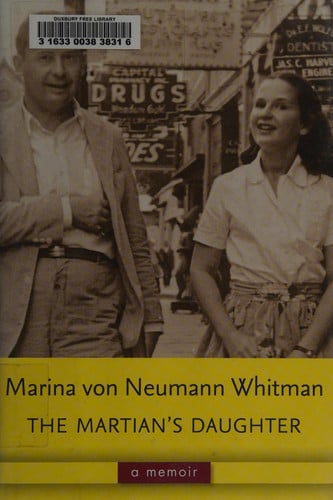
The Martian's daughter: a memoir

Whitman, Marina von Neumann
One of the five Hungarian scientific geniuses dubbed "the Martians" by their colleagues, John von Neumann is often hailed as the greatest mathematician of the twentieth century and even as the greatest scientist after Einstein. He was a key figure in the Manhattan Project; the inventor of game theory; the pioneer developer of the modern stored-program electronic computer; and an adviser to the top echelons of the American military establishment. In The Martian's Daughter , Marina von Neumann Whitman reveals intimate details about the famed scientist and explores how the cosmopolitan environment in which she was immersed, the demanding expectations of her parents, and her own struggles to emerge from the shadow of a larger-than-life parent shaped her life and work. Unfortunately, von Neumann did not live to see his daughter rise to become the first or highest-ranking woman in a variety of arenas. Whitman became a noted academic during the 1960s and '70s, casting her teaching and writing in the framework of globalization before the word had been invented; became the first woman ever to serve on the President's Council of Economic Advisers and participated actively in U.S. efforts to reshape the international monetary and financial system during the early 1970s; pioneered the role of women on the boards of leading multinational corporations; and became the highest-ranking female executive in the American auto industry in the 1980s. In her memoir, Whitman quotes from personal letters from her father and describes her interactions with such figures as Roger Smith of GM and President Nixon. She also details the difficulties she encountered as an early entrant into a world dominated by men and how she overcame the obstacles to, in her words, "have it all."
University of Michigan Press 2012-08-31 308 pages

Shanda: a memoir of shame and secrecy

Pogrebin, Letty Cottin
"In her deeply engaging, astonishingly candid memoir, author and activist Letty Cottin Pogrebin exposes the fiercely-guarded lies and intricate cover-ups woven by dozens of members of her extended family. Beginning with her own long-suppressed secret, the story spirals through the hidden lives of her parents and relatives--revealing the truth about their origins, personal traumas, marital misery, abandoned children, religious transgressions, sexual identity, radical politics, and supposedly embarrassing illnesses. While unmasking their charades and disguises, Pogrebin also showcases her family's remarkable talent for reinvention in a narrative that is, by turns, touching, searing, and surprisingly universal." --
Post Hill Press 2022 429 pages

The art of resistance: my four years in the French underground : a memoir

Rosenberg, Justus
"In 1937, as the Nazis gained control and anti-Semitism spread in the Free City of Danzig, a majority German city on the Baltic Sea, sixteen-year-old Justus Rosenberg was sent to Paris to finish his education in safety. Three years later, France fell to the Germans. Alone and in danger, penniless, and cut off from contact with his family in Poland, Justus fled south. A chance meeting led him to Varian Fry, an American journalist in Marseille helping thousands of men and women, including many artists and intellectuals--among them Hannah Arendt, Marc Chagall, Andre Breton, and Max Ernst--escape the Nazis. With his German background, understanding of French culture, and fluency in several languages, including English, Justus became an invaluable member of Fry's refugee network as a spy and scout. The spry blond who looked even younger than his age flourished in the underground, handling counterfeit documents, secret passwords, black market currency, surveying escape routes, and dealing with avaricious gangsters. But when Fry was eventually forced to leave France, Gussie, as he was affectionately known, could not get out. For the next four years, Justus relied on his wits and skills to escape captivity, survive several close calls with death, and continue his fight against the Nazis, working with the French Resistance and later, becoming attached with the United States Army. At the war's end, Justus emigrated to America, and built a new life. Justus' story is a powerful saga of bravery, daring, adventure, and survival with the soul of a spy thriller. Reflecting on his past, Justus sees his life as a confluence of circumstances. As he writes, 'I survived the war through a rare combination of good fortune, resourcefulness, optimism, and, most important, the kindness of many good people.'" -- Publisher's description.
William Collins 2020 288 pages

'My dear ones': one family and the final solution

Wittenberg, Jonathan
A family's story of human tenacity, faith and a race for survival in the face of unspeakable horror and cruelty perpetrated by the Nazi regime against the Jewish people. Growing up in the safety of Britain, Jonathan Wittenberg was deeply aware of his legacy as the child of refugees from Nazi Germany. Yet, like so many others there is much he failed to ask while those who could have answered his questions were still alive. After burying their aunt Steffi in the ancient Jewish cemetery on the Mount of Olives, Jonathan, now a rabbi, accompanies his cousin Michal as she begins to clear the flat in Jerusalem where the family have lived since fleeing Germany in the 1930s. Inside an old suitcase abandoned on the balcony they discover a linen bag containing a bundle of letters left untouched for decades. Jonathan's attention is immediately captivated as he tries to decipher the faded writing on the long-forgotten letters. They eventually draw him into a profound and challenging quest to uncover the painful details of his father's family's history. Through the wartime correspondence of his great-grandmother Regina and his grandmother, aunts and uncles, Jonathan weaves together the strands of an ancient rabbinical family with the history of Europe during the Second World War and the unfolding policies of the Nazis, telling the moving story of a family whose lives are as fragile as the paper on which they write, but whose faith in God remains steadfast.
William Collins 2016 354 pages

Inheriting Anne Frank

Maarsen, Jacqueline van
Jacqueline van Maarsen's first book My Name is Anne, She Said, Anne Frank ends in 1947, two years after the death of her close friend Anne Frank. But Anne's death did not spell the end of the friendship. Otto Frank clung desperately to his deceased daughter's dearest friend. Having remained silent about her friendship with Anne Frank for decades after the war, Jacqueline van Maarsen finally decided to tell her story, hoping to expose half-truths and fabrications surrounding her former friend and to respect Anne Frank's legacy for what it is. While her books have been written in close cooperation with the Anne Frank Foundation, there are times when she has felt obliged to disagree with the Foundation and she has not shied away from confrontation. In her second book, van Maarsen returns in detail to the most dominant person in her life, her French mother who died in 1992 at the age of 101. The aftermath of an inheritance question in France in which the author had an important role to play, takes on tragic proportions, although the hilarity of the sometimes grotesque situation surfaces now and then. Inheriting Anne Frank is the continuation of Jacqueline van Maarsen's My Name is Anne, She Said, Anne Frank, and is an important documentary contribution to our knowledge of Anne Frank and what happened to and on account of her renowned diary. It is also a stirring portrait of a woman's turbulent life in the twentieth century
Arcadia Books 2009 158 pages

The unwelcome one: returning home from Auschwitz

Frankenthal, Hans
After surviving the Nazi death camp at Auschwitz, Hans Frankenthal chose to return to live in his hometown of Schmallenberg, Germany at the age of 19. In this memoir, he describes his experiences working as a butcher in the town, a town emptied of its Jewish residences where few wanted to hear about his experiences during the war. He also describes his experiences after retirement, when he finally spoke out and became an advocate for those who had been forced to work as slave laborers for the company I.G. Farben. Translated from Verweigerte Rueckkehr (1999). Annotation (c)2003 Book News, Inc., Portland, OR (booknews.com).
Northwestern University Press 2002 169 pages