799 results for "Classics"

In Sunlight and in Shadow

Mark Helprin
A literary love story that rivals those celebrated in earlier classics. "St. Louis Post-Dispatch" In Helprin s rhapsodic rendering . . . "In Sunlight and in Shadow" is . . . the romance of life itself. " Los Angeles Times" In the summer of 1946, New York City pulses with energy. Harry Copeland, a World War II veteran, has returned home to run the family business. Yet his life is upended by a single encounter with the young singer and heiress Catherine Thomas Hale, as each falls for the other in an instant. They pursue one another in a romance played out in Broadway theaters, Long Island mansions, the offices of financiers, and the haunts of gangsters. Catherine s choice of Harry over her longtime fiance endangers Harry s livelihood and threatens his life. In the end, Harry must summon the strength of his wartime experience to fight for Catherine, and risk everything. In its storytelling heft, its moral rectitude, the solemn magnificence of its writing and the splendor of its hymns to New York City, ["In Sunlight and in Shadow"] is a spiritual pendant to Winter s Tale and every bit as extraordinary . . . Even the most stubbornly resistant readers will soon be disarmed by the nobility of the novel s sentiments and seduced by the pure music of its prose. "Wall Street Journal" [NO AUTHOR PHOTO] Mark Helprin is the acclaimed author of Winter s Tale, A Soldier of the Great War, The Pacific, Memoir from Antproof Case, Freddy and Fredericka, Ellis Island, and numerous other works. "
Mariner Books/Houghton Mifflin Harcourt 2013 705 pages

Justice without trial: law enforcement in democratic society

Skolnick, Jerome H.
Quid Pro Books presents the new Fourth Edition of JUSTICE WITHOUT TRIAL. At last in a library-quality, modern hardcover presentation, the 2015 edition features a light blue cover and adds a substantive new Foreword by Candace McCoy. [NOTE: Versions with a purple, white, or gray cover are of much earlier editions, even if this description appears on their product pages.] - This is the acclaimed and foundational study of police culture and practice, political accountability, application of and obedience to the rule of law in stops and arrests, and the dilemma of law versus order in free societies-by the renowned sociologist Jerome Skolnick using innovative and influential research techniques in law and criminology. A respected scholar in the early law and society movement, Skolnick interviewed police and criminals, rode extensively with police detectives and attended interrogations, and ultimately saw police conduct and mentality from the inside, before such methodology became popular. - Every student of law and society knows this book: now it is available again with a new Foreword by Dr. McCoy and a new Preface by the author. Fifty years after his innovative research and the first edition of this book, the continuity and change of policing and law is seen again, in all its richness and nuance. - Part of the 'Classics of Law & Society Series' from Quid Pro Books. Also available in paperback and parallel digital formats, 2011, for easy classroom adoption and diverse research options.
Quid Pro Books 2011 285 pages

Imaginary Magnitude

Stanisław Lem
These wickedly authentic introductions to twenty-first-century books preface tomes on teaching English to bacteria, using animated X-rays to create "pornograms," and analyzing computer-generated literature through the science of "bitistics." "Lem, a science fiction Bach, plays in this book a googleplex of variations on his basic themes" (New York Times Book Review). Translated by Marc E. Heine. A Helen and Kurt Wolff Book
Harcourt Brace Jovanovich 1985 264 pages

Semi-homemade cooking 2: Sandra Lee

Lee, Sandra
Fabulous family-friendly recipes for every palate and mood, created from an inspired pairing of fresh and convenience products. Recipes feature the best of Italian, Asian, and Latin American cuisine, barbecue favorites, comfort food classics, slow cooker creations, everyday dinners, and special occasion inspirations. Sandra lends her Semi-Homemade, worry-free, time-saving approach to a host of delectable appetizers, snacks, main dishes, side dishes, salads, and desserts. The on-call pantry—a foolproof list of at-the-ready convenience foods for recipe success at a moment’s notice. Tasteful tablescapes make every dining experience special. Beautiful color photo of every recipe.
Meredith Books 2005-09-20 239 pages

Battle Cry

Leon Uris
Battle Cry is the riveting Marine epic by the bestselling author of such classics as Trinity and Exodus Originally published in 1953, Leon Uris's Battle Cry is the raw and exciting story of men at war from a legendary American author. This is the story of enlisted men--Marines at the beginning of World War II. They are a rough-and-ready tangle of guys from America's cities and farms and reservations. Led by a tough veteran sergeant, these soldiers band together to emerge as part of one of the most elite fighting forces in the world. With staggering realism and detail we follow them into intense battles--Guadalcanal and Tarawa--and through exceptional moments of camaraderie and bravery, Battle Cry does not extol the glories of war, but proves itself to be one of the greatest war stories of all time.
Blackstone Publishing 2022-11-22 712 pages

Miss Lonelyhearts

NATHANAEL. WEST
Miss Lonelyhearts is Nathanael West's second novel. He began writing it early in 1930 and completed the manuscript in November of 1932. Published in 1933, it is an Expressionist black comedy set in New York City during the Great Depression. In the story, Miss Lonelyhearts is an unnamed male newspaper columnist writing an advice column for the lovelorn and lonesome, a duty that the other newspaper staff considers a joke. As Miss Lonelyhearts reads letters from desperate New Yorkers, he feels terribly burdened and falls into a cycle of deep depression, accompanied by heavy drinking and occasional bar fights. He is also the victim of the pranks and cynical advice of Shrike, his feature editor at the newspaper. Miss Lonelyhearts tries several approaches to escape the terribly painful letters he has to read: religion, trips to the countryside with his fiancée Betty, and affairs with Shrike's wife and Mrs. Doyle, a reader of his column. However, Miss Lonelyheart's efforts do not seem to ameliorate his situation. After his sexual encounter with Mrs. Doyle, he meets her husband, a poor crippled man. The Doyles invite Miss Lonelyhearts to have dinner with them. When he arrives, Mrs. Doyle tries to seduce him again, but he responds by beating her. Mrs. Doyle tells her husband that Miss Lonelyhearts tried to rape her. In the last scene, Mr. Doyle hides a gun inside a rolled newspaper and decides to take revenge on Miss Lonelyhearts. Lonelyhearts, who has just experienced a religious enlightenment after three days of sickness, runs toward Mr. Doyle to embrace him. The gun "explodes", and the two men roll down a flight of stairs together. The general tone of the novel is one of extreme disillusionment with Depression-era American society, a consistent theme throughout West's novels. However, the novel is a black comedy, characterized by a dark sense of humor and irony. Justus Neiland, among others, has pointed out the use of Bergsonian laughter, in which "the attitudes, gestures, and movements of the human body are laughable in exact proportion as that body reminds us of a machine." The novel can be read through a Marxist lens as a condemnation of alienation and the colonization of social life by commodification, foreshadowing the stance of the Situationists and Guy Debord in particular. Miss Lonelyhearts is unable to fulfill his role as advice giver in a world in which both people and advice (in the form of newspaper ads, for example) are mass-produced. People are machines for the sole purpose of laboring as far as the rest of society is concerned (thus Miss Lonelyhearts' name), and any advice for them is as mass-produced as a manual for a machine. Lonelyhearts is unable to find a personal solution to his problems because they have systemic causes. West, who worked in the newspaper business before writing Miss Lonelyhearts, is also an advice giver of a sort as a novelist. Miss Lonelyhearts is similar to a détournement because it uses a form to critique the same form. The novel also condemns itself by condemning art, which is repeatedly derided by Shrike and compared to religion as an opiate of the masses. Many of the problems described in Miss Lonelyhearts describe actual economic conditions in New York City during the Great Depression, although the novel carefully avoids questions of national politics. Moreover, the novel is particularly important due to its existential import. The characters seem to be living in an amoral world. Hence, they resort to heavy drinking, sex, and parties. Miss Lonelyhearts has a "Christ complex", which stands for his belief in religion as a solution to a world devoid of values. (wikipedia.org)
Bibliotech Press 2025-03-08 94 pages

The war of the roses

Adler, Warren
"Jonathan and Barbara Rose are the perfect couple, living the dream in their beautiful house, filled with their precious antiques, their darling children, and their prized Ferrari in the garage. It's all any red-blooded American could possibly want. But when Jonathan experiences a sudden heart attack (or so he thinks) Barbara realizes that she wants a new life, without him. There's just one problem: they both want the house. For husband and wife, it's not just a residence: it's a passion, one that will escalate an ugly divorce into a full-blown battlefield, complete with weapons and casualties. In this viciously black comedy, the Roses will each do whatever they can to destroy their better half--no matter the cost to themselves..." -- Provided by publisher.
Zando 2025-07-22 245 pages

Seize the Day

Saul Bellow
Fading charmer Tommy Wilhelm has reached his day of reckoning and is scared. In his forties, he still retains a boyish impetuousness that has brought him to the brink of chaos: He is separated from his wife and children, at odds with his vain, successful father, failed in his acting career (a Hollywood agent once cast him as the "type that loses the girl"), and in a financial mess. In the course of one climactic day he reviews his past mistakes and spiritual malaise, until a mysterious, philosophizing con man grants him a glorious, illuminating moment of truth and understanding, and offers him one last hope... Book jacket.
Viking Press 1956-11-15 118 pages

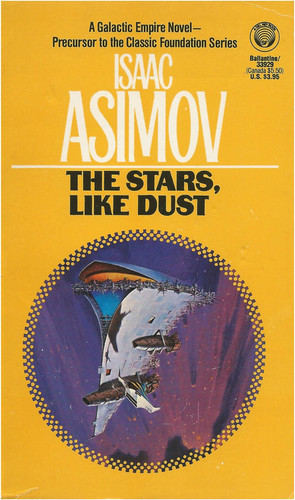
The Stars, Like Dust

Isaac Asimov
The first book in the Galactic Empire series, the spectacular precursor to the classic Foundation series, by one of history's most influential writers of science fiction, Isaac Asimov His name was Biron Farrill and he was a student at the University of Earth. A native of one of the helpless Nebular Kingdoms, he saw his home world conquered and controlled by the planet Tyrann--a ruthless, barbaric Empire that was building a dynasty of cruelty and domination among the stars. Farrill's own father had been executed for trying to resist the Tyrann dictatorship and now someone was trying to kill Biron. But why? His only hope for survival lay in fleeing Earth and joining the rebellion that was rumored to be forming somewhere in the Kingdoms. But once he cast his lot with the freedom fighters, he would find himself guarding against treachery on every side and facing the most difficult choice of all: to betray either the woman he loved or the revolution that was the last hope for the future.
Ballantine books 1986 231 pages

A Hunger Artist

Kafka, Franz
Written during Kafka's final years as he battled tuberculosis, A Hunger Artist was the last work he personally prepared for publication before his death in 1924. The story appeared first in Die Neue Rundschau before being published as part of a collection by Verlag Die Schmiede. Max Brod recounted that Kafka revised the text extensively while staying at the Kierling sanatorium near Vienna, perhaps seeing parallels between the artist's physical withering and his own condition. The story chronicles the decline of a professional faster whose art form - public starvation displays - falls out of fashion with changing times. Set against the backdrop of Europe's post-war transformation, the text captures the death of old cultural forms and the public's shifting appetites for entertainment. The hunger artist's insistence on fasting beyond forty days - the maximum his impresario allows - points to the gap between artistic purity and commercial demands. His body becomes a battlefield where artistic integrity clashes with market forces, while his cage in the circus suggests how art gets relegated to sideshows in an age of mass entertainment. The hunger artist's final confession - that he fasted simply because he could never find food he liked - strips away the spiritual and artistic pretensions surrounding his performance. This revelation transforms the story from allegory about artistic sacrifice into something more ambiguous and personally haunting. The text resonates with Kafka's own complicated relationship to food, his sense of alienation from Prague's literary culture, and his struggles with tuberculosis that made eating difficult in his final years. When circus workers clear away the hunger artist's body like so much straw, replacing him with a young panther full of vital energy, the story delivers its sharpest bite - showing how quickly culture discards what it once celebrated, how thoroughly new forms devour the old. This modern translation from the original German is a fresh, accessible and beautifully rendered text that brings to life Kafka's great literary work. This edition contains extra amplifying material including an illuminating afterword, a timeline of Kafka's life and works alongside of the historical events which shaped his art, and a short biography, to place this work in its socio-historical context.
Independently published 2025-01-20 103 pages

Near to the wild heart

Lispector, Clarice
Classics. Clarice Lispector's sensational, prize-winning debut novel Near to the Wild Heart was published when she was twenty-three and earned her the name 'Hurricane Clarice'. It tells the story of Joana, from her wild, creative childhood, as the 'little egg' who writes poems for her father, through her marriage to the faithless Ot̀vio and on to her decision to make her own way in the world. As Joana, endlessly mutable, moves through different emotional states, different inner lives and different truths, this impressionistic, dreamlike and fiercely intelligent novel asks if any of us ever really know who we are. Translated by Alison Entrekin Edited by Benjamin Moser
Penguin Classics 2014-02-06 194 pages

Stalin An Appraisal Of The Man And His Influence By Leon Trotsky

Malamuth, Charles
This work has been selected by scholars as being culturally important and is part of the knowledge base of civilization as we know it. This work is in the public domain in the United States of America, and possibly other nations. Within the United States, you may freely copy and distribute this work, as no entity (individual or corporate) has a copyright on the body of the work. Scholars believe, and we concur, that this work is important enough to be preserved, reproduced, and made generally available to the public. To ensure a quality reading experience, this work has been proofread and republished using a format that seamlessly blends the original graphical elements with text in an easy-to-read typeface. We appreciate your support of the preservation process, and thank you for being an important part of keeping this knowledge alive and relevant.
Franklin Classics 2018-10-15 532 pages

The big goodbye: Chinatown and the last years of Hollywood

Wasson, Sam
"From the New York Times bestselling author of Fifth Avenue, Five A.M. and Fosse comes the revelatory account of the making of a modern American masterpiece. Chinatown is the Holy Grail of 1970s cinema. Its twist ending is the most notorious in American film and its closing line of dialogue the most haunting. Here for the first time is the incredible true story of its making. In Sam Wasson's telling, it becomes the defining story of the most colorful characters in the most colorful period of Hollywood history. Here is Jack Nicholson at the height of his powers, as compelling a movie star as there has ever been, embarking on his great, doomed love affair with Anjelica Huston. Here is director Roman Polanski, both predator and prey, haunted by the savage death of his wife, returning to Los Angeles, the scene of the crime, where the seeds of his own self-destruction are quickly planted. Here is the fevered dealmaking of "The Kid" Robert Evans, the most consummate of producers. Here too is Robert Towne's fabled script, widely considered the greatest original screenplay ever written. Wasson for the first time peels off layers of myth to provide the true account of its creation. Looming over the story of this classic movie is the imminent eclipse of the '70s filmmaker-friendly studios as they gave way to the corporate Hollywood we know today. In telling that larger story, The Big Goodbye will take its place alongside classics like Easy Riders, Raging Bulls and The Devil's Candy as one of the great movie-world books ever written. Praise for Sam Wasson: "Wasson is a canny chronicler of old Hollywood and its outsize personalities...More than that, he understands that style matters, and, like his subjects, he has a flair for it." - The New Yorker "Sam Wasson is a fabulous social historian because he finds meaning in situations and stories that would otherwise be forgotten if he didn't sleuth them out, lovingly." - Hilton Als"--
Flatiron Books 2020-02-04 397 pages

Reagan: his life and legend

Boot, Max
"Son of the Midwest, movie star, and mesmerizing politician--America's fortieth president comes to three-dimensional life in this gripping and profoundly revisionist biography. In this "monumental and impressive" biography, Max Boot, the distinguished political columnist, illuminates the untold story of Ronald Reagan, revealing the man behind the mythology. Drawing on interviews with over one hundred of the fortieth president's aides, friends, and family members, as well as thousands of newly available documents, Boot provides "the best biography of Ronald Reagan to date" (Robert Mann). The story begins not in star-studded Hollywood but in the cradle of the Midwest, small-town Illinois, where Reagan was born in 1911 to Nelle Clyde Wilson, a devoted Disciples of Christ believer, and Jack Reagan, a struggling, alcoholic salesman. Boot vividly creates a portrait of a handsome young man, indeed a much-vaunted lifeguard, whose early successes mirrored those of Horatio Alger. And contextualizing Reagan's life against American history, Boot re-creates the world in which Reagan transitioned from local Iowa sportscaster to budding screen actor. The world of Hollywood from the 1930s to the 1950s would prove significant, not only in Reagan's coming-of-age in such classics as Knute Rockne and Kings Row but during the twilight of his film career, when he played opposite a chimpanzee in Bedtime for Bonzo, and then his eventual emergence as a television host of General Electric Theater, which established his bona fides as one of the leading conservative voices of the time. Indeed, the leap to California governor in 1966 seemed almost preordained, in which Reagan became a bellwether for a nation in the throes of a generational shift. Reagan's 1980 presidential election augured a shift that continues into this century. Boot writes not as a partisan but as a historian seeking to set the story straight. He explains how Reagan was an ideologue but also a supreme pragmatist who signed pro-abortion and gun control bills as governor, cut deals with Democrats in both Sacramento and Washington, and befriended Mikhail Gorbachev to end the Cold War. A master communicator, Reagan revived America's spirits after the traumas of Vietnam and Watergate. But Boot also shows how Reagan was armored in obliviousness. He traces Reagan's opposition to civil rights over forty years, reveals how he neglected the exploding AIDS epidemic, and details how America experienced a level of income inequality not seen since the Gilded Age. With its revelatory insights, Reagan: His Life and Legend is no apologia, depicting a man with a good-versus-evil worldview derived from his moralistic upbringing and Hollywood westerns. Providing fresh examinations of "trickle-down economics," the Cold War's end, the Iran-Contra affair, as well as a nuanced portrait of Reagan's family, this definitive biography is as compelling a presidential biography as any in recent decades."--
Liveright Publishing Corporation 2024 836 pages