
185 results for "Ecology"

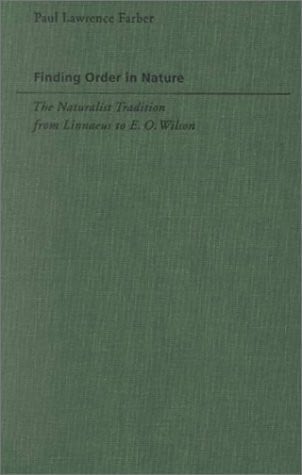
Finding order in nature: the naturalist tradition from Linnaeus to E.O. Wilson

Farber, Paul Lawrence
Since emerging as a discipline in the middle of the eighteenth century, natural history has been at the heart of the life sciences. It gave rise to the major organizing theory of life--evolution--and continues to be a vital science with impressive practical value. Central to advanced work in ecology, agriculture, medicine, and environmental science, natural history also attracts enormous popular interest. In Finding Order in Nature Paul Farber traces the development of the naturalist tradition since the Enlightenment and considers its relationship to other research areas in the life sciences. Written for the general reader and student alike, the volume explores the adventures of early naturalists, the ideas that lay behind classification systems, the development of museums and zoos, and the range of motives that led collectors to collect. Farber also explores the importance of sociocultural contexts, institutional settings, and government funding in the story of this durable discipline. "The quest for insight into the order of nature leads naturalists beyond classification to the creation of general theories that explain the living world. Those naturalists who focus on the order of nature inquire about the ecological relationships among organisms and also among organisms and their surrounding environments. They ask fundamental questions of evolution, about how change actually occurs over short and long periods of time. Many naturalists are drawn, consequently, to deeper philosophical and ethical issues: What is the extent of our ability to understand nature? And, understanding nature, will we be able to preserve it? Naturalists question the meaning of the order they discover and ponder our moral responsibility for it." -- from the Introduction
Johns Hopkins University Press 2000 136 pages

Rebels, mavericks, and heretics in biology

Oren Solomon Harman,Michael R. Dietrich
This book is the first devoted to modern biology s innovators and iconoclasts: men and women who challenged prevailing notions in their fields. Some of these scientists were Nobel Prize winners, some were considered cranks or gadflies, some were in fact wrong. The stories of these stubborn dissenters are individually fascinating. Taken together, they provide unparalleled insights into the role of dissent and controversy in science and especially the growth of biological thought over the past century. Each of the book s nineteen specially commissioned chapters offers a detailed portrait of the intellectual rebellion of a particular scientist working in a major area of biology--genetics, evolution, embryology, ecology, biochemistry, neurobiology, and virology as well as others. An introduction by the volume s editors and an epilogue by R. C. Lewontin draw connections among the case studies and illuminate the nonconforming scientist s crucial function of disturbing the comfort of those in the majority. By focusing on the dynamics and impact of dissent rather than on winners who are credited with scientific advances, the book presents a refreshingly original perspective on the history of the life sciences. Scientists featured in this volume: Alfred Russel Wallace Hans Driesch Wilhelm Johannsen Raymond Arthur Dart C. D. Darlington Richard Goldschmidt Barbara McClintock Oswald T. Avery Roger Sperry Leon Croizat Vero Copner Wynne-Edwards Peter Mitchell Howard Temin Motoo Kimura William D. Hamilton Carl Woese Stephen Jay Gould Thelma Rowell Daniel S. Simberloff "
Yale University Press 2008 400 pages

Rebels, mavericks, and heretics in biology

Oren Harman,Michael Dietrich
The stories of nineteen scientists--some famous, some forgotten--who stubbornly challenged assumptions and icons in the life sciences This book is the first devoted to modern biology's innovators and iconoclasts: men and women who challenged prevailing notions in their fields. Some of these scientists were Nobel Prize winners, some were considered cranks or gadflies, some were in fact wrong. The stories of these stubborn dissenters are individually fascinating. Taken together, they provide unparalleled insights into the role of dissent and controversy in science and especially the growth of biological thought over the past century. Each of the book's nineteen specially commissioned chapters offers a detailed portrait of the intellectual rebellion of a particular scientist working in a major area of biology--genetics, evolution, embryology, ecology, biochemistry, neurobiology, and virology as well as others. An introduction by the volume's editors and an epilogue by R. C. Lewontin draw connections among the case studies and illuminate the nonconforming scientist's crucial function of disturbing the comfort of those in the majority. By focusing on the dynamics and impact of dissent rather than on "winners" who are credited with scientific advances, the book presents a refreshingly original perspective on the history of the life sciences. Scientists featured in this volume: Alfred Russel Wallace Hans Driesch Wilhelm Johannsen Raymond Arthur Dart C. D. Darlington Richard Goldschmidt Barbara McClintock Oswald T. Avery Roger Sperry Leon Croizat Vero Copner Wynne-Edwards Peter Mitchell Howard Temin Motoo Kimura William D. Hamilton Carl Woese Stephen Jay Gould Thelma Rowell Daniel S. Simberloff
Yale University Press 2009-09 400 pages

Romantic anti-capitalism and nature: the enchanted garden

Sayre, Robert,Löwy, Michael
Romantic Anti-capitalism and Nature examines the deep connections between the romantic rebellion against modernity and ecological concern with modern threats to nature. The chapters deal with expressions of romantic culture from a wide variety of different areas: travel writing, painting, utopian vision, cultural studies, political philosophy, and activist socio-political writing. The authors discuss a highly diverse group of figures - William Bartram, Thomas Cole, William Morris, Walter Benjamin, Raymond Williams, and Naomi Klein - from the late eighteenth to the early twenty-first century. They are rooted individually in English, American, and German cultures, but share a common perspective: the romantic protest against modern bourgeois civilisation and its destruction of the natural environment. Although a rich ecocritical literature has developed since the 1990s, particularly in the United States and Britain, that addresses many aspects of ecology and its intersection with romanticism, they almost exclusively focus on literature, and define romanticism as a limited literary period of the late eighteenth and early nineteenth centuries. This study is one of the first to suggest a much broader view of the romantic relation to ecological discourse and representation, covering a range of cultural creations and viewing romanticism as a cultural critique, or protest against capitalist-industrialist modernity in the name of past, pre-modern, or pre-capitalist values. This book will be of great interest to students and scholars of ecology, romanticism, and the history of capitalism.
Earthscan from Routledge 2020 140 pages

Human ecology, human economy

Mark Diesendorf,Clive Hamilton
'A brilliant synthesis of ecology and economics that provides a sure guide to a sustainable future. It is a must for all environmentalists and economists.' Charles Birch 'Written by an impressive list of experts across a number of disciplines, this readable text provides not only analysis but vigorous criticism-and answers.' Robyn Williams 'This book is such a useful guide to responsible decision-making that it should be supplied in bulk to senior government officials and managers in the private sector.' Ian Lowe 'This is a fine contribution to ecological economics coming from Australia, and of interest worldwide.' Herman E Daly Human well-being is wholly dependent upon the continued good health of the Earth s ecosystems. Human behaviour as it interacts with the biophysical environment is enormously complex, as governments (and individuals) who must make decisions about resource use are becoming increasingly aware. Human Ecology, Human Economy provides the basic concepts and tools for understanding how to analyse that interaction. The book is designed to be used as a text for undergraduate and graduate students in environmental studies, human and social ecology, ecological economics, futures studies, and science and technology studies. It is also intended for interested members of the public and for policy-makers working on environmental issues, especially where these intersect with economic policy. Human Ecology, Human Economy not only covers the basic concepts, but also moves to some of the frontiers of thinking in several case studies. It uses a problem and solution oriented approach which crosses disciplinary boundaries, drawing together elements from biology, economics, philosophy and political science. Professor Mark Diesendorf is Director of the Institute for Sustainable Futures at the University of Technology, Sydney and Vice President of the Sustainable Energy Industries Council of Australia. Among the books he has edited are The Magic Bullet and Energy And People. Dr Clive Hamilton is Executive Director of the Australia Institute, Canberra and teaches in the Public Policy Program at the Australian National University. His books include Capitalist Industrialisation In Korea, The Mystic Economist and The Economic Dynamics Of Australian Industry.
Routledge 2021-03-31 400 pages

Dead reckoning: confronting the crisis in Pacific fisheries

Glavin, Terry
Abundant fish along North America's West Coast Coast have nurtured rich and diverse cultures for centuries. But today millions of sockeye salmon routinely seem to disappear from the Fraser River, chinook salmon populations are collapsing, the abalone fishery is one of several that has been shut down and oolichan populations are in dramatic decline. At the same time, biodiversity is being lost as the remaining stocks are concentrated into fewer populations. Will the Pacific fishery go the way of the Atlantic fishery? How can it be better managed? And what can be done to ensure its long-term sustainability? In Dead Reckoning, award-winning journalist Terry Glavin attempts to answer these troublesome questions. He begins at Byrne Creek, a local stream that shaped his boyhood world, then takes us up the Fraser River, where Coyote once assigned fishing rights and techniques, and out onto the high seas. It is later than we think - but not too late, says Glavin. In precise, highly visual and moving prose, he presents concrete alternatives for fishing communities on the West Coast and around the globe, and introduces us to some of the fishers, biologists and average citizens who are working to conserve and restore the world's great fisheries today.
David Suzuki Foundation 1996 181 pages

The way: an ecological world-view

Goldsmith, Edward
First published in 1992, The Way is Edward Goldsmith's magnum opus. In it, he proposes that the stability and integrity of humans depend on the preservation of the balance of natural systems surrounding the individual―family, community, society, ecosystem, and the ecosphere itself. Portraying life processes and ecological thinking as holistic, Goldsmith calls for a paradigm shift away from the reductionist approach of modern science. The basic belief in the whole was at the heart of the worldview of primal, earth-oriented societies, as manifested by the Tao of the ancient Chinese, the R'ta of Vedic India, the Asha of the Avestas, and the Sedaq of the tribal Hebrews. The Way was the path taken to maintain the critical order of the cosmos. Echoing the way of traditional cultures, Goldsmith presents an all-embracing, coherent worldview that promotes more harmonious and sustainable practices capable of satisfying real biological, social, ecological, and spiritual needs.
University of Georgia Press 2008-10-01 541 pages

A World of Wounds:Ecologists and the Human Dilemma: 8 (Excellence in Ecology)

Paul R Ehrlich
Recipient of the ECI Prize in 1993 for terrestrial ecology. Reviews and analyses the essential aspects of modern ecological research and its bearing on society and on related sciences. The author deplores that many ecologists are not doing enough to motivate society into counteracting the increasing degradation of our environment. Hence, he outlines and discusses what, in his opinion, research ecologists should do to avoid the world's plunge towards ecocatastrophe.
International Ecology Institute 1997-12-31 210 pages

Insect and bird interactions

Emden, Helmut F. van,Rothschild, Miriam
This unique book is the first of its kind to explore the diversity of interactions between insects and birds. A group of international experts enthusiastically agreed to contribute to the four sections of the book following the success of an Entomological Club Conference on Insect and Bird Interactions. The first section covers population management issues, discussing effects on birds highly relevant to the planting of large areas of GM crops, new opportunities for increasing biodiversity in farming landscapes, and the novel aspect of managing insects by exploiting birds as biological control agents. This is followed by a section discussing the effects of insecticides on bird populations, and includes a contribution from the RSPB, as well as a re-appraisal of the effects of DDT on raptors. Next, the foraging behaviour of birds on insects is discussed, with chapters also on ‘warning’ coloration in insects and learning by birds. The first chapter in this section is unusual in having been written by an ophthalmologist and covers colour vision in birds, more specifically ultraviolet vision in relation to insect coloration. Finally, the authors look at insects that are parasites of birds or feed on the detritus in nests, and review the ecology and evolution of the co-adaptation of insect ectoparasites with birds. Insect and Bird Interactions is unparalleled in scope and coverage and will be of interest to entomologists, ornithologists, and ecologists alike.
Intercept 2004 301 pages

Unraveling What I Learned about Life While Shearing Sheep, Dyeing Wool, and Making the World's Ugliest Sweater

Peggy Orenstein
"Orenstein is such a breezy, funny writer, it's easy to forget she's an important thinker too."--People In this lively, funny memoir, Peggy Orenstein sets out to make a sweater from scratch--shearing, spinning, dyeing wool--and in the process discovers how we find our deepest selves through craft. Orenstein spins a yarn that will appeal to everyone. The COVID pandemic propelled many people to change their lives in ways large and small. Some adopted puppies. Others stress-baked. Peggy Orenstein, a lifelong knitter, went just a little further. To keep herself engaged and cope with a series of seismic shifts in family life, she set out to make a garment from the ground up: learning to shear sheep, spin and dye yarn, then knitting herself a sweater. Orenstein hoped the project would help her process not just wool but her grief over the recent death of her mother and the decline of her dad, the impending departure of her college-bound daughter, and other thorny issues of aging as a woman in a culture that by turns ignores and disdains them. What she didn't expect was a journey into some of the major issues of our time: climate anxiety, racial justice, women's rights, the impact of technology, sustainability, and, ultimately, the meaning of home. With her wry voice, sharp intelligence, and exuberant honesty, Orenstein shares her year-long journey as daughter, wife, mother, writer, and maker--and teaches us all something about creativity and connection.
HarperCollins Publishers 2024-01-23 224 pages

Helping Young Refugees and Immigrants Succeed Public Policy, Aid, and Education

G. Holton
In a unique effort, this book brings together, for the first time, scholarly analyses by eminent researchers of the historical, social, legal, and cultural influences on the young newcomers' lives as well as reports by practitioners in major aid organizations about the concrete work that their organizations have been carrying out.
Palgrave Macmillan US 2010-10-18 316 pages

Pollution in a promised land: an environmental history of Israel

Tal, Alon
Virtually undeveloped one hundred years ago, Israel, the promised "land of milk and honey," is in ecological disarray. In this gripping book, Alon Tal provides--for the first time ever--a history of environmentalism in Israel, interviewing hundreds of experts and activists who have made it their mission to keep the country's remarkable development sustainable amid a century of political and cultural turmoil.The modern Zionist vision began as a quest to redeem a land that bore the cumulative effects of two thousand years of foreign domination and neglect. Since then, Israel has suffered from its success. A tenfold increase in population and standard of living has polluted the air. The deserts have bloomed but groundwater has become contaminated. Urban sprawl threatens to pave over much of the country's breathtaking landscape. Yet there is hope. Tal's account considers the ecological and tactical lessons that emerge from dozens of cases of environmental mishaps, from habitat loss to river reclamation. Pollution in a Promised Land argues that the priorities and strategies of Israeli environmental advocates must address issues beyond traditional green agendas.
University of California Press 2002-08-01 546 pages

Reflections on Goose Pond Stories of a Berkshire Mountain Lake

DAVID E. COHEN
Nestled high in the Berkshire Mountains of western Massachusetts, Goose Pond is surrounded by a deeply forested tranquillity that belies the many murmuring voices eager to tell its stories - stories stretching back hundreds, thousands, and yes, even millions of years. This delightful volume reveals the stories behind the abandoned paper mills, the old cabins, the founding families, the dams, the floods, the Appalachian Trail, the teaming wildlife, the Mohican arrowheads, a storied fishing club, a shoreside resort, a Presidential fishing trip, and even the geological origins of the pond's crescent shape. Writing in his engaging and witty style, the author dives deeply into the timeless legends of an Indian grave, a stone throne, a mysterious U.S. Navy operation and a sunken car. While providing readers with the spoken memories of the lake's children, some interviewed while well into their 90s, a complete written memoir, over twenty simple recipes from Goose Pond's very own cookbook, hand-drawn maps from British colonial days, restored black and white photographs rescued from dusty attic shoeboxes, and clippings discovered in the digital archives of the last century's local newspapers, this generously illustrated book tells the saga of a quintessential, mountaintop New England millpond caught up in the sweeping arc of American history.
Berkshire Mountain Books 2025-04-27 310 pages