377 results for "Educational"

The schools we need and why we don't have them

Hirsch, E. D.
From kindergarten through high school, our public educational system is among the worst in the developed world. For over fifty years, the assumption that challenging children academically is unnatural for them, that teachers do not need to know the subjects they teach, that the learning "process" should by emphasized over the facts taught has prevailed. all this is tragically wrong. As renowned educator and author E.D. Hirsch, Jr., argues in The Schools We Need, in disdaining content-based curricula for abstract - and discredited - theories of how a child learns, the ideas uniformly taught by our schools have done terrible harm to America's students. Instead of preparing our children for the highly competitive, information-based economy in which we now live, our school practices have severely curtailed their ability, and desire, to learn. There is a solution. Mainstream research has shown that if children - all children, not just the privileged - are taught in ways that emphasize hard work, the learning of facts, and rigorous testing, their enthusiasm for school will grow, their test scores will rise, and they will become successful citizens in the information-age civilization.
Doubleday 1996 317 pages

Beyond testing: seven assessments of students and schools more effective than standardized tests

Meier, Deborah,Knoester, Matthew
The authors of this timely book argue that a fundamentally complex problem--how to assess the knowledge of a child -- cannot be reduced to a simple test score. Beyond Testing describes seven forms of assessment that are more effective than standardized test results: (1) student self-assessments, (2) direct teacher observations of students and their work, (3) descriptive reviews of the child, (4) reading and math interviews with children, (5) portfolios and public defense of student work, (6) school reviews and observations by outside professionals, and (7) school boards and town meetings. These assessments are more honest about what we can and cannot know about children's knowledge, skills, and dispositions, and are more adaptable to varying educational missions. Readers can compare and contrast each approach and make informed decisions about what is most appropriate for their school. -- Provided by publisher.
Teachers College Press 2017-07-14 144 pages

Rethinking democratic education: the politics of reform

Steiner, David M.
In this timely book David Steiner argues that democratic education should equip citizens to be "the measure of all things." Questioning, criticizing, and reconstructing the language of the day, dissecting the rhetoric of politics, economy, and culture--these are the skills, Steiner contends, needed by those who will one day be the sovereign voices of our society. But this goal is not the focus of current educational reform--which aims at educating "productive citizens"--nor is it encouraged by democratic theorists in colleges and universities. A Theory of Democratic Education is the first work since John Dewey's to provide a model of education focused on the human capacity to judge and construct a well-measured life--a model in which philosophy, psychology, and pedagogy are brought together in a single, over-arching conception.
Johns Hopkins University Press 1994-08-01 253 pages

A Tribute to Teachers: Wit and Wisdom, Information and Inspiration About Those Who Change Our Lives

Lederer, Richard
Best-selling author Richard Lederer offers a chorus of praise to those who change our lives one day and one lesson at a time. Readers will meet great teachers throughout history, as well as educators captured in literature, film, and comic strips. Offering compelling proof that teachers really do make a difference in the English, math, history, and science classrooms, A Tribute to Teachers celebrates the most unheralded, exhausting, income-challenged, and ultimately rewarding of all professions.
Waterside Productions 2022-04-06 144 pages

They Who Knock at Our Gates A Complete Gospel of Immigration

Mary Antin
This work has been selected by scholars as being culturally important, and is part of the knowledge base of civilization as we know it. This work is in the "public domain in the United States of America, and possibly other nations. Within the United States, you may freely copy and distribute this work, as no entity (individual or corporate) has a copyright on the body of the work. Scholars believe, and we concur, that this work is important enough to be preserved, reproduced, and made generally available to the public. We appreciate your support of the preservation process, and thank you for being an important part of keeping this knowledge alive and relevant.
Creative Media Partners, LLC 2022-10-27 160 pages

What is intelligence? contemporary viewpoints on its nature and definition

Sternberg, Robert J.
Two dozen brief essays by the foremost experts in the field are presented in this volume. Each researcher comments on the nature of intelligence, its measurement, and the future of research in the field, bringing his or her own perspective to bear on the issues. Truly diverse viewpoints are represented: cognitive psychology, developmental psychology, psychometrics, artifical intelligence, cross-cultural psychology, educational psychology, and differential psychology. An introduction that sets an historical and philosophical context, and two essays that interrelate the contributions, complete the volume.
Ablex Pub. Corp 1986 173 pages

The Heath introduction to fiction

Clayton, John
This affordable, chronologically arranged anthology features 72 short stories carefully selected for their representation of international voices and techniques, their significance in the development of fiction, and their educational and thematic value. Selections are weighted toward the modern and contemporary, with a fair representation of earlier stories. Story groupings help instructors shape thematic units, and help students recognize thematic and technical points of comparison between readings. Multiple stories by the same author allow students to compare works and analyze the evolution of the writer's literary technique.
Houghton Mifflin 2000 879 pages

Jupiter

Isaac Asimov
Isaac Asimov's 21st Century Library of the Universe draws upon the legendary writer's wit, clarity of style, enthusiasm, and enormous command of facts about space to give youngsters the most current information about the wonders of the universe. In twelve volumes Asimov takes young astronomers on a tour of our particular place in this marvelous universe--the Solar System--proceeding step by step from the Sun at the center of it all to the distant outer orbit of Pluto. In between he covers all the interior planets, including our own Moon and the asteroid belt between Earth and Mars. Now Prometheus Books is making these enchanting and educational books available in affordable paperback editions. Jupiter, named for the king of the gods in ancient Roman myths, is the largest planet in our Solar System. This enormous world dwarfs our own Earth. In fact, nearly everything about the planet is extreme--its atmosphere, its storms, its temperatures, and its collection of moons, where you can find fiery volcanoes, icy plains, and perhaps even salty oceans. Scientists have learned much about Jupiter and its moons in recent years, thanks to the spacecrafts that have explored them. Topics include Jupiter's rings, fierce winds, swirling storms, enormous Great Red Spot, sixteen moons, and shepherd satellite, plus the Galileo mission to Jupiter. This beautifully illustrated series of astronomy books for young readers--available in paperback exclusively from Prometheus Books--by one of our all-time great science writers will educate and inspire a love of learning in the young scientists in your household.
Penguin Group (USA) Incorporated 1980-08

Howard Zinn on democratic education

Zinn, Howard
Perhaps no other historian has had a more profound and revolutionary impact on American education than Howard Zinn. This is the first book devoted to his views on education and its role in a democratic society. Howard Zinn on Democratic Education describes what is missing from school textbooks and in classrooms-and how we move beyond these deficiencies to improve student education. Critical skills of citizenship are insufficiently developed in schools, according to Zinn. Textbooks and curricula must be changed to transcend the recitation of received wisdom too common today in schools. In these respects, recent Bush Administration and educational policies of most previous US presidents have been on the wrong track in meeting educational needs. This book seeks to redefine national goals at a time when public debates over education have never been more polarised--nor higher in public visibility and contentious debate. Zinn's essays on education-many never before published--are framed in this book by a dialogue between Zinn and Donaldo Macedo, a distinguished critic of literacy and schooling, whose books with Paulo Freire, Noam Chomsky and other authors have received international acclaim.
Paradigm Publishers 2005 213 pages

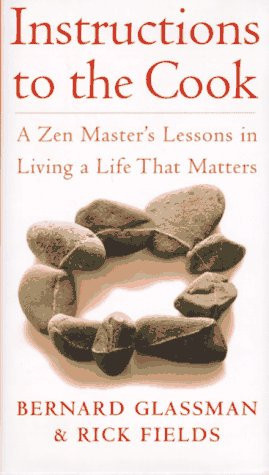
Instructions to the cook: a Zen master's lessons in living a life that matters

Glassman, Bernard
In Instructions to the Cook Glassman draws on the teaching of Dogen, the thirteenth-century founder of the Japanese Soto Zen tradition, to relate his own experiences as twentieth-century abbot-cum-entrepreneur. This book, written with Rick Fields, describes Glassman's vision and his work. It is the fruit of his long years of Buddhist practice and also of all the ways in which he has tried to improve the quality of life for those on the bottom rungs of society. The Greyston Foundation, which Glassman established in a poverty-stricken section of Yonkers, is a network of businesses and not-for-profits, including a gourmet bakery that provides training and jobs for the unemployed, three apartment buildings with social services for formerly homeless families, and a major facility for people with HIV/AIDS, which will open in 1997. With this book as our guide we can discern more clearly how to nourish both ourselves and others through integrating the economic, social, educational, and spiritual dimensions of every endeavor. According to Glassman, one of the most useful metaphors for life is what happens in the kitchen. Zen masters call a life that is lived fully and completely, with nothing held back, "the supreme meal." Some chefs keep their recipes and methods a secret, but others are willing to share their failures and successes so that the rest of us can learn how to cook our own "meals." Offering such precepts as "Use what you have," "Don't reject anything," and "Recognize your faults as your best ingredients," Brooklyn-born Glassman is forging a new, American brand of Buddhism, applying the principles of spirituality both in the community and in the marketplace, successfully practicing nonattachment while swimming with the sharks.
Bell Tower 1996 171 pages

From Babel to Dragomans: Interpreting the Middle East

Bernard Lewis
Here, the respected scholar Bernard Lewis has brought together his reflections on Middle Eastern history & foreign affairs written over six decades. The collection ranges from English originals of articles published before only in foreign languages, to previously unpublished writings to his highly regarded essays from publications such as Foreign Affairs & The New York Review of Books. With more than 50 pieces in all, prefaced by a new, personal memoir by Lewis, this volume contains a wealth of profound reflections on Middle Eastern history, culture, politics, & current events. Remarkable succinct . . . A concise study of the Muslim world s responses to the West & of its own long, sad decline. The worlds foremost Islamic scholar.
Oxford Univ. Press 2004-04-01 438 pages

With God on our side: one man's war against an evangelical coup in America's military

Weinstein, Michael L.
One of the most elite educational institutions in the world, the Air Force Academy has, from its inception, attracted the best and the brightest, producing leaders not only in the military but throughout American society. In recent years, however, the Academy has also been producing a cadre of zealous evangelical Christians intent on creating a fundamentalist power base at the highest levels of our country. With God on Our Side is shocking exposé of life inside the United States Air Force Academy and the systematic program of indoctrination sanctioned, coordinated, and carried out by fundamentalist Christians within the U.S. military. It is also the story of Michael L. Weinstein, a proud Academy graduate and the father of two graduates and a current cadet, who single-handedly brought to light the evangelicals' utter disregard of the constitutional principle of separation of church and state that is so essential to the nation's military mission. Weinstein's war would pit him and his small band of fellow graduates, cadets, and concerned citizens against a program of Christian fundamentalist indoctrination that could transform our fighting men and women into "right-thinking" warriors more befitting a theocracy. In the process, he would come face to face with religious bigotry and at its most extreme and fight an unrelenting battle to save his beloved Academy, the ideals it stood for, and the very future of the country. An important book at a critical time in our nation's history, With God on Our Side is the story of one man's courageous struggle to thwart a creeping evangelism permeating America's military and to prevent a taxpayer-funded theocracy in which only the true believers have power.
Thomas Dunne Books 2006-10-03 258 pages

The Measurement of Intelligence

Hans J. Eysenck
This book deals with one aspect of the modern, proof, and the deductions to which they give rise, and scientific study of intelligence, namely its measurement. the social aspect, which is concerned with the "good" or The term, measurement, has difficulties attached to it "evil" consequences which follow from the scientific which rival those attached to the term, intelligence; discovery or invention. Thus IQ testing would appear to many psychologists have little idea of what the word many people to give rise to desirable and "good" conse means, and what are the requirements which must be quences when it enables us to pick out bright "dis fulfilled in order to enable "measurement" to take advantaged" children for higher educational and place. Krantz, Luce, Suppes and Tversky (1971) have university training who would otherwise not have been tried to provide us with an introduction to the "Founda educated up to the level of their ability. On the other tions of Measurement"; these two volumes outline the hand, IQ testing would appear to many people to give background against which attempts to measure intelli rise to undesirable and "bad" consequences when it gence must be evaluated. * No short excerpt or set of enables trade unions to exclude coloured workers by the readings could suffice to bring home to the "innum imposition of unrealistic and irrelevant intellectual erate" reader the implications of scientific measurement, requirements for membership.
Springer Netherlands 2012-02-22 488 pages

The emancipatory promise of charter schools: toward a progressive politics of school choice

Eric Rofes,Lisa M. Stulberg
This book opens up a critical conversation among progressive educators of various generations, races, perspectives, and social locations concerning one specific school reform initiative—charter schools. Eric Rofes and Lisa M. Stulberg bring together scholars who both study and actively participate in school choice reform and charge them to be “bold in their questioning and assertive in their own ambivalence” about this complex, controversial public issue and to include issues that are underexamined in the school literature, such as the impact of school choice on race and class politics and inequalities. The editors argue that charter schools are playing a powerful role in reviving participation in public education, expanding opportunities for progressive methods in public school classrooms, and generating new energy for community-based, community-controlled school initiatives. The result is a groundbreaking volume that pushes boundaries, questions assumptions, and rocks foundations of progressive thought.
State University of New York Press 2004-10-14 314 pages

These schools belong to you and me: why we can't afford to abandon our public schools

Meier, Deborah,Gasoi, Emily
"A challenge to narrow, profit-driven conceptions of school success and an argument for protecting public education to ensure that all students become competent citizens in a vibrant democracy MacArthur award-winning educator, reformer, and author Deborah Meier draws on her fifty-plus years of experience in education to argue that the purpose of universal education is to provide young people with an "apprenticeship for citizenship in a democracy." Through an intergenerational exchange with her former colleague and fellow educator Emily Gasoi, the coauthors share their experiences working in democratically governed schools and analyze the last several decades of education reform. Reflecting on the trajectory of education and social policies that are leading our country further from rule "of, for, and by the people," the authors apply their extensive knowledge and years of research to address the question of how public education must change in order to counter the erosion of democratic spirit and practice in schools and in the nation as a whole"--
Beacon Press 2017-09-19 195 pages

Each Mind A Kingdom: American Women, Sexual Purity, And The New Thought Movement, 1875-1920

Satter, Beryl
The New Thought Movement was an enormously popular late nineteenth-century spiritual movement led largely by and for women. Mary Baker Eddy's Christian Science is but one example of the fascinating range of these groups, which advocated a belief in mind over matter and espoused women's spiritual ability to purify the world. This work is the first to uncover the cultural implications of New Thought, embedding it in the intellectual traditions of nineteenth-century America, and illuminating its connections with the self-help and New Age enthusiasms of our own fin-de-siècle. Beryl Satter examines New Thought in all its complexity, presenting along the way a captivating cast of characters. In lively and accessible prose, she introduces the people, the institutions, the texts, and the ideas that comprised the New Thought movement. This fascinating social and intellectual history explores the complex relationships among social reform, alternative religion, medicine, and psychology which persist to this day.
Diane Pub Co 2004-04 382 pages