122 results for "Environment"

U.S. trade strategy: free versus fair

Drezner, Daniel W.
U.S. trade expansion has contributed to dramatic economic growth, but it has also led to new policy challenges: a ballooning trade deficit, anxiety about foreign competition, and a potential "race to the bottom" for labor and environmental regulation. This incisive new book examines these and other challenges facing U.S. trade policy. An introduction, presented in the form of an options memorandum to the U.S. president, provides context and critical assessment of various policy options. Four white papers look in greater detail at the specific challenges facing U.S. trade negotiators. They provide a framework for exploring the menu of policy options for the Bush administration.By making the sometimes arcane issues of trade accessible without sacrificing sophistication or detail, this volume is an invaluable teaching aid, guiding students and readers through the murky waters of American foreign economic policy. The U.S. trade agenda today faces formidable challenges as well as substantial opportunities. This book offers insight into both. "Without taking sides, Drezner masterfully lays out the big trade policy choices facing a president." —Gary Clyde Hufbauer, Reginald Jones Senior Fellow, Institute for International Economics "With considerable expertise and insight, Drezner offers an enlightening overview of the decisions awaiting the United States in the making of trade policy. Above all, he explains why the United States cannot afford to turn away from trade if Americans hope to achieve a growing and lasting prosperity for all." —James Bacchus, Chairman, Global Trade Practice Group, Greenberg Traurig LLP
Council on Foreign Relations 2006 130 pages

The Peace puzzle: America's quest for Arab-Israeli peace, 1989-2011

Kurtzer, Daniel
"Having observed earlier periods of determined, persistent, creative and wise American diplomacy on the Arab-Israeli conflict, we are left to ponder whether that kind of American leadership and diplomatic wisdom can be recaptured. We also are left to wonder whether the supportive domestic environment in which previous administrations operated will recur, or whether Congressional and public support for Israel has limited administration options and thus changed the very nature of the American role in the peace process. Our overall conclusions in this volume represent a mix of process, politics, and substantive lessons learned, offered in the hope that a better understanding of the past can inform future policy."-from The Peace Puzzle Each phase of Arab-Israeli peacemaking has been inordinately difficult in its own right, and every critical juncture and decision point in the long process has been shaped by U.S. politics and the U.S. leaders of the moment. The Peace Puzzle tracks the American determination to articulate policy, develop strategy and tactics, and see through negotiations to agreements on an issue that has been of singular importance to U.S. interests for more than forty years. In 2006, the authors of The Peace Puzzle formed the Study Group on Arab-Israeli Peacemaking, a project supported by the United States Institute of Peace, to develop a set of "best practices" for American diplomacy. The Study Group conducted in-depth interviews with more than 120 policymakers, diplomats, academics, and civil society figures and developed performance assessments of the various U.S. administrations of the post-Cold War period. This book, an objective account of the role of the United States in attempting to achieve a lasting Arab-Israeli peace, is informed by the authors' access to key individuals and official archives.
Cornell University Press 2013 336 pages

All Our Relations Native Struggles for Land and Life

Winona LaDuke
Haymarket Books proudly brings back into print Winona LaDuke's seminal work of Native resistance to oppression. This thoughtful, in-depth account of Native struggles against environmental and cultural degradation features chapters on the Seminoles, the Anishinaabeg, the Innu, the Northern Cheyenne, and the Mohawks, among others. Filled with inspiring testimonies of struggles for survival, each page of this volume speaks forcefully for self-determination and community. Winona LaDuke was named by Time in 1994 as one of America's fifty most promising leaders under forty. In 1996 and 2000, LaDuke served as Ralph Nader's vice presidential running mate in the Green Party.
Haymarket Books 2016-03 256 pages

American consuls in the Holy Land, 1832-1914

Kark, Ruth
This volume provides new insights into the role of U.S. consuls in the Ottoman Middle East in the special context of the Holy Land. This volume provides new insights into the role of U.S. consuls in the Ottoman Middle East in the special context of the Holy Land. The motivations and functioning of the American consuls in Jerusalem, and of the consular agents in Jaffa and Haifa, are analyzed as part of the US diplomatic and consular activity throughout the world, and of Western involvement in the Ottoman Empire and in Palestine during the century preceding World War I. The processes of cultural, demographic, economic, environmental, and settlement change and the contribution of the US consuls and American settlers to development of and modernization of Palestine are discussed. Based on primary archival sources such facets as the role of consuls regarding the use of extraterritorial privileges, Western religious and cultural penetration, control of land and land purchase, non-Muslim settlement, judicial systems, and technological innovations are considered from American, Ottoman, and local viewpoints.
Magnes Press, Hebrew University 1994 388 pages

The law of democracy: legal structure of the political process

Issacharoff, Samuel,Karlan, Pamela S.,Pildes, Richard H.,Persily, Nathaniel
This book created the field of the law of democracy, offering a systematic account of the legal construction of American democracy. This edition represents a significant revision that reflects the embattled state of democracy in the U.S. and abroad. With the addition of Franita Tolson as well as Nathaniel Persily to the prior edition, the book now turns to a changed legal environment following the radical reconfiguration of the Voting Rights Act, the rise of social media and circumvention of the formal channels of campaign finance, and the increased fragmentation of political parties. Strikingly, in the current political environment the right to register and vote passes from being a largely historical inquiry to a source of front-burner legal challenge. This edition further streamlines the coverage of the Voting Rights Act, expands the scope of coverage of campaign finance and political corruption issues, and turns to the new dispute over voter access to the ballot. The section on election litigation and remedies has been expanded to address the expanded range of legal challenges to election results. For the first time, this book isolates the distinct problems of presidential elections, ranging from the conflict over federal and state law in Bush v. Gore, to the distinct challenges to the 2020 presidential elections, to the renewed focus on the Electoral Count Act. The basic structure of the book continues to follow the historical development of the individual right to vote; current struggles over gerrymandering; the relationship of the state to political parties; the constitutional and policy issues surrounding campaign-finance reform; and the tension between majority rule and fair representation of minorities in democratic bodies.
Foundation Press 2022 1283 pages

The militarization of Indian country

LaDuke, Winona
"When it became public that Osama bin Laden's death was announced with the phrase "Geronimo, EKIA!" many Native people, including Geronimo's descendants, were insulted to discover that the name of a Native patriot was used as a code name for a world-class terrorist. Geronimo descendant Harlyn Geronimo explained, "Obviously to equate Geronimo with Osama bin Laden is an unpardonable slander of Native America and its most famous leader." The Militarization of Indian Country illuminates the historical context of these negative stereotypes, the long political and economic relationship between the military and Native America, and the environmental and social consequences. This book addresses the impact that the U.S. military has had on Native peoples, lands, and cultures. From the use of Native names to the outright poisoning of Native peoples for testing, the U.S. military's exploitation of Indian country is unparalleled and ongoing."--Publisher's website.
Makwa Enewed 2012 92 pages

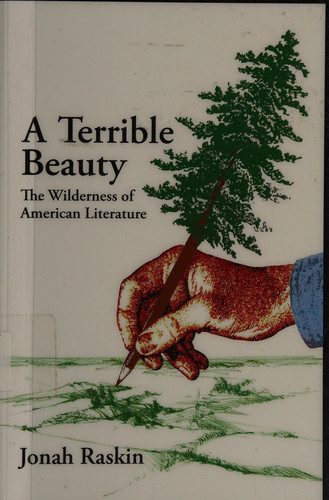
A terrible beauty: the wilderness of American literature

Raskin, Jonah
ABOUT THE BOOK Shortly before he published Walden; or Life in the Woods, Henry David Thoreau called ¿The library a wilderness of books.¿ He also noted that while Americans were ¿clearing the forest in our westward progress, we are accumulating a forest of books in our rear, as wild and unexplored as any of nature¿s primitive wildernesses.¿ In "A Terrible Beauty: the Wilderness of American Literature," Jonah Raskin takes a long close look at the forest of books that poets, novelists and essayists mapped and explored before and after Thoreau. The first work of cultural criticism to look back at writing in the United States from the perspective of the contemporary environmental crisis, Raskin offers insights for students, teachers and lovers of literature as well as for backpackers and hikers who have trekked across untrammeled forests, deserts and mountains. ABOUT THE AUTHOR Jonah Raskin, Phd, has taught American literature at Sonoma State University, the State University of New York at Stony Brook and as a Fulbright professor at the University of Antwerp and the University of Ghent in Belgium. The author of fifteen books, he earned his B.A. at Columbia College in New York, his M.A. at Columbia University and his Ph.D. at the University of Manchester, Manchester, England. He lives in northern California and has written for The San Francisco Chronicle, The L.A. Times, The Nation, The Redwood Coast Review and Catamaran.
Regent Press 2014 366 pages

Only in America: Al Jolson and The Jazz Singer

Bernstein, Richard
"Al Jolson, born Asa Yoelson, immigrated from his shtetl in Lithuania to the United States in 1894 after his father secured a job as a rabbi in Washington, D.C. A poor, Yiddish-speaking newcomer navigating a racially segregated and antisemitic America, young Jolson dreamed of becoming a star, and he did. Thanks to his immense talent and his knack for assimilating into new environments, by the time he reached his twenties he was the most famous and highly paid entertainer in America, making almost $5,000 a week at a time when the average American made $800 a year. Jolson's public adoration and widespread acceptance as a star marked the beginning of an enriching cultural transformation, a moment when the American mind opened up to ethnic and racial differences, widening the gap of acceptability. And yet Jolson himself, despite being ferociously ambitious and gigantically talented, was crippled by insecurity, often nervous to the point of collapse, prisoner to his many vices. Through Jolson, Bernstein simultaneously breaks open the history and legacy of the cultural sensation The Jazz Singer. Not only was The Jazz Singer the first feature length film with synchronized music and dialogue, but it was also taboo smashing in its content: The Jazz Singer is all about Jews, Orthodox and otherwise. Bernstein expounds on the making of The Jazz Singer, what the film meant then and now, introducing the many individuals involved in its production, including Samson Raphaelson, a young Jewish writer whose short story was the basis for the movie; the four Warner brothers who made a fortune off it; and George Jessel, Jolson's rival and the star of Raphaelson's stage adaptation of his short story. In the background emerges a picture of old Hollywood in the Roaring Twenties: cutthroat and greedy yet visionary and progressive. And while The Jazz Singer represented the future in many ways, it also dredged up the worst of the past, including Jolson's use of blackface, common at the time. At once a tale of the Judaizing of American culture and an acknowledgment of the challenges to come, Only in America is a glistening examination of a man at the center of a watershed moment in the arts"--
Schocken Books 2024 252 pages

Conversations with Grace Paley

Paley, Grace
In this collection of interviews from 1978 to 1995 Paley elaborates on the many forces that have influenced her and her writing. In these conversations she reveals not only her triple lives as writer, mother, and political activist but also her perspectives which over the years have become precise and solid. With authority, distinctness, and relentless honesty she speaks out on contemporary issues. She discusses American conditions at large, particularly those that are being neglected or denied. With firm authority Paley discusses topics of wide range, many of which she describes as personal discoveries. She includes politics and environmentalism, the family and human relationships, the impact of background and education, the moral importance of community, feminism and women's liberation, the sexual self and role enforcement, America's need for communality and women's creative response to it, the art of teaching, and the importance of friendship. Paley's conversations, like her writings, are refreshingly candid and radically different from the contemporary American mainstream.
University Press of Mississippi 1997 274 pages

The next justice: repairing the Supreme Court appointments process

Eisgruber, Christopher L.
The Supreme Court appointments process is broken, and the timing couldn't be worse--for liberals or conservatives. The Court is just one more solid conservative justice away from an ideological sea change--a hard-right turn on an array of issues that affect every American, from abortion to environmental protection. But neither those who look at this prospect with pleasure nor those who view it with horror will be able to make informed judgments about the next nominee to the Court--unless the appointments process is fixed now. In The Next Justice , Christopher Eisgruber boldly proposes a way to do just that. He describes a new and better manner of deliberating about who should serve on the Court--an approach that puts the burden on nominees to show that their judicial philosophies and politics are acceptable to senators and citizens alike. And he makes a new case for the virtue of judicial moderates. Long on partisan rancor and short on serious discussion, today's appointments process reveals little about what kind of judge a nominee might make. Eisgruber argues that the solution is to investigate how nominees would answer a basic question about the Court's role: When and why is it beneficial for judges to trump the decisions of elected officials? Through an examination of the politics and history of the Court, Eisgruber demonstrates that pursuing this question would reveal far more about nominees than do other tactics, such as investigating their views of specific precedents or the framers' intentions. Written with great clarity and energy, The Next Justice provides a welcome exit from the uninformative political theater of the current appointments process.
Princeton University Press 2009-06-07 239 pages

The Winona LaDuke reader: a collection of essential writings

LaDuke, Winona
For more than twenty years, Winona LaDuke has impressed people around the world with her oratory and debate skills and as an advocate for Native American rights, champion of women’s and children’s issues, protector of the environment, and as a leading voice of the Green Party. A charismatic and inspiring speaker and writer, LaDuke possesses a stirring passion that comes through in the 30 speeches, articles, and fiction excerpts compiled in The Winona LaDuke Reader. This is the first collection of the many political speeches and "think-pieces" that she has written for magazines such as Sierra, Smithsonian’s American Indian, and more.
Voyageur Press 2002 304 pages

Building something better: environmental crises & the promise of community change

Malin, Stephanie A.,Kallman, Meghan Elizabeth
"As the turmoil of interlinked crises unfold across the nation and world - crises ranging from climate disasters to the rise of authoritarianism to state-sponsored violence - social scientists can explain what is happening and why. Malin and Kallman offer an accessible, clear book, showing how communities are building better systems and how sociology can help us understand how and why they do this challenging work. Tackling neoliberalism head-on, these communities engage the structures that led us here and show how communities counter the structural violence of neoliberalism by building more distributive and regenerative systems. Malin and Kallman begin by analyzing the origins of these unprecedented social and environmental crises - critiquing structures from colonialism to the state to extractivism. They dig into sociology's colonial past and the consequences of it, arguing that environmental sociology still has the tools to become a more inclusive and intersectional social science. They examine the origins and staying power of neoliberal ideologies, policies, and culture - and show why they create such persistent problems. The authors then present an array of case studies, exploring how community-centered efforts expand beyond neoliberal capitalism's limitations. They show how communities craft more distributive and regenerative systems that fundamentally depart from neoliberal capitalism. These communities range from regenerative hemp farmers, to water protectors to activists fighting oil refineries and uranium mines, to celebratory street band musicians, and Indigenous-led renewable energy cooperatives. All are examples of communities creating new approaches to counter crises like inequality, climate catastrophe, and alienation. These illustrations are emergent, happening in real time and on-the-ground, and are visionary departures from business-as-usual models, showing how people can transform social inequality and environmental injustice"--
Rutgers University Press 2022-04-15 217 pages

Lessons from an American Stoic

Matousek, Mark
"This is a beautiful book, full of ideas that could help restore America’s genius for freedom and promise.” — Thomas Moore, New York Times bestselling author of Care of the Soul A lifelong Emerson lover, teacher, and spiritual seeker reveals how American philosopher Ralph Waldo Emerson’s twelve essential teachings hold the answer to living an authentic and fulfilling life, one that is in har[Bokinfo]
HarperCollins UK Publishers 2023-06-13 288 pages

The distortion of America

Handlin, Oscar
Oscar Handlin is best known as America's leading historian of ethnicity and the immigrant experience in the new nation. In 1961 he produced what was perhaps the first critique of anti-Americanism as an ideological expression of Marxism-Leninismin the schools of higher learning. In his new opening essay to this second edition, he both tells how he was able to perceive the cancer of communist ideology early, and why this new edition is needed now. The Distortion of America is a handbook on avoiding error, a methodological primer on how historians gather evidence, presume witnesses to be reliable or not, and develop forms of verification in the conduct of analysis and research. As such this work is an introduction to the study of history, as well as an examination of specific instances of ideology and mindless passion as ruinous ways to look at America. Handlin shows how social history kept his vision close to the experiences of ordinary people, whose heritage of freedom and dedication to individual liberty was the necessary antidote to academic exaggeration. Six additional chapters supplement those gathered in the earlier collection. Two written in the 1950s describe the forces that later created the economic strength of the United States, while a third treats the problem of race which long contributed to the distortions of America. An account of Yugoslavia before its collapse describes the class divisions responsible for present troubles. By contrast, no inkling of the tensions that would erupt in bloody civil war caught the attention of hundreds of journalists who crowded Sarajevo in 1984. A brief article shows the relevance to China of democracy in the United States. The final new entry is a memorable piece on how the career of Arthur Koestler exemplifies the difficulties of the ex-communist in an unsympathetic environment. These essays illustrate Handlin's working philosophy: "the study of the human past persuades me that, despite the frequent risks of failure, man has the capacity to make order an find purpose in the world in which he lives when he uses the power of his reason to do so."
Transaction Publishers 1996 232 pages

Arts for change: teaching outside the frame

Naidus, Beverly
Beverly Naidus shares her passion and strategies for teaching socially engaged art, offering, as well, a short history of the field and the candid views of more than thirty colleagues. A provocative, personal look at the motivations and challenges of teaching socially engaged arts, Arts for Change overturns conventional arts pedagogy with an activist's passion for creating art that matters. How can polarized groups work together to solve social and environmental problems? How can art be used to raise consciousness? Using candid examination of her own university teaching career as well as broader social and historical perspectives, Beverly Naidus answers these questions, guiding the reader through a progression of steps to help students observe the world around them and craft artistic responses to what they see. Interviews with over 30 arts education colleagues provide additional strategies for successfully engaging students in what, to them, is most meaningful.
New Village Press 2009-04-01 239 pages

The decomposition of sociology

Horowitz, Irving Louis
Sociology, writes Irving Louis Horowitz, has changed from a central discipline of the social sciences to an ideological outpost of political extremism. As a result, the field is in crisis. Some departments have been shut down, others cut back, research programs have dried up, and the growth of professional organizations and student enrollments have been either curbed or atrophied. In The Decomposition of Sociology, Professor Horowitz, for four decades a leading social scientist, offers a frank and full account of the maelstrom engulfing this field. Horowitz pulls no punches in this provocative volume. He charges that much contemporary sociological theory has degenerated into pure critique, strongly influenced by Marxist dogmatism. Such thinking has a strong element of anti-American and anti-Western bias, in which all questions have one answer--the evil of capitalism--and all problems one solution--the good of socialism. In criminology, for instance, he shows that high crime rates are seen as an expression of capitalist disintegration, and criminal behavior a covert expression of radical action. Indeed, in one area after another, Horowitz shows how this same formulaic thinking dominates the field, resulting in a crude reductionist view of contemporary social life. At a time when the world is moving closer to the free market and democratic norms, he concludes, such reductionist tendencies and ideological posturings are outmoded. Horowitz offers an alternative. He urges a larger vision of the social sciences, one in which universities, granting agencies and research institutes provide an environment in which research may be untainted by partisan agencies--where policy choices will not be hindered by the prevailing cultural climate. He counsels sociologists to move away from blind advocacy, to meet the challenges of the twenty-first century by incorporating the knowledge of other times and places, and to take into account the shrinking globe--in short, to develop and maintain a new set of universal standards in this era of a world culture. Here then is an eloquent plea for a revolution in sociology, written by one of the field's foremost figures. It offers as well a cautionary tale about the potentially devastating effect of ideology on scholarly pursuits.
Oxford University Press 1993 282 pages

American Jewry's challenge: conversations confronting the twenty-first century

Manfred Gerstenfeld
Watershed events - including the second Palestinian uprising in 2000, September 11 2001 and the Iraq war - have created major challenges for American Jewry, leading to changes in its perceptions and environment. Through conversations with some of America's most influential Jewish leaders, Manfred Gerstenfeld sheds light on the how the tumultuous events of recent years have affected and will continue to influence the American Jewish population. These include issues surrounding education, assimilation and revitalization, relationships with other religious communities, anti-Semitism and generational change. Of enormous historical value, American Jewry's Challenge serves as a time capsule capturing American Jewry at the dawn of the 21st century.
Rowman & Littlefield 2005-01-26 305 pages