350 results for "Literature"

Yummy yoga: playful poses and tasty treats

Bauer, Joy
A wildly imaginative introduction to yoga and nutrition by bestselling author, professional nutritionist, and beloved TV personality Joy Bauer Written by beloved health expert Joy Bauer, Yummy Yoga is a fun and fresh introduction to yoga and nutrition. Playful photographs feature a diverse group of kids demonstrating yoga poses. On the opposite sides of the spreads, imaginatively sculpted fruits and vegetables mirror the same poses! Lift the gatefold flaps to find simple, child-friendly recipes incorporating all of the healthy ingredients featured in each photo.
Abrams Books for Young Readers 2019-10-08 24 pages

100 years: wisdom from famous writers on every year of your life

Prager, Joshua
An extraordinary literary journey, 100 Years celebrates every age from birth to 100 with quotations from the world’s greatest writers. This literary tapestry of the human experience will delight readers of all backgrounds. Moving year by year through the words of our most beloved authors, the great sequence of life reveals itself—the wonders and confinements of childhood, the emancipations and frustrations of adolescence, the empowerments and millstones of adulthood, the recognitions and resignations of old age. This trove of wisdom—featuring immortal passages from Arthur Rimbaud, Sylvia Plath, Virginia Woolf, David Foster Wallace, William Shakespeare, Herman Melville, Jane Austen, and Maya Angelou, among many others—reminds us that the patterns of life transcend continents, cultures, and generations. As Thomas Mann wrote of our most shared human experience: "It will happen to me as to them." Designed by the legendary Milton Glaser, who created the I ♥ NY logo, 100 Years brings together color, type, and text to illuminate the ebb and flow of an entire life.
W.W. Norton & Company 2016-05-10 208 pages

The ballerina of Auschwitz

Eger, Edith Eva,Schwall, Esmé
"Edie is a talented dancer and skilled gymnast with hopes of making the Olympics. Between her rigorous training and her struggle to find her place in a family where she's considered the daughter "with brains but no looks," Edie's too busy to dwell on the state of the world. But life in Hungary in 1943 is dangerous for a Jewish girl. Just as Edie falls in love for the first time, Europe collapses into war, and Edie's family is forced onto a train bound for the Auschwitz concentration camp. Even in that darkest of moments, Edie's beloved, Eric, kindles hope. "I'll never forget your eyes," he tells her through the slats of the cattle car. Auschwitz is horrifying beyond belief, yet through starvation and unthinkable terrors, dreams of Eric sustain Edie. Against all odds, Edie and her sister Magda survive, thanks to their sisterhood and sheer grit. In this young adult edition of her bestselling, award-winning memoir The Choice, renowned psychologist and Holocaust survivor Dr. Edith Eger gives readers a gift of hope and strength"--
Atheneum Books for Young Readers 2024-10 182 pages

Who has what? all about girls' bodies and boys' bodies

Harris, Robie H.
This series for young children provides easy-to-understand facts and answers. Launching the series is Who Has What?, a simple story following Nellie and Gus on a family outing to the beach. Humorous illustrations, conversations between the siblings, and a clear text all reassure young kids that whether they have a girl's body or a boy's, their bodies are perfectly normal, healthy, and wonderful.
Candlewick Press 2011-09-13 34 pages

Freedom and the arts: essays on music and literature

Rosen, Charles
"Is there a moment in history when a work receives its ideal interpretation? Or is negotiation always required to preserve the past and accommodate the present? The freedom of interpretation, Charles Rosen suggests in these sparkling explorations of music and literature, exists in a delicate balance with fidelity to the identity of the original work. Rosen cautions us to avoid doctrinaire extremes when approaching art of the past. To understand Shakespeare only as an Elizabethan or Jacobean theatergoer would understand him, or to modernize his plays with no sense of what they bring from his age, deforms the work, making it less ambiguous and inherently less interesting. For a work to remain alive, it must change character over time while preserving a valid witness to its earliest state.
Harvard University Press 2012 438 pages

Fallout: spies, superbombs, and the ultimate Cold War showdown

Sheinkin, Steve
"As World War II comes to a close, the United States and the Soviet Union emerge as the two greatest world powers on extreme opposites of the political spectrum. After the United States showed its hand with the atomic bomb in Hiroshima, the Soviets refuse to be left behind. With communism sweeping the globe, the two nations begin a neck-and-neck competition to build even more destructive bombs and conquer the Space Race. In their battle for dominance, spy planes fly above, armed submarines swim deep below, and undercover agents meet in the dead of night. The Cold War game grows more precarious as weapons are pointed towards each other, with fingers literally on the trigger. The decades-long showdown culminates in the Cuban Missile Crisis, the world's close call with the third-and final-world war"--
Roaring Brook Press 2021-09-07 342 pages

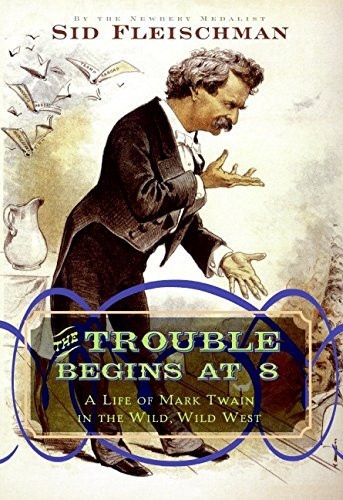
The trouble begins at 8: a life of Mark Twain in the wild, wild West

Fleischman, Sid
"Mark Twain was born fully grown, with a cheap cigar clamped between his teeth." So begins Sid Fleischman's ramble-scramble biography of the great American author and wit, who started life in a Missouri village as a barefoot boy named Samuel Clemens. Abandoning a career as a young steamboat pilot on the Mississippi River, Sam took a bumpy stagecoach to the Far West. In the gold and silver fields, he expected to get rich quick. Instead, he got poor fast, digging in the wrong places. His stint as a sagebrush newspaperman led to a duel with pistols. Had he not survived, the world would never have heard of Tom Sawyer or Huckleberry Finn—or red-headed Mark Twain. Samuel Clemens adopted his pen name in a hotel room in San Francisco and promptly made a jumping frog (and himself) famous. His celebrated novels followed at a leisurely pace; his quips at jet speed. "Don't let schooling interfere with your education," he wrote. Here, in high style, is the story of a wisecracking adventurer who came of age in the untamed West; an ink-stained rebel who surprised himself by becoming the most famous American of his time. Bountifully illustrated.
Greenwillow Books 2008 224 pages

Who we are! all about being the same and being different

Harris, Robie H.
Join Nellie, Gus, baby Jake, and their parents at Funland as they go on rides, watch performers, and play games along with many other children and grown-ups. As they enjoy their excursion, they notice that people are the same as one another in lots of ways, and different in lots of ways too. Helps children realize why it's important to treat others the way they want to be treated whether a person is a lot like you or different from you, a good friend or someone you have just met or seen for the first time.
Candlewick Press 2016

Fascinating: the life of Leonard Nimoy

Michelson, Richard
Once there was a boy named Leonard who loved to sing and to act. His parents were immigrants who felt like aliens in America, and certainly didn't understand Leonard's drive to perform. "Learn to play the accordion," his father told him. "Actors starve, but at least musicians can eke out a living." But Leonard reached for the stars... and caught them. He moved to Hollywood, where he took acting lessons, and drove a taxi and took every role he could get. He worked hard, learned his lines, showed up on time, and studied his craft. Until one day he was offered the role of an alien science officer on a new TV show called Star Trek. Leonard knew what it felt like to be an alien. But did he want the role?
Alfred A. Knopf 2016-09-06 40 pages