549 results for "Public Policy"

Occupy

Chomsky, Noam
PRAISE FOR NOAM CHOMSKY'S OCCUPY AND ZUCCOTTI PARK PRESS: "Having spent so much time thinking about and engaging with social movements, Chomsky is both optimistic about the energy of Occupy and realistic about the challenges it faces. He appreciates the "just do it" ethos and embraces its radical approach to participatory democracy...What makes Chomsky's perspective so interesting, aside from the wealth of his political experience, is the range of his interests. He draws from examples around the world to demonstrate his points. ...It's a big agenda that Occupy has identified, nothing less than a complete renewal of U.S. society and the U.S. role in the world. Chomsky sees not only the radical agenda but also the radical practice of the Occupiers. "Part of what functioning, free communities like the Occupy communities can be working for and spreading to others is just a different way of living, which is not based on maximizing consumer goods, but on maximizing values that are important for life," he concludes in this valuable set of remarks and interviews." --John Feffer, Foreign Policy in Focus, Pick Review "For decades, Chomsky has been marginalized for his insightful, levelheaded, and accurate observations about how our society functions. In Occupy , Chomsky... sets the record straight. And he's got an answer for everything. "It's necessary," Chomsky warns, "to get out into the country and get people to understand what this is about, and what they can do about it, and what the consequences are of not doing anything about it." Occupy begins with a powerful editor's note from Greg Ruggiero, who comments on 'the heartlessness and inhumanity of the system, ' where 'people's stolen homes are sold off to the highest bidder.' And if it isn't obvious to those who are still asking what the demands of Occupy Wall Street are, Ruggiero puts it plainly: 'Occupy embodies a vision of democracy that is fundamentally antagonistic to the management of society as a corporate-controlled space that funds a political system to serve the wealthy, ignore the poor.' One can only cringe at the thought of what will happen if we continue to ignore the wisdom of Noam Chomsky. He gives a clue in Occupy ...." --The Coffin Factory, The Magazine for People who Love Books Occupy is another vital contribution from Chomsky to the literature of defiance and protest, and a red-hot rallying call to forge a better, more egalitarian future. --Alternet Chomsky advocates intelligent activism by those who see the divorce between public policy and public opinion. He is both optimistic and realistic towards this "first major public response to 30 years of class war." --IRISH TIMES, PICK REVIEW " Occupy , is at once a vivid portrait of the now-global movement and a practical guide to intelligent activism, infused with Chomsky's signature meditations on everything from how the wealthiest 1% came to steer society to what a healthy democracy would look like to how we can separate money from politics. Alongside Chomsky's words are some of the most moving and provocative photographs from the Occupy movement. ... [One of] 10 essential books on protest." --Maria Popova, Brain Pickings In Occupy , Chomsky discusses the cornerstone issues, questions and demands that have been driving ordinary Americans to critique the influence of the 1%. The book begins and ends with Chomsky celebrating the life and work of his longtime friend and colleague, Howard Zinn, author of A People's History of the United States. As a call to action, Chomsky encourages people to continue organizing, to continue struggling, and to continue defending citizenship and community-driven democracy from predation from the relentless encroachments of wealth and corporate power.
Zuccotti Park Press 2012 125 pages

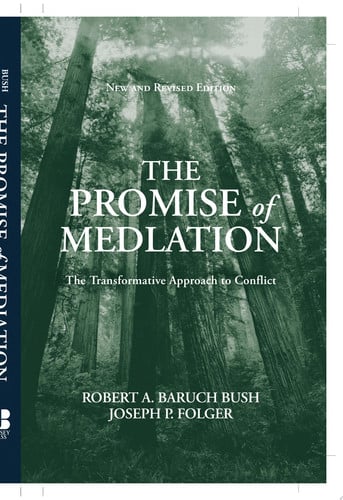
The promise of mediation: the transformative approach to conflict

Bush, Robert A. Baruch
The award-winning first edition of The Promise of Mediation, published ten years ago, is a landmark classic that changed the field's understanding of the theory and practice of conflict intervention. That volume first articulated the "transformative model" of mediation, which greatly humanized the vision of how the mediation process could help parties in conflict. In the past decade, the transformative model has proved itself and gained increasing acceptance. It is now being used in such diverse arenas as workplace, community, family, organizational, and public policy conflicts, among others. In this new edition, the authors draw on a decade of work in theory development, training, practice, research, and assessment to present a thoroughly revised and updated account of the transformative model of mediation and its practical application, including a compelling description of how the field has moved toward increasing acceptance of the transformative modela new and clearer presentation of the theory and practices of transformative mediation, with many concrete examplesa new case study that provides a vivid picture of the model in practice, with a commentary full of new information about how to use it effectively clarifications of common misconceptions about the model a vision for the future that shows how the model can coexist with other approaches and where the "market" for transformative mediation is emerging. This volume is a foundational resource on transformative practice, for both readers of the first edition and new readers - including mediators, facilitators, lawyers, administrators, human resource professionals, policymakers, and conflict resolution researchers and educators. More generally, this book will strike a chord with anyone interested in humanizing our social institutions and building on a relational vision of society.
Jossey-Bass 2005 287 pages

Class and schools: using social, economic, and educational reform to close the Black-white achievement gap

Rothstein, Richard
Contemporary public policy assumes that the achievement gap between black and white students could be closed if only schools would do a better job. In this book, the author points the way toward social and economic reforms that would give all children a more equal chance to succeed in school.
Teachers college press 2004-10-07 210 pages

Twenty minutes in Manhattan

Sorkin, Michael
""This is the most brilliant epitome of Manhattan ever written." --Mike Davis Every morning, the architect and writer Michael Sorkin walks from his apartment in Greenwich Village to his office in Tribeca. Unlike most commuters, Sorkin isn't in a hurry, and he doesn't try to drown out his surroundings. Instead, he's always paying attention. As he descends the narrow stairs of his town house, Sorkin explains why New York doesn't have the grand stairwells so common in European apartment buildings. Stepping out onto his block, he imagines a better, more efficient, far less dirty way to dispose of garbage. As he crosses Canal Street, he remembers the mad proposals for tunnels, elevated highways, and mega-structures that threatened lower Manhattan and could have destroyed its urban fabric. Fifty years after Jane Jacobs's groundbreaking The Death and Life of Great American Cities, Sorkin's vision of city life is every bit as perceptive and fine-grained as that of Jacobs's classic. With important insights into history, architecture, and public policy, Twenty Minutes in Manhattan is an extraordinary, deeply personal look at a city undergoing--always undergoing--dramatic transformations"--
North Point Press 2013-03-12 258 pages

Big is beautiful: debunking the myth of small business

Atkinson, Robert,Lind, Michael
"In public discourse in the United States, small businesses are lauded as drivers of the economy and keys to economic growth, while "big business" is often vilified. Even in the face of evidence that larger firms are proven to be more likely to stimulate economic growth, American public policy favors small businesses through measures such as lowering taxes or regulatory requirements for firms under a certain number of employees. The authors trace the anti-big business sentiment back to its roots in the early founding of our nation. While the Jeffersonian ideal of every citizen being self-employed made sense for a pre-industrial agrarian society, changes in technology have led to significant economies of scale for big businesses. Now, we see that countries with more self-employed workers are also more likely to be in poverty (think of emerging economies where everyone is an entrepreneur, and compare it to the compensation and benefits packages available to employees of large firms in more advanced economies). Rather than simply taking the opposite view that "bigger is better," the authors argue that a modern capitalist society has room for businesses of all sizes and that we should not be privileging one type of business over another due to size alone, especially when our perception of who creates jobs and grows the economy does not track with reality"--
MIT Press 2018-03-30 352 pages

Climate shock: the economic consequences of a hotter planet

Wagner, Gernot,Weitzman, Martin L.
If you had a 10 percent chance of having a fatal car accident, you'd take necessary precautions. If your finances had a 10 percent chance of suffering a severe loss, you'd reevaluate your assets. So if we know the world is warming and there's a 10 percent chance this might eventually lead to a catastrophe beyond anything we could imagine, why aren't we doing more about climate change right now? We insure our lives against an uncertain future--why not our planet? In Climate Shock, Gernot Wagner and Martin Weitzman explore in lively, clear terms the likely repercussions of a hotter planet, drawing on and expanding from work previously unavailable to general audiences. They show that the longer we wait to act, the more likely an extreme event will happen. A city might go underwater. A rogue nation might shoot particles into the Earth's atmosphere, geoengineering cooler temperatures. Zeroing in on the unknown extreme risks that may yet dwarf all else, the authors look at how economic forces that make sensible climate policies difficult to enact, make radical would-be fixes like geoengineering all the more probable. What we know about climate change is alarming enough. What we don't know about the extreme risks could be far more dangerous. Wagner and Weitzman help readers understand that we need to think about climate change in the same way that we think about insurance--as a risk management problem, only here on a global scale. With a new preface addressing recent developments Wagner and Weitzman demonstrate that climate change can and should be dealt with--and what could happen if we don't do so--tackling the defining environmental and public policy issue of our time.
Princeton University Press 2016 250 pages

Billionaires and stealth politics

Page, Benjamin I.,Seawright, Jason,Lacombe, Matthew J.
In 2016, when millions of Americans voted for Donald Trump, many believed his claims that personal wealth would free him from wealthy donors and allow him to “drain the swamp.” But then Trump appointed several billionaires and multimillionaires to high-level positions and pursued billionaire-friendly policies, such as cutting corporate income taxes. Why the change from his fiery campaign rhetoric and promises to the working class? This should not be surprising, argue Benjamin I. Page, Jason Seawright, and Matthew J. Lacombe: As the gap between the wealthiest and the rest of us has widened, the few who hold one billion dollars or more in net worth have begun to play a more and more active part in politics—with serious consequences for democracy in the United States. Page, Seawright, and Lacombe argue that while political contributions offer a window onto billionaires’ influence, especially on economic policy, they do not present a full picture of policy preferences and political actions. That is because on some of the most important issues, including taxation, immigration, and Social Security, billionaires have chosen to engage in “stealth politics.” They try hard to influence public policy, making large contributions to political parties and policy-focused causes, leading policy-advocacy organizations, holding political fundraisers, and bundling others’ contributions—all while rarely talking about public policy to the media. This means that their influence is not only unequal but also largely unaccountable to and unchallengeable by the American people. Stealth politics makes it difficult for ordinary citizens to know what billionaires are doing or mobilize against it. The book closes with remedies citizens can pursue if they wish to make wealthy Americans more politically accountable, such as public financing of political campaigns and easier voting procedures, and notes the broader types of reforms, such as a more progressive income tax system, that would be needed to increase political equality and reinvigorate majoritarian democracy in the United States.
The University of Chicago Press 2019 221 pages

The Phantom Public

Lippmann, Walter
Is the "Will of the People" a myth? Discover the controversial classic that shattered the romantic illusion of democracy. In a world saturated with media manipulation, fake news, and political polarization, do you ever feel like a "deaf spectator in the back row" of history? You are not alone. In 1925, legendary journalist and political critic Walter Lippmann wrote a book so prophetic it reads like a commentary on today’s headlines. The Phantom Public is a cold splash of water for anyone who believes that the average citizen is capable of governing a complex world. Lippmann argues that the "public" is an abstraction—a phantom—and that the idea of the "omnicompetent citizen" is a dangerous fiction. Why is this 20th-century masterpiece essential reading for the modern era? Understand the Machinery of Power: Learn why Lippmann believed that the average voter is too busy, distracted, and uninformed to manage public affairs, leaving the real power to insiders and experts. The Origins of "Manufacturing Consent": Before Noam Chomsky, there was Lippmann. This text lays the foundation for understanding how public opinion is shaped, controlled, and often ignored by the elite. A Realist View of Democracy: Move beyond idealistic slogans. Lippmann proposes that the true purpose of democracy is not to express a mystical "will," but simply to manage conflicts without violence. Navigate the Information Age: Written decades before the internet, Lippmann’s analysis of how limited information leads to bad policy is the key to decoding our current political philosophy and social unrest. "The private citizen today has come to feel rather like a deaf spectator in the back row... He lives in a world which he cannot see, does not understand and remains unable to direct." Whether you are a student of political science, a skeptic of the mainstream narrative, or a reader of Edward Bernays and Hannah Arendt, this book will challenge everything you think you know about your role in society. Stop watching the shadows on the wall. Scroll up and click "Buy Now" to confront the reality of The Phantom Public.
Independently published 2025-11-30 130 pages

In an uncertain world: tough choices from Wall Street to Washington

Rubin, Robert Edward
Publisher's description: Robert Rubin was sworn in as the seventieth U.S. Secretary of the Treasury in January 1995 in a brisk ceremony attended only by his wife and a few colleagues. As soon as the ceremony was over, he began an emergency meeting with President Bill Clinton on the financial crisis in Mexico. This was not only a harbinger of things to come during what would prove to be a rocky period in the global economy; it also captured the essence of Rubin himself--short on formality, quick to get into the nitty-gritty. From his early years in the storied arbitrage department at Goldman Sachs to his current position as chairman of the executive committee of Citigroup, Robert Rubin has been a major figure at the center of the American financial system. He was a key player in the longest economic expansion in U.S. history.
Random House 2003 427 pages

Fuzzy Math: A Citizen's Guide to the Tax Cut

Paul Krugman
This little book packs a big wallop. It puts Krugmans wisdom and steely-eyed analysis firmly at the center of the debate about how to spend upwards of $5 trillion. It may very well change the course of history. Paul Krugman, who writes better than any economist since John Maynard Keynes (Fortune), writes the biweekly Reckonings column for the New York Times. Winner of the John Bates Clark Medal, Krugman teaches at Princeton University.
W. W. Norton & Company 2001-05-01 128 pages

What We Say Goes

Noam Chomsky
An indispensable set of interviews on foreign and domestic issues with the bestselling author of "Hegemony or ""Survival," "America's most useful citizen." ("The Boston Globe") In this new collection of conversations, conducted in 2006 and 2007, Noam Chomsky explores the most immediate and urgent concerns: Iran's challenge to the United States, the deterioration of the Israel-Palestine conflict, the ongoing occupations of Iraq and Afghanistan, the rise of China, and the growing power of the left in Latin America, as well as the Democratic victory in the 2006 U.S. midterm elections and the upcoming presidential race. As always, Chomsky presents his ideas vividly and accessibly, with uncompromising principle and clarifying insight. The latest volume from a long-established, trusted partnership, "What We Say Goes" shows once again that no interlocutor engages with Chomsky more effectively than David Barsamian. These interviews will inspire a new generation of readers, as well as longtime Chomsky fans eager for his latest thinking on the many crises we now confront, both at home and abroad. They confirm that Chomsky is an unparalleled resource for anyone seeking to understand our world today.
H.Hamilton 2008-01-31

Manipulation: what it is, why it's bad, what to do about it

Sunstein, Cass R.
"New technologies are offering companies, politicians, and others unprecedented opportunity to manipulate us. Sometimes we are given the illusion of power - of freedom - through choice, yet the game is rigged, pushing us in specific directions that lead to less wealth, worse health, and weaker democracy. In, Manipulation, nudge theory pioneer and New York Times bestselling author, Cass Sunstein, offers a new definition of manipulation for the digital age, explains why it is wrong; and shows what we can do about it. He reveals how manipulation compromises freedom and personal agency, while threatening to reduce our well-being; he explains the difference between manipulation and unobjectionable forms of influence, including 'nudges'; and he lifts the lid on online manipulation and manipulation by artificial intelligence, algorithms, and generative AI, as well as threats posed by deepfakes, social media, and 'dark patterns,' which can trick people into giving up time and money. Drawing on decades of groundbreaking research in behavioral science, this landmark book outlines steps we can take to counteract manipulation in our daily lives and offers guidance to protect consumers, investors, and workers." --
Cambridge University Press 2025-08-28 219 pages

Climate justice: what rich nations owe the world - and the future

Sunstein, Cass R.
The social cost of carbon: The most important number you've never heard of—and what it means. If you’re injuring someone, you should stop—and pay for the damage you’ve caused. Why does this simple proposition, generally accepted, not apply to climate change? In Climate Justice , a bracing challenge to status quo thinking on the ethics of climate change, renowned author and legal scholar Cass Sunstein clearly frames what’s at stake and lays out the moral imperative: When it comes to climate change, everyone must be counted equally, regardless of when they live or where they live—which means that wealthy nations, which have disproportionately benefited from greenhouse gas emissions, are obliged to help future generations and people in poor nations that are particularly vulnerable.
The MIT Press 2025 195 pages

Combating terrorism: strategies of ten countries

Yonah Alexander
The tragic events of September 11, 2001, and the consequent "war on terrorism" have made the question of effective counterterrorism policy a growing public concern. The original essays in Combating Terrorism offer a unique overview and evaluation of the counterterrorism policies of ten countries: the United States, Argentina, Peru, Colombia, the United Kingdom, Spain, Israel, Turkey, India, and Japan. Postscripts for each of the country chapters provide post-September 11 assessments of current counterterrorism practices. Most of the contributors to this volume have served in official governmental capacities and many continue to serve as consultants to governmental policy and decision makers. All of the essays address the same set of questions to allow for cross-national comparison of strategies and an assessment of counterterrorism practices: What is the governmental and public perception of the sources of terrorism? How successful have the policies of governments been in combating both domestic and international terrorism? What factors influence a government's willingness and ability to cooperate with other countries in combating terrorism? To what degree are the terrorist realities and the concerns of governments interconnected with global terrorism? To what degree are certain countries "natural hosts" of either terrorist groups or propensities that target Western or closely allied interests? To what degree are terrorist organizations mainly concerned about winning political participation in their target countries? Which counterterrorism strategies work, and which do not? What are the lessons of past experiences for future counterterrorism responses at the national, regional, and global levels? The conclusion to the volume summarizes the lessons that may be learned from the experiences of the ten countries and discusses a list of best practices in counterterrorism. This book will be of interest to policymakers, scholars, and other individuals with professional responsibilities in the area of terrorism and security studies. Written in clear, accessible prose, this book will also appeal to the general reader who is interested in gaining insight into the array of issues facing governments that endeavor to combat terrorism, and into the possible solutions to one of the foremost threats to world peace in our time. Yonah Alexander is Professor and Director, Inter-University Center for Terrorism Studies; Senior Fellow and Director, International Center for Terrorism Studies, Potomac Institute for Policy Studies; and Co-Director, Inter-University Center for Legal Studies, International Law Institute.
University of Michigan Press 2002 436 pages

The cost-benefit revolution

Sunstein, Cass R.
Why policies should be based on careful consideration of their costs and benefits rather than on intuition, popular opinion, interest groups, and anecdotes. Opinions on government policies vary widely. Some people feel passionately about the child obesity epidemic and support government regulation of sugary drinks. Others argue that people should be able to eat and drink whatever they like. Some people are alarmed about climate change and favor aggressive government intervention. Others don't feel the need for any sort of climate regulation. In The Cost-Benefit Revolution, Cass Sunstein argues our major disagreements really involve facts, not values. It follows that government policy should not be based on public opinion, intuitions, or pressure from interest groups, but on numbers--meaning careful consideration of costs and benefits. Will a policy save one life, or one thousand lives? Will it impose costs on consumers, and if so, will the costs be high or negligible? Will it hurt workers and small businesses, and, if so, precisely how much? As the Obama administration's "regulatory czar," Sunstein knows his subject in both theory and practice. Drawing on behavioral economics and his well-known emphasis on "nudging," he celebrates the cost-benefit revolution in policy making, tracing its defining moments in the Reagan, Clinton, and Obama administrations (and pondering its uncertain future in the Trump administration). He acknowledges that public officials often lack information about costs and benefits, and outlines state-of-the-art techniques for acquiring that information. Policies should make people's lives better. Quantitative cost-benefit analysis, Sunstein argues, is the best available method for making this happen--even if, in the future, new measures of human well-being, also explored in this book, may be better still.
The MIT Press 2019 266 pages

Dangerous Offenders The Elusive Target of Justice

Hauser Professor of Nonprofit Organizations Mark H Moore,Mark H. Moore,Susan R. Estrich,Robert Kingsley Professor of Law and Political Science Susan R Estrich,Daniel McGillis,William Spelman
Americans rank crime among the most urgent of social concerns. Overflowing prisons and public outcry have led many to propose that the criminal justice system could control crime more effectively by focusing on dangerous offenders. Recent social studies have suggested that serious criminality is highly concentrated and that high-rate offenders can be distinguished from others on the basis of prior criminal conduct, drug abuse, and employment record. Such studies urge judges to shift from rehabilitative sentencing to selective incapacitation, with longer prison sentences for convicted criminals who are deemed unusually dangerous. In response to these recommendations, some prosecutors' offices have established career criminal units designed to assure that repeat offenders will be prosecuted to the full measure of the law. Some police departments are experimenting with "perpetrator-oriented patrols" targeted on suspected high-rate offenders. The authors of this major book in criminal jurisprudence describe and analyze the intellectual and social challenge posed to public officials by this new thrust in criminal justice policy. They develop a framework for evaluating policies that focus on dangerous offenders. They first examine the general issues that arise as society considers the benefits and risks of concentrating on a particular category of criminals. They then outline how that approach might work at each stage of the criminal justice system--sentencing, pretrial detention, prosecution, and investigation. This cogently argued book provides much needed guidance on the crucial questions of whether sharpened attention to dangerous offenders is just, whether such a policy can be effective in managing the problem of crime, which applications seem particularly valuable, what the long-term risks to social institutions are, and what uncertainties must be monitored and resolved as the policy evolves.
Harvard University Press 2013-10 258 pages

Strong religion: the rise of fundamentalisms around the world

Almond, Gabriel A.
After the September 11 terrorist attacks against the United States, religious fundamentalism has dominated public debate as never before. Policymakers, educators, and the general public all want to know: Why do fundamentalist movements turn violent? Are fundamentalisms a global threat to human rights, security, and democratic forms of government? What is the future of fundamentalism? To answer questions like these, Strong Religion draws on the results of the Fundamentalism Project, a decade-long interdisciplinary study of antimodernist, antisecular militant religious movements on five continents and within seven world religious traditions. The authors of this study analyze the various social structures, cultural contexts, and political environments in which fundamentalist movements have emerged around the world, from the Islamic Hamas and Hizbullah to the Catholic and Protestant paramilitaries of Northern Ireland, and from the Moral Majority and Christian Coalition of the United States to the Sikh radicals and Hindu nationalists of India. Offering a vividly detailed portrait of the cultures that nourish such movements, Strong Religion opens a much-needed window onto different modes of fundamentalism and identifies the kind of historical events that can trigger them.
University of Chicago Press 2003-01-15 281 pages

Rumsfeld

Decter, Midge
US Defense Secretary Donald Rumsfeld has become the leading spokesman for the Bush administration on all matters related to the military and its prosecution of the war on terror. Midge Decter, an accomplished political journalist who has enjoyed over two decades of friendship with Rumsfeld, will answer the question of why and how he has come to play such a critical role. Partly biographical and partly analytical, the book focuses on Rumsfeld's past and current activities as well as what he represents: an ethos of sturdiness, frankness, and resilience that has clearly resonated with the American public. Decter gained Rumsfeld's full cooperation, and she trailed him through the Pentagon and beyond as he prosecuted the war on terror and the military campaign against Saddam Hussein. The daily stresses of advising the president, handling the media, crafting military policy, and dealing with issues of life and death are examined from the inside – as they happened. This book offers a dynamic, intimate, behind–the–scenes look at the biggest political star (apart from the President himself) of the Bush administration.
HarperCollins 2004-10-12 240 pages

Can American capitalism survive? why greed is not good, opportunity is not equal, and fairness won't make us poor

Pearlstein, Steven
Pulitzer Prize-winning economics journalist Steven Pearlstein argues that our thirty year experiment in unfettered markets has undermined core values required to make capitalism and democracy work. Thirty years ago, 'greed is good' and 'maximizing shareholder value' became the new mantras woven into the fabric of our business culture, economy, and politics. Although, around the world, free market capitalism has lifted more than a billion people from poverty, in the United States most of the benefits of economic growth have been captured by the richest 10%, along with providing justification for squeezing workers, cheating customers, avoiding taxes, and leaving communities in the lurch. As a result, Americans are losing faith that a free market economy is the best system. In Can American Capitalism Survive', Pulitzer Prize-winning journalist Steven Pearlstein chronicles our descent and challenges the theories being taught in business schools and exercised in boardrooms around the country. We're missing a key tenet of Adam Smith's wealth of nations: without trust and social capital, democratic capitalism cannot survive. Further, equality of incomes and opportunity need not come at the expense of economic growth. Pearlstein lays out bold steps we can take as a country: a guaranteed minimum income paired with universal national service, tax incentives for companies to share profits with workers, ending class segregation in public education, and restoring competition to markets. He provides a path forward that will create the shared prosperity that will sustain capitalism over the long term ; Thirty years ago, 'greed is good' and 'maximizing shareholder value' became the new mantras woven into the fabric of our business culture, economy, and politics. Pearlstein argues that our thirty year experiment in unfettered markets has undermined core values required to make capitalism and democracy work. He challenges the theories being taught in business schools and in boardrooms, believing that we're missing a key tenet of Adam Smith's wealth of nations: without trust and social capital, democratic capitalism cannot survive. -- adapted from jacket
St. Martin's Press 2018 244 pages