331 results for "Pulitzer"

Ours was the shining future: the story of the American dream

Leonhardt, David
"The stagnation of living standards for most Americans over the past few decades has been the defining trend of modern life in the United States. Wealth and educational attainment have all slowed to a crawl in the twenty first century, while life expectancy has declined, economic inequality has soared, and the Black-White wage gap is as large as it was when Harry Truman was president. How did this happen in the world's most powerful country? Drawing from decades of writing about the economy for the New York Times, as well as years spent digging through archives, Pulitzer Prize-winning writer David Leonhardt tells the story of the past century of the American economy, starting with the Great Depression and the invention of the term "American dream." UNTITLED explains how the United States built the most prosperous mass economy in history after the Depression, then examines how that economy unraveled after our postwar boom. Its central argument is that three forces, above all, have dictated the economy's rise and fall: political power through grass-roots movement, culture, and investment in making life better for the future. Filled with the clear, lucid writing for which Leonhardt is known, UNTITLED is an enlightening economic history, featuring the unforgettable figures who helped shape the American dream: Frances Perkins, Eisenhower, Cesar Chavez, Betty Friedan, Robert Kennedy, Grace Hopper, Paul Hoffman, and more"--
Random House 2023-10-24 492 pages

A country of strangers: Blacks and Whites in America

Shipler, David K.
A Country of Strangers is a magnificent exploration of the psychological landscape where blacks and whites meet. To tell the story in human rather than abstract terms, the Pulitzer Prize-winning writer David K. Shipler bypasses both extremists and celebrities and takes us among ordinary Americans as they encounter one another across racial lines. We learn how blacks and whites see each other, how they interpret each other's behavior, and how certain damaging images and assumptions seep into the actions of even the most unbiased. We penetrate into dimensions of stereotyping and discrimination that are usually invisible, and discover the unseen prejudices and privileges of white Americans, and what black Americans make of them. We explore the competing impulses of integration and separation: the reference points by which the races navigate as they venture out and then withdraw; the biculturalism that many blacks perfect as they move back and forth between the white and black worlds, and the homesickness some blacks feel for the comfort of all-black separateness. There are portrayals of interracial families and their multiracial children--expert guides through the clashes created by racial blending in America. We see how whites and blacks each carry the burden of our history. Black-white stereotypes are dissected: the physical bodies that we see, the mental qualities we imagine, the moral character we attribute to others and to ourselves, the violence we fear, the power we seek or are loath to relinquish. The book makes clear that we have the ability to shape our racial landscape--to reconstruct, even if not perfectly, the texture of our relationships. There is an assessment of the complexity confronting blacks and whites alike as they struggle to recognize and define the racial motivations that may or may not be present in a thought, a word, a deed. The book does not prescribe, but it documents the silences that prevail, the listening that doesn't happen, the conversations that don't take place. It looks at relations between minorities, including blacks and Jews, and blacks and Koreans. It explores the human dimensions of affirmative action, the intricate contacts and misunderstandings across racial lines among coworkers and neighbors. It is unstinting in its criticism of our society's failure to come to grips with bigotry; but it is also, happily, crowded with black people and white people who struggle in their daily lives to do just that. A remarkable book that will stimulate each of us to reexamine and better understand our own deepest attitudes in regard to race in America.
Vintage Books 1998-09-01 607 pages

Angler The Cheney Vice Presidency

Barton Gellman
The landmark exposé of the most powerful and secretive vice president in American history Barton Gellman shared the Pulitzer Prize in 2008 for a keen-edged reckoning with Dick Cheney's domestic agenda in The Washington Post . In Angler , Gellman goes far beyond that series to take on the full scope of Cheney's work and its consequences, including his hidden role in the Bush administration's most fateful choices in war: shifting focus from al Qaeda to Iraq, unleashing the National Security Agency to spy at home, and promoting cruel and inhumane methods of interrogation. Packed with fresh insights and untold stories, Gellman parts the curtains of secrecy to show how the vice president operated and what he wrought. An inspiration for the film Vice, starring Christian Bale, Amy Adams, and Steve Carrell.
National Geographic Books 2009-08-25 512 pages

Make No Law

Anthony Lewis
The First Amendment puts it this way: "Congress shall make no law...abridging the freedom of speech, or of the press." Yet, in 1960, a city official in Montgomery, Alabama, sued The New York Times for libel -- and was awarded $500,000 by a local jury -- because the paper had published an ad critical of Montgomery's brutal response to civil rights protests. The centuries of legal precedent behind the Sullivan case and the U.S. Supreme Court's historic reversal of the original verdict are expertly chronicled in this gripping and wonderfully readable book by the Pulitzer Prize -- winning legal journalist Anthony Lewis. It is our best account yet of a case that redefined what newspapers -- and ordinary citizens -- can print or say. "From the Trade Paperback edition.
Random House Value Publishing 1995-08-08

Origins of the Fifth Amendment

Levy, Leonard W.
Winner of the Pulitzer Prize in history and a landmark in the study of constitutional origins, Leonard Levy’s now-classic study appears for the first time in paperback. Origins probes the intentions of the framers of the Fifth Amendment and emphasizes their belief that in a society based upon respect for the individual, it is more important that the accused not unwillingly contribute to his conviction than that the guilty be punished. "A work of monumental scholarship―broad in scope, thorough, carefully annotated, accurate, and imaginative."―Political Science Quarterly. "Vastly learned...everywhere critical and reflective...written in a style at once lucid and vigorous. All in all, it is quite clearly one of the important contributions to historical literature."―Henry Steele Commager. "A matchless contribution to our understanding of the historical background underlying the adoption of a major provision of the Bill of Rights."―American Political Science Review. "A masterful job."―Oscar Handlin.
Oxford University Press 1968 576 pages

Join the club: how peer pressure can transform the world

Rosenberg, Tina
"Empowering . . . sweepingly ambitious . . . . Rosenberg's case studies are as different as they are fascinating . . . A brilliant book." —Abraham Verghese, Newsweek A winner of the National Book Award and the Pulitzer Prize, Tina Rosenberg has spent her career tackling some of the world’s hardest problems. Now, through striking stories from around the globe, Rosenberg shows how positive peer pressure can change people’s behavior and solve seemingly intractable social quandaries. In every case, pioneering social entrepreneurs throw out the old models for social change in favor of humanity’s most powerful and abundant resource: our connections with one another. The result is one of those rare books that will not only revolutionize the way you look at the world but also give you the power to change it.
Norton 2011 402 pages

And they all sang: adventures of an eclectic disc jockey

Terkel, Studs
A half-century of previously unpublished interviews with legendary musicians, in a brand-new book from America's foremost oral historian "I'm one of these people that thinks that everybody has certain gifts, you know, when they're born I used to play the guitar when I was ten, you know. So I figured maybe my thing is playing the guitar, maybe that's my little gift."Bob Dylan, interviewed in 1963, from And They All Sang Throughout the second half of the twentieth century, Pulitzer Prize-winning oral historian Studs Terkel hosted a legendary daily radio program on WFMT in Chicago, presenting listeners with his inimitable take on a wide range of music from classical opera to jazz, blues, gospel, folk, and rock. His latest work of oral history shows us this completely different side of Studs Terkelthat of a brilliant and far-ranging musicologist. And They All Sang features over forty conversations with some of the greatest musical luminaries of the past century: rock icons Bob Dylan and Janis Joplin, influential folk singer Pete Seeger, jazz geniuses Louis Armstrong and Dizzy Gillespie, composers Aaron Copland and Leonard Bernstein, classical musicians Andres Segovia and Ravi Shankar, legendary opera divas Rosa Raisa and Edith Mason, and gospel giants Thomas A. Dorsey and Mahalia Jackson. Transcending genres and generations, Studs Terkel goes behind the music and doesn't miss a beat. Musicians featured include: Marian Anderson, Louis Armstrong, Leonard Bernstein, Aaron Copland, Bob Dylan, Dizzy Gillespie, Woody Guthrie, Mahalia Jackson, Janis Joplin, Keith Jarrett, Alan Lomax, Catherine Malfitano, Jean Ritchie, Pete Seeger, Ravi Shankar, Richard Tucker.
New Press 2005 301 pages

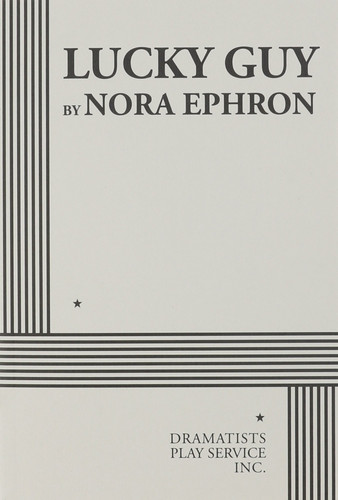
Lucky guy

Ephron, Nora
LUCKY GUY marks a return to Nora Ephron's journalistic roots. The charismatic and controversial tabloid columnist Mike McAlary covered the scandal- and graffiti-ridden New York of the 1980s. From his sensational reporting of New York's major police corruption to the libel suit that nearly ended his career, the play dramatizes the story of McAlary's meteoric rise, fall and rise again, ending with his coverage of the Abner Louima case for which he won the Pulitzer Prize, shortly before his untimely death on Christmas Day, 1998.
Dramatists Play Service, Inc 2014-06-04 75 pages

What Charlie Heard

Gerstein, Mordicai
The extraordinary story of the composer Charles Ives. "Sometimes little Charlie lay in his crib just listening. He heard his motherâ s long dress as she moved around his room. He heard big clocks and little clocks. He heard wagons and horse hooves. He heard dogs and crickets and the church bell next door." Charlie listened all through his boyhood, and as he grew into a man, he found he wanted to re-create in music the sounds that he heard every day. But others couldnâ t hear what Charlie heard. They didnâ t hear it as music â only as noise. In this daring and original book, Mordicai Gerstein graphically translates the audible into the visible â filling his pictures with noise â to tell the story of Charles Ives (1874â 1954), a great musical innovator who let neither criticism nor public scorn keep him from composing music that expressed all that he heard in the world. He was finally recognized with a Pulitzer Prize in 1947. What Charlie Heard is a 2003 Bank Street - Best Children's Book of the Year.
Live Oak Media 2004

Bookends: collected intros and outros

Chabon, Michael
A brilliant, idiosyncratic collection of introductions and afterwords (plus some liner notes) by New York Times bestselling and Pulitzer Prize winning author Michael Chabon—“one of contemporary literature’s most gifted prose stylists” (Michiko Kakutani, New York Times). In Bookends, Pulitzer Prize winning author Michael Chabon offers a compilation of pieces about literature—age-old classics as well as his own—that presents a unique look into his literary origins and influences, the books that shaped his taste and formed his ideas about writing and reading. Chabon asks why anyone would write an introduction, or for that matter, read one. His own daughter Rose prefers to skip them. Chabon's answer is simple and simultaneously profound: "a hope of bringing pleasure for the reader." Likewise, afterwords—they are all about shared pleasure, about the "pure love" of a work of art that has inspired, awakened, transformed the reader. Ultimately, this thought-provoking compendium is a series of love letters and thank-you notes, unified by the simple theme of the shared pleasure of discovery, whether it's the boyhood revelation of the most important story in Chabon's life (Ray Bradbury's "The Rocket Man"); a celebration of "the greatest literary cartographer of the planet Mars" (Edgar Rice Burroughs, with his character John Carter); a reintroduction to a forgotten master of ghost stories (M. R. James, ironically "the happiest of men"); the recognition that the worlds of Wes Anderson's films are reassembled scale models of our own broken reality (as is all art); Chabon's own rude awakening from the muse as he writes his debut novel, The Mysteries of Pittsburgh; or a playful parody of lyrical interpretation in the liner notes for Mark Ronson's Uptown Special, the true purpose of which, Chabon insists, is to "spread the gospel of sensible automotive safety and maintenance practices." Galaxies away from academic or didactic, Bookends celebrates wonder—and like the copy of The Phantom Tollbooth handed to young Michael by a friend of his father he never saw again—it is a treasured gift.
Harper Perennial 2019-01-22 175 pages

Sunday in the park with George

Lapine, James
Inspired by Georges Seurat's pointillist masterpiece, Sunday Afternoon on the Island of La Grande Jatte, Stephen Sondheim and James Lapine's musical celebrates the art of creation and the creation of art. In the first half of the musical, set in 1884, the people - and the animals - in the painting come to life in a world where, for the artist George, art comes before love, before everything. In the second half, a century later, Seurat's great-grandson is wrestling with the same obsessions in present-day New York. Sunday in the Park with George was premiered on Broadway in May 1984, in a production directed by James Lapine. An earlier, incomplete version had been performed Off-Broadway at Playwrights Horizons in July 1983. The musical went on to win the 1985 Pulitzer Prize for Drama. The first London production opened at the National Theatre in March 1990. It won the 1991 Olivier Award for Best New Musical.
National Theatre 1990 110 pages

Don't stop the carnival: a novel

Wouk, Herman
The "compulsively and clock-racingly readable" novel ( New York Times Book Review ) that captures the comedy and tragedy of island life and inspired a Jimmy Buffett musical. It's every parrothead's dream: to leave behind the rat race of the workaday world and start life all over again amidst the cool breezes, sun-drenched colors, and rum-laced drinks of a tropical paradise. It's the story of Norman Paperman, a New York City press agent who, facing the onset of middle age, runs away to a Caribbean island to reinvent himself as a hotel keeper. (Hilarity and disaster -- of a sort peculiar to the tropics -- ensue.) It's the novel in which the Pulitzer Prize-winning author of such acclaimed and bestselling novels as The Caine Mutiny and War and Remembrance draws on his own experience (Wouk and his family lived for seven years on an island in the sun) to tell a story at once brilliantly comic and deeply moving.
Little, Brown and Co 1992-05-15 395 pages

Life on a little-known planet: dispatches from a changing world

Kolbert, Elizabeth
"A landmark collection of Pulitzer Prize winner Elizabeth Kolbert's most important pieces about climate change and the natural world "To be a well-informed citizen of Planet Earth," Rolling Stone has advised, "you need to read Elizabeth Kolbert." From her National Magazine Award-winning series The Climate of Man to her Pulitzer Prize-winning book The Sixth Extinction, Kolbert's work has shaped the way we think about the environment in the twenty-first century. Collected in Life on a Little-Known Planet are her most influential and thought-provoking essays. An intrepid reporter and a skillful translator of scientific idees, Kolbert expertly captures the wonders of nature and paints vivid portraits of the researchers and concerned citizens working to preserve them. She takes readers all around the globe, from an island in Denmark that's succeeded in going carbon neutral, to a community in Florida that voted to give rights to waterways, to the Greenland ice sheet, which is melting in a way that has implications for everyone. We meet a biologist who believes we can talk to whales, an entomologist racing to find rare caterpillars before they disappear, and a climatologist who's considered the "father of global warming," amongst other scientists at the forefront of environmental protection. The threats to our planet that Kolbert has devoted so much of her career to exposing have only grown more serious. Now is the time to deepen our understanding of the world we are in danger of losing"-- Provided by publisher.
Crown 2025-11-04 300 pages

Love at Goon Park Harry Harlow and the Science of Affection

Deborah Blum
In the early twentieth century, affection between parents and their children was discouraged—psychologists thought it would create needy kids, and doctors thought it would spread infectious disease. It took a revolution in psychology to overturn these beliefs and prove that touch ensures emotional and intellectual health. In Love at Goon Park, Pulitzer Prize winner Deborah Blum charts this profound cultural shift by tracing the story of Harry Harlow—the man who studied neglect and its life-altering consequences on primates in his lab. The biography of both a man and an idea, Love at Goon Park ultimately invites us to examine ourselves and the way we love.
Basic Books 2011-07-05 368 pages

Resurrection: the struggle for a new Russia

Remnick, David
Pulitzer Prize-winning author David Remnick chronicles the new Russia that emerged from the ash heap of the Soviet Union. From the siege of Parliament to the farcically tilted elections of 1996, from the rubble of Grozny to the grandiose wealth and naked corruption of today's Moscow, Remnick chronicles a society so racked by change that its citizens must daily ask themselves who they are, where they belong, and what they believe in. Remnick composes this panorama out of dozens of finely realized individual portraits. Here is Mikhail Gorbachev, his head still swimming from his plunge from reverence to ridicule. Here is Vladimir Zhirinovsky, the half-Jewish anti-Semite who conducts politics as loony performance art. And here is Boris Yeltsin, the tottering populist who is not above stealing elections. In Resurrection , they become the players in a drama so vast and moving that it deserves comparison with the best reportage of George Orwell and Michael Herr. "This is what happens when a good writer unleashes eye and ear on a story that moves with the speed of light. Resurrection has the feel of describing vast, historical change even as it is happening."--Chicago Tribune
Vintage Books 1998-05-26 412 pages

The Unfinished Odyssey of Robert Kennedy

Halberstam, David
The Pulitzer prize-winning newsman's analysis of Kennedy's ideological journey toward "increasing radicalism" and a personal account of his subsequent successes (and single major defeat) along the campaign trail. Halberstam shows how Kennedy in his role as "leader of the honorable opposition in the Democratic party" became the caustic critic of the administration's ghetto policies as well as a more cautious critic of its Vietnam policy, placing himself at "the exact median point of American idealism and American power." It is a fascinating story of realpolitik (the Kennedy staff wanted Mayor Daley's backing in Chicago) played for radical aims, but Halberstam demonstrates his thesis that Kennedy was the rare politician who surpassed his image. The Kennedy backers were a coalition of old eggheads, youngish radicals (Allard Lowenstein was a major booster and a radicalizer of the candidate), veterans like Larry O'Brien, and--possibly--because he was the first, candidate to visit them and make demands for them--the ghetto residents. Kennedy was a crucial bridge to the New Politics which was, like the country, "in transition politically." Halberstam mourns him.
Random House Inc 1969 212 pages

Ho

Halberstam, David
One of the most influential leaders of the twentieth century, Ho Chi Minh was founder of the Indochina Communist Party and its successor, the Viet-Minh, and was president from 1945 to 1969 of the Democratic Republic of Vietnam (North Vietnam). In exploring the life and career of Ho Chi Minh, Pulitzer Prize-winning author David Halberstam provides a window into traditions and culture that influenced the American war in Vietnam, while highlighting the importance of nationalism in determining the war's outcome. As depicted by Halberstam, Ho is first and foremost a nationalist and a patriot. He was also, according to the author, a pragmatist "who was able to turn the abstract into the practical and to embody the concept of revolution to his own people." This edition includes a new preface by the author.
Rowman & Littelfield Publishers 2007-08-20 118 pages

The problem of slavery in the age of Revolution, 1770-1823

Davis, David Brion
David Brion Davis's books on the history of slavery reflect some of the most distinguished and influential thinking on the subject to appear in the past generation. The Problem of Slavery in the Age of Revolution, the sequel to Davis's Pulitzer Prize-winning The Problem of Slavery in Western Culture and the second volume of a proposed trilogy, is a truly monumental work of historical scholarship that first appeared in 1975 to critical acclaim both academic and literary. This reprint of that important work includes a new preface by the author, in which he situates the book's argument within the historiographic debates of the last two decades.
Cornell University Press 1975 576 pages

The problem of slavery in the age of Revolution, 1770-1823

Davis, David Brion
David Brion Davis's books on the history of slavery reflect some of the most distinguished and influential thinking on the subject to appear in the past generation. The Problem of Slavery in the Age of Revolution, the sequel to Davis's Pulitzer Prize-winning The Problem of Slavery in Western Culture and the second volume of a proposed trilogy, is a truly monumental work of historical scholarship that first appeared in 1975 to critical acclaim both academic and literary. This reprint of that important work includes a new preface by the author, in which he situates the book's argument within the historiographic debates of the last two decades.
Cornell Univ. Press 1977 576 pages