274 results for "World History"

Holocaust literature: a history and guide

Roskies, David G.,Diamant, Naomi
"What is Holocaust literature? When does it begin and how is it changing? Is there an essential core of diaries, eyewitness accounts of the concentration camps, tales of individual survival in hiding? Is it the same everywhere: in the West as in the East, in Australia as in the Americas, in poetry as in prose? Is this literature sacred and sui generis, or can it be studied in the light of other literatures? What of the perpetrators and bystanders, the hidden children, the children of Holocaust survivors: Do they speak with the same authority? What works of Holocaust literature will be read a hundred years from now--and why? Here, for the first time and told from beginning to end, is an historical survey of Holocaust literature in all genres, countries, and major languages. Beginning in wartime, it proceeds from the literature of mobilization and mourning in the Free World to the vast and varied literature produced in the Nazi-occupied ghettos, the bunkers and places of hiding, the transit and concentrations camps. Within weeks of the liberation, in displaced persons camps, a new memorial and testamentary literature begins to take shape. Moving from Europe to Israel, the U.S., and beyond, the authors situate the writings by real and proxy witnesses within three distinct postwar periods: a period of "communal memory," still internal and internecine; a period of "provisional memory" in the '60s and '70s that witnesses the birth of a self-conscious Holocaust genre; to the period of "authorized memory" in which we live today, following the collapse of the Soviet Union (1989-91), and the opening of the US Holocaust Museum (1993). Twenty book covers - first editions in their original languages - and an eminently readable guide to the "first hundred books" together show the multilingual scope, historical depth, the moral and artistic range of this extraordinary body of writing."--Publisher's website.
Brandeis University Press 2012 355 pages

Why Mahler? how one man and ten symphonies changed our world

Lebrecht, Norman
"Why Mahler? Why does his music affect us in the way it does? Norman Lebrecht, one of the world's most widely read cultural commentators, has been wrestling obsessively with Mahler for half his life. Pacing out his every footstep from birthplace to grave, scrutinizing his manuscripts, talking to those who knew him, Lebrecht constructs a compelling new portrait of Mahler as a man who lived determinedly outside his own times. Mahler was - along with Picasso, Einstein, Freud, Kafka, and Joyce - a maker of our modern world."--Book jacket.
Pantheon Books 2010 326 pages

The age of Clinton: America in the 1990s

Troy, Gil
"The 1990s was a decade of extreme change. Shifts in culture, politics, and technology radically altered the way Americans did business, expressed themselves, and thought about their role in the world. At the center of it all was Bill Clinton, the charismatic and flawed baby boomer president, along with his polarizing but increasingly popular wife, Hillary. Although it was in many ways a Democratic Gilded Age, the 1990s was also a time of great anxiety. The Cold War was over. America was stable and prosperous. Yet Americans felt more unmoored and isolated. This was the era of glitz and grunge, when we relished living in the Republic of Everything even as we feared it might degenerate into the Republic of Nothing. Bill Clinton dominated this era, but his complex legacy has yet to be clearly defined. Historian Gil Troy examines Clinton's presidency alongside the decade's cultural changes. Taking the '90s year by year, Troy shows how the culture of the day shaped the Clintons even as the Clintons shaped it, offering answers to two enduring questions about Bill Clinton's legacy: How did such a talented politician leave Americans thinking he accomplished so little when he actually accomplished so much? And to what extent was Clinton responsible for the catastrophes of the following decade, specifically 9/11 and the collapse of the housing market? Even more relevant as we head toward the 2016 election, The Age of Clinton will appeal to readers on both sides of the aisle as it chronicles the wild, transformative decade and the president at its center"--
Thomas Dunne Books/St. Martin's Press 2015-10-06 368 pages

Original story by -: a memoir of Broadway and Hollywood

Laurents, Arthur
(Applause Books). Here is the original story of a true original, the celebrated and internationally renowned director, playwright and screenwriter Arthur Laurents, whose creative genius continues to energize American stage and screen today. Say his name, and images of West Side Story , Gypsy, Anastasia, The Turning Point , and The Way We Were appear. Laurents' highly praised memoir is a dazzling portrait of his life as he recounts the great moments, the trials and the joys of his incredible career. He takes us into his world, peopled with the creative artists, directors, actors and personalities who came of age in the theatre and in Hollywood after WWII. Later, back in New York, he writes about jump-starting Barbra Streisand's career by casting her in I Can Get It for You Wholesale . He writes about the creation of Gypsy with Jule Styne and Stephen Sondheim. And he writes about coming together in a complex, fraught collaboration with his three old pals, Jerome Robbins, Leonard Bernstein and Sondheim for West Side Story . Throughout, Laurents is funny, fierce, and frank a life recounted as richly as it was lived. "This is a historic work. A 'must' for show biz mavens." LIZ SMITH, Newsday & Syndicated
Applause 2001-04 436 pages

Adventures of a bystander

Drucker, Peter F.
"It is [a] belief in diversity and pluralism and the uniqueness of each person that underlies all my writings . . . " -from the Preface. Regarded as the most influential and widely read thinker on modern organizations and their management, Peter Drucker has also established himself as an unorthodox and independent analyst of politics, the economy, and society. A man of impressive scope and expertise, he has paved significant inroads in a number of key areas, sharing his knowledge and keen insight on everything from the plight of the employee and the effects of technology to the vicissitudes of the markets and the future of the new world order. Adventures of a Bystander is Drucker's rich collection of autobiographical stories and vignettes, in which this legendary figure paints a portrait of his remarkable life, and of the larger historical realities of his time. In a style that is both unique and engaging, Drucker conveys his life story -from his early teen years in Vienna through the interwar years in Europe, the New Deal era, World War II, and the postwar period in America-through intimate profiles of a host of fascinating people he's known through the years. Their personal histories are, as Drucker tells us, the beads for which his own life serves as the string. A colorful group, these diverse, often unpredictable, always multidimensional individuals were chosen "because each of them, in his or her own highly personal way, reflects and refracts the thirty crucial years from the end of World War I to the first post-World War II decade-the thirty years that largely formed the world in which we now live." An amazing pageant of characters, both famous and otherwise, springs from these pages, illuminating and defining one of the most tumultuous periods in world history. Along with bankers and courtesans, artists, aristocrats, prophets, and empire-builders, we meet members of Drucker's own family and close circle of friends, among them such prominent figures as Sigmund Freud, Henry Luce, Alfred Sloan, John Lewis, and Buckminster Fuller. Playing to perfection their roles as those who "reflect and refract" the customs, beliefs, and attitudes of the times, these singular personalities lend Adventures of a Bystander a striking "you-are-there" feel. A brief encounter with Freud becomes the catalyst for an absorbing, multidimensional description of the economics, politics, and social psychology of pre-World War II Europe. Drucker introduces us to Fritz Kraemer, a brilliant, monocle-wearing eccentric who became an influential mentor to the young Henry Kissinger. His personal memoir of Henry Luce documents the development of modern journalism, while in "The Indian Summer of Innocence," he rescues and preserves the very heart of the American experience during the last New Deal years before World War II. Shedding light on a turbulent and important era, Adventures of a Bystander also reflects Peter Drucker himself as a man of imaginative sympathy and enormous interest in people, ideas, and history. These enthralling stories complement and complete the groundbreaking analytical writing for which he is so revered. Luminous autobiographical stories by one of the greatest thinkers of our time "The cast of characters among whom Drucker moves is superbly rich, and the informed glimpse he provides of a vanished social and political universe is an education in itself. Adventures of a Bystander is better than a novel, more lively than an essay, and as thoughtful as both at their best." -The Harvard Business Review. "Adventures of a Bystander is a virtuoso performance in which Drucker displays a dazzling diversity of personal interests and knowledge, an awesome power of recall, and a crisp, highly readable writing style." -BusinessWeek. "Adventures of a Bystander appears in a stroke to have restored the art of the memoir and of the essay. It will doubtless be a while before its like comes round again." -The Washington Post.
Wiley 1997 344 pages

The Devil's playground: a century of pleasure and profit in Times Square

Traub, James
As Times Square turns 100, New York Times Magazine contributing writer James Traub tells the story of how this mercurial district became one of the most famous and exciting places in the world. The Devil’s Playground is classic and colorful American history, from the first years of the twentieth century through the Runyonesque heyday of nightclubs and theaters in the 1920s and ’30s, to the district’s decline in the 1960s and its glittering corporate revival in the 1990s. First, Traub gives us the great impresarios, wits, tunesmiths, newspaper columnists, and nocturnal creatures who shaped Times Square over the century since the place first got its name: Oscar Hammerstein, Florenz Ziegfeld, George S. Kaufman, Damon Runyon, Walter Winchell, and “the Queen of the Nightclubs,” Texas Guinan; bards like A. J. Liebling, Joe Mitchell, and the Beats, who celebrated the drug dealers and pimps of 42nd Street. He describes Times Square’s notorious collapse into pathology and the fierce debates over how best to restore it to life. Traub then goes on to scrutinize today’s Times Square as no author has yet done. He writes about the new 42nd Street, the giant Toys “R” Us store with its flashing Ferris wheel, the new world of corporate theater, and the sex shops trying to leave their history behind. More than sixty years ago, Liebling called Times Square “the heart of the world”—not just the center of the world, though this crossroads in Midtown Manhattan was indeed that, but its heart. From the dawn of the twentieth century through the 1950s, Times Square was the whirling dynamo of American popular culture and, increasingly, an urban sanctuary for the eccentric and the untamed. The name itself became emblematic of the tremendous life force of cities everywhere. Today, Times Square is once again an awe-inspiring place, but the dark and strange corners have been filled with blazing light. The most famous street character on Broadway, “the Naked Cowboy,” has his own website, and Toys “R” Us calls its flagship store in Times Square “the toy center of the universe.” For the giant entertainment corporations that have moved to this safe, clean, and self-consciously gaudy spot, Times Square is still very much the center of the world. But is it still the heart?
Random House 2004-03-16 313 pages

The goddess pose

Goldberg, Michelle
When the woman who would become Indra Devi was born in Russia in 1899, yoga was virtually unknown outside of India. By the time of her death, in 2002, it was being practiced everywhere, from Brooklyn to Berlin to Ulaanbaatar. In The Goddess Pose, New York Times best-selling author Michelle Goldberg traces the life of the incredible woman who brought yoga to the West and in so doing paints a sweeping picture of the twentieth century. Born into the minor aristocracy (as Eugenia Peterson), Devi grew up in the midst of one of the most turbulent times in human history. Forced to flee the Russian Revolution as a teenager, she joined a famous Berlin cabaret troupe, dove into the vibrant prewar spiritualist movement, and, at a time when it was nearly unthinkable for a young European woman to travel alone, followed the charismatic Theosophical leader Jiddu Krishnamurti to India. Once on the subcontinent, she performed in Indian silent cinema and hobnobbed with the leaders of the independence movement. But her greatest coup was convincing a recalcitrant master yogi to train her in the secrets of his art. Devi would go on to share what she learned with people around the world, teaching in Shanghai during World War II, then in Hollywood, where her students included Gloria Swanson and Greta Garbo. She ran a yoga school in Mexico during the height of the counterculture, served as spiritual adviser to the colonel who tried to overthrow Panamanian strongman Manuel Noriega, and, in her eighties, moved to Buenos Aires at the invitation of a besotted rock star. Everywhere she went, Indra Devi evangelized for yoga, ushering in a global craze that continues unabated.
Corsair 2017-04-06 336 pages

After the miracle: the political crusades of Helen Keller

Wallace, Max
In this "stunning" new history, New York Times bestselling author Max Wallace draws on groundbreaking research to reframe Helen Keller's journey after the miracle at the water pump, vividly bringing to light her rarely discussed, lifelong fight for social justice across gender, class, race, and ability (Rosemary Sullivan, New York Times bestselling author). Kirkus Best Nonfiction Book of 2023 Raised in Alabama, she sent shockwaves through the South when she launched a public broadside against Jim Crow and donated to the NAACP. She used her fame to oppose American intervention in WWI. She spoke out against Hitler the month he took power in 1933 and embraced the anti-fascist cause during the Spanish Civil War. She was one of the first public figures to alert the world to the evils of Apartheid, raising money to defend Nelson Mandela when he faced the death penalty for High Treason, and she lambasted Joseph McCarthy at the height of the Cold War, even as her contemporaries shied away from his notorious witch hunt. But who was this revolutionary figure? She was Helen Keller. From books to movies to Barbie dolls, most mainstream portrayals of Keller focus heavily on her struggles as a deafblind child--portraying her Teacher, Annie Sullivan, as a miracle worker. This narrative--which has often made Keller a secondary character in her own story--has resulted in few people knowing that her greatest accomplishment was not learning to speak, but what she did with her voice when she found it. After the Miracle is a much-needed corrective to this antiquated narrative. In this first major biography of Keller in decades, Max Wallace reveals that the lionization of Sullivan at the expense of her famous pupil was no accident, and calls attention to Keller's efforts as a card-carrying socialist, fierce anti-racist, and progressive disability advocate. Despite being raised in an era when eugenics and discrimination were commonplace, Keller consistently challenged the media for its ableist coverage and was one of the first activists to highlight the links between disability and capitalism, even as she struggled against the expectations and prejudices of those closest to her. Peeling back the curtain that obscured Keller's political crusades in favor of her "inspirational" childhood, After the Miracle chronicles the complete legacy of one of the 20th century's most extraordinary figures.
Grand Central Publishing 2024-04-09 416 pages

Driven: a daughter's odyssey

Heldman, Julie
"In the mid-20th century, the Heldmans were tennis royalty. Julie was a volatile and gutsy tennis star, twice ranked number 5 in the world. Her mother Gladys was broadly admired for her unique magazine, World Tennis, and for engineering the women's tennis revolution. No one guessed that Gladys's hidden emotional abuse was the source of Julie's powerful drive. Driven is a highly readable insider's account of a pivotal time in women's tennis history; an in-depth look at Gladys's complex character; and the revealing story of Julie's interior journey, both on and off the court."--Page 4 of cover
Julie Heldman 2019 435 pages

John Singleton Copley

Flexner, James Thomas
A book for both the general reader of American history and the student of art, Flexner's study of Copley (1738-1815) brings into vivid detail the struggle the artist endured against an unfavorable environment in the New World, his rise to fame, the development of his unique style, and the personal growth of the man who became America's first great artist. Copley's life began in the humble surroundings of Boston's waterfront. As a poor boy growing up in a city where no formal art instruction was available, rigorous self-instruction was Copley's only means to his goal of becoming a painter. Through laborious work Copley mastered his craft; the portraits he produced between 1753 and 1774, at the height of his fame, were distinguished by the fully rounded modeling and realism which make the personalities of his subjects come alive. His paintings in these years were the best works a colonial American artist had ever produced. Yet his personal letters reveal that he found life in Boston limited; he cites the dearth of great art from which to learn and by which to be inspired, and complains of what he perceives to be the underappreciation of his patrons. The Boston Tea Party and other events led inexorably toward the Revolution. Copley was unwillingly drawn into the troubled political arena; his loyalist connections made his life in Boston increasingly turbulent and precarious. In 1774, at the suggestion of Joshua Reynolds and Benjamin West, Copley became convinced he was wasting his talents in the colonies and moved to London to study the European masters. This decision marked the second period of his life, lasting forty years, and instigated a no less dramatic shift in the style and subjectof his art. Copley's tour of European cities and galleries broadened the range and scope of his work. He produced large canvases of sweeping historical scenes of war, political subjects, and religious subjects considered taboo in the colonies. Copley's fame soared to world-wide recognition as a historical painter. But in his later work Copley seems to have lost his strong sense of composition; eventually, even his draftsmanship seemed to fail him. The rejection and scorn of critics stung Copley, and he spent the last years of his life struggling to regain his former acclaim.
Fordham University Press 1993 139 pages

Getting to the heart of the matter: my 36 years in the Senate

Levin, Carl
"Representing Michigan for thirty-six years in the U.S. Senate, Carl Levin, the longest-serving senator in Michigan history, was known for his dogged pursuit of the truth, his commitment to holding government accountable, and his basic decency. Getting to the Heart of the Matter: My 36 Years in the Senate is his story - from his early days in Detroit as the son of a respected lawyer to the capstone of his career as chair of both the Senate Armed Services Committee and the Senate Permanent Subcommittee on Investigations. Levin's career placed him at the center of some of our nation's most critical points in modern times: from the aftermath of the 1967 Detroit riots, to the Clinton impeachment, through 9/11 and the wars in Iraq and Afghanistan, and the 2008 financial crisis. He met with numerous world leaders, including Egypt's Anwar Sadat and China's Jiang Zemin. Getting to the Heart of the Matter recounts Levin's experiences, thoughts, and actions during these historic moments. Consisting of seventeen chapters, the book takes the reader through Levin's early life in Detroit of the 1940s, 50s, and 60s where he met his wife, started a family, practiced law and served as the first General Counsel for the newly created Michigan Civil Rights Commission and the chief appellate defender for Detroit's Legal Aid Office. Elected to the Detroit City Council in 1969, where Levin served for eight years including four as Council president, the book describes how his fight against the Department of Housing and Urban Development's devastating housing practices in the neighborhoods of Detroit led him to run for the U.S. Senate with a pledge to make government work more effectively. Winning election six times, Levin had an illustrious career in the Senate where he challenged leaders in government and the private sector for the greater good of the nation. Levin describes how, as a Democrat, throughout his time in the Senate, he worked with Republican senators who often held different policy positions in order to find common ground to achieve national goals, and how he and his Senate staff searched for creative solutions to trade issues, support for the auto industry and manufacturing sector, U.S. military action in Iraq and Afghanistan, and efforts to protect the Great Lakes and the environment, among many other issues. Levin's hope in writing this memoir is that by sharing his deeply held beliefs about the responsibility of elected officials, the book will serve as a resource for people beginning a career in, or contemplating running for, public office. Readers with an interest in politics, history, facts, and perseverance will find kinship in this book" -- provided by the publisher
Wayne State University Press 2021 338 pages

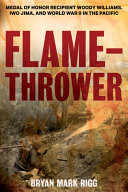
Flamethrower: Medal of Honor recipient Woody Williams, Iwo Jima, and World War II in the Pacific

Rigg, Bryan Mark
"Imagine strapping on a highly flammable 70-pound pack and entering combat as a surefire walking target-and you'd only begin to understand the job, and the horror, of Marine Corps flamethrower man. That's precisely what Hershel "Woody" Williams did in World War II, most importantly in February 1945 on Iwo Jima, one of the Pacific War's toughest battles. A few days into the battle, Marines were fighting hard for an airfield, and his captain asked Woody if he could do anything. He responded, "I'll try"-and for the next four hours, he virtually singlehandedly took on and ultimately destroyed seven enemy pillboxes and helped secure the airfield. Accomplished military historian Bryan Mark Rigg reconstructs Williams' remarkable story, from his youth in West Virginia to his experiences on Guadalcanal, Saipan, Guam, and most significantly Iwo Jima. In Rigg's telling, Williams's Medal of Honor action is not "just" a brave deed, but one of only a few strategically significant brave deeds-one that secured a strategic objective during a major campaign. Rigg tells Williams' story vividly, and objectively, and places it in the context of the broader Pacific theater of World War II."--
Stackpole Books 2020 544 pages

Algiers, Third World capital: freedom fighters, revolutionaries, Black Panthers

Mokhtefi, Elaine
A fascinating portrait of life with the Black Panthers in Algiers: a story of liberation and radical politics Following the Algerian war for independence and the defeat of France in 1962, Algiers became the liberation capital of the Third World. Elaine Mokhtefi, a young American woman immersed in the struggle and working with leaders of the Algerian Revolution, found a home here. A journalist and translator, she lived among guerrillas, revolutionaries, exiles, and visionaries, witnessing historical political formations and present at the filming of The Battle of Algiers. Mokhtefi crossed paths with some of the era's brightest stars: Frantz Fanon, Stokely Carmichael, Timothy Leary, Ahmed Ben Bella, Jomo Kenyatta, and Eldridge Cleaver. She was instrumental in the establishment of the International Section of the Black Panther Party in Algiers and close at hand as the group became involved in intrigue, murder, and international hijackings. She traveled with the Panthers and organized Cleaver's clandestine departure for France. Algiers, Third World Capital is an unforgettable story of an era of passion and promise.
Verso Books 2018 242 pages

Inside the economist's mind: conversations with eminent economists

Paul A. Samuelson,William A. Barnett
By focusing on the human side as well as the intellectual dimensions of how economists work and think, this collection of interviews with top economists of the 20th century becomes a startling and lively introduction to the modern world of macroeconomics. A fun read! For more information, frequent updates, and to comment on the forthcoming book, visit William A. Barnett's weblog at http://economistmind.blogspot.com/. Acclaim for Inside the Economist's Mind "In candid interviews, these great economists prove to be fabulous story tellers of their lives and times. Unendingly gripping for insiders, this book should also help non-specialists understand how economists think." Professor Julio Rotemberg, Harvard University Business School, and Editor, Review of Economics and Statistics. "Economics used to be called the 'dismal science'. It will be impossible for anybody to hold that view anymore ... This is science with flesh and blood, and a lot of fascinating stories that you will find nowhere else." Dr. Jean-Pascal Bénassy, Paris-Jourdan Sciences Économiques, Paris, France "This book provides a rare and intriguing view of the personal and professional lives of leading economists ... It is like A Beautiful Mind , scaled by a factor of 16 [the number of interviews in the book]." Professor Lee Ohanian, University of California at Los Angeles " ... if you want an insider view of how economics has been developing in the last decades, this is the (only) book for you." Professor Giancarlo Gandolfo, University of Rome ‘La Sapienza,’ Rome "Here we see the HUMAN side of path-breaking research, the personalities and pitfalls, the DRAMA behind the science." Professor Francis X. Diebold, University of Pennsylvania, Philadelphia
Blackwell Pub 2007 419 pages

Jefferson measures a moose

Rockliff, Mara
Thomas Jefferson was wild about numbers. He was constantly counting, measuring, and observing things that caught his interest. He loved sharing his discoveries and reading the discoveries of others. But when a famous Frenchman published a book about America, Jefferson was appalled: all the information in the book was wrong. The author insisted that America was a wretched, dismal place, where birds could not sing, dogs could not bark, and everything and everyone was puny and weak. Thomas Jefferson resolved to set the record straight - with numbers - and prove to the world that the new nation was worthy of investment.
Candlewick Press 2020-08-04 48 pages

Family sayings

Ginzburg, Natalia
Family Sayings is Natalia Ginzburg's masterpiece and a classic of contemporary Italian literature. Although it asks to be read as fiction, the author, one of Italy's finest twentieth-century writers, admits that it is highly autobiographical. The book spans the period from the rise of Fascism through World War II (in which her first husband perished at the hands of the Nazis) and its aftermath. Its subject is the other people in Ginzburg's family. Woven around the inconsequential, revealing remarks that are repeated in a family until they become its affectionate private code, rich in memory and association, this is one of the rare true evocations of a family in modern literature. Family Sayings is at the same time a living history that documents the life of the assimilated Jewish Ginzburg family and the culture to which they belonged. Winner of the Strega Prize-Italy's Pulitzer for literature-this intimate and candid portrait is no less relevant today than when it was first published in 1963. --
Arcade Pub 2013 181 pages

Legacy: one family, a cup of tea and the company that took on the world

Harding, Thomas
A panoramic new history of modern Britain, as told through the story of one extraordinary family, and one groundbreaking company. In the early 1800s, Lehmann Gluckstein and his family escaped the pogroms of Eastern Europe and made their way to Whitechapel in London's East End. There, starting with nothing, they worked tirelessly to pull themselves out of poverty, creating a small tobacco factory that grew to become the largest catering company in the world: J. Lyons. For over a century, Lyons was on every high street, in every home, in every coffee and teacup. It was an ascent from rags to riches in the face of many obstacles: poverty, hatred and anti-Semitism stood between this poor immigrant family and the British Dream. Legacy charts the rise and fall of one of the most influential dynasties in British history through the lives of five astonishing generations. Both sweeping and intimate, it is a story of sacrifice and selflessness, betrayal and personal tragedy, and Empire and its cost. It is also an illuminating new exploration of Britain and its place in the world, from the bestselling author of Hanns and Rudolf and The House by the Lake.
William Heinemann 2019 561 pages