222 results for "World History"

Judaism and the challenges of modern life

Moshe Halbertal,Donniel Hartman
Much more than a particular period in world history, modernity has fundamentally transformed how we think and live, and especially how we understand and relate to religious traditions. As the 'ghetto walls' have fallen, both empirically and metaphorically, Judaism is compelled to compete in an open marketplace of ideas. Jews can no longer count on an assumedly necessary Jewish identity or commitment, nor on the rallying force of anti-Semitism to ensure an individual and collective sense of belonging. Rather Jewish moral, spiritual and historical values and ideas must be read with new eyes and challenged to address modernity's proliferating array of questions and realities. The pertinent questions modern Jewry faces are how to embrace modernity as Jews and what such an embrace means for the meaning and future of Jewish life. This collection of essays, authored by scholars of the Shalom Hartman Institute, addresses three critical challenges posed to Judaism by modernity: the challenge of ideas, the challenge of diversity, and the challenge of statehood, and provides insights and ideas for the future direction of Judaism. Providing readers with new insights into Judaism and the Jewish people in contemporary times, the collection explores a wide range of issues that includes: the significance of Israel for the future of Judaism; the Jewish people as a people; the relationship between monotheism and violence; revelation and ethics; Judaism and the feminist challenge; and Judaism and homosexuality.
Continuum 2007-12-11 192 pages

A history of the Jews in the English-speaking world: Great Britain

Rubinstein, W. D.
Deals also with British antisemitism from Cromwell's time to the present. There were objections against the admission of Jews to England in 1655, as well as attempts to restrict their rights in the 17th-18th centuries. Discusses pre-World War I antisemitic writers (e.g. G.K. Chesterton, H. Belloc) and the eugenics movement. Racial antisemitism was almost non-existent before 1914. Antisemitism reached a peak in Britain in 1917-22, but it was milder than in other Western countries. Relates, also, to left-wing antisemitism between the two World Wars. Ch. 3 (pp. 280-363), "Anglo-Jewry and the Holocaust, 1933-1945", deals with the reactions of Jews and non-Jews to the rise of Nazism and the Holocaust. Nazi antisemitism aroused revulsion in British society, even among conservatives and pro-Germans. States that Britain did more for refugees from Germany than any other country. British Jewry did all it could to rescue Jews to the extent that it understood their situation. During the war and the hostilities in the Middle East, there was an upsurge of antisemitism in the country but it receded in the 1950s. Contends that antisemitism in Britain was always a marginal phenomenon.
Macmillan 1996 539 pages

History of the Jews in America

Peter Wiernik
"History of the Jews in America: From the Period of the Discovery of the New World to the Present Time" by Peter Wiernik offers a comprehensive chronicle of Jewish life in America, tracing their journey from the earliest days of exploration to the present. This meticulously researched volume illuminates the rich tapestry of Jewish American history, documenting their contributions, challenges, and evolving identity within the broader American narrative. Explore the waves of immigration, the establishment of communities, and the impact of Jewish culture on American society. Wiernik's work delves into the complexities of navigating religious freedom, economic opportunities, and the persistent threat of antisemitism. A vital resource for understanding the intertwined narratives of Jewish history and American history, this book provides invaluable insights into the experiences of Jewish Americans and their enduring legacy. This historical account remains a significant contribution to the study of both Jewish and American experiences. This work has been selected by scholars as being culturally important, and is part of the knowledge base of civilization as we know it. This work is in the public domain in the United States of America, and possibly other nations. Within the United States, you may freely copy and distribute this work, as no entity (individual or corporate) has a copyright on the body of the work. Scholars believe, and we concur, that this work is important enough to be preserved, reproduced, and made generally available to the public. We appreciate your support of the preservation process, and thank you for being an important part of keeping this knowledge alive and relevant.
Creative Media Partners, LLC 2025-03-29 408 pages

˜Theœ rise of modern Judaism: an intellectual history of German Jewry 1650-1942

Graupe, Heinz Mosche
This book illustrates the rise of modern Judaism through the social and intellectual history of the Jews in Germany. It covers three centuries, up until the violent suppression of the last spark of visible Jewish spiritual-intellectual life in Germany during the Second World War. As a background understanding of this intellectual development, the political, economic, and social events of this three-century-long development are repeatedly drawn upon. This book shows the significance of German Jewry in Jewish history.
Krieger 1978 329 pages

Jewish emancipation: a history across five centuries

Sorkin, David Jan
The first comprehensive history of how Jews became citizens in the modern world For all their unquestionable importance, the Holocaust and the founding of the State of Israel now loom so large in modern Jewish history that we have mostly lost sight of the fact that they are only part of—and indeed reactions to—the central event of that history: emancipation. In this book, David Sorkin seeks to reorient Jewish history by offering the first comprehensive account in any language of the process by which Jews became citizens with civil and political rights in the modern world. Ranging from the mid-sixteenth century to the beginning of the twenty-first, Jewish Emancipation tells the ongoing story of how Jews have gained, kept, lost, and recovered rights in Europe, North Africa, the Middle East, the United States, and Israel. Emancipation, Sorkin shows, was not a one-time or linear event that began with the Enlightenment or French Revolution and culminated with Jews' acquisition of rights in Central Europe in 1867–71 or Russia in 1917. Rather, emancipation was and is a complex, multidirectional, and ambiguous process characterized by deflections and reversals, defeats and successes, triumphs and tragedies. For example, American Jews mobilized twice for emancipation: in the nineteenth century for political rights, and in the twentieth for lost civil rights. Similarly, Israel itself has struggled from the start to institute equality among its heterogeneous citizens. By telling the story of this foundational but neglected event, Jewish Emancipation reveals the lost contours of Jewish history over the past half millennium.
Princeton University Press 2021-09-14 511 pages

Journey to heaven: exploring Jewish views of the afterlife

Bronner, Leila Leah
Journey to heaven invites readers to rediscover some of the basic tenets of Jewish belief concerning the hereafter: resurrection, immortality, judgment, messianism, and the World to Come. Starting with the Bible's references to Sheol and allusions to resurrection, this comprehensive survey explores immortality and bodily resurrection in Second Temple literature; the Mishnah's discussions of olam ha-ba, the World to Come, and how to merit entertering it; and the Talmud's depictions of Gan Eden (paradise), Gehinnom (hell), and the soul's journey through these metaphysical landscapes. Bronner also explores the views of medieval scholars such as Maimonides and Nahmanides, Jewish mystical teachings about reincarnation, and modern views of faith and belief. A separate chapter is devoted to views of the Messiah over the course of Jewish history. Bronner demonstrates that the afterlife is indeed a vital part of Judaism, as she reveals how generations of Jews, from biblical times to the present, have grappled with its core ideas and beliefs about the hereafter
Urim Publications 2011-06-01 206 pages

Neusner on Judaism

Neusner, Jacob
Jacob Neusner has published more than 1000 books and articles, scholarly and academic, popular and journalistic, and is one of the most published humanities scholars in the world. Over a period of fifty years he has made significant, insightful and challenging contributions to the study of Rabbinic Judaism, particularly in the disciplines covered in the three volumes which make up Neusner on Judaism: the study of history (volume 1), literature (volume 2), and religion and theology (volume 3). These unique volumes of selective writings by Jacob Neusner, with new introductions by the author, offer scholars an invaluable resource in the field of Judaic Studies.
Ashgate 2004 477 pages

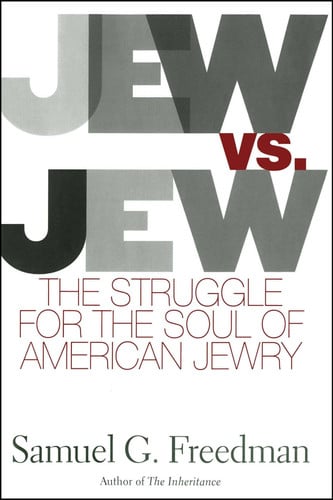
Jew Vs Jew The Struggle For The Soul Of American Jewry

Samuel G. Freedman
At a time when American Jews should feel more secure and cohesive than ever, civil war is tearing apart their community. Congregations, neighborhoods, even families are taking sides in battles about Jewish identity and Jewish authenticity. The conflict pits fundamentalist against secularist, denomination against denomination, even liberal against conservative within each branch of Jewry. Jew vs. Jew tells the story of how American Jewry has increasingly -- and perhaps terminally -- broken apart in the last forty years. Jew vs. Jew stretches in time from 1960 to 2000. It travels the country from Florida to New England, from Los Angeles to the Catskills in New York, from Cleveland to Denver, and it also crosses the ocean to Israel to show how tensions within the Jewish state inflame those among American Jews. The flash-points range from conversion standards to the role of women, from the peace process in Israel to the sexual climate on an Ivy League campus. But behind them all, as Samuel Freedman writes, lie common causes. First, far from unifying American Jews, Israel now divides them on both political and religious grounds. Second, neither America nor the larger world presents Jews with a single enemy against whom to coalesce. Third, and most important, nothing in the Jewish history of persecution, oppression, and exile prepared the Chosen People for the challenge posed by America, the challenge of being absorbed into a tolerant and diverse nation, being accepted so thoroughly that the intermarriage rate tops 50 percent. Jew vs. Jew introduces readers to memorable places and characters. Freedman describes one of the final summers at a Labor Zionist camp in the Catskills whose brand of secular Jewishness is becoming obsolete because Zionism succeeded in creating Israel. He tells the story of Orthodox and Reform Jews in a Cleveland suburb who are fighting about the construction of several synagogues -- and, on a deeper level, about whether unity or pluralism ought to be the goal of Jewish life. He portrays a Florida Jew so violently opposed to the Oslo peace accords that he planted a bomb in a synagogue where Shimon Peres was speaking. He tells about a Los Angeles congregation that spent three years debating whether or not to honor the Biblical matriarchs in its liturgy.We come to know the Long Island neighbors who cannot tolerate sharing even a property line because their versions of Jewish identity are so irreconcilably different. Jew vs. Jew is a work of vigorous reporting, lucid writing, and intellectual curiosity. And even as it chronicles an embittered and polarized community, it refuses to take sides or pass judgment. Instead, with compassion and acuity, Jew vs. Jew bears witness.
Simon & Schuster 2007-09-21 400 pages

The philosophy of Chabad

Mindel, Nissan
Few luminaries in Jewish history, particularly in modern times, have made such a lasting and profound contribution to our spiritual heritage as Rabbi Schneur Zalman of Liadi (1745-1812). His works embrace the entire spectrum of Jewish thought - mysticism, philosophy, psychology, ethics and law - and represent an expression of unparalled creative genius.This richly detailed biography traces Rabbi Schneur Zalman's life from his childhood and formative years to his trials and triumph as a leader who revolutionized Jewish life. It reveals many hitherto unknown facts, and offers the reader considerable insight into his extraordinary strength of character. Vilified by many of his contemporaries and arrested by the Czar, Rabbi Schneur Zalman emerged victorious; today his teachings continue to inspire and vitalize Jewish life all over the world.
Chabad Research Center, Kehot Publication Society 1985 255 pages

Confronting Creation How Judaism Reads Genesis

Jacob Neusner
By setting forth the book of Genesis as it is re-presented in the rabbinic statement Genesis Rabbah, Neusner demonstrates the way in which Judaism confronted creation and the Genesis story. In 'Confronting Creation', the author presents a new, analytical translation of Genesis Rabbah, a document that came to closure around 400 C.E. What made that particular time crucial in the life of Israel and the Jewish people is an event that also helped shape the entire history of Western civilization - the rise of Christianity to the status of the official religion of the Roman Empire. The Judaic sages' rereading of the Torah's accounts of the beginning of the world and of Israel took place during a time of significant change in Western civilization. That fact explains the importance of this reading of Genesis to Western civilization, because Genesis Rabbah illuminates the Judaic tradition in contemplating God's creation of the world.
Wipf and Stock Publishers 2004-06-15 400 pages

The Jew and the other

Benbassa, Esther
In the current situation of polarization in the Middle East, it is easy to lose sight of the fact that a long tradition of dialogue and openness toward the "Other" exists in many strands of Jewish thought. Himself or herself the quintessential Other in a world in which she or he has existed dispersed, in exile, as a minority, the Jew has consistently envisioned the self in relation to surrounding societies. Esther Benbassa and Jean-Christophe Attias show that alterity is a useful and morally compelling notion with which to structure Judaism's historically specific and politically charged encounters with deity, femininity, the Christian West, and the Muslim East. In Benbassa and Attias's view, the Other may be rejected, but it is also a mirror, both reminding the Jew of ethical duties and constituting a source of temptation and danger. Sometimes, the authors find, the Other is the enemy. They note that it is with the enemy that peace is made, peace with the Other and peace with the self. The Jew and the Other , which is an extended commentary on a dozen Biblical verses and which follows the five books of the Pentateuch, offers the history of that encounter as an inextricable part of the Jewish condition and is itself a meditation on this encounter.
Cornell University Press 2004 157 pages

Jewish Theology Systematically and Historically Considered

Kaufmann Kohler
"The most important book on Jewish learning of this season, and one of the leading works published within the past few years....The work is a pioneer of its kind, in English as well as in other languages, in so far as it is a 'systematic' study of the subject....All other attempts made hitherto by German and other Jewish scholars at a presentation of Jewish theology have been of a limited scope....Kohler, on the other hand, through writing from the standpoint of the Reformer, does not refrain from giving the viewpoint of Orthodox or Conservative Judaism, which he endeavors to present fairly, howsoever much he disagrees with it....And never does Dr. Kohler better sustain his reputation as a scholar, nor use his vast learning to greater advantage, than in this splendid compendium of Jewish theology....Kohler's work covers the entire range of Jewish theological development, thus justifying its claim that it is a 'systematic' exposition of the subject where other works of a like nature dealt only with a partial survey. A mere glance at the table of contents reveals the immensity of the task performed, while a careful study of the book itself shows that the work is not only all-inclusive and exhaustive, but that it was executed with a charm and grace seldom to be met with in a work of so 'dry' a nature....The book is a truly valuable contribution to the treasure-house of Jewish learning for which its eminent author deserves the gratitude of the Jewish community. It is a book which will be read with pleasure and profit by student and layman alike." -The American Jewish Chronicle "In truth, Dr. Kohler's extended work of Jewish theology, the first of its kind, is an epoch-making contribution not only in the field of Jewish theological study, but also in the larger field of the study of comparative religion. Judging by the many favorable and even enthusiastic criticisms with which the book was received by scholars in the non-Jewish world, we are justified in believing that this work was, and will be instrumental in no small degree in correcting the utterly vicious and false view of Jewish theology, broadcasted in Christian circles.... Father Time often rectifies the encomiastic estimates made of living men so that men who were exalted in their day sink into insignificance and sometimes into oblivion with the passing of those who knew them. In the case of Dr. Kohler, I believe, that we may say, even now, that in the light of his signal and path-finding contributions in the field of Jewish scholarship, his eminence as a scholar in Israel will not be fugitive." -Hebrew Union College Monthly "Of all branches of Jewish study theology was hitherto the most neglected one. While here and there articles were written dealing with certain theological problems, no comprehensive book covering the entire field of Jewish theology and presenting a systematic treatment of the fundamental beliefs and doctrines of Judaism has heretofore appeared. Dr. Kohler's book is the first attempt in this direction....The method of Dr. Kohler in treating the subject of Jewish theology is a very excellent one and should be take as a starting point by future writers on the subject. He divides the subject into three parts God, where all questions relating to God, his nature and relation to the world are discussed; Man, dealing with man's relation to God and the world; and Israel and the Kingdom of God, describing the Jewish Mission and the destiny of Israel in history...The great scholarship displayed in it, the warmth and enthusiasm, the beautiful and simple style...and the zeal and earnestness, as well as the store of knowledge on traditional theology contained in it, will always serve as a source of inspiration to all those who respect earnestness and scholarship no matter how much their opinions may differ from the author's." -The Jewish Forum
CreateSpace Independent Publishing Platform 2017-12-19 588 pages

The rabbi's wife: the rebbetzin in American Jewish life

Schwartz, Shuly Rubin
2006 National Jewish Book Award, Modern Jewish Thought Long the object of curiosity, admiration, and gossip, rabbis' wives have rarely been viewed seriously as American Jewish religious and communal leaders. We know a great deal about the important role played by rabbis in building American Jewish life in this country, but not much about the role that their wives played. The Rabbi’s Wife redresses that imbalance by highlighting the unique contributions of rebbetzins to the development of American Jewry. Tracing the careers of rebbetzins from the beginning of the twentieth century until the present, Shuly Rubin Schwartz chronicles the evolution of the role from a few individual rabbis' wives who emerged as leaders to a cohort who worked together on behalf of American Judaism. The Rabbi’s Wife reveals the ways these women succeeded in both building crucial leadership roles for themselves and becoming an important force in shaping Jewish life in America.
New York University Press 2006-01-01 312 pages

Under crescent and cross: the Jews in the Middle Ages

Cohen, Mark R.
Did Muslims and Jews in the Middle Ages cohabit in a peaceful "interfaith utopia"? Or were Jews under Muslim rule persecuted, much as they were in Christian lands? Rejecting both polemically charged ideas as myths, Mark Cohen offers a systematic comparison of Jewish life in medieval Islam and Christendom--and the first in-depth explanation of why medieval Islamic-Jewish relations, though not utopic, were less confrontational and violent than those between Christians and Jews in the West. Under Crescent and Cross has been translated into Turkish, Hebrew, German, Arabic, French, and Spanish, and its historic message continues to be relevant across continents and time. This updated edition, which contains an important new introduction and afterword by the author, serves as a great companion to the original.
Princeton University Press 2008-08-24 296 pages

Covenantal Rights: A Study in Jewish Political Theory

Novak, David
Covenantal Rights is a groundbreaking work of political theory: a comprehensive, philosophically sophisticated attempt to bring insights from the Jewish political tradition into current political and legal debates about rights and to bring rights discourse more fully into Jewish thought. David Novak pursues these aims by presenting a theory of rights founded on the covenant between God and the Jewish people as that covenant is constituted by Scripture and the rabbinic tradition. In doing so, he presents a powerful challenge to prevailing liberal and conservative positions on rights and duties and opens a new chapter in contemporary Jewish political thinking. For Novak, "covenantal rights" are rooted in God's primary rights as creator of the universe and as the elector of a particular community whose members relate to this God as their sovereign. The subsequent rights of individuals and communities flow from God's covenantal promises, which function as irrevocable entitlements. This presents a sharp contrast to the liberal tradition, in which rights flow above all from individuals. It also challenges the conservative idea that duties can take precedence over rights, since Novak argues that there are no covenantal duties that are not backed by correlative rights. Novak explains carefully and clearly how this theory of covenantal rights fits into Jewish tradition and applies to the relationships among God, the covenanted community, and individuals. This work is a profound and provocative contribution to contemporary religious and political theory.
Princeton University Press 2009-11-22 248 pages

Art and Judaism in the Greco-Roman world

Fine, Steven
Art and Judaism During the Greco-Roman Period explores the Jewish experience with art during the Greco-Roman period-from the Hellenistic period through the rise of Islam. It starts from with the premise that Jewish art in antiquity was a "minority" or "ethnic" art and surveys ways that Jews fully participated in, transformed, and at times rejected the art of their general environment. Art and Judaism focuses upon the politics of identity during the Greco-Roman period, even as it discusses ways that modern identity issues have sometimes distorted and at other times refined scholarly discussion of ancient Jewish material culture. Art and Judaism, the first historical monograph on ancient Jewish art in forty years, evaluates earlier scholarship even as it sets out in new directions. Placing literary sources in careful dialogue with archaeological discoveries, this "New Jewish Archaeology" is an important contribution to Judaic Studies, Religious Studies, Art History, and Classics. The Revised Edition includes a new introduction, additional images, and color plates.
Cambridge University Press 2009 271 pages

A history of the Jews in Babylonia

Neusner, Jacob
Jacob Neusner is Research Professor of Religion and Theology at Bard College and Senior Fellow of the Institute of Advanced Theology at Bard. He has published more than 900 books and unnumbered articles, both scholarly and academic and popular and journalistic, and is the most published humanities scholar in the world. He has been awarded nine honorary degrees, including seven US and European honorary doctorates. He received his AB from Harvard College in 1953, his PhD from Columbia University and Union Theological Seminary in 1961, and rabbinical ordination and the degree of Master of Hebrew Letters from the Jewish Theological Seminary of America in 1960. Neusner is editor of the 'Encyclopedia of Judaism' (Brill, 1999. I-III) and its Supplements; Chair of the Editorial Board of 'The Review of Rabbinic Judaism, ' and Editor in Chief of 'The Brill Reference Library of Judaism', both published by E. J. Brill, Leiden, The Netherlands. He is editor of 'Studies in Judaism', University Press of America. Neusner resides with his wife in Rhinebeck, New York. They have a daughter, three sons and three daughters-in-law, six granddaughters and two grandsons.
Scholars Press 1999 512 pages