14302 results for "History"

River

Nayman, Shira
"River is the story of a fourteen-year-old girl who travels back in time, and across continents, encountering her maternal forbears when they were her age. From the Australian Outback, where she meets a young Aboriginal man, to racist, rigidly segregated South Africa during World War II, to the midst of a pogrom in Lithuania, and then all the way back to the Babylon of biblical times, Emily has deep encounters with the young women she meets, as well as with the history that shapes them-and ultimately, the histories that have mysteriously and yet powerfully shaped her own soul"--
Guernica Editions 2020

The one facing us

Matalon, Ronit
Esther, seventeen years old, wild and rebellious, is sent from Israel to Cameroon to stay with her hardheaded uncle Sicourelle, who is charged with straightening her out. But Esther resists her uncle's plans for her future-which include marriage to a cousin-and in the privileged indolence of postcolonial Africa, she looks to the past instead. Using sepia portraits and scraps of letters, Esther pieces together the history of her family, a once-grand Egyptian-Jewish clan, and its displacement from Cairo in the 1950s to Israel, West Africa, and New York. As the worn photographs yield their secrets, Esther uncovers a rich tale of wives and ex-wives; revolving mistresses and crushing marriages; intrigues and disappointments; poignant contrats between the living past and the dead present. In sensuous, inventive prose, Matalon penetrates the mysteries of cultural exile and family life to produce a first novel that is mature, authentic, and deeply moving.
Henry Holt 1999-06-15 304 pages

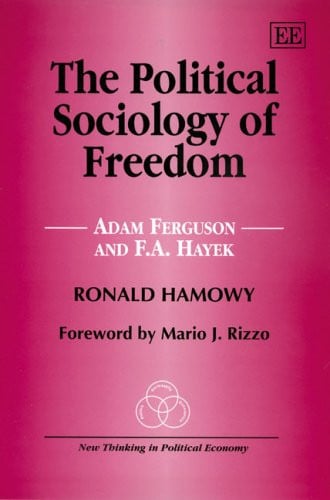
The political sociology of freedom: Adam Ferguson and F.A. Hayek

Hamowy, Ronald
Adam Ferguson and Friedrich Hayek, separated by a period of almost two hundred years, made original but similar contributions to the field of theoretical sociology. In this collection of essays, Ronald Hamowy explores the life and work of these two thinkers, giving special emphasis to their insights into the diffusion of knowledge. Ferguson, a giant of the Scottish Enlightenment, can be credited with laying the foundations of theoretical history by first proposing the idea that social institutions undergo evolutionary change. He theorized that while these institutions are formed by the actions of human beings, they are not the product of human design. Less than two centuries later, Hayek extended this insight to dealing with economic and social interaction, arguing that the knowledge requisite for structuring the social institutions under which we live is far too complex to be comprehended by any one mind or group of thinkers, and that these institutions had in fact evolved over long periods of time without deliberate design. Hayek was also the first to introduce the notion that market processes are a function of all participants contributing the limited knowledge that each possesses, out of which an orderly arrangement of enormous complexity emerges. Scholars and students of sociology, economics, history and political theory will find The Political Sociology of Freedom a unique and provocative read.
Edward Elgar 2005 265 pages

Surface and depth: dialectics of criticism and culture

Shusterman, Richard
A paradox of surface and depth pervades the field of aesthetics. How can art's surface meanings and qualities be properly appreciated without understanding the cultural context that shapes their creation and perception? But exploring such underlying cultural conditions challenges the perception of thosequalities and meanings of aesthetic surface that constitute the captivating power of art. If aesthetics deals with both surface and depth, impassioned immediacy yet also critical distance of judgment, how can this doubleness be held together in one philosophical vision? In his new book, Richard Shusterman explores the dialectics of surface and depth by examining key issues in the philosophy of art and culture?from the logic of interpretation and evaluation to the roots of taste and convention, from the meanings of aesthetic purity and immediacy to the role of nature, theory, and history in our experience and understanding of art. In treating these topics, Shusterman combines the methods of analytic philosophy, critical theory, and poststructualism to arrive at new positions, displaying the philosophical versatility, originality of vision, and graceful, accessible writing that have become his trademark. Surface and Depth is crowned by a new definition of art as dramatization.
Cornell University Press 2002 280 pages

The Canadian Naturalist

P. H. Gosse
PREFACE. THE Author of this very practical treatise on Scotch Loch - Fishing desires clearly that it may be of use to all who had it. He does not pretend to have written anything new, but to have attempted to put what he has to say in as readable a form as possible. Everything in the way of the history and habits of fish has been studiously avoided, and technicalities have been used as sparingly as possible. The writing of this book has afforded him pleasure in his leisure moments, and that pleasure would be much increased if he knew that the perusal of it would create any bond of sympathy between himself and the angling community in general. This section is interleaved with blank shects for the readers notes. The Author need hardly say that any suggestions addressed to the case of the publishers, will meet with consideration in a future edition. We do not pretend to write or enlarge upon a new subject. Much has been said and written-and well said and written too on the art of fishing but loch-fishing has been rather looked upon as a second-rate performance, and to dispel this idea is one of the objects for which this present treatise has been written. Far be it from us to say anything against fishing, lawfully practised in any form but many pent up in our large towns will bear us out when me say that, on the whole, a days loch-fishing is the most convenient. One great matter is, that the loch-fisher is depend- ent on nothing but enough wind to curl the water, -and on a large loch it is very seldom that a dead calm prevails all day, -and can make his arrangements for a day, weeks beforehand whereas the stream- fisher is dependent for a good take on the state of the water and however pleasant and easy it may be for one living near the banks of a good trout stream or river, it is quite another matter to arrange for a days river-fishing, if one is looking forward to a holiday at a date some weeks ahead. Providence may favour the expectant angler with a good day, and the water in order but experience has taught most of us that the good days are in the minority, and that, as is the case with our rapid running streams, -such as many of our northern streams are, -the water is either too large or too small, unless, as previously remarked, you live near at hand, and can catch it at its best. A common belief in regard to loch-fishing is, that the tyro and the experienced angler have nearly the same chance in fishing, -the one from the stern and the other from the bow of the same boat. Of all the absurd beliefs as to loch-fishing, this is one of the most absurd. Try it. Give the tyro either end of the boat he likes give him a cast of ally flies he may fancy, or even a cast similar to those which a crack may be using and if he catches one for every three the other has, he may consider himself very lucky. Of course there are lochs where the fish are not abundant, and a beginner may come across as many as an older fisher but we speak of lochs where there are fish to be caught, and where each has a fair chance. Again, it is said that the boatman has as much to do with catching trout in a loch as the angler. Well, we dont deny that. In an untried loch it is necessary to have the guidance of a good boatman but the same argument holds good as to stream-fishing...
Read Books 2008-10 392 pages

The new-old land of Israel

Bentwich, Norman
First published in 1960, The New-Old Land of Israel deals particularly with the excavations which have amazingly enlarged our knowledge of Bible times. The unique quality of the Bible land of Israel is that it has the thrill of a rich historic past, an ardent, bustling present and an exciting, incalculable future. It is the purpose of this book to give to the reader that thrill, to describe the historical places which have been excavated by the archaeologists and link the past with the present. It starts with a survey of Palestine archaeology in the last hundred years, and a brief history of Jerusalem through the ages. Then it gives an account of the modern big town by the sea, Tel Aviv- Jaffa, and the ancient Roman town by the sea, Caesarea; of the Philistine city of Askalon and a biblical fortress of Judaea which are again populous: of Beersheba, the home of the patriarchs Abraham and Isaac, and now a teeming modern town which grows by thousands every year, and of a Eilat, a port of King Solomon and today of Israel to the Red Sea. This is an important read for scholars and researchers of archaeology, history of Israel, Middle East history and history in general.
Routledge 2024-06-29 160 pages

Revelation and the God of Israel

Samuelson, Norbert M.
Norbert M. Samuelson asks--what is the most reasonable possible conception of the doctrine of "revelation" found in the sources of the Abrahamic religions (Judaism, Christianity, and Islam) in the light of modern challenges from academic studies of evolutionary psychology, analytic philosophy, and biblical history? The proposed answer is drawn from his extensive knowledge of western philosophy-- from ancient Greece to contemporary England and America and Jewish intellectual history from Maimonides to Buber and Rosenzweig. The book engages with the history of philosophy, religious thought and Judaism.
Cambridge University Press 2008-11-06 272 pages

Crossing the line

McKenzie, Nick
An explosive exposé and testament to the power of investigative journalismIn mid-2017, whispers from Australia's most secretive and elite military unit reached Walkley Award-winning journalist Nick McKenzie. McKenzie and veteran reporter Chris Masters began an investigation that would not only reveal shocking information about Australia's most famous and revered SAS soldier but plunge the two reporters into the defamation trial of the century.For five years, McKenzie waged an epic fight for the truth to be acknowledged, persuading special forces soldiers to reveal dark secrets about the murders of prisoners and civilians involving Victoria Cross recipient Ben Roberts-Smith.This fight to investigate allegations of war crimes and murder took McKenzie across Australia and to Afghanistan, and from the newsroom to the courtroom. It would see him sued for defamation by Ben Roberts-Smith, who denied the allegations. The reporter had to confront the powerful forces that could destroy his career and silence brave SAS soldiers who were prepared to speak up.An enthralling and meticulously researched book, Crossing the Line tells the untold story of how a small group of brave soldiers and two determined reporters exposed one of the greatest military scandals in Australian history.
Hachette Australia 2023 480 pages

War Minus the Shooting

Marqusee, Mike
Combining personal reflection and social observation, this work paints a complex portrait of a sub-continent in ferment, set against the backdrop of the 1996 cricket World Cup, the most extravagant and controversial event in the long history of the gamebook delves into the dilemmas that dog modern cricket - ball-tampering, biased umpires, media moguls and sponsors, race and national identity, gambling syndicates, and more.
Mandarin 1996 175 pages

West-Germany's foreign policy in the era of Brandt and Schmidt, 1969-1982 ; an introduction

Wolffsohn, Michael
Product Description I. The Global Context of German Foreign Policy. II. Fields of Activity (Ostpolitik, economisation of foreign policy, defence policy, German-American Relationship, Middle East, North-South, European policy). III. The Decision-Making Process (bureaucratic politics, parties, parliament, Constitutional Court). IV. Thematic Problem Areas (legitimacy, political integration, Germany's role in world politics, controversial political concepts: détente, «the nation», the second foundation of the state?; innovation and parliamentary majorities; personalistic approach; political generations; political geography; political steering.) V. An Apparaisal (turning-point in the history of West Germany's foreign relations?; historical cycles; «normal» foreign policy?; Germany's image, self perception.) Review «Ich bin überzeugt, daß W.s Studie ihrem Ziel gerecht wird, ausländischen Studenten die komplexen Zusammenhänge unserer Situation nahezubringen. Ja, ich glaube sogar, daß er manchem Kenner unserer außenpolitischen Verhältnisse Anregungen zu weiterem Nachdenken bietet.» (Arnulf Baring, Historische Zeitschrift)
P. Lang 1986 95 pages

The legacy of ad hoc tribunals in international criminal law: assessing the ICTY's and the ICTR's most significant legal accomplishments

Milena Sterio,Michael P. Scharf
"In the post-Nuremberg era two of the most important developments in international criminal law are the International Criminal Tribunal for Yugoslavia (ICTY) and the International Criminal Tribunal for Rwanda (ICTR). Created through UN Security Council resolutions, with specific mandates to prosecute those responsible for serious violations of international humanitarian law, the ICTY and the ICTR played crucial roles in the development of international criminal law. Through a series of chapters written by leading authorities in the field, this book addresses the history of the ICTY and the ICTR, and the important aspects of the tribunals' accomplishments. From examining the groundwork laid by the ICTY and the ICTR for greater international attention to crimes against humanity to the establishment of the International Criminal Courts, this volume provides a comprehensive overview of the impact and lasting roles of these tribunals"
Cambridge University Press 2019 376 pages

The Turning

Chernoff, Maxine
Poetry. "Maxine Chernoff's THE TURNING turns at the moment 'when we survive our disappearances,' 'when murder chastises history,' in other words, right now - when all that's left is the leveled playing field of the page, where graffiti scrawled on a wall is just as likely to carry import as Kristeva or Emerson or 'memory or Memorex.' In stanzas taut as guitar strings - or purse strings pulled tight against the chest - these poems recall a kind of classic Ahkmatovan cry (though they never plangent) combined with a Tsvetaeva-like pluckiness, all of which gets overridden by Chernoff's supreme humanity, ferocity, intelligence, wit, honesty: 'I had thought I knew how the world would end, but all I really know is how to stare and point.' Then the book takes yet another turn, beyond the staring and pointing" - Gillian Conoley.
Apogee Press 2008-07-16 99 pages

Camera

Chernoff, Maxine
Poetry. CAMERA is both paean and lament for a world in flux. To render such a world with its unresolvable tensions between time's embodiment and erasure is the focus of the collection. What does it mean to hold many irreconcilable presences? The task is to measure small changes, arrivals and departures. The work is a border between existence and disappearance. Moments named and described are "framed." Though the created world with its emotional truths will not last, it is a topography of words and a realm of heightened scrutiny. To hold and revere its presence is the poem's agency. A world is predicated by representation of nature, seasons, ritual, location, and the arts. Loss looming, love is attention given and the human bond holding writer and reader. "'I lifted to mind a piece of bright blue air, ' wrote Robert Creeley, in a line Maxine Chernoff quotes in CAMERA. It's apt: this is a book full of air and breezes, populated with doves and thrushes, swallows and crows. It's an earthy book, too, where tender roots push through an eroticized earth ('thigh of hill/breast of leaves/belly of witness'). It's never just a book of the body, though, or of the material world: each sharply sensed moment spirals out into history, geography, biology, or grief. It is a book where the world aspires to be voiced, and where words 'send their tendrils toward the next refrain.' CAMERA lifts a world to mind, and holds it there." --Robert Archambeau
Subito Press 2017 76 pages

Magical nominalism: the historical event, aesthetic reenchantment, and the photograph

Jay, Martin
"In this bold and wide-ranging book, intellectual historian Martin Jay traces across several centuries the conflict between two versions of nominalism-"conventional" nominalism and what he calls "magical" nominalism. According to Jay, since at least William of Ockham, the conventional form of nominalism contributed to the disenchantment of the world by rejecting the notion of general terms as anything other than names we use to group particular objects together, rejecting the idea that they have any reference to a further, "higher" reality. Magical nominalism, instead, performs a reenchanting function by investing names with an auratic power of their own. Starting with the initial revolution of nominalism against Scholastic realism, Jay proceeds to unpack various "counterrevolutions" against nominalism itself. Ranging from theology to critical theory, philosophy of history, aesthetics, and political theory, engaging with thinkers including Adorno, Barthes, Bataille, Benjamin, and Derrida; artists such as Marcel Duchamp; and a range of contemporary theorists, this book provides us with a new way to understand humanity's intellectual path to modernity and its aftermath. Focusing on fundamental debates over the relationship between language and reality, Jay shows, allows for surprising, illuminating connections across thinkers, disciplines, and vast realms of human experience"--
The University of Chicago 2025 389 pages

Jerusalem crucified, Jerusalem risen: the resurrected Messiah, the Jewish people, and the land of promise

Kinzer, Mark
The good news (euangelion) of the crucified and risen Messiah was proclaimed first to Jews in Jerusalem, and then to Jews throughout the land of Israel. In Jerusalem Crucified, Jerusalem Risen, Mark Kinzer argues that this initial audience and geographical setting of the euangelion is integral to the eschatological content of the message itself. While the good news is universal in concern and cosmic in scope, it never loses its particular connection to the Jewish people, the city of Jerusalem, and the land of Israel. The crucified Messiah participates in the future exilic suffering of his people, and by his resurrection offers a pledge of Jerusalem's coming redemption. Basing his argument on a reading of the Acts of the Apostles and the Gospel of Luke, Kinzer proposes that the biblical message requires its interpreters to reflect theologically on the events of post-biblical history. In this context he considers the early emergence of Rabbinic Judaism and the much later phenomenon of Zionism, offering a theological perspective on these historical developments that is biblically-rooted, attentive to both Jewish and Christian tradition, and minimalist in the theological constraints it imposes on the just resolution of political conflict in the Middle East.
Cascade Books, an imprint of Wipf and Stock Publishers 2018-10-30 325 pages

Hello. This is Jane.

Judith Arcana
"Judith Arcana's remarkable feat in Hello. This is Jane. is to paint, tile by tile, a complex mosaic of compelling linked stories- children's playgrounds and adult tattoo parlors, ill-advised lovers and underground abortion activists. In the mainstream and on the edges, you'll feel the urgency of the struggle for reproductive justice as you turn these pages." -Cindy Cooper, Founding Director of Words of Choice and The Reproductive Freedom Festival, Judith Arcana has taught and written about motherhood and reproductive justice for decades. The prose and poetry of Our Mothers' Daughters, Every Mother's Son, and What if your mother are feminist classics. The stories in this new collection, rooted in her experience as a Jane in Chicago's pre-Roe v. Wade underground abortion service, were written as the United States has moved relentlessly into constraining motherhood and denying reproductive justice. By necessity, these stories reach from the past into the future, offering history and hope. "I'm profoundly grateful to Judith Arcana for writing these vital, electrifying stories. With abortion rights in America being stripped away-state by state, clinic by clinic-we need to hear from those who've fought this battle before. Arcana is a Jane; her work in the pre-Roe abortion underground has provide the seeds for her fiction, stories rooted in essential history to spark action in our terrifying present." -Leni Zumas, Author of Red Clocks
Left Fork 2020-05-03 226 pages

Texts without referents: reconciling science and narrative

Margolis, Joseph
"Texts Without Referents" offers a detailed and systematic theory of human culture, ranging across both Anglo-American and Continental European philosophy, and their allied disciplines. In it Joseph Margolis provides an account of history and interpretation and the ontology of cultural entities (persons, artefacts, artworks, words and sentences, actions, institutions, societies). Central to the book is the question of the coherent relationship between the human and the natural sciences. The author elaborates a theory that may be said to question, and challenge, the traditional emphasis given in the Western philosophical canon to the subordination of the human sciences to the physical sciences. Margolis' strategy is to show the strong conceptual evidence offered by such diverse movements as pragmatism, naturalism, phenomenology, deconstruction, Marxism, Frankfurt Critical Theory, hermeneutics, and Wittgensteinian and Nietzschean currents, for overturning this ranking. Margolis argues that it is the physical sciences that depend on the human for their distinctive rigour, and that they need to be brought under the larger constraints of social existence if, together, they are to yield a coherent and comprehensive picture of the full powers of human inquiry. This, the third volume in Margolis' trilogy, brings the issues of the first two volumes together, reworking them within a general theory of cultural life. A number of strategic questions are examined, including the nature of texts, reference, selves, praxis, thinking, and historical time. Expansive and challenging, it represents the climax to an ambitious reassessment of the relationship, within the world of culture, between the natural and the human sciences, and a reassessment of the complexities of human existence. The books is aimed at students and specialists in philosophy, social theory and the philosophy of culture.
Basil Blackwell 1989 386 pages