58,196 results in 0.07 seconds

The Singularity Is Nearer

Kurzweil, Ray
"This successor volume to The Singularity Is Near explores how technology will refashion the human race in the decades to come. In this entirely new book, Ray Kurzweil brings a fresh perspective to advances in the singularity-assessing the progress of many of his predictions and examining the novel advancements that, in the near future, will bring a revolution in knowledge and an expansion of human potential. Among the topics he discusses are rebuilding the world atom by atom with devices like nanobots; radical life extension beyond the current age limit of 120; reinventing intelligence by expanding biological capacity with nonbiological intelligence in the cloud; how life is improving with declines in poverty and violence; and the growth of technologies that can be applied to everything from clothes to building materials to growing human organs. He also considers the potential perils of biotechnology, nanotechnology, and artificial intelligence, including such topics as how AI will impact unemployment and the safety of autonomous cars, and "After Life" technology, which will reanimate people who have passed away through a combination of data and DNA"--
Penguin USA 2025-06-03 432 pages

Hope in the dark: untold histories, wild possibilities

Solnit, Rebecca
With Hope in the Dark, Rebecca Solnit makes a radical case for hope as a commitment to act in a world whose future remains uncertain and unknowable. Drawing on her decades of activism and a wide reading of environmental, cultural, and political history, Solnit argued that radicals have a long, neglected history of transformative victories, that the positive consequences of our acts are not always immediately seen, directly knowable, or even measurable, and that pessimism and despair rest on an unwarranted confidence about what is going to happen next.
Haymarket Books 2016 152 pages

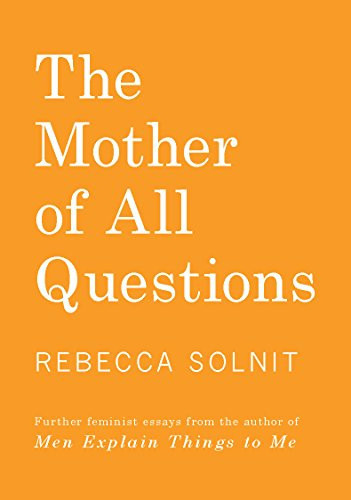
The Mother of All Questions

Rebecca Solnit
In a timely follow-up to her national bestseller Men Explain Things to Me, Rebecca Solnit offers indispensable commentary on women who refuse to be silenced, misogynistic violence, the fragile masculinity of the literary canon, the gender binary, the recent history of rape jokes, and much more. In characteristic style, Solnit mixes humor, keen analysis, and powerful insight in these essays.
Haymarket Books 2019-09-20 192 pages

Altered traits: science reveals how meditation changes your mind, brain, and body

Goleman, Daniel,Davidson, Richard J.
More than forty years ago, two friends and collaborators at Harvard, Daniel Goleman and Richard Davidson were unusual in arguing for the benefits of meditation. Now, as mindfulness and other brands of meditation become ever more popular, promising to fix everything from our weight to our relationship to our professional career, these two bestselling authors sweep away the misconceptions around these practices and show how smart practice can change our personal traits and even our genome for the better. Drawing on cutting-edge research, Goleman and Davidson expertly reveal what we can learn from a one-of-a-kind data pool that includes world-class meditators. They share for the first time remarkable findings that show how meditation - without drugs or high expense - can cultivate qualities such as selflessness, equanimity, love and compassion, and redesign our neural circuitry. Demonstrating two master thinkers at work, The Science of Meditation explains precisely how mind training benefits us. More than daily doses or sheer hours, we need smart practice, including crucial ingredients such as targeted feedback from a master teacher and a more spacious worldview. Gripping in its storytelling and based on a lifetime of thought and action, this is one of those rare books that has the power to change us at the deepest level.
Avery 2017-09-05 330 pages

The Feynman Lectures on Physics - Vol. I, II & III Bundle

Richard P. Feynman,Robert B. Leighton,Matthew Sands
Timeless and collectible, The Feynman Lectures on Physics bundle are essential reading, not just for students of Physics, but for anyone seeking an insightful introduction to the field from the inimitable Richard P. Feynman.Published by Pearson Education, this set of books consists of The Feynman Lectures on Physics: The Millenium Edition, Vol. 1 by Feynman (9788131792117), The Feynman Lectures on Physics: The Millenium Edition, Vol. 2 by Feynman (9788131792124) and The Feynman Lectures on Physics: The Millenium Edition, Vol. 3 by Feynman (9788131792131). These carefully selected books will enable science graduates to master their subject and will prove to be ideal companions in their academic journeys.
Pearson 2012 1552 pages

The color of law: a forgotten history of how our government segregated America

Rothstein, Richard
In this groundbreaking history of the modern American metropolis, Richard Rothstein, a leading authority on housing policy, explodes the myth that America's cities came to be racially divided through de facto segregation--that is, through individual prejudices, income differences, or the actions of private institutions like banks and real estate agencies. Rather, The Color of Law incontrovertibly makes it clear that it was de jure segregation--the laws and policy decisions passed by local, state, and federal governments--that actually promoted the discriminatory patterns that continue to this day.
Liveright Publishing Corporation, a division of W. W. Norton & Company 2017-05-02 345 pages

Master of the Senate

Caro, Robert A.
Master of the Senate, Book Three of The Years of Lyndon Johnson, carries Johnson’s story through one of its most remarkable periods: his twelve years, from 1949 to 1960, in the United States Senate. A Los Angeles Times Best Nonfiction Book of the Last 30 Years At the heart of the book is its unprecedented revelation of how legislative power works in America, how the Senate works, and how Johnson, in his ascent to the presidency, mastered the Senate as no political leader before him had ever done. It was during these years that all Johnson’s experience—from his Texas Hill Country boyhood to his passionate representation in Congress of his hardscrabble constituents to his tireless construction of a political machine—came to fruition. Caro introduces the story with a dramatic account of the Senate itself: how Daniel Webster, Henry Clay, and John C. Calhoun had made it the center of governmental energy, the forum in which the great issues of the country were thrashed out. And how, by the time Johnson arrived, it had dwindled into a body that merely responded to executive initiatives, all but impervious to the forces of change. Caro anatomizes the genius for political strategy and tactics by which, in an institution that had made the seniority system all-powerful for a century and more, Johnson became Majority Leader after only a single term-the youngest and greatest Senate Leader in our history; how he manipulated the Senate’s hallowed rules and customs and the weaknesses and strengths of his colleagues to change the “unchangeable” Senate from a loose confederation of sovereign senators to a whirring legislative machine under his own iron-fisted control. Caro demonstrates how Johnson’s political genius enabled him to reconcile the unreconcilable: to retain the support of the southerners who controlled the Senate while earning the trust—or at least the cooperation—of the liberals, led by Paul Douglas and Hubert Humphrey, without whom he could not achieve his goal of winning the presidency. He shows the dark side of Johnson’s ambition: how he proved his loyalty to the great oil barons who had financed his rise to power by ruthlessly destroying the career of the New Dealer who was in charge of regulating them, Federal Power Commission Chairman Leland Olds. And we watch him achieve the impossible: convincing southerners that although he was firmly in their camp as the anointed successor to their leader, Richard Russell, it was essential that they allow him to make some progress toward civil rights. In a breathtaking tour de force, Caro details Johnson’s amazing triumph in maneuvering to passage the first civil rights legislation since 1875. Master of the Senate, told with an abundance of rich detail that could only have come from Caro’s peerless research, is both a galvanizing portrait of the man himself—the titan of Capital Hill, volcanic, mesmerizing—and a definitive and revelatory study of the workings and personal and legislative power.
Knopf 2002-04-23 1167 pages

The years of Lyndon Johnson. Volume 1. The path to power

Caro, Robert A.
'The greatest biography of our era ... Essential reading for those who want to comprehend power and politics ' The Times Robert A. Caro's legendary, multi-award-winning biography of US President Lyndon Johnson is a uniquely riveting and revelatory account of power, political genius and the shaping of twentieth-century America. This first instalment tells of the rise to national power of a desperately poor young man from the Texas Hill Country, revealing in extraordinary detail the genesis of the almost superhuman drive, energy and ambition that set LBJ apart. It charts his boyhood through the years of the Depression to his debut as a Congressman, his heartbreaking defeat in his first race for the Senate and his attainment, nonetheless, at the age of thirty-one of the power for which he hungered.
The Bodley Head 2019-07-04 882 pages

The years of Lyndon Johnson

Caro, Robert A.
The Years of Lyndon Johnson is the political biography of our time. No president—no era of American politics—has been so intensively and sharply examined at a time when so many prime witnesses to hitherto untold or misinterpreted facets of a life, a career, and a period of history could still be persuaded to speak. The Path to Power, Book One, reveals in extraordinary detail the genesis of the almost superhuman drive, energy, and urge to power that set LBJ apart. Chronicling the startling early emergence of Johnson’s political genius, it follows him from his Texas boyhood through the years of the Depression in the Texas hill Country to the triumph of his congressional debut in New Deal Washington, to his heartbreaking defeat in his first race for the Senate, and his attainment, nonetheless, of the national power for which he hungered. We see in him, from earliest childhood, a fierce, unquenchable necessity to be first, to win, to dominate—coupled with a limitless capacity for hard, unceasing labor in the service of his own ambition. Caro shows us the big, gangling, awkward young Lyndon—raised in one of the country’s most desperately poor and isolated areas, his education mediocre at best, his pride stung by his father’s slide into failure and financial ruin—lunging for success, moving inexorably toward that ultimate “impossible” goal that he sets for himself years before any friend or enemy suspects what it may be. We watch him, while still at college, instinctively (and ruthlessly) creating the beginnings of the political machine that was to serve him for three decades. We see him employing his extraordinary ability to mesmerize and manipulate powerful older men, to mesmerize (and sometimes almost enslave) useful subordinates. We see him carrying out, before his thirtieth year, his first great political inspiration: tapping-and becoming the political conduit for-the money and influence of the new oil men and contractors who were to grow with him to immense power. We follow, close up, the radical fluctuations of his relationships with the formidable “Mr. Sam” Raybum (who loved him like a son and whom he betrayed) and with FDR himself. And we follow the dramas of his emotional life-the intensities and complications of his relationships with his family, his contemporaries, his girls; his wooing and winning of the shy Lady Bird; his secret love affair, over many years, with the mistress of one of his most ardent and generous supporters . . . Johnson driving his people to the point of exhausted tears, equally merciless with himself . . . Johnson bullying, cajoling, lying, yet inspiring an amazing loyalty . . . Johnson maneuvering to dethrone the unassailable old Jack Garner (then Vice President of the United States) as the New Deal’s “connection” in Texas, and seize the power himself . . . Johnson raging . . . Johnson hugging . . . Johnson bringing light and, indeed, life to the worn Hill Country farmers and their old-at-thirty wives via the district’s first electric lines. We see him at once unscrupulous, admirable, treacherous, devoted. And we see the country that bred him: the harshness and “nauseating loneliness” of the rural life; the tragic panorama of the Depression; the sudden glow of hope at the dawn of the Age of Roosevelt. And always, in the foreground, on the move, LBJ. Here is Lyndon Johnson—his Texas, his Washington, his America—in a book that brings us as close as we have ever been to a true perception of political genius and the American political process.
Knopf 1982-11-12 882 pages

Maxwell Daily Reader 365 Days of Insight to Develop the Leader Within You and Influence Those Around You

John C. Maxwell
Actively grow your leadership skills day-by-day with this timeless wisdom--comprised from fourteen of New York Times bestselling author John C. Maxwell's greatest leadership books. The Maxwell Daily Reader draws its unique power from an ageless truth: the heart of leadership is created by actions--big and small--put into practice one day at a time. Each person has inborn potential to be a great leader. Each day's message in this 365-day reader will equip you with the inspiration and advice to unlock your full leadership potential. Daily entries contain an excerpt from one of Maxwell's books that helps: Encourage and inspire you Teach you to lead Challenge you to be better Prompt you to grow The secret to your success can be found in your daily agenda. People who achieve their potential do so because they invest in themselves every day. They take the time to add value to themselves and because of that, they are also able to add value to others. Easily accessible and highly actionable, this is the very best of John C. Maxwell, and it will bring out the very best of the leader in everyone.
Thomas Nelson Inc 2011-04-18 432 pages

Bowling alone: the collapse and revival of American community

Putnam, Robert D.
Once we bowled in leagues, usually after work; but no longer. This seemingly small phenomenon symbolizes a significant social change. Drawing on surveys on Americans' changing behavior over the past twenty-five years, Putnam shows how we have become increasingly disconnected from family, friends, neighbors, and social structures, whether the PTA, church, recreation clubs, political parties, or bowling leagues. Our shrinking access to the "social capital" that is the reward of communal activity and community sharing is a serious threat to our civic and personal health. The loss of social capital is felt in critical ways : communities with less social capital have lower educational performance and more teen pregnancy, child suicide, low birth weight, and prenatal mortality. Social capital is also a strong predictor of crime rates, other measures of neighborhood quality of life, and health. America has faced this crisis before. At the turn of the last century, social capital was at low ebb, reduced by urbanization, industrialization, and vast immigration that uprooted Americans from their friends, social institutions, and families. Faced with this challenge, the country righted itself. Within a few decades, a range of organizations was created, from the Red Cross, Boy Scouts, and YWCA to Hadassah and the Knights of Columbus and the Urban League and social capital was rebuilt. Putnam calls on Americans to start the process again.
Simon & Schuster 2001 541 pages

The worldly philosophers: the lives, times, and ideas of the great economic thinkers

Heilbroner, Robert L.
The bestselling classic that examines the history of economic thought from Adam Smith to Karl Marx—“all the economic lore most general readers conceivably could want to know, served up with a flourish” ( The New York Times ). The Worldly Philosophers not only enables us to see more deeply into our history but helps us better understand our own times. In this seventh edition, Robert L. Heilbroner provides a new theme that connects thinkers as diverse as Adam Smith and Karl Marx. The theme is the common focus of their highly varied ideas—namely, the search to understand how a capitalist society works. It is a focus never more needed than in this age of confusing economic headlines. In a bold new concluding chapter entitled “The End of the Worldly Philosophy?” Heilbroner reminds us that the word “end” refers to both the purpose and limits of economics. This chapter conveys a concern that today’s increasingly “scientific” economics may overlook fundamental social and political issues that are central to economics. Thus, unlike its predecessors, this new edition provides not just an indispensable illumination of our past but a call to action for our future.
Simon & Schuster 1999 365 pages

A Night in Terror Tower (Classic Goosebumps #12)

Stine, R. L.
Sue and her brother, Eddie, are visiting London when they run into a little problem. They can't find their tour group. Still, there's no reason to panic. No way their tour guide would just leave them. All alone. In a gloomy old prison tower. No way they'd get locked inside. After dark. With those eerie sounds. And a strange dark figure who wants them...dead. A favorite Goosebumps, now with all-new bonus features including author secrets, fear facts, haunting games, and more!
Scholastic Paperbacks 2009 129 pages

Night of the Living Dummy II

R. L. Stine
They're baa-ack! Make way for the bestselling children's series of all time! With a fresh new look, GOOSEBUMPS is set to scare a whole new generation of kids. So reader beware--you're in for a scare! He's still walking. He's still stalking. Amy's ventriloquist dummy, Dennis, keeps losing his head -- for real. So Amy begs her family for a new dummy. That's when her dad finds Slappy in a local pawnshop. Slappy's kind of ugly, but at least his head stays on! And besides, Amy's having fun practicing her new routine. It's like this dummy knows what she's thinking. Like he can move on his own. And it's great - until Slappy starts a routine of his own. A nasty, horrible routine. And Amy can't control him....
Scholastic 1995 120 pages

It's perfectly normal: changing bodies, growing up, sex, gender, and sexual health

Harris, Robie H.
Fully and fearlessly updated, this vital new edition of the acclaimed book on sex, sexuality, bodies, and puberty deserves a spot in every family’s library. With more than 1.5 million copies in print, It’s Perfectly Normal has been a trusted resource on sexuality for more than twenty-five years. Rigorously vetted by experts, this is the most ambitiously updated edition yet, featuring to-the-minute information and language accompanied by new and refreshed art. Updates include : * A shift to gender-neutral vocabulary throughout * An expansion on LGBTQIA topics, gender identity, sex, and sexuality—making this a sexual health book for all readers * Coverage of recent advances in methods of sexual safety and contraception with corresponding illustrations * A revised section on abortion, including developments in the shifting politics and legislation as well as an accurate, honest overview * A sensitive and detailed expansion on the topics of sexual abuse, the importance of consent, and destigmatizing HIV/AIDS * A modern understanding of social media and the internet that tackles rapidly changing technology to highlight its benefits and pitfalls and ways to stay safe online Inclusive and accessible, this newest edition of It’s Perfectly Normal provides young people with the knowledge and vocabulary they need to understand their bodies, relationships, and identities in order to make responsible decisions and stay healthy.
Candlewick Press 2021-05-18 128 pages

The Warburgs: the twentieth-century odyssey of a remarkable Jewish family

Chernow, Ron
From the Pulitzer Prize–winning bestselling author of Alexander Hamilton , the inspiration for the hit Broadway musical, comes this definitive biography of the Warburgs, one of the great German-Jewish banking families of the twentieth century. Bankers, philanthropists, scholars, socialites, artists, and politicians, the Warburgs stood at the pinnacle of German (and, later, of German-American) Jewry. They forged economic dynasties, built mansions and estates, assembled libraries, endowed charities, and advised a German kaiser and two American presidents. But their very success made the Warburgs lightning rods for anti-Semitism, and their sense of patriotism became increasingly dangerous in a Germany that had declared Jews the enemy. Ron Chernow's hugely fascinating history is a group portrait of a clan whose members were renowned for their brilliance, culture, and personal energy yet tragically vulnerable to the dark and irrational currents of the twentieth century.
Vintage Books, a division of Random House LLC 2016-11-15 820 pages