14302 results for "History"

Conversations with Wilder

Billy Wilder,Cameron Crowe
In Conversations with Wilder, Hollywood's legendary and famously elusive director Billy Wilder agrees for the first time to talk extensively about his life and work. Here, in an extraordinary book with more than 650 black-and-white photographs -- including film posters, stills, grabs, and never-before-seen pictures from Wilder's own collection -- the ninety-three-year-old icon talks to Cameron Crowe, one of today's best-known writer-directors, about thirty years at the very heart of Hollywood, and about screenwriting and camera work, set design and stars, his peers and their movies, the studio system and films today. In his distinct voice we hear Wilder's inside view on his collaborations with such stars as Barbara Stanwyck, Gary Cooper, Marilyn Monroe, Jack Lemmon, Tony Curtis, William Holden, Audrey Hepburn, and Greta Garbo (he was a writer at MGM during the making of "Ninotchka." Here are Wilder's sharp and funny behind-the-scenes stories about the making of "A Foreign Affair, Double Indemnity, Sunset Boulevard, Love in the Afternoon, Some Like It Hot, The Apartment," and "Ace in the Hole," among many others. Wilder is ever mysterious, but Crowe gets him to speak candidly on Stanwyck: "She knew the script, everybody's lines, never a fault, never a mistake"; on Cary Grant: "I had Cary Grant in mind for four of my pictures . . . slipped through my net every time"; on the "Lubitsch Touch" "It was the elegant use of the super-joke." Wilder also remembers his early years in Vienna, working as a journalist in Berlin, rooming with Peter Lorre at the Chateau Marmont -- always with the same dry wit, tough-minded romanticism, and elegance that are the hallmarks of Wilder's films. This book is a classic of Hollywood history and lore.
Knopf 1999 373 pages

100 people who are screwing up America

Goldberg, Bernard
The number one New York Times bestselling author of Bias delivers another bombshell—this time aimed at . . . 100 People Who Are Screwing Up America No preaching. No pontificating. Just some uncommon sense about the things that have made this country great—and the culprits who are screwing it up. Bernard Goldberg takes dead aim at the America Bashers (the cultural elites who look down their snobby noses at "ordinary" Americans) . . . the Hollywood Blowhards (incredibly ditzy celebrities who think they're smart just because they're famous) . . . the TV Schlockmeisters (including the one whose show has been compared to a churning mass of maggots devouring rotten meat) . . . the Intellectual Thugs (bigwigs at some of our best colleges, whose views run the gamut from left wing to far left wing) . . . and many more. Goldberg names names, counting down the villains in his rogues' gallery from 100 all the way to 1—and, yes, you-know-who is number 37. Some supposedly "serious" journalists also made the list, including the journalist-diva who sold out her integrity and hosted one of the dumbest hours in the history of network television news. And there are those famous miscreants who have made America a nastier place than it ought to be—a far more selfish, vulgar, and cynical place. But Goldberg doesn't just round up the usual suspects we have come to know and detest. He also exposes some of the people who operate away from the limelight but still manage to pull a lot of strings and do all sorts of harm to our culture. Most of all, 100 People Who Are Screwing Up America is about a country where as long as anything goes, as one of the good guys in the book puts it, sooner or later everything will go. This is serious stuff for sure. But Goldberg will also make you laugh as he harpoons scoundrels like the congresswoman who thinks there aren't enough hurricanes named after black people, and the environmentalist to the stars who yells at total strangers driving SUVs—even though she tools around the country in a gas-guzzling private jet. With Bias, Bernard Goldberg took us behind the scenes and exposed the way Big Journalism distorts the news. Now he has written a book that goes even further. This time he casts his eye on American culture at large—and the result is a book that is sure to become the voice of all those Americans who feel that no one is speaking for them on perhaps the most vital issue of all: the kind of country in which we want to live.
HarperCollins 2005-07-05 305 pages

Underground airlines

Winters, Ben H.
'The most timely of alternate history novels. Ben Winters has created a spellbinding world that forces the reader to look around-and to look within. This is a thriller not to be missed and one that will not be easily forgotten.' Hugh Howey It is the present-day, and the world is as we know it. Except for one thing- slavery still exists. Victor has escaped his life as a slave, but his freedom came at a high price. Striking a bargain with the government, he has to live his life working as a bounty hunter. And he is the best they've ever trained. A mystery to himself, Victor tries to suppress his memories of his own childhood and convinces himself that he is just a good man doing bad work, unwilling to give up the freedom he is desperate to preserve. But in tracking his latest target, he can sense that that something isn't quite right. For this fugitive is a runaway holding something extraordinary. Something that could change the state of the country forever. And in his pursuit, Victor discovers secrets at the core of his country's arrangement with the system that imprisoned him, secrets that will be preserved at any cost. 'It is a rare thing when a writer has a fresh new provocative idea - and then executes it beautifully. This is what Ben H. Winters has done in his novel Underground Airlines. Imagine an America in which slavery still exists. Now imagine a dramatic telling of the story.' James Patterson
Arrow Books 2017-05-18 327 pages

Essays on the Great Depression

Bernanke, Ben
Few periods in history compare to the Great Depression. Stock market crashes, bread lines, bank runs, and wild currency speculation were worldwide phenomena--all occurring with war looming in the background. This period has provided economists with a marvelous laboratory for studying the links between economic policies and institutions and economic performance. Here, Ben Bernanke has gathered together his essays on why the Great Depression was so devastating. This broad view shows us that while the Great Depression was an unparalleled disaster, some economies pulled up faster than others, and some made an opportunity out of it. By comparing and contrasting the economic strategies and statistics of the world's nations as they struggled to survive economically, the fundamental lessons of macroeconomics stand out in bold relief against a background of immense human suffering. The essays in this volume present a uniquely coherent view of the economic causes and worldwide propagation of the depression.
Princeton University Press 2004-01-25 310 pages

Desert notebooks: a road map for the end of time

Ehrenreich, Ben
"A book about the literal and figurative end of time and what that means for us as conscious beings, Desert Notebooks looks at how both the unprecedented pace of destruction to our environment and our increasingly unstable global socio-political institutions have led to an existential crisis orders of magnitude greater than any humankind has confronted before. As inhabitants of the Anthropocene what might some of our own histories tell us about how to grapple with apocalypse? And how might the geologies and ecologies of desert spaces inform how we see and act towards time? Employing an elegant, discursive style that interweaves memoir with science writing, creation myths, and history, National Magazine Award winner and The Nation columnist Ben Ehrenreich uses the desolate landscape of the American desert -the main locales for the book are Joshua Tree and Las Vegas- as a springboard to examine how we formulate our concepts of time and what it means to confront the looming apocalypse. Desert Notebooks is a moving confrontation with Deep Time and a meditation on landscape in the face of climate change. Faced with an uncertain future, Ehrenreich argues there is comfort in reflecting on the role we humans have played in our own demise in the past. The difference is that this time the clock may finally be running out for good"--
Counterpoint Press 2020 325 pages

Amongst our weapons

Aaronovitch, Ben
THE BRAND NEW NOVEL IN THE #1 BESTSELLING RIVERS OF LONDON SERIES There is a world hidden underneath this great city... The London Silver Vaults - for well over a century, the largest collection of silver for sale in the world. It has more locks than the Bank of England and more cameras than a celebrity punch-up. Not somewhere you can murder someone and vanish without a trace - only that's what happened. The disappearing act, the reports of a blinding flash of light and memory loss amongst the witnesses all make this a case for Detective Constable Peter Grant and the Special Assessment Unit. Alongside their boss DCI Thomas Nightingale, the SAU find themselves embroiled in a mystery that encompasses London's tangled history, foreign lands and, most terrifying of all, the North! And Peter must solve this case soon because back home his partner Beverley is expecting twins any day now. But what he doesn't know is that he's about to encounter something - and somebody - that nobody ever expects... Effortlessly original, endlessly inventive and hugely entertaining - step into the world of the much-loved, Number One bestselling Rivers of London series. * * * * * PRAISE FOR BEN AARONOVITCH & THE RIVERS OF LONDON SERIES: 'Highly entertaining' SUNDAY EXPRESS 'Charming, witty, exciting' THE INDEPENDENT 'Ben Aaronovitch has created a wonderful world full of mystery, magic and fantastic characters. I love being there more than the real London' NICK FROST 'As brilliant and funny as ever ... Masterfully crafted - gives the late, great Terry Pratchett a run for his money' THE SUN 'An incredibly fast-moving magical joyride for grown-ups' THE TIMES 'Funny and wildly inventive' MAIL ON SUNDAY Discover why this incredible series has sold over two million copies worldwide. If you're a fan of Terry Pratchett, you will love the imaginative, irreverent and all-round irresistible RIVERS OF LONDON books.
Orion Books 2022-04-07 404 pages

Female chauvinist pigs: women and the rise of raunch culture

Levy, Ariel
A classic work on gender culture exploring how the women’s movement has evolved to Girls Gone Wild in a new, self-imposed chauvinism. In the tradition of Susan Faludi’s Backlash and Naomi Wolf’s The Beauty Myth , New York Magazine writer Ariel Levy studies the effects of modern feminism on women today. Meet the Female Chauvinist Pig—the new brand of “empowered woman” who wears the Playboy bunny as a talisman, bares all for Girls Gone Wild, pursues casual sex as if it were a sport, and embraces “raunch culture” wherever she finds it. If male chauvinist pigs of years past thought of women as pieces of meat, Female Chauvinist Pigs of today are doing them one better, making sex objects of other women—and of themselves. They think they’re being brave, they think they’re being funny, but in Female Chauvinist Pigs , Ariel Levy asks if the joke is on them. In her quest to uncover why this is happening, Levy interviews college women who flash for the cameras on spring break and teens raised on Paris Hilton and breast implants. She examines a culture in which every music video seems to feature a stripper on a pole, the memoirs of porn stars are climbing the bestseller lists, Olympic athletes parade their Brazilian bikini waxes in the pages of Playboy, and thongs are marketed to prepubescent girls. Levy meets the high-powered women who create raunch culture—the new oinking women warriors of the corporate and entertainment worlds who eagerly defend their efforts to be “one of the guys.” And she traces the history of this trend back to conflicts between the women’s movement and the sexual revolution long left unresolved. Levy pulls apart the myth of the Female Chauvinist Pig and argues that what has come to pass for liberating rebellion is actually a kind of limiting conformity. Irresistibly witty and wickedly intelligent, Female Chauvinist Pigs makes the case that the rise of raunch does not represent how far women have come, it only proves how far they have left to go.
Free Press 2006-10-03 236 pages

Annie Leibovitz at work

Leibovitz, Annie
In this newly revised edition of her seminal work, Leibovitz addresses young photographers and readers interested in what photographers do, but any reader interested in contemporary history will be fascinated by her account of one of the richest bodies of work in the photographic canon. 00The subjects include photojournalism, studio work, photographing dancers and athletes, working with writers, and making the transition from shooting with film to working with digital cameras. Originally published in 2008 and then updated and reissued in 2018, this revised and updated edition brings Leibovitz's bestselling book up to date, showcasing some of her most recent work. The photographs discussed include: portraits of the Rolling Stones, John Lennon and Yoko Ono, Meryl Streep, Keith Haring, Joan Didion, Mikhail Baryshnikov, Patti Smith, William S. Burroughs, Rihanna, Agnes Martin, HRH Queen Elizabeth II, and Barack Obama.
Phaidon Press Inc 2024 275 pages

Fermat's last theorem: unlocking the secret of an ancient mathematical problem

Aczel, Amir D.
Over three hundred years ago, a French scholar scribbled a simple theorem in the margin of a book. It would become the world's most baffling mathematical mystery. Simple, elegant, and utterly impossible to prove, Fermat's Last Theorem captured the imaginations of amateur and professional mathematicians for over three centuries. For some it became a wonderful passion. For others it was an obsession that led to deceit, intrigue, or insanity. In a volume filled with the clues, red herrings, and suspense of a mystery novel, Dr. Amir Aczel reveals the previously untold story of the people, the history, and the cultures that lie behind this scientific triumph. From formulas devised for the farmers of ancient Babylonia to the dramatic proof of Fermat's theorem in 1993, this extraordinary work takes us along on an exhilarating intellectual treasure hunt. Revealing the hidden mathematical order of the natural world in everything from stars to sunflowers, Fermat's Last Theorem brilliantly combines philosophy and hard science with investigative journalism. The result: a real-life detective story of the intellect, at once intriguing, thought-provoking, and impossible to put down.
Four Walls Eight Windows 1996-10-20 147 pages

The Trials Of Zion

Dershowitz, Alan M.
50 years after Leon Uris's book, Exodus, which told the tumultuous and inspiring story of the founding of the state of Israel, celebrated attorney and bestselling author Alan M. Dershowitz has produced a thrilling novel of Israel today, a place where warring factions from within and outside the Middle East continue to battle for the soul of a land they all regard as holy. A shocking act of terror brings the simmering tensions of the Holy Land to the point of explosion. As the internal conflicts of this troubled region threaten to erupt in, a young Jewish-American lawyer joins the defense team of an arrested but possibly innocent Palestinian. Soon the lawyer's father, a famed criminal attorney, must win the Palestinian's case in court or risk losing his daughter forever. To solve the case, he must take into account the history of the Holy Land as it was experienced by people on all sides. THE TRIALS OF ZION combines the tension of the greatest courtroom dramas with the action of a fast-moving thriller, all set against the backdrop of one of the most colorful, complex and historically significant cultural settings in the world.
Grand Central Publishing 1960-01-01 400 pages

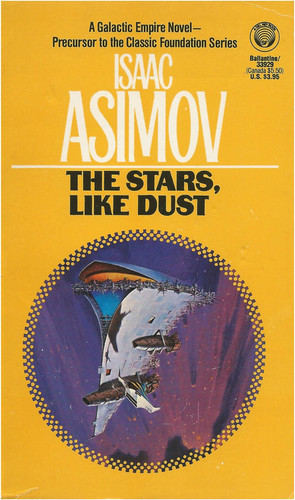
The Stars, Like Dust

Isaac Asimov
The first book in the Galactic Empire series, the spectacular precursor to the classic Foundation series, by one of history's most influential writers of science fiction, Isaac Asimov His name was Biron Farrill and he was a student at the University of Earth. A native of one of the helpless Nebular Kingdoms, he saw his home world conquered and controlled by the planet Tyrann--a ruthless, barbaric Empire that was building a dynasty of cruelty and domination among the stars. Farrill's own father had been executed for trying to resist the Tyrann dictatorship and now someone was trying to kill Biron. But why? His only hope for survival lay in fleeing Earth and joining the rebellion that was rumored to be forming somewhere in the Kingdoms. But once he cast his lot with the freedom fighters, he would find himself guarding against treachery on every side and facing the most difficult choice of all: to betray either the woman he loved or the revolution that was the last hope for the future.
Ballantine books 1986 231 pages

With Wings Like Eagles The Untold Story of the Battle of Britain

Michael Korda
In the summer of 1940, fewer than three thousand young fighter pilots of the Royal Air Force stood between Hitler and the victory that seemed almost within his grasp. In this superb history of three epic months that saved the world, Michael Korda brilliantly re-creates the intensity of combat in "the long, delirious, burning blue" of the sky above southern England—while tracing, perhaps for the first time, the entire complex web of political, diplomatic, scientific, industrial, and human decisions during the 1930s that inexorably led to the world's first, greatest, and most decisive air battle. With Wings Like Eagles brings to vivid life the extraordinary men and women on both sides of the conflict—from Winston Churchill, Neville Chamberlain, and Reichsmarschall Hermann GÖring to the ground crews, the German pilots, the American volunteers, and the courageous airmen and airwomen of the RAF.
HarperCollins 2010-01-19 352 pages

The dream life: movies, media, and the mythology of the sixties

Hoberman, J.
A witty and penetrating look at the celluloid culture of the 1960s by the Village Voice 's celebrated film critic. In The Dream Life , Village Voice film critic J. Hoberman turns his attention to the 1960s, the era when politics and culture became one. With wildly entertaining reinterpretations of key Hollywood movies (such as Dr. Strangelove, Bonnie and Clyde, The Wild Bunch , and Shampoo ), Hoberman reconstructs the hidden political history of 1960s cinema. Meanwhile, against the pageantry of four national elections1960 to 1972he describes the formation of America's spectacular, image-laden political culture. In the era when the missile gap, the sexual revolution, and the Vietnam War became inseparable from the triumph of television, the development of political image-making, and the advent of Pop Art, American politics, mass media, and publicity became the new social spectacle. Through meditations on the personas of Che Guevara, John Wayne, Patty Hearst, Jane Fonda, Ronald Reagan, and Dirty Harry, Hoberman moves deftly between the political backgrounds of movies and the fantastic dimensions of politics, producing a brilliant and comic cultural history of the rise of our mass-mediated politics.
New Press 2003 461 pages

The Romanovs: 1613-1918

Sebag Montefiore, Simon
The Romanovs were the most successful dynasty of modern times, ruling a sixth of the world's surface for three centuries. How did one family turn a war-ruined principality into the world's greatest empire? And how did they lose it all? This is the intimate story of twenty tsars and tsarinas, some touched by genius, some by madness, but all inspired by holy autocracy and imperial ambition. Simon Sebag Montefiore's gripping chronicle reveals their secret world of unlimited power and ruthless empire-building, overshadowed by palace conspiracy, family rivalries, sexual decadence and wild extravagance, with a global cast of adventurers, courtesans, revolutionaries and poets, from Ivan the Terrible to Tolstoy and Pushkin, to Bismarck, Lincoln, Queen Victoria and Lenin. To rule Russia was both imperial-sacred mission and poisoned chalice: six of the last twelve tsars were murdered. Peter the Great tortured his own son to death while making Russia an empire, and dominated his court with a dining club notable for compulsory drunkenness, naked dwarfs and fancy dress. Catherine the Great overthrew her own husband (who was murdered soon afterward), enjoyed affairs with a series of young male favorites, conquered Ukraine and fascinated Europe. Paul I was strangled by courtiers backed by his own son, Alexander I, who in turn faced Napoleon's invasion and the burning of Moscow, then went on to take Paris. Alexander II liberated the serfs, survived five assassination attempts and wrote perhaps the most explicit love letters ever composed by a ruler. The Romanovs climaxes with a fresh, unforgettable portrayal of Nicholas II and Alexandra, the rise and murder of Rasputin, war and revolution--and the harrowing massacre of the entire family. Dazzlingly entertaining and beautifully written from start to finish, The Romanovs brings these monarchs--male and female, great and flawed, their families and courts--blazingly to life. Drawing on new archival research, Montefiore delivers an enthralling epic of triumph and tragedy, love and murder, encompassing the seminal years 1812, 1914 and 1917, that is both a universal study of power and a portrait of empire that helps define Russia today.
Alfred A. Knopf 2016 744 pages

Hog pilots, blue water grunts: the American military in the air, at sea, and on the ground

Kaplan, Robert D.
Foreign affairs journalist Kaplan lets readers experience up close the American military worldwide in the air, at sea, and on the ground: flying in a B-2 bomber, living on a nuclear submarine, and traveling with a Stryker brigade on missions around the world. Provided unprecedented access, Kaplan moves from destroyers off the coast of Indonesia to submarines in the central Pacific, from simulated Iraqi training grounds in Alaska to technology bases in Las Vegas. He goes deep into their highly technical and exotic worlds, and tells this story through the words and perspectives of the enlisted personnel and junior officers themselves--men and women who, as he writes, have "had their national identities as Americans engraved in sharp bas-relief." He not only conveys the vast scope of America's military commitments, but also shows us astonishing and vital operations as they unfold--from the point of view of the troops themselves.--From publisher description
Random House 2007-09-04 428 pages

History on trial: my day in court with a Holocaust denier

Lipstadt, Deborah E.
In her acclaimed 1993 book Denying the Holocaust, Deborah Lipstadt called putative WWII historian David Irving "one of the most dangerous spokespersons for Holocaust denial." A prolific author of books on Nazi Germany who has claimed that more people died in Ted Kennedy's car at Chappaquiddick than in the gas chambers at Auschwitz, Irving responded by filing a libel lawsuit in the United Kingdom -- where the burden of proof lies on the defendant, not on the plaintiff. At stake were not only the reputations of two historians but the record of history itself
Harper Perennial 2006 18 pages